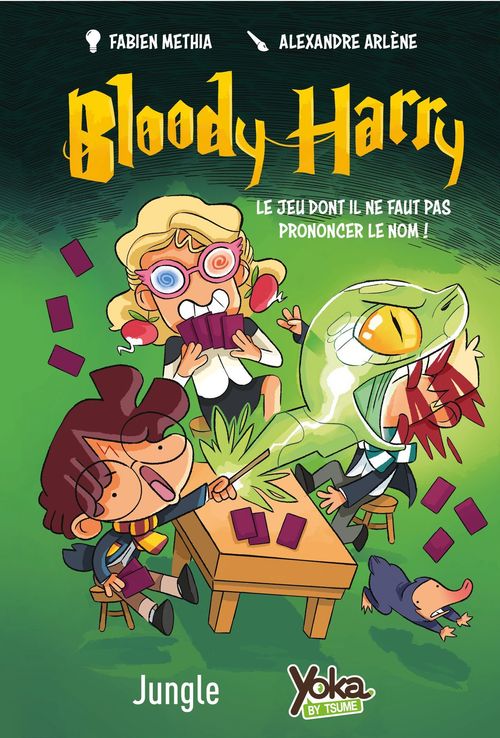
Bloody Harry
Bloody Harry Rulebook
Table of Contents
Table of Contents
Components
- 55 Magic cards: these are used to acquire School cards. Spell cards may also be played during the game for their effects.
- 12 Spell cards
- 3 Bonus cards
- 49 School cards
- 6 different courses, 6 copies of each (36 cards)
- 7 Horcrux cards
- 6 Diverter cards
- School deck
- 4 House cards
- 30 Mail tokens
- 1 First Player card: the First Player changes during the game, and this card shows who starts the turn.
Setup
- Each player takes and reveals 1 House card. You may shuffle the 4 House cards face down and take one at random. Note: With 2 players, you may take 2 House cards and combine their powers.
- The player of the House Grosfondor takes the First Player card. Note: If no player is Grosfondor, the youngest player takes the First Player card.
- Shuffle the 49 School cards and form a face-down School deck. Place a timetable next to this deck by revealing 2 School cards per player (4 cards with 2 players, 6 cards with 3 players and 8 cards with 4 players).
- Shuffle the 55 Magic cards and form a face-down Magic deck. Deal 5 Magic cards to each player.
- Shuffle the 30 Mail tokens face down and form a reserve. Add 1 Mail token face down to each card of the timetable.
Objective
To win the game, you must accumulate more victory points (VP) than your opponents.
VP are mainly obtained by collecting the School cards available in the timetable. The Bonus cards from the Magic deck can also earn or lose VP.
Course of the Game
The game is played as a succession of turns.
Start of Turn
Except for the first turn, a turn always begins by completing the timetable in these 2 steps:
- A. Add 1 Mail token face down to each card remaining in the timetable.
- B. Reveal 1 School card for each empty slot in the timetable (the number of cards acquired during the previous turn).
Player's Turn
Starting with the First Player, each player has 2 actions to choose from:
- Draw Magic cards (see page 6 of the rulebook).
- Collect 1 School card (see page 6 of the rulebook).
Note: You may play your two actions in any order you like. The two actions may be identical.
During your turn, you may play Magic cards from your hand to benefit from their effects (see page 8 of the rulebook).
When a player finishes their turn, it is the turn of the player on their left to play their 2 actions.
End of Turn
A turn ends when all players have taken their actions.
If, at the end of a turn, a player has 10 School cards in front of them, the game ends. Otherwise, a new turn begins.
Actions
1 - Draw Magic Cards
For 1 action, you may draw 2 Magic cards. You may use both your actions to draw 5 Magic cards.
Note: If the Magic deck is empty, reshuffle all the Magic cards from the discard pile to form a new Magic deck.
2 - Collect a School Card
For 1 action, you may collect a School card.
- Choose a School card present in the timetable.
- Discard as many Magic cards from your hand as necessary (see below).
- Take the chosen School card and place it in your play area, forming a column with identical cards. You immediately take the Mail tokens present on the acquired card and look at them secretly before placing them face down in front of you (see page 10 of the rulebook).
- You may apply the effect of the School card acquired.
Horcrux and Diverter cards have no immediate effect, but they earn VP at the end of the game.
Collecting a Course Card
To collect 1 Course card, you must discard 1 Magic card. You must discard 1 additional Magic card for each copy of this course already present in your play area.
- To collect the 1st card of a course, discard 1 Magic card from your hand.
- To collect the 2nd card of a course, discard 2 Magic cards from your hand.
- To collect the 3rd card of a course, discard 3 Magic cards from your hand, and so on.
Example:
- Discard 4 for your 4th Herbology course.
- Discard 3 for your 3rd Defense course.
- Discard 2 for your 2nd Transfiguration or Potions course.
- Discard 1 for your 1st Charms or Broomsticks course.
- Discard 2 for a Horcrux or a Diverter.
Collecting a Horcrux or Diverter Card
As indicated on the Horcrux and Diverter cards, to collect these cards you must discard 2 Magic cards, regardless of how many cards you already have.
Playing Magic Cards
Spell Cards
During your turn, in addition to your 2 actions, you may play Spell cards from your hand to benefit from their effects.
Once a Spell card has been used, it is discarded.
The Spell symbol on the "Oubliettes" and "Copius" cards means they may be played at any time, even when it is not your turn. They serve to cancel the effects of other cards.
Note: You may play a Spell card to cancel the effect of a course card. However, be careful: a "Copius" card does not copy the effect of an "Oubliettes" card.
Bonus Cards
During your turn, you may also play Bonus cards from your hand, either in your own play area or in an opponent's.
At the end of the game, the Balai-Ball and Bons points cards earn VP, while the Mauvais points cards cost you VP (see End of Game below).
Note: The Bonus card names "Balai-Ball", "Bons points" and "Mauvais points" are kept as printed on the French components.
Houses
At the start of the game, each player takes and reveals 1 House card; the Houses that are not in play go back in the box. Each House has its own power. Using the power is not mandatory, but it is strongly recommended.
Grosfondor
With the First Player card, you start the game and every turn. Starting the turn is a real advantage: since the timetable is complete, you have the choice of School cards to collect.
Serpentin
You draw as many Magic cards as there are players, then you must give one of your Magic cards to each of the other players (it does not matter whether you have just drawn it or already had it).
Serdongle
Looking at the Mail tokens on a card in the timetable lets you avoid collecting School cards with bad Mail and collect those with good Mail on them.
Poufmoufle
In addition to knowing the reward of a Mail token, you decide to place it on the School card of your choice. The power does not apply if there are no more School cards in the timetable.
Mail Tokens
The 30 Mail Tokens
At the start of each turn, 1 Mail token is added face down to each card in the timetable.
When a player collects 1 School card, they take the Mail tokens present on that card, look at them secretly, and place them face down in front of them.
A player may look at the Mail tokens in front of them at any time.
End-of-Game Mail
These Mail tokens can make the difference when they are revealed during the end-of-game scoring.
- You gain VP at the end of the game (+1, +2 or +3).
- You lose VP at the end of the game (-1 or -2).
- The symbols obtained this way count as a Balai-Ball card at the end of the game (1 or 2).
Mail to Use
These Mail tokens are removed from the game once used.
- On your turn, a player may reveal this Mail token to draw 1 Magic card (1 or 2).
- This Mail token may be used to cancel the effect of a Spell card or a Course card (such as the Spell card of the same name).
Scolding Mail ("Engueulantes")
When this Mail token is collected, it is immediately placed back in the Mail reserve, and then the reserve is shuffled.
End of Game
The game ends when a player has at least 10 School cards in front of them at the end of a turn.
To determine the winner, each player counts the VP of all the cards and Mail tokens in their play area. The player with the most VP wins.
-
Courses: the more identical courses you have, the more VP you gain.
Number of courses 1 2 3 4 5 6 Victory points 1 4 9 16 25 36 -
Horcruxes: as with courses, the more Horcrux cards you have, the more VP you gain (as indicated on the Horcrux cards). Note: You win the game automatically if you possess all 7 Horcrux cards.
-
Diverters: you gain the VP indicated on the effect of the Diverter cards.
-
Balai-Ball: the player with the most Balai-Ball cards gains 10 VP, and the 2nd player gains 5 VP. If several players are tied, they all earn the points. Note: Mail tokens showing the broom symbol count as a Balai-Ball card.
Example (total of 37 VP): the illustration in the rulebook shows cards and tokens worth 16, 4, 4, 1 and 4 VP, a first-place Balai-Ball bonus of 10 (first place with 4), and further values of 2 and -4 VP. The text does not spell out the illustrated breakdown in more detail.