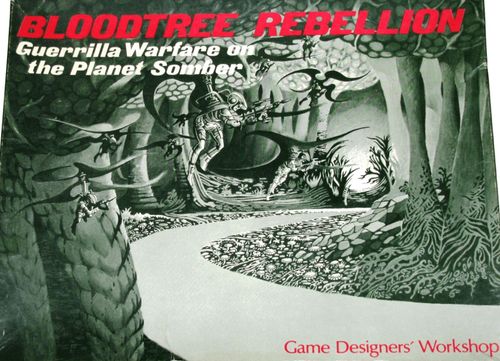
Bloodtree Rebellion: Guerilla Warfare on the Planet Somber
Bloodtree Rebellion: Guerilla Warfare on the Planet Somber Rulebook
Table of Contents
Table of Contents
- 0. Notes on This Edition
- Introduction
- 1. Game Components
- 2. Sequence of Play
- 3. Movement
- 4. Stacking
- 5. Zones of Control
- 6. Guerrilla Hidden Deployment
- 7. Unit Integration
- 8. Probing
- 9. Combat
- 10. Panic Fire
- 11. Casualties and the Register of Unassigned Manpower
- 12. Gunplats and Hovercraft
- 13. Lasers
- 14. FLEX Missiles
- 15. PO Garrisons and Police
- 16. The TEDEX
- 17. The Sand Guide
- 18. Guerrilla Committees of Responsibility
- 19. Guerrilla Variable Forces
- 20. Reinforcement, Replacement, Recruitment, and Rebuilding
- 21. Dochanivann Entry
- 22. Sanctuaries
- 23. Bridges and Cuts
- 24. Hoverbeds
- 25. Weather
- 26. Mykin/PO Alliance
- 27. The City Maps
- 28. The Political Game
- 29. The Draw and Counter-draw Phases
- 30. Power Bases
- 31. Desertion of Petrochem Orionid Troops
- 32. Action Counters
- 33. Military Assault on Power Bases and Rioters
- 34. Prison Breaks
- 35. Victory Conditions
- 36. Initial Setup
- 37. Action Cost Schedule
0. Notes on This Edition
0.1 Added text is italicized, and enclosed by square brackets, for example [The die is a d6]. Replaced text is removed if the change is immaterial, or struck through and retained if its presence is needed to aid understanding.
0.2 If the rules and the map or official player aids are in conflict (e.g., the timing of the Guerrilla reinforcements), then the rules take precedence. In my experience of game publishing, errors are often introduced in the final artwork stage following the final playtests. In addition, rules are proofed more tightly than the graphical aids.
0.3 The PO "militia" counters use the infantry symbol, and they behave more like regular infantry than militia infantry, so they have been consistently renamed as "PO infantry."
0.4 Farmer units are removed when they cause civilian casualties (during probes and unspotted attacks by Lasers, Gunplats, and Hovercraft). The farmer unit can be rebuilt during the next Recruitment phase at a friendly Forest Settlement. This is a deliberate rules change, otherwise the implication in the original rules is that Guerrilla units underneath a farmer unit are immune to combat because the farmer is immortal. I doubt that Lynn intended farmers to be Impenetrable Force Fields. Therefore, Farmers die like dummies but have political side-effects.
0.5 Optional: Units cannot disband during the opponent's movement and combat phase, except to fulfil combat results. If disbanding "at any time" is allowed during the opponent's combat phase, then a player can avoid all casualties by disbanding before the dice are rolled for a combat. Highly recommended.
0.6 Optional: Infantry are not Turbine Blades. Equipment Heavy Units (Gunplats, Hovercraft, SRBMs, Lasers, Flex, Fusion bombs etc) units cannot use the manpower register to satisfy Exchange Results. There is no change to the 10, 20, 30 percentage loss results, which represent repairable damage and light personnel losses. An exchange represents a long grinding battle with heavy losses to both sides. It bothers me that a squad of infantry can disband and then be reborn as gunplats. Where did those gunplats come from? Are the clones doubling as turbine blades?
0.7 This section is numbered as "zero" so that the original section numbers are maintained.
Introduction
The 1041st clone regiment landed at dawn without bombardment. By afternoon, the regiment controlled every agency and facility in the tiny colony. No one resisted. Colonel Galen and his 1300 identical men worked efficiently; in three days the local managers of the hydrocarbons trust Petrochem Orionid concluded an alliance of convenience with the clone soldiers. Food would still sail to the island pumping and reduction stations, and from them the precious bricks would soar to the stars, though this time the stars of Heliat. Somber would remain idyllic, parsecs from the war.
Yet rumors had begun to float, and overnight posters had appeared in Robachy Put and Dinnivan which jeered at the Mykin/PO rapprochement. Galen stirred in his shimmering lutig-wood chair. Things were not quite right. He had planned to shift the COD from gold to green; now they would deepen it instead, to warning orange. Had FedTrust finally acted aggressively and left partisans behind? Galen frowned, then summoned the senior lieutenant commanding his political police.
Three hundred kilometers east, another human pondered. Captain Joanna Cavorte, commander plenipotentiary of the tiny FedTrust mission on Somber, swayed on a lutig frond two hundred meters above the fungi-shrouded forest floor. Far below an arms crate shifted into, then out of, her sight. Given a little more time, the guns would never be found by any Mykin sweep. But Cavorte needed soldiers behind those weapons, and though Planning had thought thousands might battle the clones, to date Cavorte had recruited eighteen. The people of the colony would not die to substitute one bland tyranny for another, she supposed. She sighed. If a leader found little to choose between the actualities of Mykin/PO and FedTrust/PO, what else could she expect of the people?
But an hour later, fader and Dochanivann representatives, the final angles in Somber's pentagonal tangle, presented to her a logical, workable, and completely traitorous plan of action...
Bloodtree Rebellion simulates a guerrilla action on the planet Somber (fifth satellite of Nu Phoenicis) several centuries from now. Presented in science fictional guise, the game integrates military action with the realities of power politics in a fashion relevant to and revealing of many earthly situations.
Bloodtree Rebellion is operational in scale, with military units ranging from squad to company size. Political factors include riots, demonstrations, kidnappings, assassinations, and more.
One player takes the part of the Mykin invader and his ally of convenience, Petrochem Orionid. The other plays the FedTrust-sponsored (but not controlled) guerrilla movement and its sympathetic but necessarily secret allies, the native Dochanivann or Glyphs.
To appreciate the nuances of the rules and political situation, players may wish to read first the background briefing at the end of this book.
1. Game Components
1.1 Bloodtree Rebellion includes the following components:
- One operations map. The five color map displays the full area of the Petrochem Orionid leasehold on Somber, within which the fighting occurred. A hexagonal grid has been superimposed to regulate movement and combat. Each hexagon (called hereafter a hex) has been numbered for easy reference. In game scale, each hex is five kilometers from side to side.
- One sheet of three city maps. Each city map represents one of the three cities of the colony in greater detail than the operations map allows. Also included on the city map sheet is the turn record chart.
- A set of four charts, including: the Mykin organization chart; Mykin charts: register of unassigned manpower and three city safe zones; Guerrilla charts: register of unassigned manpower, three city safe zones, and the guerrilla force composition chart; Terrain effects chart and combat results table.
- Two sheets of 240 counters. Most counters represent combat units involved in the rebellion. Other counters represent power bases, political actions, and changes in terrain. The various counters and their symbolism are explained on the unit identification chart.
- This rules book.
- One die.
2. Sequence of Play
2.1 Bloodtree Rebellion is played in turns, each two weeks long. Each turn consists of a number of phases as shown below. During a turn, the phases are performed in sequence; all activities of the game take place in one or another of the phases, and no action may take place other than in the correct phase.
Sequence of Play
- Weather Phase. The weather condition is determined for the turn.
- Draw Phase. Both players draw power base and action counters from the draw piles.
- Counter-draw Phase. Both players draw counters from the other player's city safe zones.
- Reinforcement Phase. Both sides receive new and replacement units.
- Guerrilla Political Phase. The guerrilla player exposes power bases and uses action counters. The Mykin player may cancel action counters with identical counters.
- Mykin Political Phase. The Mykin player exposes power bases and uses action counters. The guerrilla player may cancel action counters with identical counters.
- Guerrilla Movement Phase. The guerrilla player moves their units.
- Guerrilla Combat Phase. The guerrilla player conducts attacks.
- Mykin Movement Phase. The Mykin player moves their units.
- Mykin Combat Phase. The Mykin player conducts attacks.
2.13 After all phases in a turn have been completed, move the turn record marker forward one space on the turn record chart and begin the sequence again. The game ends at the end of turn 12.
Editor's note: the source document as published numbers section 2 as 2.1 and then 2.13. Paragraphs 2.2 through 2.12 do not appear in the source and are not supplied here.
3. Movement
3.1 All units (except Gunplats and Hovercraft) are moved during the player's movement phase. A player may move as many or as few units as they want, in any direction or combination of directions. Units move from hex to adjacent hex to adjacent hex, etc., following a continuous path. [Gunplats and Hovercraft move during the Combat Phase].
3.2 Units are moved one at a time, in any order the owning player wants. One unit must finish its movement before another unit's movement may begin. A unit's movement ends when it runs out of movement points, when it enters an enemy zone of control, when it probes, or whenever the owning player wishes it to stop.
3.3 Movement points. Guerrilla and Glyph units must expend movement points to move. Movement points are a measure of the time spent in moving. Mykin and PO units do not expend movement points and may move an unlimited distance. Each guerrilla unit may expend up to 20 movement points in a movement phase; each Glyph unit may expend up to 10. Movement points are spent when entering hexes or, in the case of rivers, when crossing hexsides. Each type of terrain has a movement point cost, as listed on the terrain effects chart. Movement costs for guerrillas and Glyphs differ.
3.4 Movement points may not be transferred from unit to unit or saved from one turn to another. No unit may enter a hex if it does not have enough movement points remaining to pay the cost; if a unit has spent all its movement points it may not move into a hex even if the movement cost to enter is zero.
3.5 Prohibited terrain. No unit may enter a hex containing an enemy unit. Most guerrilla and Mykin units travel in antigravity vehicles and are thus able to move into (or above) all terrain types. Some units, however, are limited.
3.6 Hoverbeds and hovercraft travel close to the ground and may not enter forest or mountain hexes except on roads. They may not enter dry tuber plains, but may enter wet tuber plains. [During rain turns, hovercraft and hoverbeds may also move on river hexsides]. They may not enter a destroyed cut.
3.7 Lasers, flex missiles, Mykin headquarters units, and the TEDEX are tracked vehicles. They may not enter forest, mountain, ocean/lake, or tuber plains (wet or dry) except on roads. They may not cross rivers except on bridges and may not enter a destroyed cut. [The TEDEX unit can enter one forest hex per turn in order to clear it].
3.8 Glyph units all travel on foot [well, hooves]. They may not enter ocean/lake or wet tuber plain hexes, but may enter dry tuber plains. They may not cross rivers except on bridges.
3.9 Movement is also restricted by political considerations. Until the Glyphs enter the war, no units except Glyphs may enter dune or mound hexes. Until the Mykin have allied with the PO, Mykin units may not enter city hexes. Mykin/PO units may never enter sanctuary hexes.
3.10 Special movement on Flooded Rivers. During rain turns, hovercraft and hoverbeds may move on river hexsides. They are moved through any hexes adjacent to the river they are following, even hexes normally prohibited to them. If the weather changes while a unit is in a normally prohibited hex, it is eliminated.
3.11 Glyph units may move from mound hex to any other mound hex without cost and without crossing the intervening hexes; this may be done at any time in their movement phase. This rule simulates the extensive subway system connecting the mounds.
3.12 Guerrila Flight. Guerrilla units may choose to move without expending movement points for a turn by braving the Mykin air defense network. Roll one die for each unit attempting: on a roll of 1-3, the unit is successful; on a roll of 4-6, it is destroyed.
3.13 Gunplats and hovercraft move in the combat phase instead of the movement phase. All other movement rules apply. See the gunplat rule.
4. Stacking
4.1 Any number of unit counters may occupy a single hex. The order in which they are stacked is important: only the top unit in a hex may be attacked. Only if it is destroyed or retreated may the next unit be attacked. See the combat rule. [Stacking order can be changed at any time during a friendly movement phases, and at the end of both players' combat phases.]
4.2 On the city map, only one unit with a defense strength may be in a hex, although that unit may be of any size. Other counters lacking a defense strength may also be present.
4.3 [The city hexes do not really exist on the Operational Map. If a unit enters that hex, then it must enter the city. If it is required to pass an infiltration roll, then if it fails it remains in its original hex, adjacent to the city. Why? I cannot understand the dual-plane reality if both locations exist.]
5. Zones of Control
5.1 Some large units have zones of control, indicated by the presence of a dot in the upper right hand corner of the counter. A unit's zone of control covers the six immediately adjacent hexes surrounding the unit.
5.2 Any unit entering a hex in the zone of control of an enemy unit must end its movement for the turn. A unit starting its turn in a zone of control may leave. A unit may move from one hex in a zone of control directly to another adjacent zone of control if that is its only movement in the turn.
5.3 Guerrilla units may not make a guerrilla hop out of a hex in an enemy zone of control (see the probe rule).
5.4 A friendly unit blocks enemy zones of control in the hex it occupies. Thus if a friendly unit ends its movement in a hex in an enemy zone of control, other friendly units may move through that hex without hindrance for the rest of the turn.
6. Guerrilla Hidden Deployment
6.1 As is usual in guerrilla warfare the guerrillas on Somber relied on stealth and secret maneuver to protect themselves from the much more powerful Mykin forces. The following rule is designed to enable the guerrilla to conceal their exact movements from the Mykin.
6.2 Force markers. The guerrilla player has 31 force markers, lettered A through EE. Each force marker corresponds to a box on the guerrilla force composition chart. At any time, any guerrilla unit or stack of units may be removed from the board and replaced by a force marker. The units are placed in the corresponding box, out of the Mykin player's sight. The force marker is not a unit; it only indicates the position on the map of the units it replaces, and these units are considered to occupy the hex the force marker is in for all purposes. The force marker may move on the board exactly like a unit. In order to appear on the board, a force marker must have at least one unit in its box (the unit could be a dummy or a farmer).
6.3 Inverted units. Guerrilla units (including force markers) may be kept upside down to prevent the Mykin from learning their identities.
6.4 Dummies and Farmers. The guerrilla has three farmer counters and two dummy counters. They move exactly as if they were combat units. Dummies represent false reports of guerilla activity; farmers are innocent civilians mistaken for combat units. They exist to confuse and embarrass the Mykin. [The counter set erroneously has three dummy counters, but the Guerrilla player only actually has two.]
6.5 When are guerrilla units revealed. Guerrilla units are revealed (upside down units are turned over and units on the force composition chart are returned to the board) on three occasions: 1) when they are probed, 2) when they are attacked, and 3) when they must reveal a capability, for instance when they attack or when they choose to exert a zone of control. [For case 3, the Guerrilla player only needs to reveal the unit providing that capability, other units can remain hidden.] In all cases, they are concealed again at the end of the combat phase.
7. Unit Integration
7.1 To reflect their flexible natures, Mykin and guerrilla infantry units may change the organizational level at which they are represented: large units may break down into several smaller ones and vice versa.
Mykin Integration
7.2 Mykin unit organization is diagrammed on the Mykin organization chart. In addition, each unit's ID number describes its position in the regiment, giving battalion, company, and platoon affiliation. For example, a squad identified as 2C3 is part of the 3rd platoon of C company of the regiment's 2nd battalion. Mykin units may only break down and combine within the constraints of their organization. [Notice that the naming convention is the opposite of all human militaries, in this example the unit would normally be named as 3/C/2.]
7.3 A platoon counter may replace (or be replaced by) the three squad counters bearing the same ID number. A company counter may be similarly interchanged with its three subordinate platoons plus the company headquarters. Only the properly identified units may be used; no other unit may be substituted.
7.4 To break down, a unit is removed to the organization chart and replaced by its component units. A unit may break down at the beginning of the movement phase or as the result of an exchange combat result.
7.5 To combine, all of the components of a higher unit must be present in the same hex at the end of the movement phase. Remove them to the organization chart and substitute the higher unit. If any of the component units has been eliminated or is not present in the hex, the substitution may not be made.
7.6 If a company headquarters has been removed from the game for any reason, the units of that company may no longer break down or combine; they are frozen in form for the rest of the game and if eliminated may be rebuilt only in that form. If the battalion headquarters has been eliminated, all Mykin units may no longer break down or combine.
Guerrilla Integration
7.7 The guerrillas were considerably less formal than the Mykins. Guerrillas normally worked in squads; platoons and, very rarely, companies were ad hoc units assembled for a specific mission. Therefore any three infantry squads may be interchanged with any platoon. Companies may be assembled from any three platoons and a heavy weapons squad, and break down the same way. As there is no fixed organization, no organization chart is provided; simply remove substituted units from the board.
8. Probing
8.1 No guerrilla unit may be attacked unless it has first been probed (for exceptions see the rules on gunplats and hovercraft, and on lasers). Probing causes a concealed guerrilla unit or stack of units to be revealed.
8.2 Procedure. Probing is done during the Mykin movement phase. Any Mykin infantry unit or PO infantry unit may probe a guerrilla occupied hex by ending its movement adjacent to the hex. All units in that hex are immediately revealed. Probing is not mandatory; a unit may end its move adjacent to a guerrilla without probing.
8.3 Results. If a probed unit is revealed to be a dummy, it is removed from the board; the guerrilla may return it to play from any sanctuary hex in the next reinforcement phase. If a probed unit is revealed to be a farmer, it [is removed and can reappear at any friendly Forest Settlement the next Reinforcement Phase] remains on the board and the Mykin consults the probe table for civilian and/or Mykin casualties. If a probed unit is an infantry, heavy weapons, or militia unit or a committee of responsibility, it may remain in the hex or attempt the guerrilla hop.
The Guerrilla Hop
8.4 Immediately after it has been probed, any guerrilla infantry, heavy weapons, or militia unit or committee of responsibility may attempt to evade its attackers by performing the guerilla hop. Units hop individually. To hop, roll a die and consult the scatter diagram printed on the map. The guerrilla moves one hex in the direction corresponding to the die roll.
8.5 If, after hopping, the guerrilla unit is no longer adjacent to the unit that probed it, the guerrilla has evaded; it is concealed again and may not be attacked unless it is probed again, in which case it may attempt another hop. A unit may be probed and hop away many times in a phase, if its luck holds out.
8.6 If, after hopping, the guerrilla is still adjacent to the probing unit, the guerrilla has not evaded; it has been successfully probed and may be attacked.
8.7 If, after hopping, the guerrilla would be in the same hex as the probing unit, an ambush has occurred. See below.
8.8 A unit may not hop out of a hex in an enemy zone of control. A unit may not hop into a hex occupied by an enemy unit, or off the board. If it tries to do so it has not evaded and stays in its original hex.
8.9 If a unit hops into a sanctuary it has evaded.
Ambush!
8.10 If an ambush occurs, the guerrilla unit stays in its original hex. Roll one die. On a roll of 1-4, the probing unit has been ambushed. The guerrilla unit immediately attacks the prober with three times its normal attack strength; guerrilla militia have an attack strength of three for this purpose only. No terrain effects on combat are considered, and the combat result is applied immediately. On a roll of 5, there is no ambush; continue as if the guerrilla had not attempted to hop. On a roll of 6, the prober has ambushed the guerrilla. The probing unit immediately attacks the guerrilla unit with three times its normal attack strength, as above.
8.11 If the probing unit is eliminated or retreats from the ambush, the guerrilla unit has evaded; if the guerrilla unit retreats, it has evaded. If both units survive combat and are still adjacent to each other, the guerrilla has not evaded. The probing unit may still attack in the combat phase, but it may not be used for spotting.
8.12 Panic fire. If a Mykin (not PO) unit discovers that a unit it is probing has a higher attack strength than it does, the Mykin commander may order high-dial fire. See the panic fire rule.
8.13 Forest settlements. Any time a Mykin infantry or PO infantry unit moves into or through a forest settlement hex not already occupied by a Mykin/PO unit, it must probe. This probe takes no time and the unit is not required to end movement; merely consult the probe table to determine Mykin and/or civilian casualties. PO units do not take casualties.
9. Combat
9.1 During a player's combat phase, their units may attack enemy units within range. The player whose phase it is is the attacker, and the opposing player is the defender. Units attack with their attack strengths and defend with their defense strengths.
9.2 Any unit with an attack strength may attack. All, some, or none of a player's units may attack in the same phase. Attacking is voluntary; no unit is ever required to attack (for exceptions see the panic fire rule and the ambush section of the probing rule).
9.3 Range. All combat units have a range, representing the maximum distance in hexes over which the unit may attack. A unit may not attack an enemy unit which is farther away than its range. Range is counted along the shortest path from defender's hex but not the attacker's. For example, if the attacker is adjacent to the defender, the range is one hex. Combat units without a printed range have a range of one. [The ranges of gunplats and hovercraft are halved during fog and rain turns.]
9.4 Spotting. Mykin flex missiles, gunplats, and hovercraft may not attack guerrilla units in covering terrain (forest, mountain, dry tuber plain, city, or farm settlement hexes) unless the units have been spotted. A guerrilla unit is spotted if it has been probed that turn (and has not evaded) and is adjacent to any Mykin infantry or headquarters unit. [Note that PO units cannot act as spotters.]
9.5 Probing. Guerrilla units may not be attacked unless they have first been probed and have not evaded. Exception: under certain conditions Mykin lasers, gunplats, and hovercraft may attack units which have not been probed. See the rules covering these units.
9.6 Only guerrilla units must be probed or spotted before being attacked. Glyph, Mykin, and PO units may be attacked without such actions being performed.
Attacks in General
9.7 In general, only one unit may attack at a time; units may not combine their attack factors to attack together. Exceptions are covered under combined attacks below. One unit must complete all its combat in a phase before another unit's combat may begin. Units attack in any order the attacking player wants.
9.8 A unit may attack only one hex in a turn. Defending units in the hex are attacked individually, starting with the top unit. If the top unit is eliminated [i.e. removed from the map, in the standard rules an X result can avoid removal be paying the manpower cost], or retreats out of the hex, the attacking unit may, at the attacker's option, go on to attack the next unit in the hex. The attacking unit's combat is ended for the turn when 1) it fails to eliminate or retreat a unit it attacks, 2) it has attacked the last unit in the hex, or 3) the attacker chooses not to attack further.
9.9 A unit may be attacked several times in a phase, but may only be attacked once by any single enemy unit.
9.10 Procedure. To resolve an attack, divide the attack strength of the attacker by the defense strength of the defender. The defender's strength may be modified by the terrain of the hex it occupies; see the terrain effects chart. Round down if necessary, in favor of the defender to create one of the odds ratios found on the combat results table. For example, a unit with a strength of 2 attacking a unit with a strength of 3 would give odds of 1:2; 16 attacking 5 would give 3:1, etc. Roll one die, cross-indexing the die roll with the odds to determine the result. Apply the result immediately.
9.11 Combined attacks. Mykin infantry units belonging to the same company may make combined attacks. PO units from the same city may make combined attacks. These are the only cases in which more than one unit may participate in the same attack. To make a combined attack, add together the attack strengths of all participating units and consider them as a single combined attack strength.
9.12 Combat results. There are several possible types of results on the combat results table. Those to the left of the slash apply to the attacker; those to the right apply to the defender. All possible results are explained below. If two results are indicated (such as 10R) apply both.
10, 20, 30: The affected unit loses that percentage of its men. Each Mykin and guerrilla unit has a manpower strength, as listed on the unit manpower chart. When a unit takes casualties, the stated percentage of its strength is removed from the side's register of unassigned manpower. For example, if a guerrilla infantry platoon takes 20% losses, the guerilla player must subtract 9 men from their manpower register. Fractional losses are rounded to the nearest whole number; round .5 up. A unit's combat abilities are not altered by percentage losses; only the manpower register is affected.
Glyphs are not affected by percentage losses; Glyph units ignore this result. Remember that attacking units with Range advantage do not take any losses Mykin and guerrilla militia and all PO units are eliminated if they receive any percentage losses.
R: The affected unit must retreat one hex. It may not enter prohibited terrain or any hex occupied by an enemy combat unit; if there is no other possible path it is eliminated. A unit may not end its retreat adjacent to the unit it is retreating from unless no other path exists. Within these restrictions, the owning player chooses the path of their retreat.
Units retreating across [unbridged] rivers suffer 10% losses, in addition to any already inflicted.
E: The unit is eliminated. Remove it from play.
X: Exchange. The defending unit is eliminated. The attacker must eliminate participating attacking units with attack strengths totaling at least the defender's defense strength, using the values printed on the counters for both. The attacker is never forced to eliminate units that did not participate in the attack merely to equal the defender's strength. Mykin and guerrilla infantry units may break down to lower formations to take losses. Mykin and guerrilla units, both attacker and defender, may pay a unit's cost from the manpower register in lieu of eliminating it.
[Optional: The Manpower Register can be used for manpower-heavy units, but Equipment-heavy units (Lasers, Gunplats, Flex Missiles, SRBMs, Hovercraft) cannot use the Manpower Register if they receive an Exchange Result.]
Example: A Mykin infantry company attacks a guerrilla heavy weapons squad in a forest hex. The odds are 1:1 and the Mykin rolls an exchange. The guerrilla chooses to pay their unit's manpower cost (30) instead of eliminating it. The Mykin must eliminate or pay the manpower costs for units totaling an attack strength of 6; they can either break down their company and eliminate three squads (each with an attack strength of 2) or they can pay the manpower cost of the squads (45) and retain their company intact.
Editor's note: the source document as published numbers section 9 as 9.1 through 9.12 and then 9.20. Paragraphs 9.13 through 9.19 do not appear in the source and are not supplied here.
Advance after combat
9.20 If a hex has been cleared of defending units by combat, any unit of the attacker which has not already attacked some other hex (either it has not attacked or it attacked that hex) may move into it immediately. The advancing unit may attack if it has not yet attacked during that phase. Advancing Mykin units may probe guerrilla units they come adjacent to if they did not probe during the movement phase. [Attacking unit must be adjacent to the attacked hex.]
9.21 If a hex has been cleared of attacking units by combat, any unit in the defending hex may, if the attacker was adjacent, move into the attacker's hex immediately.
9.22 Range advantage. Regardless of any combat result above, any unit which is attacking from beyond the defender's range (for example, a Mykin infantry company attacking a guerrilla infantry platoon from two hexes away) is never affected by the combat result. It neither takes casualties nor retreats.
10. Panic Fire
10.1 All Mykin infantry units had the capability to fire more powerful microtherms than they did, but were under orders not to, because of the complications ensuing with the Dochanivann over the destruction of the local real estate.
10.2 If any probing Mykin unit [Therefore only Mykin infantry] discovers that the attack strength of a guerrilla unit being probed is greater than its own attack strength, panic fire may occur. Roll one die; on a roll of 4-6, the unit commander orders high-dial fire. Multiply the attack strength of the Mykin unit by 5 and immediately engage all adjacent non-Mykin units (including farmers) in sequential attacks, [no probe necessary for other stacks]. The Mykin unit is not affected by any combat results until it has completed all attacks; then it is affected by all of them. But it cannot retreat or be eliminated more than once, nor can it take more total casualties than it has men. After the conclusion of panic fire, place a cleared terrain marker in each target hex. The turn then continues normally; surviving guerrilla units may attempt to hop, and so on.
10.3 Panic fire in cities is, by comparison, restrained. No clear terrain markers are placed (Mykin leaders never got that rattled). Instead, roll one die and multiply by the population numbers of each target hex; this gives the number of civilian casualties caused by Mykin fire. Units on the operations map do not use panic fire at units in city hexes or on the city maps.
10.4 There are political costs (see the action cost schedule) for panic fire in a city, and additional costs for each civilian casualty thereby incurred.
10.5 In addition, the Dochanivann are alarmed. Each turn in which panic fire occurs, the Glyphs move one step closer to direct involvement in the war; see the rule on Dochanivann entry.
11. Casualties and the Register of Unassigned Manpower
11.1 Mykin and guerrilla units usually will take casualties rather than be destroyed as a result of combat. Casualties are taken from the player's register of unassigned manpower instead of weakening the unit involved. Two week turns allow plenty of time for personnel shuffling.
11.2 Each player has a register of unassigned manpower. The register consists of three scales, enabling a player to represent any total from 000 to 399 with the markers provided. This total represents the number of men available in the player's manpower pool for assignment to units.
11.3 Every Mykin and guerrilla unit has a personnel strength, shown on the unit manpower chart. At any time a player A player may disband (remove) one of their units from the game and add its full manpower strength to the manpower register during their own Reinforcement-, Movement-, and Combat Phases (and optionally guerrillas can choose to disband rather than hop), and also to satisfy combat results. When a unit takes casualties, they are removed from the register. If the register does not contain enough men to satisfy a demand for casualties, the player must eliminate one of their units (not necessarily one involved in combat) and add its strength to the register in order to pay the cost. Remember that an E (Eliminated) means remove the unit from the map. The unit cannot be saved by paying from the Register of Unassigned Manpower. [Optional: Equipment-heavy units (Lasers, Gunplats, Flex Missiles, SRBMs, Hovercraft) cannot use the Manpower Register if they receive an Exchange Result.]
11.4 Mykin and guerrilla infantry platoons and squads (only) may be rebuilt by paying their full manpower strengths out of the register. See the reinforcement rule.
11.5 The Mykin battalion headquarters may not be burned to provide men for the manpower register.
12. Gunplats and Hovercraft
12.1 Gunplats were heavily armed ground support craft, seeking safety from the power of enemy weaponry by means of a complex pattern of evasive turns and reverses, programmed by a flight's master computer, and designed to gradually close the range of engagement to point blank. Hovercraft were somewhat similar in general tactics, but were much less massive, more lightly armed, and much cheaper.
12.2 Gunplats and hovercraft do not move in the movement phase, but both move and fire during the combat phase. They may move and fire up to three times in a phase. The unit moves to the hex where it will attack first, engages in combat under the normal combat rules, and may then move and attack twice more. It may attack the same hex more than once. It may also use up two or three of its attacks at once, in which case its attack strength is doubled or tripled. After a hovercraft or gunplat attacks for the third time in a phase, its movement and combat are over; place an exhaustion marker on it as a reminder. The marker is removed at the end of the combat phase.
12.3 Gunplats and hovercraft never have their defense strengths modified by terrain effects. During rain and fog turns, their ranges are halved.
12.4 Gunplats and hovercraft may not attack guerrilla units in covering terrain unless they have been spotted. See the combat rule 9.4.
12.5 Gunplats and hovercraft may attack guerrilla units not in covering terrain without the necessity of their first being probed. The guerrilla is revealed just before the attack takes place. If the revealed unit is a dummy, it is removed. If the revealed unit is a farmer, roll one die; this is the number of civilian casualties caused. [The farmer is then removed and mya be re-recruited next turn, see recruitment section.]
12.6 Hovercraft, since they are not antigravity vehicles, are somewhat more restricted in their operation than gunplats. See the movement rule.
12.7 Repeating 19.5 The guerrilla gunplat. The guerrilla gunplat operates in the same manner as Mykin gunplats, except that it may only fire once and move twice in the guerrilla combat phase. It has twenty movement points. It does not require spotting to fire at enemy units.
13. Lasers
13.1 Lasers were intended mainly as air defense weapons, but were also sometimes useful in the ground support role. Their utility was limited by dense terrain, fog, and planetary curvature.
13.2 Lasers may fire only in direct line of sight. The line of sight is a straight line from the laser to its target. The line of sight may pass into [or out of] but not through forest, city, mountain, tuber plain, farm settlement, or mound hexes. For example, a laser could fire from hex 1334 at a unit in hex 1332, but not at a unit in hex 1331. If the line of sight passes along the side of a hex containing blocking terrain it is not blocked. In addition, a laser may trace a line of sight down a straight line of road, even through forest or mountain hexes. [Please don't ask me how laser beams bend up and then down over mountain passes, presumably roads and the cut are absolutely dead level.]
13.3 Lasers, unlike other units, may attack several hexes in a turn. They may make separate attacks on every hex within range and line of sight, [but only one attack (combat sequence) per hex].
13.4 Lasers may attack guerrilla units which have not been probed. The unit is revealed just before it is attacked [Implication: Each unit in a stack is revealed one at a time]. If it is a dummy, it is removed. If it is a farmer, roll one die to determine the number of civilian casualties suffered in the attack. [The farmer is then removed and may be re-recruited next turn, see recruitment section.]
13.5 Lasers, as air defense weapons, are especially effective against the FedTrust destroyer and the guerilla SRBMs. See the relevant rules for effects.
14. FLEX Missiles
14.1 The flex missile was a close support heavy weapon. Launched drone units tailed infantry units. The drone fired a single missile each time a soldier painted a target with a laser marker. Subject to multiple commands, the missile could stay aloft up to two minutes and had a dialed charge of up to 1 kt. Ideal in open country, the flex missiles performed poorly among the bloodtrees. Consequently, when attacking targets in forests [and forest settlements], dry tuber plains, and mountains, the flex missile has an attack strength of one. It uses its full strength (10) when attacking units in all other terrain.
14.1 Flex missiles require a spotter in covering terrain (forest, mountain, dry tuber plain, city, or farm settlement hexes), see 9.4.
Editor's note: the source document as published numbers both paragraphs of section 14 as 14.1. The paragraph numbers are reproduced as printed.
15. PO Garrisons and Police
15.1 PO garrison and police units may never leave their home cities. They may move at will on the city map [only.] or may occupy the city hex on the operations map.
16. The TEDEX
16.1 The TEDEX represents an automated construction unit generally used by Petrochem Orionid for building roads through the forests. In the game it performs two functions: clearing forest hexes and repairing bridges and cuts.
16.2 Clearing forests. The TEDEX clears a forest hex by ending its move in the hex. [Immediately] Place a cleared terrain marker in the hex. [Cleared hexes are not Farmland. Other units can use this newly-cleared hex in this movement phase.] In order to connect a road to a cleared hex, the road hex itself must be cleared.
16.3 Repair. The TEDEX may repair up to two bridges or cuts in a turn by moving over one and ending its move in the hex of another. It may not both repair a hex and clear a forest hex in the same turn.
16.4 Any attack will destroy the TEDEX. If not stacked with another unit, it may be captured by moving a unit adjacent to it. The captured TEDEX then moves in the capturer's movement phase.
17. The Sand Guide
17.1 In peacetime, the Glyphs used the sand guide, a complex structure of monofilament cables and plastic sails, to channel the prevailing winds, shifting sand hills literally overnight and creating new fields for the salt-water farming practiced by their coastal agricultural stations. In war, the moving dunes could change the nature of battlefield terrain to the Glyphs' advantage.
17.2 The sand guide converts any hex except mountain or city into a dune hex. To lay sand, move the sand guide to any dune or mound hex in the movement phase. At the beginning of the next guerilla movement phase, place a new dune marker in any adjacent hex and move the sand guide into it. The hex is a dune hex for the rest of the game. Sand may not be moved into a hex containing an enemy unit. The sand guide may not move sand until the Glyphs declare war.
18. Guerrilla Committees of Responsibility
18.1 These counters lead the rebellion and provide coordination between the disparate rebel factions. They are irreplaceable. If all three committees are destroyed, the guerrilla no longer receives reinforcements and no longer participates in the draw phase.
19. Guerrilla Variable Forces
19.1 Although in the main they relied on hit and run infantry tactics and political persuasion, the guerrillas also used, or contemplated using, a number of unusual weapons. At the beginning of the game, the guerrilla player draws four at random from their pool of variable forces, consisting of the following: the fusion mine, the guerilla gunplat, two SRBMs, the FedTrust destroyer, and the three espionage counters.
19.2 The fusion mine, gunplat, and SRBMs, if drawn, are placed in sanctuary hexes. The other counters are kept hidden until they are used.
19.3 The fusion mine. This 50kt device was considered but ultimately rejected on political grounds. In using it, the guerrillas risk Glyph disapproval. The mine is moved, using normal movement procedures, into any hex containing enemy units and explodes during the guerrilla combat phase. All units in the hex are attacked. After combat remove the mine, placing its men in the manpower register, and place a cleared terrain marker in the hex. The mine may not be used in a city hex. Any attack destroys the mine (it doesn't explode).
19.4 The Glyphs, in their distaste for widespread destruction, may be offended. Roll a die. If the mine is exploded before the Glyphs enter the war, a roll of 1-3 delays Glyph entry, even after it is triggered, until the turn in which the guerrilla first successfully rolls a 6 during the reinforcement phase. If the mine explodes after the Glyphs enter, on a roll of 1 or 2 they immediately return to their dune and mound hexes, declaring neutrality for the rest of the game.
19.5 The guerrilla gunplat. The guerrilla gunplat operates in the same manner as Mykin gunplats, except that it may only fire once and move twice in the guerrilla combat phase. It has twenty movement points. It does not require spotting to fire at enemy units.
19.6 The SRBMs. The two short range ballistic missiles are usable once each. They move normally in the movement phase, and attack any hex within range. After completion of its attack, an SRBM is removed from play and its men are placed in the manpower register. SRBMs may not attack any hex within three hexes of a laser battery.
The FedTrust Destroyer
19.7 FedCenCom provided a destroyer for a coordinated raid. If the guerrilla draws this counter, they must write down at the beginning of the game the two consecutive turns on which it will appear. When the raid begins, they must show this notation to the Mykin player.
19.8 The destroyer makes two passes on consecutive turns [i.e., one pass in each turn]. In each pass, it flies in a straight line of hexes across the map during the guerrilla combat phase, attacking every enemy-occupied hex it passes over. The destroyer is never affected by the results of an attack. Units in city or farm settlement hexes are immune from attack. [Optional, a kinder, gentler Fedtrust destroyer. The FedTrust destroyer can only attack one unit in a stack, but it can choose which unit. If not, it usually wipes out an entire stack, which feels too powerful.]
19.9 Each laser battery the destroyer comes within range of may attempt to eliminate it. A laser's range against the destroyer is ten hexes, or five during rain and fog turns. As soon as the destroyer comes within range of each battery for the first time in a turn, the Mykin rolls a die. On a roll of one, the destroyer is eliminated.
Espionage counters
19.10 Espionage counters. The three espionage counters, numbered 1, 2, and 3, represent traitors (or patriots) secreted within the Mykin/PO organization.
19.11 Espionage 1. This counter simulates traitors in the PO planning section. At least one PO unit must be in existence and loyal to the Mykin for this counter to be in effect. If the guerrilla shows this counter to the Mykin, they must state, at the beginning of each guerrilla movement phase, whether they will make a sanctuary attack that turn (see the sanctuary rule) and, if so, which sanctuary area will be attacked. Following display of this counter, the Mykin may attempt to discover the traitor. They roll one die before the guerrilla movement phase of each turn. On a roll of 6, the counter is eliminated.
19.12 Espionage 2. This counter represents traitors in the PO pass office. At least one PO unit must be in existence and loyal to the Mykin for this counter to be in effect. If the guerrilla shows this counter to the Mykin, all guerrilla units may pass through any PO or Mykin units in road, farm, farm settlement, or city hexes, and may enter enemy-controlled cities without the need to infiltrate. The Mykin may attempt to discover the forgers and eliminate the counter by rolling a 6 before each guerrilla movement phase. This roll is separate from the attempt to eliminate counter 1 above.
19.13 Espionage 3. With the aid of sympathetic technicians, the guerrillas were able to tap the Mykin satelspy system, distorting data and causing some skewed decisions. Possession of this counter enables the guerrilla, twice in each Mykin movement phase, to pick up a Mykin unit which has just ended movement and displace it one or two hexes in any direction (but not into a prohibited hex). Units in city hexes or on city maps and units which do not move during the phase may not be displaced. The Mykin may ask to see this counter but in game terms they never discover it and may never eliminate it.
20. Reinforcement, Replacement, Recruitment, and Rebuilding
20.1 New units may enter the game and previously eliminated units may be returned to play in several ways, differing among the various factions. All new and returning units enter the game during the reinforcement phase.
Mykins
20.2 Reinforcements. Beginning on turn 3, the Mykin may request reinforcements from Archipelago Command. Each reinforcement phase they roll a die: on a roll of 1 they receive infantry company 2C; on a roll of 2, they receive the three platoons of gunplat company 4B. If they has already received a unit and rolls its number, they get nothing. Until the Dochanivann enter, the Mykin may not request reinforcements in the same turn they makes a sanctuary attack. See the sanctuary rule. Mykin reinforcements appear in Robachy Put or on the west edge of the map.
20.3 Rebuilding. Mykin infantry squads and platoons may be rebuilt by removing their manpower from the unassigned manpower register. Only destroyed units may be rebuilt; units currently in existence in another form may not be rebuilt (a squad may not be rebuilt if its platoon counter is on the board, etc.). Rebuilt units appear in Robachy Put or on the west edge of the map.
20.4 Recruitment. If any Mykin unit occupies a farm settlement hex presently without a Mykin militia unit during the reinforcement phase, place a Mykin militia unit in the hex. Mykin militia may not move. If the Mykin declares civilian impressment, all Mykin militia immediately disappear and no more may be recruited for the rest of the game.
Petrochem Orionid
20.5 Replacements. When a PO unit is lost, it returns to play three turns later. For example, a unit eliminated in turn 2 would be returned to play in turn 5. Place units due to be replaced on the turn record chart box for the turn they will enter. The TEDEX and PO hoverbeds are not replaced. Replaced units appear anywhere in their home cities.
Guerrilla
20.6 Reinforcements. The guerrillas receive reinforcements on turns 2-5, as noted on the turn record chart. They appear in any sanctuary. [The turn record chart says Turn 1-5, play as the rules are written, turns 1-5].
20.7 Rebuilding. Guerrilla infantry squads and platoons may be rebuilt by removing their manpower strengths from the unassigned manpower register. They appear in any sanctuary. [Farmers removed due to probing or unspotted fire can now be rebuilt at any Forest Settlement not occupied by Mykin or PO units. Dummies that were discovered in the previous turn can be rebuilt in any Sanctuary.]
20.8 Recruitment. Guerrillas may recruit militia in two ways.
20.9 Forest settlement recruitment. If a guerrilla infantry unit, heavy weapons squad, or committee of responsibility occupies a forest settlement hex currently without a guerrilla militia unit during the reinforcement phase, place a guerrilla militia unit in the hex.
20.10 City recruitment. All city map hexes with a multiplier number are potential guerrilla recruitment sources. Both guerrilla power base counters and combat units may recruit. In the reinforcement phase, place a guerrilla militia counter on top of every exposed guerrilla power base. Also, if any guerrilla infantry unit, heavy weapons squad, or committee of responsibility is in any hex with a multiplier number, place a militia unit in each adjacent hex [with a population multiplier] not containing an enemy power base or an enemy unit with a defense strength.
20.11 A militia unit may not move in the turn it is recruited.
20.12 Any militia unit beginning the reinforcement phase in a sanctuary is exchanged for a guerrilla infantry squad.
20.13 Dochanivann. Glyphs do not receive reinforcements or replacements, and do not rebuild or recruit. However, see the Dochanivann entry rule.
21. Dochanivann Entry
21.1 At first aiding the guerrillas only secretly, the local Glyphs became increasingly concerned at the widespread destruction caused by Mykin forces. Each turn in which panic fire occurs draws the Glyphs one step closer to involvement. Place the following units on dune or mound hexes immediately as they are triggered.
First turn in which panic fire occurs: the mull, six dark leaders (2-3, DL).
Second turn: Act, six way-watch (4-6, WW).
Third turn: six fighters (10-10, Ftr).
Fourth turn: six killers (20-10, Klr).
Editor's note: the source document as published has no paragraphs 21.2 through 21.5; the unit list above appears there unnumbered, and the next numbered paragraph is 21.6. Numbering is reproduced as printed.
21.6 On the fifth turn in which panic fire occurs, the local Glyphs declare war. The Dochanivann planetary government disclaims the fighting as a local clan activity. Strongly aware that Mykin on-planet forces could destroy Dochani civilization, the Glyphs are compelled to move carefully.
21.7 Mykin preemptive strike. The Mykin may attack the Glyphs before their entry into the war. If the Mykin preemptive attack succeeds in destroying all 21 Glyph mound hexes, the Glyphs continue fighting but do not receive any further units. If any mound hexes survive the attack, the Glyphs receive all additional units immediately and declare war. To be destroyed, a mound hex must be attacked as if it were a combat unit with a defense strength of 2, and an exchange or elimination result must be rolled. Any Glyph units on the mound hexes must be disposed of first. Destroyed mound hexes are marked with cleared terrain markers and may not be used for Glyph subway movement for the rest of the game.
21.8 Non-Glyph units may not enter dune or mound hexes, and Glyph units may enter no others, until the Glyphs enter the war. Glyph zones of control do not extend into hexes other than mound and dune until this occurs. The sand guide may not be used until the Glyphs enter the war.
22. Sanctuaries
22.1 There are seven guerrilla sanctuaries, each five hexes in extent and surrounded with a black border, along three sides of the map edge. These sanctuaries represent the thousands of kilometers of empty forest and mountain terrain surrounding the colony.
22.2 Only guerrilla and Glyph units may enter sanctuaries. Movement into a sanctuary costs five movement points. Units may move from one sanctuary to its immediate neighbor without cost, one sanctuary per turn, and may freely mix normal and intersanctuary movement.
22.3 Units in sanctuaries may not be attacked or probed with the following exception. Once per turn, any combination of Mykin gunplats and/or hovercraft may attack any one guerrilla or Glyph counter within range and chosen at random in a sanctuary hex. They combine their attack strengths into a single attack. No spotting is required and there are no terrain effects on combat. If the defender survives, it may, if the guerrilla player wishes and range allows, counterattack immediately.
22.4 Since the sanctuaries were beyond Petrochem Orionid's leasehold, sanctuary attacks represented delicate political questions to Mykin Archipelago Command, from which any Mykin reinforcements must come. To reflect this, until Glyph entry into the war, the Mykin player must choose at the beginning of each reinforcement phase whether they will roll for reinforcements or conduct a sanctuary attack that turn; they cannot do both. After the Glyphs enter, the Mykin may do both.
23. Bridges and Cuts
23.1 There is a bridge at every point where a road crosses a river; there is a road cut in the hex where a road crosses through the mountains. The guerrilla may score political advantage and disrupt Mykin communications by destroying them.
23.2 To destroy either, any unit with an attack strength moves onto the feature (into the hex in the case of the cut, or into either adjacent hex in the case of a bridge) and expends five movement points. The feature is destroyed and marked with a destruction marker. The unit may continue moving.
23.3 Hovercraft, hoverbeds, and tracked vehicles may not enter a destroyed cut hex. Tracked vehicles and Glyph units may not cross rivers at destroyed bridges.
23.4 Any Mykin combat unit, or any two PO infantry militia units, may repair a bridge or cut by ending movement in the hex (or in a hex adjacent to a bridge). The TEDEX also repairs bridges and cuts.
24. Hoverbeds
24.1 Hoverbed counters represent the large hovercraft transports carrying foodstuffs from the colony's farms to Robachy Put for shipment to the Archipelago. The hoverbed counters themselves do not actually move; they stay in place to represent the hoverbed pipeline. They move only if the route of the pipeline is changed.
24.2 By destroying hoverbeds, the guerrilla gains political points and hastens the day when the Mykin must impress civilian transport to maintain the flow of goods. Hoverbeds may be destroyed by attack or negotiation.
24.3 Any attack on a hoverbed eliminates it. Hoverbeds may be attacked in the combat phase (after first disposing of units stacked on top of them). If a hoverbed is alone in a hex, it may be eliminated during the movement phase simply by moving any unit with an attack strength over it. In either case, if a PO hoverbed is attacked, the guerrilla will inflict civilian casualties equal to the number rolled on one die. Each casualty has a cost in political points. Attacking Mykin hoverbeds does not generate civilian casualties.
24.4 To negotiate the destruction of a PO hoverbed, any guerrilla unit with an attack strength must move adjacent to the counter. If the unit is still there at the beginning of the next guerrilla movement phase, the hoverbed is eliminated without civilian casualties, even if stacked with combat units. Mykin hoverbeds do not respond to negotiation. A hoverbed may not move away from a unit attempting to negotiate with it.
24.5 Once destroyed, hoverbeds are never replaced.
25. Weather
25.1 Weather conditions affect combat and movement, by reducing visibility and by changing the nature of rivers and tuber plains.
25.2 Weather conditions for a turn are determined during the weather phase. Consult the weather section of the turn record chart. For some turns a die must be rolled to decide among possible weather conditions. The three possible conditions are clear, rain, and fog.
25.3 During clear turns, tuber plains are dry.
25.4 During rain turns, tuber plains are wet. See the terrain effects chart and the movement rule for consequences. Hovercraft and hoverbeds may move along rivers. See the movement rule. The ranges of gunplats and hovercraft, and the attack strengths of lasers, are halved.
25.5 During fog [and rain] turns, the ranges of gunplats and hovercraft, and the attack strengths of lasers, are halved. Tuber plains are dry.
26. Mykin/PO Alliance
26.1 During the counter-draw phase of the first turn, and each turn thereafter until they are successful, the Mykin attempts to conclude an alliance with the local representatives of Petrochem Orionid. They roll one die; on a roll of 1-3 they has succeeded.
26.2 Until an alliance has been concluded, no Mykin unit may enter city hexes or the city maps. Mykin units may not stack with PO units except hoverbeds, and PO combat units may not leave their home cities and associated farm and farm settlement hexes. In addition, the Mykin does not participate in the draw or counter-draw phases.
26.3 Upon entry into an alliance, all the above restrictions vanish. The Mykin immediately receives the three Mykin power base counters marked P.O. and two arrest action counters. On their next turn, they begin to participate in the draw and counter-draw phases.
26.4 Once Mykin and PO have allied, there is no dis-alliance.
27. The City Maps
27.1 In addition to the operations map, there are three city maps at reduced scale, showing in detail the population and power bloc distributions of Robachy Put, Clearing, and Dinnivan.
[The city hexes on the operations map do not have a separate existence from the city maps. In other words, a unit cannot be in that city hex on the operations map, it must be on the City map.]
27.2 Movement. Units of the in-power player (the player who owns the govern box of the city's polsup chart) may move from the operations map to a city map at will, passing from a hex adjacent to the city to any hex of the city map bordering on that hex.
27.3 Units of the out-of-power player must infiltrate. Roll a die every time a unit attempts to move from the operations map to a city map or vice versa; the number rolled must equal or exceed the number of enemy units with a defense strength present on farm or farm settlement hexes associated with the city (Dinnivan, 17; Clearing, 17; Robachy Put, 16) for the infiltration to be successful. If the infiltration is not successful, the unit ends movement in the farm hex it tried to enter the city from (or leave the city from).
27.4 Movement within a city map is without cost for all units.
27.5 Combat. Every hex with a population multiplier counts as a city hex for combat. Every hex without a multiplier counts as a farm hex. All combat on the city map is limited to a range of one city hex. [Ranged combat is possible on the farmland hexes on the city map].
27.6 Stacking. Only one unit with a defense strength may occupy a city map hex, although that unit may be of any size. Any number of units without defense strengths may stack. [Optional: breaking down for an exchange can cause overstacking, which is allowed temporarily. The affected player must move units in their next movement phase to correct that situation.]
27.7 Safe zones. Guerrilla units on a city map may move from the map to the safe zone at any time during the guerrilla movement phase. Conversely, guerrilla units in the safe zone may move onto the city map, appearing in any hex not containing an enemy counter.
27.8 City map hexes are color coded to indicate relative population density. The city map key gives the population multipliers for each color. Hexes marked "Health", "School", etc. are power base hexes, representing major centers of the city's power blocs. Hexes marked "(H)", "(S)", etc. are echo hexes, representing secondary foci of power.
28. The Political Game
28.1 Most of the colony's population lived in or close to the three cities of Dinnivan, Clearing, and Robachy Put. Of equal importance to the military battle was the conflict waged by Mykin and guerrilla to enlist the support of the mass of the people by manipulating public opinion.
28.2 Each city has a political support (polsup) chart: three scales numbered in ones, tens, and hundreds. Three markers are provided to record the nature of public opinion in the city. The position of the markers at any time is called the polsup number. 000 marks the position of maximum Mykin support, while 999 is the position of maximum guerrilla support. The part of the chart above the polsup number (whatever it may be) is called the Mykin area of the chart, while the part below and including the polsup number is called the guerrilla area.
28.3 The names of all the city's power bases and its PO infantry militia and garrison units are contained in various of the hundreds boxes of the chart, showing the relative degree of their natural inclinations toward one side or the other.
28.4 The polsup number in each city will change as a result of players' actions. The action cost schedule describes all the actions which may add points to the polsup chart or subtract them from it. The polsup chart is adjusted immediately after the relevant action is performed. [Net all points from each single action before applying, this can matter if the polsup would go negative]. Some actions affect all three charts, while others affect only the city in which they occur.
28.5 The polsup number may never go below 000 or above 999.
28.6 Other important elements of the political game include:
28.7 Power base counters. These counters, together with the associated polsup chart boxes and city map hexes, represent the important power blocs of each city. There are two power base counters, one each in guerrilla and Mykin colors, for each power base in each city. They may, among other things, be used to extend a player's influence on the polsup chart beyond the actual polsup number.
28.8 Action counters. Action counters represent the capacity to perform various politically significant acts within a city. Black action counters may be used only by the in-power player; red counters may be used only by the out-of power player.
28.9 Safe zones. Each city has a guerrilla and a Mykin safe zone, consisting of twenty numbered boxes and an overflow box. These represent areas of relative security within a city — safe houses, sympathizers, and so forth. Counters may be kept in the safe zones and are thereby free from enemy action (except during the counter-draw phase).
29. The Draw and Counter-draw Phases
29.1 The draw phase. During the draw phase players alternately draw power base and action counters at random from the draw piles. The guerrilla always draws four of each (unless they have lost all three committees of responsibility). The Mykin draws one of each for every existing PO police unit, and one of each for the Mykin political police unit, if it is in existence, for a possible maximum of four each. The guerrilla draws first from each pile, the Mykin second, and both players alternate drawing one of each until they have completed their draws or the pile is empty.
29.2 Action counters which are drawn are placed in any of the three city safe zones; power base counters are placed in the safe zone of their home city.
29.3 Safe zones. Each city's safe zone consists of twenty numbered boxes and an overflow box. Each numbered box may contain one counter; the overflow box holds all additional counters. Safe zone boxes must be filled in order; a given box may not be filled until all lower numbered boxes are filled, and all twenty numbered boxes must be filled before there may be counters in the overflow box. The contents of a player's safe zone are kept secret from the other player.
29.4 All safe zones may be filled with action and power base counters. Guerrilla combat units may hide in guerrilla safe zones.
29.5 Counters may be placed in the safe zones in any order. Action counters may be moved from city to city at the beginning of a player's political phase, and all counters may be shuffled within a safe zone at the beginning of the counter-draw phase and after every draw. The contents of the safe zones are kept secret from the other player.
29.6 The counter-draw phase. This phase is skipped until the turn after the Mykin has allied with the PO. The guerrilla player always draws one counter at random [not at random, they call a safe zone number, but the call is made "without information" so it can feel random] from each city's Mykin safe zone. The Mykin draws one at random from the guerrilla safe zone of each city whose PO police unit is alive; in addition, they draw one counter from the safe zone of whatever city (if any) their political police unit is in. Counters are drawn one at a time, with players alternating draws. The guerrilla draws first. Counters which are drawn are immediately placed in the safe zone of the city they were drawn from.
29.7 In order to counter-draw, a player states a number from one to twenty, and the city they are drawing from. The other player gives him the counter, if any, occupying the corresponding box of their safe zone. If there is no counter in the box, tough luck.
29.8 If the Mykin player draws a guerrilla combat unit, it is assumed to have been flushed from cover. Place it on the city map. If the guerrilla has a power base counter exposed, put the unit on the echo hex of that power base. If that is impossible, put it on a friendly power base counter; if there are no friendly exposed power bases, put the unit on any unoccupied hex with a population multiplier of two. It may not re-enter that city's safe zone in that turn.
30. Power Bases
30.1 Power base counters may be hidden, in their city's safe zone, or exposed, on the city map. Exposure represents an attempt by the player to affect public opinion by demonstrating openly the control and support of a power bloc. However, this leaves the power base open to action by the other side.
30.2 Exposing power bases. A player may expose power base counters in their political phase. Only friendly power bases (those in the player's color) may be exposed; enemy power bases are useful only in that possession of the counter denies it to the enemy. To expose a power base, place its counter on the corresponding power base hex of the city map. If an enemy unit or rioter is in the hex, move it to an adjacent (or, failing that, nearby) empty hex of the owning player's choice.
30.3 Exposure of a power base gains the player polsup points; see the action cost schedule.
30.4 Which power bases may be exposed. A player may not expose a power base if the corresponding enemy power base is already exposed (although they may be able to use their counter to cancel the enemy power base — see below). A player may expose any power base whose polsup chart box lies in their area. They may also expose power bases whose polsup chart boxes are in the enemy area by laying a column.
30.5 Columns. A column is a series of exposed power bases whose boxes are sequential on the polsup chart. A column must start with a power base whose box is in the friendly area of the chart and may be extended from there as far as the player is able into the enemy area, as long as no power base in the sequence is skipped.
30.6 For example, suppose the polsup number in Dinnivan is 255. The guerrilla, in their political phase, exposes the power bases school (in their own area), retail, and transport (both in the enemy area). Note that they could not have exposed transport without first having exposed retail; no power base in the sequence may be skipped.
30.7 In addition to laying new columns, a player may add to the length of existing columns. For instance, if the guerrilla player in their next turn drew the Dinnivan govern counter, they could add it to the end of their column in their political phase.
30.8 Control. Regardless of the actual polsup number, a player controls any box of the polsup chart containing one of their exposed power bases, and any box closer to their area of the chart than their furthest exposed power base. Control of polsup chart boxes is important in determining the allegiance of PO units, and control of the govern box determines which player is the in-power player.
30.9 Vulnerability. Only a vulnerable power base may be attacked, either by action counters, cancellation by an enemy power base, or direct military assault. A power base is vulnerable if it is the base closest to the enemy end of the chart (i.e., the Mykin power base lowest on the chart, or the guerrilla power base highest on the chart). In addition, any power base is vulnerable if it is in the enemy area of the chart and is not connected by a column to the friendly area.
30.10 A power base which becomes vulnerable during a political phase as a result of the elimination of other friendly power bases may be attacked during the same phase.
30.11 For instance, in the example above, only the guerrilla transport power base is vulnerable. If the polsup number were to fall below 200, the school and retail power bases would also become vulnerable. (The guerrilla could restore the situation by exposing their health power base, if they had it.)
30.12 Cancellation. During their political phase, a player may cancel any exposed, vulnerable enemy power base by playing their own corresponding power base counter on it. Both counters are then placed in the drawpile. This does not count as having exposed a power base for gaining polsup points.
31. Desertion of Petrochem Orionid Troops
31.1 Petrochem Orionid militia and garrison units became increasingly unreliable as public sentiment turned against the Mykins, and units began deserting en masse. Several boxes on the city polsup charts contain the notation militia or garrison. When the guerrilla gains control of one of these boxes, either by submerging it in their area of the chart or by laying a column of power bases past it, one unit of the correct type from that city deserts to the guerrilla. Remove one unit of the guerrilla's choice from the map and place the corresponding unit in guerrilla colors in the guerrilla safe zone of its home city. PO units on the guerrilla side have all the characteristics (in combat, movement, and replacement) of PO units, and lack the unique characteristics (hidden deployment, the guerrilla hop, etc.) of guerrilla units. If there is no living PO unit of the correct type when a desertion is called for, a unit awaiting replacement on the turn record chart deserts. Switch counters on the chart; when the unit returns, it returns as a guerrilla. Units which have been permanently eliminated (by panic fire or as a result of loss during a turn of civilian impressment) may not return to the game even if they should desert.
31.2 If the Mykin regains control of a polsup chart box containing a deserted PO unit, it deserts back to the Mykin. Remove a PO unit in guerrilla colors from the board and place the corresponding unit in PO colors on any hex of its home city. If there is no surviving unit of the correct type, units awaiting replacement may be switched, as above.
32. Action Counters
32.1 Action counters signify the ability to perform a specific political action (or prevent that action). They are of two varieties: those usable by the in-power player and those usable by the out-of-power player. A player is in power in a city if they control the box on the polsup chart containing the govern power base; the other player is out of power. In-power action counters are black; out-of-power action counters are red.
32.2 A player may play action counters during their political action phase; counters played must come from the safe zone of the city they are used in.
Immediately after a counter is played the opposing player may cancel it by playing an identical counter. Both counters then go to the drawpile and the attempted action does not take effect. A player may play any number of action counters in a phase.
Editor's note: the source document as published has no number for this paragraph, which follows 32.2, and the next numbered paragraph is 32.4. It is reproduced unnumbered.
Action Types
32.4 Kidnap. During the out-of-power player's political phase, they may place this counter on any exposed, vulnerable in-power power base. If not canceled, the player moves the enemy power base to their safe zone and puts the action counter in the drawpile.
32.5 Assassinate and bomb. These two actions differ only in the public reaction to them (see the action cost schedule). During the out-of-power player's political phase, they place the counter on any exposed, vulnerable in-power power base. If not canceled, the power base and action counter are placed in the drawpiles.
32.6 Demonstrate. There are both in-power and out-of-power demonstrate counters. A demonstrate counter may only be canceled by another demonstrate counter of the same type. A demonstrate counter is played on any friendly exposed power base. If not canceled, the counter is placed in the drawpile and the player gains the points listed on the action cost schedule.
32.7 Riot. The out-of-power player puts this counter on any exposed friendly power base. If it is not canceled, place a blank counter, representing rioters, on every adjacent hex which does not contain an enemy unit with a defense strength or an enemy power base counter. The player receives the points listed on the action cost schedule. The power base counter may not be canceled, arrested, or otherwise assaulted until all the surrounding rioters have been dispersed by military assault. When all the rioters have been eliminated, the riot counter is placed in the drawpile.
32.8 Arrest. The in-power player puts this counter on any exposed, vulnerable out-of-power power base counter. If it is not canceled, remove the arrested power base counter from its hex and place it face down on the city's govern hex; return the arrest counter to the drawpile. The arrested counter must be guarded by a combat unit or it will escape immediately on the city map. The out-of-power player may attempt a rescue. See the prison break rule.
32.9 The Mykin player may move imprisoned power base counters from one city to another (as long as they are kept in a govern hex), thus enabling him to establish a central political prison. They move during the Mykin movement phase, accompanying their guards. If they escape, they may return to their home cities in a subsequent guerrilla movement phase. They move instantly, without the need to move on the map.
32.10 Execute. The in-power player plays this counter on any imprisoned out-of-power power base counter except those arrested in the current turn. If it is not canceled, place the power base and execute counter in the drawpiles.
32.11 Power base guards. A power base counter may be protected from enemy action counters by placing on top of it any friendly unit with an attack strength. Any enemy action counter played on the power base (and which is not canceled) requires a die roll. On a roll of 1-3, the attempt (kidnapping, bombing, assassination, or arrest) was thwarted by the guards. Place the action counter in the drawpile.
33. Military Assault on Power Bases and Rioters
33.1 Military power may be used as a counter to political power, but politically costly civilian casualties will result. Exposed, vulnerable power bases and rioters may be attacked by combat units during the combat phase. They defend with the population multipliers of the hexes they occupy (unmodified). They are unaffected by any result except elimination and exchange. Affected rioters are removed. Affected power base counters displace to their echo hexes and continue the fight. Enemy units on the echo hex are moved to an adjacent hex. If successfully attacked while on its echo hex, a power base is eliminated. Once moved to its echo hex, a power base remains there until eliminated (or canceled, arrested, etc.).
33.2 If a power base or rioter is assaulted (even unsuccessfully) there will be civilian casualties. Roll one die and multiply by the hex's population multiplier to determine their number. Each casualty has a political cost as stated on the action cost schedule.
33.3 A power base or rioter may not be assaulted until any enemy combat unit stacked on top of it has been cleared away.
34. Prison Breaks
34.1 Arrested power base counters may escape or be rescued by friendly units.
34.2 If an imprisoned power base is left unguarded (no enemy unit with a defense strength occupies the hex) at any time during the enemy movement or combat phase, it immediately moves to the local safe zone.
34.3 If an imprisoned power base is guarded, it must be rescued by friendly combat units. Friendly units attack the guard unit. If they eliminate it, roll one die. On a roll of 1-3, place all imprisoned units in the safe zone, leaving the rescuers on the map. On a roll of 4 or 5, place all imprisoned units in the safe zone, leaving the rescuers on the map. On a roll of 6, all units remain on the map.
34.4 If the out-of-power player gains control of the govern box of the polsup chart, thus becoming the in-power player, all their imprisoned power bases in the govern hex are set free and return to their safe zone.
35. Victory Conditions
35.1 The major purpose of Mykin presence in the colony was to ensure the uninterrupted flow of food shipments from the farms through Robachy Put to the Archipelago. The conditions of victory are designed to reflect this. In order to maintain the smooth flow of foodstuffs, the Mykin must achieve three things. First, they must keep control of the port of Robachy Put; by treaty all goods were required to pass through Robachy Put and to be shipped to the oil stations of the Archipelago by sea, allowing the archaic Dochani navy to keep watch on the trade. The Mykins have no resources to create an alternate shipping point. Second, the Mykin must maintain a clear hoverbed route from the farms to the port, free of guerrilla interference. Last, they must ensure sufficient transport to carry the food, either by using their own and PO hoverbeds, or by impressment of civilian vehicles.
35.2 Some definitions are useful:
35.3 Linking. A farm or farm settlement hex is linked to Robachy Put if both the following conditions are satisfied.
- There is a path of hexes, traversable by hoverbeds, from the hex to Robachy Put. There may not be any enemy units or zones of control in any hex of the path, although a friendly unit in a hex negates enemy zones of control in the hex.
- There is a hoverbed or a non-guerrilla controlled city in at least every seventh hex of the path. If civil impressment is in effect, this requirement is eliminated.
Editor's note: the source shows a stray margin label, "Safe", beside item 2 of paragraph 35.3; it is not part of the rule text and is omitted.
35.4 Control of a farm hex. A player controls a farm or farm settlement hex if their units were the last to occupy or exert a zone of control into the hex.
35.5 Control of a city. A player controls a city if they has a unit in the city hex of the operations map and there are no enemy units with a defense strength on the corresponding city map. There may be enemy units in the city's safe zone.
Determination of Victory
35.6 Victory is determined at the end of turn 12 based on the following criteria:
35.7 Guerrilla Victory. The guerrillas win if they control Robachy Put or if the Mykins control sixteen or fewer farm or farm settlement hexes linked to Robachy Put. [Count of city areas: Dinnivan, 17; Clearing, 17; Robachy Put, 16]
35.8 Draw. Neither player wins if the Mykins control 17 to 33 farm or farm settlement hexes linked to Robachy Put.
35.9 Mykin Victory. The Mykins win if they control 34 or more farm or farm settlement hexes linked to Robachy Put.
35.10 Priority of Commitment. Throughout the game, the Mykin player's first priority is the maintenance of the food supply routes. At the beginning of each Mykin combat phase, they must demonstrate an attempt to clear the routes. They must allocate sufficient forces and make sufficient attacks such that, given optimum die rolls, both Clearing and Dinnivan would be linked to Robachy Put. The routes need not actually be clear, but that must be a possible outcome of their attacks [, and they must carry out these attacks, even though the odds might be bad]. They must also repair the cut, place hoverbeds, or declare civilian impressment if necessary to create the possibility of an open route.
35.11 If on any turn the Mykin fails to demonstrate the possibility of an open route, the guerrilla wins the game immediately.
35.12 Impressment of civilian transport. The loss of too many hoverbeds will force the Mykin to commandeer civilian vehicles in order to keep the food shipments flowing. Declaring civilian impressment [during the Mykin Combat Phase] frees the Mykin from the need to use hoverbed counters, but there are adverse political effects.
35.13 All PO units lost in combat during a turn of civilian impressment are not replaced.
35.14 On the first turn in which civilian impressment is declared, all Mykin militia units are removed from the board and no more may be recruited for the rest of the game.
35.15 There is a cost in polsup points. See the action cost schedule. Note that there is also a credit if impressment is ended.
36. Initial Setup
36.1 All registers of unassigned manpower and all polsup charts begin at 000.
36.2 Place aside the three Mykin power base counters marked P.O. and two of the arrest action counters. Place all remaining power base and action counters in separate opaque containers. These are the drawpiles.
36.3 Guerrilla setup. The guerrilla sets up first. They receive:
- One committee of responsibility,
- One heavy weapons squad,
- Ten infantry squads,
- Three farmer counters, and
- Two dummy counters.
Shoot, a fella could have a pretty good weekend in Vegas with all that stuff. Major T. J. "King" Kong
They may be placed in any forest, tuber plain, mountain, or sanctuary hexes. [They cannot set up in a Forest Settlement hex].
In addition they draw at random four of the guerrilla variable forces counters. [The drawn counters, and the variable force counters not drawn, should be kept secret from the Mykin player.]
36.4 The guerrilla also sets up the Dochanivann units, placing the sand guide and the voice counter on any dune or mound hex.
36.5 Mykin Setup. The Mykin receives:
- The three platoons of gunplat company 4A,
- The four sections of hovercraft company 4D,
- The two flex missile batteries 5A and 5B,
- The three laser batteries 6A, 6B, and 6C,
- The two hoverbeds,
- The three Mykin military police squads,
- The Mykin political police squad, and
- The first infantry battalion in any form they want.
- Unused infantry counters and company 2C should be placed in their boxes on the Mykin organization chart.
All units may be placed in any farm, [farm settlement], or road hex. Mykin units cannot set up in PO cities. [They cannot stack with PO units, except for the PO Hoverbeds.]
36.6 The Mykin also sets up the PO counters. They place:
- One hoverbed counter on each of the seven road hexes containing a white circle,
- The remaining two hoverbeds in any city,
- The TEDEX in any city, and
- The ten PO infantry units, the four garrison units, and the three police units in their home cities.
The home cities can be found as very tiny letters on the right-side of the badge on the counter: RP for Robachy Put, C for Clearing, and D for Dinnivan.
37. Action Cost Schedule
37.1 The actions listed below raise or lower polsup numbers by the quantity indicated. Some actions affect only the city in which they occur; others affect the polsup charts of all three cities.
37.2 Actions affecting only the city in which they occur:
- Mykin panic fire occurs in city, +50
- Per guerrilla power base counter exposed, +40
- Per Mykin power base counter exposed, -40
- Guerrilla power base escapes from prison, +30
- Mykin power base escapes from prison, -30
- Guerrilla demonstration, +25
- Mykin demonstration, -15
- Per PO civil police squad destroyed, +10
- Per PO unit of the city destroyed by panic fire, +10
- Mykin power base counter arrested, +10
- Guerrilla power base counter arrested, -10
- Mykin power base counter assassinated, +10
- Guerrilla power base counter assassinated, -10
- Guerrillas perform execution, -5
- Mykins perform execution, +5
- Per guerrilla unit ending its move on an associated farm or farm settlement hex, +
37.3 Actions affecting all three cities:
- Guerrillas gain control of first city, +500
- Mykins regain control of any guerrilla-controlled city, -300
- Mykins pre-empt Dochanivann, +100
- All Dochanivann units are destroyed, -100
- Dochanivann enter fighting, +60
- FedTrust destroyer eliminated, -50
- Fusion mine explodes in farm or farm settlement hex, -50
- Guerrilla company counter destroyed, -50
- Per turn of civilian impressment, +45
- Guerrilla committee of responsibility destroyed, -40
- Any Mykin HQ counter destroyed, +25
- Mykins cease civilian impressment, -25
- Escaping Mykin power bases are recaptured, -10
- Escaping guerrilla power bases are recaptured, -5
- Guerrilla riot begins, +20
- Mykin riot begins, -20
- Guerrillas bomb, -15
- Mykins bomb, +15
- Hoverbed counter destroyed, +5
- Per Mykin militia unit built, -5. Per Mykin-caused civilian casualty, +4
- Per guerrilla-caused civilian casualty, -3
- Cut or bridge destroyed, +2
- Cut or bridge repaired, -1
Editor's note on omitted material: Section 38 (Game Credits) is omitted as credits. Section 39 (Background Briefing: in-world quotations, setting chronology, and faction notes) is omitted as flavour text. Section 40 (Unit Identification Chart) is a graphic reference sheet, reproduced in the source as an image on page 28 and not transcribed here; the counter symbology it shows is not reproduced.