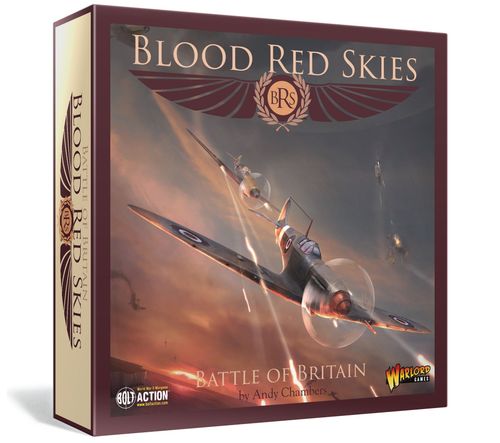
Blood Red Skies: Battle of Britain
Blood Red Skies: Battle of Britain Rulebook
Table of Contents
Table of Contents
Winning the Game
You win the game through morale, which is measured with 'Boom chits'. Boom chits represent light damage and a squadron's cohesion breaking down as pilots get rattled by enemy attacks, along with the rapid expenditure of fuel and ammunition during a dogfight.
Give the opposing player one boom chit for each time you score a hit with a shooting attack against one of their aeroplanes (whether it ends up being dodged or not), and another boom chit for every one of their aeroplanes shot down.
If a player reaches a total number of boom chits greater than their current number of aircraft (e.g. six for five planes) their squadron will disengage from the fight at the end of the current game turn, the survivors driven off by the fierce opposition and accumulated damage.
If both squadrons are driven off in the same turn the game is a draw, with the honours going to the player that shot down the most enemy aeroplanes. If all opposing squadrons disengage the player left in control of the battlefield is declared the winner.
Game Contents
Blood Red Skies: Battle of Britain is a self-contained game that allows you to experience all the thrill of dogfighting in the skies of the World War II period. This box contains everything you need to play a complete game of Blood Red Skies (BRS):
Model Planes
BRS: Battle of Britain is supplied with six German Messerschmitt BF109 E and six British Supermarine Spitfire Mark II single engine fighters.
BRS Advantage Flying Bases
Each plane is supplied with its own BRS flying base. The flying base has been designed so it can adopt three positions that are key to the game mechanics: Neutral, Advantaged and Disadvantaged.
Navigation and Measuring Templates
BRS: Battle of Britain includes three measuring and manoeuvring templates: the range finder (6" long) to establish the distance to an enemy target, the movement template (11" long) to move the planes on the table and the navigation caliper to calculate the plane's turning in ranges of 45 degrees.
Gaming Dice
These are six-sided dice with faces showing 1 to 5 results and an iconic spade representing the score of 6. Most dice rolls in Blood Red Skies need a roll of spade to score a success - you get multiple dice to roll, don't worry.
Gaming Booklets
There are three booklets included in Blood Red Skies: Battle of Britain. Firstly, read and get familiar with the Rules booklet before moving on to the Expanded Rules booklet which will allow you to play all the missions given in the Scenario booklet.
Aircraft Cards
All statistics and gaming information for each aeroplane are included in their corresponding Aircraft cards. In BRS: Battle of Britain box set, you can find the Aircraft cards for the BF109 E and the Spitfire II single engine fighters.
Action Cards
Blood Red Skies includes three types of Action cards: Aircraft Trait, Doctrine and Theatre. These cards will create the Action deck used only in games using Expanded Rules. We recommend you skip this when playing the basic rules contained in this booklet.
Quick Reference Sheets
This boxed game also includes two quick reference sheets which you and your opponent can consult whilst playing the game. No need to flip back and forth through the rulebooks in the middle of the fight!
Game Markers and Tokens
These are used to provide "real-time" information about the pilot and the plane: the Boom token, the Zoom token, and the High Cover marker.
Pilot Skill Discs - When selecting your squadrons, insert the corresponding skill level marker on the plane's flying base.
Scenic Elements
The sky can present pilots with challenges and opportunities in the shape of cloud clusters and anti-aircraft defences. These are represented by a selection of scenic markers (or scenery) included in the game.
Game Set Up
When preparing the playing surface for a game of Blood Red Skies, remember to leave some room to keep the Aircraft cards, Action deck and gaming tools and tokens within reach.
Basic Rules
The Advantage System
The core mechanic of Blood Red Skies lies in the use of a specially designed flying base that can be set at three different levels of "Advantage" to represent aircraft status during their manoeuvres:
Advantaged Neutral Disadvantaged
Broadly speaking, Advantage represents differences in height – high, medium, low – but can also represent a fighter's "energy state." That means their ability to make rapid manoeuvres and control the fight.
Every Ace pilot knows that 'Advantage' is vital in air combat. To show this in Blood Red Skies, fighters can manoeuvre to place enemy aircraft at a Disadvantage, or climb to gain Advantage. Advantage determines the turn sequence (Advantaged planes go first). Advantage can also be "burned" to gain increased movement and turning options when an aircraft moves (as we'll see later). Most importantly, only Disadvantaged planes are vulnerable to being shot down.
Advantage states are shown for aircraft models with a swivel stand by tilting the aircraft forward to denote Disadvantaged and back to show Advantaged.
In real life, an aircraft that is caught while attempting to climb can still be at a disadvantage, even if they temporarily get higher than a faster-moving enemy. They will be slowed by the climb, and their manoeuvre options will be strictly limited, if they don't want to stall or enter a spin. Conversely, a plane that is pulling up at the bottom of a steep dive has masses of momentum it can then use to execute a very rapid climb, a sharp turn, or a burst of straight-line speed.
Planes' Facing
All flying bases in Blood Red Skies are designed with markings to help players trace and determine lines of fire and facing.
The facing arrow establishes the front facing of the plane and sits in the middle of its 90 degrees front arc.
The sides and rear arcs of the plane are defined by 90 degree angles with their origin in the flying base's rod as showed on the picture.
Model Characteristics
Each model in Blood Red Skies represents a single aircraft. Most aircraft typically have a single crewman acting as pilot. The characteristics of a model in Blood Red Skies really come from two places: the skill of the pilot doing the flying, and the capabilities of the aircraft they are flying in.
Pilot Skill
Pilot Skill is a factor of training and experience. A good combat pilot was reckoned to need a good combination of technical expertise, physical fitness, coolness, and aggression to survive and shoot down enemy planes. A Pilot's Skill is rated from 2 to 5, with 2 being the lowest and 5 being the highest as follows:
2: Rookie – A basic trained pilot with little or no experience of air combat.
3: Average – A pilot who has flown in combat before, or who had exceptionally good training.
4: Veteran – An experienced pilot who has flown lots of sorties and fought many battles.
5: Ace – An exceptionally skilled pilot with multiple enemy kills.
Pilot Skill is a very important characteristic in Blood Red Skies, but guns and speed also make the man. When equally-skilled pilots fight one another, the capabilities of their respective aircraft become critical.
Aircraft Card
Aeroplanes in Blood Red Skies are divided into one of four categories: Single-engine Fighters, Multi-engine Fighters, Jet Fighters and Multi-engine Bombers. The type of aeroplane is listed on the Aircraft card just underneath the name.
Certain rules and cards may be restricted or only apply to certain types of aeroplanes.
The performance of a plane in terms of the game is rated by three main aircraft statistics (or stats): Firepower, Agility and Speed.
Firepower
The Firepower characteristic is a representation of the plane's armament in terms of accuracy, range, ammunition, and reliability. Firepower for each aircraft is rated from one to three, with 1 being the lowest, and 3 being the highest:
1: Good – Multiple, rifle-calibre machine guns; or 20mm cannon and heavy machine guns in limited numbers, or with restricted ammunition supplies.
2: Excellent – Either combined cannon and rifle calibre machine guns with plentiful ammo, or multiple heavy machine guns like the American .50cal.
3: Superior – A quad cannon armament, plus additional machineguns; or a very large array of heavy machine guns.
Agility
The Agility characteristic represents how nimble a plane can be in the air. Its acceleration, turning radius, climb, dive, and roll rate, plus stall characteristics, are reproduced in one, handy number. Agility for each aircraft is rated one to three, with 1 being the lowest, and 3 being the highest:
1: Good – An aircraft with decent handling characteristics, but no exceptional ones, and possibly some nasty failings that can be exploited by a clever enemy.
2: Excellent – An aircraft that will perform well and can pull off most of the manoeuvres it is called upon to make.
3: Superior – An all-round agile aircraft with some areas of excellence that a pilot can exploit to really gain an edge in combat.
Speed
The Speed characteristic represents an aircraft's top speed. It is expressed as a maximum distance, in inches, that the model can move across the tabletop in one game turn.
Real MPH
Speed is important because it not only determines how far models can move across the tabletop, it also dictates what order models move in. Faster planes normally move before slower ones.
The Speed statistic on the aircraft profile card incorporates the real aircraft's maximum speed value in miles per hour. If two aircrafts have the same speed value, their real-life speed is used as a tie-breaker in favour of the highest value.
In addition to the aircraft stats, there are three recruitment traits at the back of the corresponding aircraft card that complete their type and model's profile to help you flavor and balance your games.
Points Cost
This is the recruitment cost per plane of this type when recruiting your forces to play a scenario. Points cost ensure opposing forces start with the same chance to win regardless of the type or number of planes used. You can find out more about buying forces in the scenarios booklet.
Nationality
This trait tells you which nationality the fighter type in question fought for and helps if you want to stick to playing historical games where certain nations were allied.
Throughout the war, alliances between nations allowed certain planes to fight for other nations, like the lend lease agreement between the Allied powers.
British, German, American, Soviet, Japanese.
Year of Service
This date indicates the year when it first saw service. Although all planes have been balanced to perform well against each other regardless of the year they were in action, this is a very useful trait should you want to stick to historical accuracy. You may want to restrict certain scenarios to planes from a period, for example.
Playing the Game
How to Start
We recommend that you start first by reading this booklet and then trying out Scenario 0 'Intruder Flight' from the Scenarios Booklet. After playing it as both sides you will have a real grasp of the game.
Once you have mastered these rules you can move on to read the Expanded Rules booklet which gives you more options and allows you to play the other scenarios supplied in the Scenarios Booklet.
Turn Order
Planes are activated each turn in order of their level of advantage. The turn is therefore split into three phases:
-
Advantaged Action Phase: Advantaged planes are activated in order from highest Pilot Skill to lowest.
-
Neutral Action Phase: Neutral planes are activated in order from highest Pilot Skill to lowest.
-
Disadvantaged Action Phase: Disadvantaged planes are activated in order from highest Pilot Skill to lowest.
Tied Initiative
If two or more planes have the same Pilot Skill value, the order of activation is determined by the Speed value from highest to lowest. If the tie persists, remember to use the Real MPH tie-breaker value to work out the activation sequence.
Activating a Fighter
In the action phase, activate fighters, one at a time. The most skilled plane goes first within each advantage category, any ties in Pilot Skill are broken by Speed value and ultimately by the Real MPH tie-breaker as explained.
Complete all the actions of one plane before moving on to the next. A plane takes the following actions, in this order, when it activates:
1. Shoot
You can shoot an enemy plane that is in your front arc, within the range template distance and is at a lower advantage level. Advantaged to Neutral and Disadvantaged. Neutral to Disadvantaged only.
2. Burn Advantage
When activating your plane, you may choose to burn one advantage level - going down a level from Advantaged to Neutral or Neutral to Disadvantaged - to perform one of these two special actions: Manoeuvre or Dive.
3. Move
Move your fighter straight ahead up to its maximum Speed, then you can turn up to 45° using the navigation caliper template. You must move at least half your maximum Speed, rounding down to the nearest inch.
4. Pilot Action
After the plane has completed its move, the controlling player may choose one pilot action from the following options:
Shooting. You may shoot an enemy plane that is in your front arc, is within 6", and is at a lower advantage level.
Outmanoeuvring. You may attempt to reduce an enemy plane's advantage level by one. From Advantaged to Neutral or Neutral to Disadvantaged.
Climbing for Advantage. Raise your advantage level by one. From Neutral to Advantaged or Disadvantaged to Neutral.
5. End Activation
Place a Zoom token on the fighter's base to show it's taken its turn.
I. Shooting
Fighters carried a heavy, forward-facing armament of machine guns and automatic cannon to shoot down enemy aircraft. The high engagement speeds of fighters made it essential to do enough damage to shoot down an enemy plane in just a few seconds of accurate fire.
The Shooting range for all planes covered in these rules is 6" and you use the range template to resolve the shooting action. To be able to declare a shooting action, the target must be in the forward 90° arc of the firing plane, and at a lower advantage level.
To check the range and facing, place the range template so the curved inset matches the front of the flying base and ensure the facing arrow and the aiming cross are aligned as shown on the example below.
90° arc of fire and facing decided by measuring from the centre mark straight ahead.
To resolve a shooting attack, the shooter adds the Pilot Skill value to the plane's Firepower value, and rolls that many dice. If at least one success (spade) is rolled, a hit is scored and a Boom token given to the opponent.
Once a hit is scored, the target can try to dodge the attack by rolling a number of dice equal to the sum of its Pilot Skill value and the plane's Agility value. If at least one spade is rolled the hit is dodged.
Unless the hit is dodged, the target loses an advantage level. If the plane was already Disadvantaged, it is shot down.
Critical Hits
If during a shooting action, more than one spade is scored, the shooter inflicts a critical hit.
Critical hits are harder to dodge and to represent this, the target's Agility value is reduced by one when trying to dodge.
Positioning Shooting
Shooting attacks are often influenced by the relative positions of the shooter and its target. This is represented by the following two special shooting situations.
Head-on Attacks
Head-on attacks could be highly effective during WWII, but they were always risky.
A shooting attack that comes at the front arc of the target plane is called a head-on attack. In this case, the target is allowed to counter-attack by shooting back regardless of their advantage state.
The exchange of shooting attacks is simultaneous and is resolved even if one of the planes involved is shot down.
The target aircraft attacks are assumed to be in the front arc too so there is no need to position the range template at all.
Deflection Shooting
Shooting a target from the sides is considerably more difficult.
To reflect this, the target can use its plane's maximum Speed instead of its Agility to add to their Pilot Skill when calculating the number of dice rolled to dodge shooting attacks.
This only applies to attacks that do not originate within a target plane's front or rear arc.
II. Burning Advantage
Combat pilots climb to higher altitudes to gain momentum or energy that they can then use to execute sharp manoeuvres and increase their speed in order to best their opponents.
When activating their planes, players can burn their advantage down one level – from Advantaged to Neutral or Neutral to Disadvantaged - in order to perform one of the following actions:
Manoeuvre
Make a turn of up to 180° at any point during the aeroplane's movement. This replaces the normal 45° turn as explained later. After this turn, the aeroplane can continue its movement up to its maximum Speed.
Dive
Simply add 6" to the aeroplane's maximum Speed value during the aircraft's movement this turn.
III. Moving
Facing and positioning is crucial in Blood Red Skies and an important part of the game's strategy. Players must always follow straight lines when resolving their aeroplanes' moves. To assist with this, the movement template has a central line along which the facing arrow is aligned whilst an aircraft is moved.
In order to perform a move, use the movement template provided. This has been designed so the curvature of the base and its diameter fit the movement template.
Place the front of the model's base against the movement template with its front arrow aligned to the central movement line. Finish the move with the back of the model's base stopping at any point up to the aeroplane's maximum Speed as shown in the example below.
Minimum Move
Remember, a plane must move at least half of its full Speed (rounding up) just to stay in the air!
Turning
Planes can turn up to 45° after they complete a movement. Use the navigation caliper template to turn. To make a right turn make sure the facing arrow of the aircraft base is aligned with the left arrow on the caliper. For a left turn align the facing arrow with the right arrow of the caliper. Then, rotate the flying base on the spot so the facing arrow aligns with the other arrow on the caliper template.
Tailing
A pilot was at his most deadly when he got in close range to the rear quarter of an enemy. From here it was much easier to follow the target's moves and deliver a deadly-accurate attack.
A plane counts as tailing an enemy when it finishes its movement with its facing arrow pointing directly towards the rear arc of an enemy plane, and within the range template's length.
Tailing reduces the enemy plane to a Disadvantaged state immediately. There is no ongoing effect from tailing, and it only comes into play when a plane ends it move and before it takes its pilot action (so you cannot Climb for Advantage and then claim a tailing position). A plane can only claim to be tailing one enemy plane per turn.
Tailing is most commonly used to set up an immediate shooting attack.
A plane cannot claim to be tailing an enemy if it is Disadvantaged itself, or if it is in the front arc of a Neutral or Advantaged enemy plane within 6". We call this "The Wingman Effect."
Note that this means a neutral plane that burns advantage cannot tail an enemy in the same move because it is in a Disadvantaged state during its movement.
IV. Pilot Actions
On completion of a plane's movement it can perform one Pilot Action chosen from the following options.
Shooting
A plane can shoot a second time during its activation as a Pilot Actions' choice. To resolve a Shoot Action, follow all the rules for shooting as explained in the Shooting section above.
Outmanoeuvring
By using the correct manoeuvres, a pilot can set up an enemy for an attack. This could be by adopting an angle of attack that forces the foe onto the defensive, acting as a decoy to deflect attention away from a blindside attack, or any of a host of other tricks of the trade. However if the manoeuvre succeeds, the enemy will be put on the defensive if they aren't skilled enough to escape the trap.
A player can try to outmanoeuvre an enemy fighter that is within 9" of their plane. An outmanoeuvre attempt can be made regardless of respective Advantage levels. Use the movement template normally to calculate this distance from the base of your plane.
To resolve an outmanoeuvring action, controlling players compare the Pilot Skills of the planes involved. The target plane adds one to its Pilot Skill value if it is not the closest enemy.
Pilots with a higher skill level outmanoeuvre lower skilled pilots automatically; otherwise the target must make a manoeuvre test.
In order to resolve a manoeuvre test, the target plane rolls a number of dice equals to its Pilot Skill value plus the plane's Agility value.
If at least one spade is rolled, the target avoids being outmanoeuvred.
If the outmanoeuvring action succeeds, the outmanoeuvred target reduces its Advantage level by one from Advantaged to Neutral or Neutral to Disadvantaged. If they were already Disadvantaged, there is no additional effect.
Remember, that if the target plane is not the closest target, the Pilot Skill value benefits from a +1!
Climbing for Advantage
As explained earlier, a pilot may lose advantage as a result of shooting or being outmanoeuvred. To regain their position, a player may declare their plane is Climbing as a Pilot Actions' choice.
When climbing, the aircraft moves up its advantage level, from Disadvantaged to Neutral or from Neutral to Advantaged.
Chocks Away!
Time to take off on your first sorties in the Scenarios booklet.