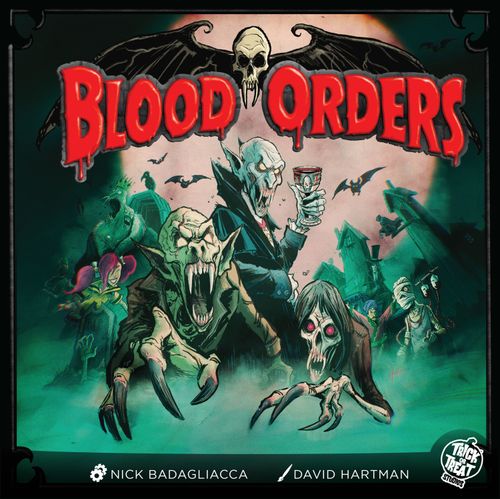
Blood Orders
Blood Orders Rulebook
Table of Contents
Table of Contents
Game Components
- 1 Main Game Board
- 4 Individual Player Screens
- 4 Individual Player Boards
- 36 Location Cards
- 36 Ritual Cards
- 114 Victim Cards, including 36 Bleeder Cards and 36 Elder Cards
- 92 Blood Tokens
- 91 Influence Tokens
- 56 Victory Point Tokens
- 1 Start Player Marker
- 1 Day/Act Marker
- 4 Fear Tracking Dice
- 4 Fear Tracking Tokens
- 12 Order Tokens (3 per player)
Object of the Game
In a game of Blood Orders, you and up to 3 opponents will each take on the roles of powerful but disgraced vampires, looking to build a new underground kingdom of your own from the ground up. Building your new Order will involve managing a continuously evolving hand of vampire cards at your command, sending them throughout the city to visit Locations, perform arcane Rituals, bewitch Victims, and recruit new vampires, all over the course of 9 rounds (Days). All of these activities take the form of cards activated by your Order Tokens on the board, allowing you to amass critical resources, perform useful actions, and earn Victory Points. However, as your power grows, so does Fear within the city, making your quest increasingly difficult as the Days go by.
At the end of the 9th Day, the vampire player with the most Victory Points will reign supreme!
Game Setup
Prepare the Game Board
- Place the game board in the center of the table within easy reach of all players, leaving space around it for various card decks and token supplies.
- Place the Blood, Influence, and Victory Point tokens in separate piles next to the board within easy reach of all players.
- Place the decks of Bleeder and Elder cards in their designated spaces in the Catacombs section of the board. NOTE: all the cards in the Bleeder and Elder decks are identical except for their artwork, so they do not need to be shuffled.
- Separate the Ritual cards into their three 12-card decks by Game Act (I, II, or III in the bottom right of the card) and shuffle each deck individually. Set the II and III decks aside. Place 4 cards from the top of Deck I in a face up row next to the Altar section of the board to form a market. Set the rest of Deck I at the end of this row to form a draw pile.
Prepare the City
- Separate the Location cards into their three 12-card decks by Game Act (I, II, or III in the bottom right of the card) and shuffle each deck individually. Set the II and III decks aside. Using Deck I, place 1 card from the top of the deck face up in each of the designated Location spaces in each City Quarter on the board. Return the rest of Deck I to the game box. NOTE: Only place a Location card in the West Quarter if playing with 4 players.
- Separate the Victim cards into their three 14-card decks by Game Act (I, II, or III in the bottom right of the card) and shuffle each deck individually. Set the II and III decks aside. Using Deck I, place 1 card from the top of the deck face up in the designated Victim spaces in each City Quarter on the board. Set the rest of Deck I to the side of the board within easy reach. NOTE: Only place a Victim card in the West Quarter if playing with 4 players.
- In each of the City Quarters with a Victim, place 3 Blood tokens as well as a number of Influence tokens equal to the Influence cost of the Victim card on the Night space.
- In each of the City Quarters with a Victim, add the total Fear values appearing on the Location and Victim cards together. Turn a fear tracking die so its pips show this total and place it in the designated Fear tracking space. If a card has no Fear symbols printed on it, its value is considered to be 0. Example: the printed rulebook shows The Laboratory Location card and The Pop Icon Victim card with their Fear values added together and the die set to the total.
- Place the Day/Act tracking marker on the X space of Act I, located at the bottom of the Day Track.
Distribute Individual Player Components
- Each player chooses a color and takes the matching player screen, player board, and 3 Order tokens, placing their board behind the screen in front of them.
- Next, each player takes the Fear tracking token of their player color and places it on the 0 space of the Fear track on the main game board. At the beginning of the game, these will form a stack (the order is not important).
- Each player then takes a set of starting resources:
- 4 Bleeder and 3 Elder cards from the Catacombs to form their starting hand
- 7 total Blood
- 5 total Influence
- Finally, the player who most recently drank blood receives the Start Player Marker. If no one wants to admit to doing this, the most ancient (oldest) player receives it instead.
Card Overview
Victim Cards
The residents of the city can be influenced for powerful effects or be drained of their blood to join your Order!
- Victim class: shown by the icon beside the action values.
- Dawn, Dusk, and Night action values: the values the card contributes to the City Quarter's action requirements.
- Dusk Influence cost and effect: the Influence cost paid to perform the Dusk action, and the effect gained.
- Victim name
- Game Act: the Act (I, II, or III) the card belongs to.
- End-game Victory Points
- Fear value
Bleeder Cards
Bleeders are hangers-on, inexperienced and often unsavory vampires whose help you will need to begin your Order, but should be tossed aside as soon as they've served their purpose.
- Dawn, Dusk, and Night action values
- Vampire name: Bleeder
- Rules/gameplay reminders: Cannot complete Rituals. Do not discard to Torpor. Instead, return this card to the top of the Bleeder deck.
Elder Cards
Elders are ancient, decrepit vampires who have long since grown weary of conflict and the lust for power and influence. They are wise and strong, but stubborn and apathetic. They will prove useful but only for as long as necessary.
- Dawn, Dusk, and Night action values
- Vampire name: Elder
- Rules/gameplay reminders: Cannot complete Rituals. Do not discard to Torpor. Instead, return this card to the top of the Elder deck.
Location Cards
Locations represent specific places in the city vampires can visit during Dawn to gather intelligence, spread or intercept rumors, and gain resources.
- Location name
- Location effect
- Fear value
- Action symbol, Victim card, and Blood requirements (Dawn action)
- Game Act
Ritual Cards
As your influence and hand of vampires grows, you will have the opportunity to perform infernal rites and ceremonies that give your Order special powers and abilities, plus additional Victory Points at the end of the game.
- Ritual name
- End-game Victory Points
- Action symbol, Victim card, and Blood requirements
- Game Act
- Ongoing effect: the effect text on the card, such as the Ravenous Appetite card's "Once per day, on your turn, gain Blood."
Rules Overview
Game Flow and Concepts
Days and Acts
A game of Blood Orders is broken into 3 Game Acts, each of which has 3 Days (for a total of 9 Days per game). At the beginning of each new Game Act, the Locations, Victims, and Rituals available to the Vampire Players are replaced with decks of new, upgraded cards. The effects and rewards in these decks become increasingly powerful, but also more difficult and dangerous to obtain!
Orders
The most important tool available to the Vampire Players are their Order tokens, which they will use to plan out their activities for each Day on the game board and behind their screens. These tokens represent the missions that groups of minions from players' hands will undertake during the 3 parts of each Day: Dawn, Dusk, and Night. Orders placed in the City Quarters on the board are resolved along with all the other players' in a 'first-come, first-served' manner, so careful timing is essential!
Fear
Throughout the game, Vampire Players must manage their personal Fear total to avoid potentially disastrous consequences at the end of the game. This represents the city's residents becoming more and more terrified of a player's army of vampires in their midst! As Game Acts progress and the cards available to players become more powerful, the increased Fear associated with using or acquiring them can escalate quite quickly if not kept under control.
Blood
If there's one thing vampires crave above all else, it's Blood! Vampire Players need Blood not only to feed and retain the minions in their hand, but also to perform Rituals giving them special abilities and Victory Points. However, Blood is also scarce and comes at a high price, so successful players will need to manage their supply effectively.
Playing Through a Day
Each of the 9 Days in the game follows the same structure, broken into 4 phases:
- Planning Phase: Simultaneously, players decide where they will place their Order tokens on the main board during the Day and secretly assign cards from their hand to these Orders using their player boards.
- Order Phase: Players take turns placing Order tokens face down on the game board and optionally triggering other effects. After all tokens have been placed, they are revealed to show the plans Vampire Players have set in motion for the Day!
- Resolution Phase: All Orders placed in City Quarters are resolved by type from left to right (Dawn in each Quarter, Dusk in each Quarter, and so on), with those players who placed tokens earliest getting to go first and continuing until all actions have been completed.
- Cleanup Phase: Finally, players simultaneously use their Blood supply to feed the vampires they deem worthy to carry into the next Day, discarding any they do not (or cannot) feed and returning the rest to their hand. The board is then reset, the Start Player Marker is passed, and a new Day can begin!
Rules in Detail
Planning Phase
Each Day begins with the Planning Phase, when Vampire Players decide which actions they will take using their 3 Order tokens, secretly pairing them with cards from their hand. This is referred to as assigning orders.
Assigning Orders
To assign an Order, a Vampire Player secretly chooses one of their 3 Order tokens that has not already been used and a City Quarter row (North, South, East, or West) in which to place it. Behind their player screen, the player places this token face up (with its action symbol visible) in the corresponding token slot on the bottom of their player board. The token should be rotated so that the chosen City Quarter name is at the top. This will serve as a reminder of where it should be placed during the Order Phase.
Finally, the Vampire Player chooses any number of cards from their hand to form a face up pile below each Order token on their player board. The cards in this pile must have Dawn, Dusk, or Night symbols equal to or greater than the number showing on the Quarter's Fear tracking die in order to perform the action successfully (see Example of assigning an Order and Overcoming Fear in the Resolution Phase). However, higher totals may help you edge out your opponents if actions become Contested or dice values change; placing a total greater than the current Fear die value may be a winning strategy!
Players may repeat this process as many times as they wish until they run out of Order tokens. However, players are not required to assign any of their Order tokens to City Quarter spaces if they do not wish to do so.
Once all players have finished organizing their cards and tokens behind their screens, the Planning Phase is complete and the Order Phase can begin. When the Planning Phase is over, the cards players have placed on their boards are considered locked and may not be changed for the rest of the Day.
Example of assigning an Order: Player A has decided to take the Dusk action in the South Quarter (1). First, they place their Dusk order token in the corresponding slot at the bottom of their player board. The token has been rotated so that 'South' is at the top, reminding the player that this token will be moved to the South Quarter (2). Finally, Player A will need to place cards from their hand underneath the Dusk token with symbols greater than or equal to the pips on the South Quarter's Fear tracking die. They place a stack of 3 Elders under the token, giving them a total of 3 Dusk symbols (3). Player A is now finished assigning this Order! During the Order Phase, they will move the Dusk token onto the main board. When it resolves during the Resolution Phase, they will be able to activate the effect of The Occultist (4).
City Quarter Actions
Each Order token a Vampire Player can assign matches one of the 3 action columns on the main game board:
- Dawn Action: Use the effect of the Location card in that Quarter. This represents vampires scouting the city in disguise and gathering resources.
- Dusk Action: Pay the Influence on the Victim card in that Quarter, then use its effect. This represents vampires using magic and hypnosis, casting spells to gain advantages and elicit favors from unsuspecting mortals in the city.
- Night Action: Take the Victim card in that Quarter from the board, adding it to your hand, and take all the Blood and Influence tokens that have accumulated in the Night space of the Quarter. Your minions have drained the Victim's blood, absorbed their essence, and they are now a freshly-turned vampire under your command!
NOTE: It is important to keep in mind that City Quarter actions always resolve in order by type from left to right (Dawn, then Dusk, then Night), and the topmost Quarters are always resolved before the ones below them. Timing is key in choosing which actions you will take during the Day!
Other Spaces
Instead of assigning an Order token to one of the City Quarter spaces, a Vampire Player may instead choose to reserve it to place on The Altar or The Catacombs. Instead of resolving during the Resolution Phase, these spaces have an immediate effect as soon as a player places one of their tokens there during the Order Phase (although they still do so face down). As a reminder, these spaces are marked with the Immediate Effect symbol on the board while spaces that resolve later in the Day are marked with the Delayed Effect symbol. A player may use any Order token to take these actions.
The Altar
When a player places a token at The Altar, they must do the following:
- Choose a Ritual card from the market next to the game board.
- Reveal cards from their hand that, when combined, meet the card's Victim and Dawn / Dusk / Night symbol requirements. Bleeders and Elders may not be used to complete Rituals (a reminder of this is printed on these cards).
- Pay the Ritual's Blood cost to the common supply.
You may use any number of Victim cards to fulfill a Ritual's requirements as long as it is greater than or equal to the value printed on it. Cards revealed to complete a Ritual are not discarded and remain in your hand.
If the player is able to meet all the requirements of the chosen Ritual card, they may place it next to their player screen in view of the other players. Any and all effects of an acquired Ritual card are immediately available for the active player to use, even on the same turn if possible. The market is then immediately refilled by sliding any remaining Rituals to the right and drawing a replacement to fill in the empty space.
If any of the criteria on the chosen Ritual card cannot be met, nothing happens. The player does not retrieve their Order token, leaving it face down until the Cleanup Phase.
NOTE: Since only Victim cards can be used to complete Rituals and a player's starting hand consists exclusively of Bleeders and Elders, players will not be able to complete Rituals during the first Day of the game.
The Catacombs
When a player places a token at The Catacombs, they immediately take one card of their choice from either the Bleeder or Elder decks and immediately add it to their hand.
Order Phase
The Order Phase is the only part of the Day where players take turns in sequence. When a card mentions a player may trigger an effect 'on your turn', it refers to the Order Phase.
Beginning with the current starting player and moving clockwise to their left, each player takes a turn placing one of their Order tokens face down into the circular spaces next to any City Quarter, the Altar, or the Catacombs. If another player has already placed a token in the chosen space, the new token is placed on top to form a stack.
NOTE: Remember if the token is placed on either the Altar or the Catacombs, that space's effect is resolved immediately.
After all players have assigned all of their tokens on the game board, they are all revealed and the Day moves on to the Resolution Phase.
A player may only place a single Order token on their turn during the Order phase, but there is no limit to the number of their own Orders they may place on the same space during a Day. There is also no limit on the number of tokens belonging to all players that can be on any given space (i.e. no player is ever 'blocked' from placing a token if they wish).
At any time during the Order phase, players may look at the reverse side of any of their own tokens they have placed face down on the main game board (for example, to make sure they placed the correct one on a given space), provided they do not look at any other players' tokens or alter the order of a stack.
NOTE: Although the cards on a player's board are considered locked once the Order Phase begins, their Order Tokens are not. If you choose, you may place Order Tokens on different spaces than you selected during the Planning Phase, and may wish to do so in response to other players' actions.
Scavenging
At points during the game, Vampire Players may find themselves with less Blood in their supply than they need to perform an action. Either before or after placing an Order token (but not both), a player may optionally Scavenge by increasing their marker on the Fear tracker by any number of spaces, taking 1 Blood from the common supply for each space moved.
If you have no available spaces to move your marker on the Fear track, you may not take the Scavenge action. However, if an effect that triggers during your turn would change this, you may then take the Scavenge action if you haven't done so before the effect occurred.
Revealing Orders
Example of Revealing Orders: Players have placed their Order tokens and it is time to reveal them so the Resolution Phase can begin. All 3 players have Order tokens in the East Quarter, so they will be revealed from the top of the stack to the bottom. The blue player is on top, so their token is flipped face up and moved to the Night action space. The next token in the stack is the red player, whose token is flipped and moved to the Dusk space. Green is the final Order in the stack and theirs is also a Dusk action, so their token is placed on top of the red player's. The green player will get to resolve their Dusk action first during the Resolution Phase.
Finally, once all players have placed all 3 of their Order tokens on the board, all tokens in City Quarters are revealed and moved to their corresponding action spaces. Tokens in The Altar or The Catacombs remain face down and are not revealed or retrieved until the Cleanup Phase.
Unstacking and Re-stacking Revealed Order Tokens
When revealing Order Tokens, their place in a stack of several is important, since this dictates when they will be able to resolve the chosen action during the Resolution Phase. This may be either before or after other players, so the timing distinction can prove to be strategically important!
In each City Quarter entrance space, starting from the top of the stack of Order tokens, flip each one face up and place it in the column shown by its action symbol. Just as during the rest of the Order Phase, if an action space already has tokens on it, place the newly revealed face up token on top of the stack (see Example of Revealing Orders).
The Dawn, Dusk, and Night actions in the city are now ready to be resolved!
Using Ritual Effects
Certain effects on Ritual cards players can acquire during the game will include the text "Once per day, on your turn...". These effects can also be activated either before or after placing an Order token and you may activate as many as you choose. After an effect has been used, turn it sideways or flip it face down to show that it has already been triggered for the current day. Other Rituals that do not include text referencing a player's turn are considered always in effect.
Resolution Phase
Once all of the Order tokens in the City Quarters have been revealed and placed in their corresponding action spaces, players remove their screens and the Resolution Phase begins.
Each type of action in the city (Dawn, Dusk, Night) is resolved in each Quarter from top to bottom:
- Dawn Actions in all Quarters from North → West
- Dusk Actions in all Quarters from North → West
- Night Actions in all Quarters from North → West
If there are multiple player tokens in a stack on the same action space, they are resolved in order from the topmost token to the bottom before moving on to the next space.
While an Order token is being resolved, the player who controls it is considered the 'Active Player' and the Quarter in which it is being resolved is the 'Active Quarter'.
Overcoming Fear
For all City Quarter actions, players will have assigned cards behind their player screens into spaces for Dawn, Dusk, and Night actions. They will hopefully have planned accordingly, but other players may have subsequently thrown a wrench in their machinations by manipulating the Quarter's Fear die!
To resolve any action, the Active Player must have cards in the corresponding column of their player board with matching action symbols meeting or exceeding the total number of pips showing on the Fear tracking die for that Quarter. For example, a Dawn Action in a Quarter with 4 pips showing on its Fear die requires cards that show a minimum of 4 Dawn symbols, while a Dusk Action in a Quarter with 2 on the die only requires a minimum of 2 Dusk symbols.
If the Active Player meets this requirement, they may show the cards in the corresponding column to the other players, then place them in a discard pile next to their player board called Torpor (more about this in the Cleanup Phase). They then resolve the action as normal.
If the Active Player fails to overcome Fear, nothing happens and they retrieve their Order token, moving all cards they had assigned to Torpor. If an action is Contested, there are additional steps to complete before one player may take that action (see Contested Actions below).
NOTE: Remember, if you cannot overcome the Fear value for a given Dawn, Dusk, or Night action, you may not resolve it and must still move any assigned cards to Torpor!
Overcoming Fear, Example 1
Player B wants to take a Dawn action in the North Quarter, which has a die showing a 2. They have 2 cards in the Dawn section of their player board, each showing 1 Dawn symbol. Since their total Dawn symbols equal the die value in the North Quarter, they may take the Dawn action.
Overcoming Fear, Example 2
Player B wants to take a Night action in the South Quarter, which has a die showing a 3. They have 2 cards in the Night section of their player board, each showing 1 Night symbol. Since they have only assigned cards to their Order with a total of 2 symbols and do not meet or exceed the value on the die, they may NOT take the Night action in this Quarter. When this Order resolves, nothing happens.
Resolving Dawn Actions
To resolve a Dawn Action, the Active Player simply follows the text printed on the Location card, performing its effect. Most often this consists of gaining one or more types of resources or lowering their personal Fear total.
When a Dawn Action is complete, return the Order token to the Active Player. Dawn Actions cannot be Contested.
Resolving Dusk Actions
Much like Dawn Actions, during a Dusk Action the Active Player will follow the text printed on the card, performing its effect. However, these are more powerful actions performed by mortals who must be persuaded with hypnosis and other nefarious means!
Before taking a Dusk Action, the Active Player first must pay the Influence cost listed on the bottom left of the card, adding it to the Night space in that Quarter. Choose where you take Dusk actions wisely, since a player who later resolves the Night action there will take credit for your scheming, collecting all the Influence in that Quarter!
When a Dusk Action is complete, return the Order token to the Active Player. Dusk Actions cannot be Contested. If a player does not have enough Influence in their supply to pay the Dusk action cost, nothing happens and they move any assigned cards to Torpor.
Resolving Night Actions
The nighttime is for hunting, and Night Actions resolve differently than at Dawn or Dusk. To resolve a Night Action, the Active Player performs 3 steps as follows:
- Take the Victim card in the Active Quarter and add it to your hand. It has now become a vampire under your control!
- Take all the Blood tokens and Influence tokens in the Night space of the Active Quarter and add them to your own supply.
- Increase your Fear marker on the Fear track by the number showing on the Fear tracking die in the Active Quarter.
NOTE: There will be empty action spaces in the Active Quarter once a Night Action is completed — these are not refilled until the Cleanup Phase.
Contested Actions
Frequently, more than one player will have chosen to take the same action in the Night space of a City Quarter. When this occurs, only one player can turn the Victim there into a vampire under their command! This action is considered Contested.
Contested Actions are resolved as follows:
- The player with the highest total Night symbols on the cards they have assigned to the space is the winner.
- In a tie, the player who assigned the highest number of cards to the action space is the winner.
- If the players are still tied, the player with the most Influence tokens in their personal supply is the winner.
- If the players are still tied, there is a stalemate and all players lose!
When a player wins a Contested Action, they then continue taking the action as normal and all other contesting players lose. Players who have lost immediately return the cards they assigned to their hand. These vampires were chased away during the hunt and will start in a player's hand for the next day.
Shifting Fear
Sometimes certain card effects (especially Dusk actions) will manipulate the Fear dice in various City Quarters after the Planning Phase is over and cards can no longer be assigned or rearranged. Overcoming Fear is always done with the die value at the time an action is resolved — much like Contested actions, it may sometimes be worthwhile to commit more Dawn / Dusk symbols than the minimum as well!
Action and Card Effect Notes
If resolving a Dawn, Dusk, or Night action would move your Fear tracking token past the upper or lower limits of the track on the game board, simply stop when you no longer have available spaces to move.
If a card effect or other printed text instructs you to increase or decrease a Fear die farther than the pips on it will allow, simply increase or decrease it as much as you can (if possible): the total Fear in a City Quarter can never be less than 1 or greater than 6. You must still pay any resource or other cost required for triggering the effect even if the die would not change.
If a card effect or action requires drawing from or otherwise manipulating the Victim deck and it is empty, shuffle any discarded Victim cards from the current Act and use them to form a new draw pile. If there are no Victim cards left in either the draw pile or the discard pile for the current Act, the effect or action does nothing. Any resource costs, including assigned cards, must still be paid.
Some card effects, primarily Dusk actions, may require a player to discard a Victim card from their hand. If this happens, the card is immediately moved to that player's Torpor. If a card effect instead instructs you to remove a card from the game board, add this to a common Victim discard pile next to the board, starting one if it doesn't exist already. This common discard pile is also where Victims are placed if not fed during the Cleanup Phase (see Feeding Vampires).
Finally, if resolving a card effect would contradict an aspect of the rulebook, assume that the text printed on the card supersedes any base rules.
Cleanup Phase
Once all players' assigned Orders have been fully resolved, the Cleanup Phase begins. The Cleanup Phase has 2 parts: feeding vampires, and preparing for the next Day.
Feeding Vampires
Simultaneously, players set aside their hand and pick up the cards that were discarded into Torpor. For each vampire in Torpor they want to keep for the next day, they must pay 1 Blood token to the supply to 'feed' it and add it back to their hand. Any cards in Torpor a player chooses not to feed are placed in a common discard pile next to the board (see Example of Feeding Vampires).
Players may have a maximum of 10 cards in their hand at the end of the Cleanup Phase, and must discard down to 10 cards even if they have Blood available to feed a larger number of vampires.
When discarding a Bleeder or Elder during the feeding process, do not add it to the common discard pile. Instead, place it on top of its corresponding deck in The Catacombs.
NOTE: Remember that you never pay Blood for cards that remain in or return to your hand during the Day! This includes cards you used to complete Rituals and any cards returned from a Contested Action you lost.
Example of Feeding Vampires: It's the Cleanup Phase and time for Player C to feed the vampires they will carry into the next round. Looking at the 7 cards in their Torpor, all of them could be "useful"! But Player C only has 11 Blood tokens in their supply, and if they spend the 7 required to keep all of them, they won't have enough to perform a Ritual they were planning to purchase during the next Day. They would also like to perform a Night action in a City Quarter with a particularly high Fear value. Since they offer very few Night symbols, Player C decides to discard The Undertaker and 1 Bleeder, paying the 5 Blood tokens for the remaining cards to the common supply and returning them to their hand.
Preparing for the Next Day
To prepare for the next Day, perform the following steps:
- For every City Quarter space that still has a Victim card in it, add 1 Blood and 1 Influence to its Night action space.
- For every City Quarter space that does not have a Victim card in it, draw one from the top of the deck to replace it. Add 3 Blood and Influence equal to its Influence cost, just as during initial setup.
- In each City Quarter, readjust the Fear tracking die to match the combined total of the Fear symbols on the Location and Victim cards currently in that Quarter.
- Move the Day/Act tracking marker forward 1 space on the Day Track.
- Finally, have the player currently holding the Start Player Marker pass it to the player on their left.
NOTE: Whether they have been activated by any Vampire Players or not, Location cards remain on the board until the end of the current Act.
Starting a New Act
At the end of the 3rd and 6th Days, a new Game Act will begin, as indicated by the sections on the Day Track. To prepare for the next Act, there are a few changes to the Cleanup Phase:
- Before doing anything else, remove all Location and Victim cards from the board and return them (as well as the remainder of the current Act's Victim draw deck and discard pile) to the game box.
- Using the appropriate new Deck (II or III), deal out new Locations and Victims as at the beginning of the game, adjusting the Blood tokens and Influence tokens in Night spaces to reflect the new Victim cards in those Quarters.
- Readjust the Fear dice in each Quarter to match the new total on Location and Victim cards.
- Discard the rightmost (oldest) Ritual from the Altar market and slide the remaining 3 cards to the right. Replace the draw deck with the next Game Act's and draw a Ritual from it to fill in the empty space.
Ending the Game
After the Cleanup Phase at the end of the final Act (Day 9), the game is over. Now it's time to see who emerged as the new Monarch of the Underworld!
NOTE: Remember that each player must feed any vampires in Torpor they want to return to their hand during the Cleanup Phase, so be sure to save enough Blood in the final round to keep your cards for final scoring!
Totaling Victory Points
Finally, each player checks their position on the Fear track and adds or subtracts the Victory Points indicated by the nearest space they have met or passed. The resulting total is their final score!
Vampire Players receive Victory Points for:
- Victory Points shown on vampires in their hand
- Victory Points shown on Ritual cards they have acquired
- Individual Victory Point tokens they have accumulated
- 1 Victory Point for every 2 Influence tokens in their supply (rounded down)
Breaking Ties
If 2 or more players are tied for final score, the tie can be broken as follows, in order:
- The player with the most vampires in their hand wins.
- If still tied, the player with the most Ritual cards wins.
- If still tied, the player with the most Influence tokens in their personal supply wins.
If 2 or more players are still tied, they share the victory and rule the Underworld together!
Quick Reference
Day Sequence
Planning Phase: Behind their player screens, players simultaneously choose which Order tokens to place and assign cards from their hand using their personal player boards.
Order Phase: In turn order beginning with the current start player and moving clockwise to their left, players place 1 Order token at a time face down in any circular space on the board. On their turn, players may also optionally use the Scavenge action or any effects of their acquired Rituals. After all Order tokens are placed, flip and move them to their corresponding action spaces.
Resolution Phase: Resolve each action (Dawn, Dusk, and Night) one at a time starting in the North Quarter and moving down toward the West Quarter.
Cleanup Phase: Simultaneously, all players pay 1 Blood for each card in their Torpor they want to keep for the next round, discarding any others. Refill the board with new Victims, Blood, and Influence, using the appropriate decks for the current Game Act. Adjust the Fear tracking dice on the board to reflect the current total Fear symbols in that City Quarter.
At the end of the 3rd and 6th Days, follow the special instructions in the Starting a New Act section of the rulebook before continuing the Cleanup Phase.
Symbols
- Actions: Dawn (sun), Dusk (eye), Night (crescent moon)
- Victim classes: three class icons (green, orange, and magenta)
- Card types: Victim (skull), Location (house), Ritual (ritual wand)
- Resources and scoring: Fear (cross), Blood (drop), Victory Points (tooth), Influence (swirl)
- Effect timing: Immediate Effect (lightning bolt), Delayed Effect (clock)
- Contest: Contested (rosette), Not Contested (crossed-out rosette)
End of Game Scoring
After the final Cleanup Phase is complete, Vampire Players receive Victory Points for:
- Victory Points shown on vampires in their hand
- Victory Points shown on Ritual cards they have acquired
- Individual Victory Point tokens they have accumulated
- 1 Victory Point for every 2 Influence tokens in their supply (rounded down)
Finally, add or subtract Victory Points from their total according to their position on the Fear track.