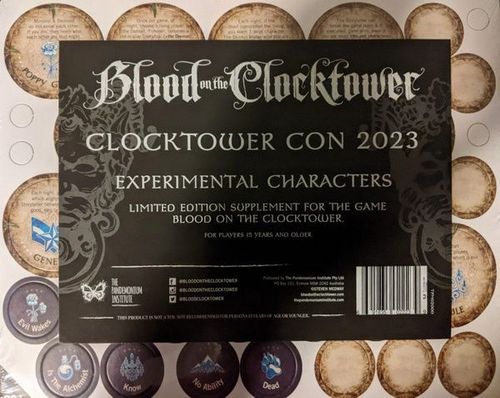
Blood on the Clocktower: Clocktower Con 2023 Experimental Characters
Blood on the Clocktower: Clocktower Con 2023 Experimental Characters Rulebook
Table of Contents
Townsfolk
The Acrobat dies when they find a drunk or poisoned player.
- Each night except the first, the Acrobat chooses a player. If the chosen player is sober and healthy, nothing happens. If the player is drunk or poisoned, the Acrobat dies.
- If the Acrobat is drunk or poisoned, they cannot die to their own ability.
- The Acrobat may choose any player, dead or alive, even themself.
- If the chosen player is sober and healthy at the time the Acrobat picks, but becomes drunk or poisoned later in the night, the Acrobat dies.
- The Acrobat does not learn if the player they selected was drunk, or poisoned, or both.
- The Drunk registers as drunk to the Acrobat.
Examples
The Sailor chooses the Assassin, and the Storyteller makes the Sailor drunk. The Acrobat chooses the Sailor, and dies because the Sailor is drunk.
The Acrobat chooses the Tinker, who is sober and healthy. Nothing happens.
The Acrobat chooses the Preacher. Later that night, the Pukka poisons the Preacher. The Acrobat dies, because the Preacher is no longer healthy.
How to run
Each night, wake the Acrobat. They point to a player. Put the Acrobat to sleep.
If the player the Acrobat pointed to is drunk or poisoned, or becomes drunk or poisoned at any time tonight, the Acrobat dies.
[Note: the BoardGameGeek listing for this supplement gives the Acrobat as an Outsider. The almanac prints the Acrobat under its Townsfolk heading, and it is transcribed here under Townsfolk as printed.]
The Alchemist has a Minion ability.
- The Alchemist's ability is usually that of a not-in-play Minion, but can duplicate an in-play Minion ability.
- The Alchemist learns which ability this is on the first night.
- They are still a good Townsfolk. They win when good wins, and lose when good loses. They register as good and as the Alchemist.
- The Alchemist does not wake to learn who the other Minions are or who the Demon is, like Minions do.
- If the Alchemist's Minion ability adds or removes characters during setup, this still occurs during setup.
- If the Alchemist has an ability where the player chooses something, like the Poisoner or the Vizier, the Storyteller may ask the Alchemist to choose differently. The Alchemist must do so.
Examples
The Alchemist has the Baron ability. There are 2 extra Outsiders in play.
The Alchemist has the Poisoner's ability. On the first night, they wake and poison the Wizard. On the second night, they wake and poison the Alsaahir. On the third night, they wake and try to poison the Lord of Typhon, but the Storyteller prompts them to choose differently. They poison the King instead. The Lord of Typhon is not poisoned.
How to run
During the first night, wake the Alchemist. Show the "You Are" info token then the character token of a Minion. Put the Alchemist to sleep. If the Alchemist has a not-in-play Minion ability, mark the Alchemist with the "Is The Alchemist" reminder and swap the Alchemist token with this Minion token and turn it upside down. (This shows they are still good.)
The Alchemist has this Minion ability. They use it as if they were a Minion, and wake at night when that Minion would normally wake to use their ability.
If the Alchemist makes a choice using their ability, you may ask them to choose differently. If this is during the day, ask verbally. If this is during the night, shake your head, point at the Alchemist ability text on the character sheet, and wait for the Alchemist to choose again.
The Amnesiac doesn't know what their ability is.
- The Storyteller decides what the Amnesiac's ability is. It may be the same ability as another character in Blood On The Clocktower, something similar, or something original.
- The Amnesiac may wake at any time during the night to learn information or to choose a player, or their ability may be passive—not requiring action from the Amnesiac player.
- Each day, the Amnesiac talks to the Storyteller in private, and makes a guess as to what their ability is. The Storyteller answers "cold" if the guess is very wrong, "warm" if the guess is on the right track, "hot" if the guess is very close, and "bingo" if the guess is spot on.
- Their guess may be specific, such as "Am I learning two players each night that are the same alignment?", or vague, such as "Is my ability something to do with dead players?"
Examples
Each night, the Amnesiac wakes and is prompted by the Storyteller to point to two players. On the first night, the Storyteller shakes their head. On the second night, the Storyteller nods. The Amnesiac guesses "Am I learning if both players are Minions?" The Storyteller says "Hot" because their ability is that they detect if either of two players are a Minion.
Each night, the Amnesiac learns a number. The Amnesiac is learning how many of their living neighbors are Townsfolk.
How to run
During setup, decide what ability the Amnesiac player has. During the game, treat that player as if they had that ability, waking them when needed, prompting them to choose players when needed, or whatever else is appropriate. Use the Amnesiac's "?" reminders if you need to.
Each day, the Amnesiac makes a guess about their ability in private. Answer "Cold", "Warm", "Hot", or "Bingo".
Make the Amnesiac's ability guessable, so that the Amnesiac can figure out what their ability is over time. Learning a piece of information each night, or a power that affects the game in a way that the Amnesiac notices, are both good ideas.
If the Amnesiac guesses their ability, but the wording is different, still tell them they guessed correctly.
You can make the Amnesiac's ability slightly better than a normal Townsfolk's ability. Not knowing what it is, the player will need to work harder to receive its full benefit.
The Atheist knows that all players are good and there is no such thing as Demons.
- With the Atheist in play, there are no evil players—no Minions and no Demons.
- Good wins if the Storyteller is executed. Any living player may nominate the Storyteller, and the Storyteller is executed if 50% or more of the living players vote.
- If the Atheist is not in play and the Storyteller is executed, evil wins.
- Good loses if just two players are alive.
- The Storyteller may break any of the game's rules. They may kill a player who nominated to simulate a Witch curse, kill players at night to simulate a Demon attacking, give players false information to simulate drunkenness, change characters at night to simulate a Pit-Hag, or even have the wrong number of Outsiders in play.
Examples
The Investigator learns that either the Grandmother or the Seamstress is the Boomdandy. The Investigator nominates, and dies, even though there is no Witch in play. The Slayer uses their ability on the Gossip, who dies.
There are three Outsiders in play, when there should be two. The players execute the Storyteller. Good wins.
How to run
During setup, before giving the bag to the players, remove all evil character tokens and add Townsfolk or Outsider character tokens to match the player count.
Break any game rules, as you see fit. Use evil reminder tokens if you need them.
The Atheist is a complex character, and is recommended for experienced Storytellers. In addition to rules knowledge, it requires you to have a good sense of fun and fairness. It is your job to create a fun game for all players, so only break the game rules to give false information (as much or as little as you want) or simulate the actions of evil characters that could be in play, but aren't. If you can convince the players that there is no Atheist in play, or at least get them discussing the possibility, you've done well.
Avoid creating arbitrary rules or changing the win conditions. In order to have a good time, the players need to know how they can win the game if an Atheist is in play.
The Balloonist learns players of different character types.
- Each time the Balloonist learns a player, the player must have a different character type to the previously shown player.
- The Balloonist does not learn the character type of the player they learn.
- The shown player can be alive or dead.
- The shown player can be good or evil.
- If the Balloonist is drunk or poisoned, they may learn a character of the same type as the previously shown player. When the Balloonist becomes sober and healthy, they must learn a player of a different character type to the previously shown player.
- During setup, the Storyteller may choose to add an Outsider due to the Balloonist's ability.
Examples
Abdallah is the Vizier, Lewis is the High Priestess, and Sarah is the Politician. On the first night, the Balloonist learns Abdallah. On the second night, the Balloonist learns Lewis. On the third night, the Balloonist learns Sarah.
Julian is the Nightwatchman, Alex is the Sailor, and Lachlan is the Puzzlemaster. On the first night, the Balloonist learns Julian. On the second night, the Poisoner chooses the Balloonist. Because the Balloonist is poisoned, the Storyteller chooses to show the Balloonist another Townsfolk, and the Balloonist learns Alex. On the third night, the Balloonist is sober and healthy, and learns Lachlan, who is a different character type to Alex.
How to run
During setup, you may add an Outsider.
When preparing the first night, mark any player with the "Know" reminder. When preparing each night afterwards, mark a character of a different type than the current with the "Know" reminder.
Each night, wake the Balloonist. Point to the player marked "Know". Put the Balloonist to sleep.
The Bounty Hunter tracks down evil players, one at a time.
- The Bounty Hunter starts knowing one evil player. When that player dies, they learn another evil player.
- The Bounty Hunter only learns the evil player, not their character.
- If the Bounty Hunter is drunk or poisoned when they should learn a new player, the Storyteller may show them a good player. When the recently shown player dies, the Bounty Hunter learns a new player that night.
- The Bounty Hunter cannot learn the same evil player twice.
- If the Bounty Hunter is in the game at setup, one Townsfolk is evil. The Bounty Hunter may learn the evil Townsfolk.
Examples
Alex is the Bounty Hunter, Ben is the Harpy, and Abdallah is the Tea Lady. During setup, the Storyteller decides that Abdallah will be the Evil Tea Lady. On the first night, Alex learns Ben. On day 3, Ben is executed. That night, Alex learns Abdallah.
On the first night, the Bounty Hunter learns Julian, who is the evil Baron. When Julian dies, the Poisoner targets the Bounty Hunter. That night, the Bounty Hunter learns Evin, who is the good Magician.
Lachlan is the Drunk who thinks he is the Bounty Hunter. No evil Townsfolk was added at setup, because the Bounty Hunter is not in play. On the first night, Lachlan learns Marianna, who is the good Empath. When Marianna dies, Lachlan learns Doug, who is the good Flowergirl.
How to run
During setup, turn one Townsfolk character token upside down, to represent that they are evil. Mark one evil player with the "Know" reminder.
During the first night, wake the Bounty Hunter. Point to the player marked "Know". Put the Bounty Hunter to sleep.
Each time the player marked "Know" dies, mark a new evil player with the "Know" reminder. That night, wake the Bounty Hunter, point to the player marked "Know", then put the Bounty Hunter to sleep.
The Cannibal eats executed characters, gaining their ability.
- If a good player dies by execution, the Cannibal gains that player's ability. If an evil player dies by execution, the Cannibal only thinks that they gain an ability, since the Cannibal is poisoned. The Storyteller may be lying to them.
- Each time a player dies by execution, the Cannibal loses the ability of the previous player.
- Executing a dead player won't grant the Cannibal an ability. Executing a living player who doesn't die won't grant the Cannibal an ability. A player must be executed and die for the Cannibal to gain their ability.
- The Cannibal is not told which ability they have gained. They must figure that out for themselves.
- If the Cannibal has an "even if dead" ability, such as the Recluse, or an ability that implies it works while dead, such as the Ravenkeeper or Sweetheart, the Cannibal keeps that ability when they die, but loses their Cannibal ability.
Examples
The Clockmaker is executed and dies. That night, the Cannibal learns a "2" because the Demon and Minion are two steps apart.
The Witch is executed. The Witch was bluffing as the Investigator. That night, the poisoned Cannibal learns that either the Mayor or the Juggler is the Witch.
The Soldier dies by execution. That night, the Imp attacks the Cannibal, but the Cannibal doesn't die. The Monk dies by execution. That night, the Cannibal chooses the Gossip, as does the Imp. The Gossip does not die. The next day, no one is executed. The Cannibal has the Monk's ability again tonight.
How to run
If a good player dies by execution, mark them with the "Lunch" reminder, and remove the Cannibal's "Poisoned" reminder if necessary. The Cannibal now has this good player's ability (do not say which), and will wake at night when this good character would normally wake.
If an evil player dies by execution, mark them with the "Lunch" reminder and mark the Cannibal with the "Poisoned" reminder. The Cannibal is poisoned. You may wake them when this evil character would normally wake, and pretend that they have a new ability.
Pay attention to which character each evil player is bluffing as. If they are executed, then their bluffed ability is the best one to pretend that the Cannibal has gained.
The Choirboy learns who the Demon is when the King is slain.
- The King can be in play without the Choirboy. During the setup phase, if the Choirboy is in play and the King isn't, the King is added. If a King is already in play, the Choirboy doesn't add a second King.
- If the Demon kills the King using their ability, the Choirboy learns which player is the Demon. The Demon nominating and executing the King doesn't count. Minions that kill the King, such as the Assassin, don't count either.
- If the Demon attacks the King but doesn't kill the King, the Choirboy doesn't learn who the Demon is.
- The Choirboy learns which player the Demon is, but does not learn which character.
Examples
The Imp attacks the Empath. The Empath dies. The next night, the Imp attacks the King, who is protected by the Monk. The King lives. The next night, the Imp attacks the King, who is not protected by the Monk. The King dies. The Choirboy learns which player is the Demon.
The Shabaloth kills the King. The drunk Choirboy wakes and learns that the Cannibal player is the Demon.
How to run
During setup, before putting character tokens in the bag, if the King is not already in play, remove a Townsfolk character token and add the King character token.
Each night except the first, if the Demon kills the King, put the Demon to sleep then wake the Choirboy. Point to the Demon player then put the Choirboy to sleep.
The Cult Leader wins if everyone joins their cult.
- At the end of each night, the Cult Leader becomes the alignment of a living neighbor.
- Once per day, the Cult Leader may publicly choose to form a cult. If all good players vote to join the cult, the game ends immediately and the Cult Leader's team wins.
- The Cult Leader may form a cult at any point in the day.
- Voting to join a cult does not require a vote token.
- Players may say whatever they want at any time, so a player bluffing as the Cult Leader may pretend to form a cult.
Examples
On day 3, the good Cult Leader's living neighbors are the good Town Crier and the evil Goblin. The Cult Leader requests to form a cult, and all good players vote to join the cult. The game ends and the good team wins!
The Cult Leader neighbors the No Dashii. On day 2, the Cult Leader attempts to form a cult. All players vote to join the cult, but a cult is not formed, because the Cult Leader is poisoned.
The Cult Leader's living neighbors are the evil Poisoner and the good Fortune Teller. The Poisoner chooses the Cult Leader, and the Kazali kills the Fortune Teller. The Cult Leader's living neighbors are now the evil Poisoner and the evil Wizard. While the Cult Leader's living neighbors are both evil, the Cult Leader doesn't turn evil, because they cannot change alignment while poisoned.
How to run
Each night, turn the Cult Leader character token right side up (if both alive neighbors are good) or upside down (if both alive neighbors are evil) or either (if one alive neighbor is good and the other alive neighbor is evil). If the Cult Leader's alignment changes, wake the Cult Leader and give a thumbs up or a thumbs down, then put the Cult Leader to sleep. If the Cult Leader's alignment doesn't change, do not wake them.
During the day, the Cult Leader may declare that they wish to use their ability. If so, enter the circle and run a vote in the same way that you would for an Exile. If all good players raise their hand, declare which team has won. If not all good players raise their hand, nothing happens.
If a player is bluffing as the Cult Leader and declares they wish to use their ability, act as if they were indeed the Cult Leader—allow time for discussion, run a vote, and declare that nothing happens after the vote.
The Engineer manufactures the threat that the town faces.
- The Engineer can choose which Minion characters are in play, or which Demon is in play, but not both.
- When the Engineer creates new in-play characters, the Demon player remains the Demon, and the Minion players remain Minions. The number of evil players stays the same.
- If the Engineer tries to create an in-play character, that character stays as the same player. The Engineer doesn't learn this, and may not use their ability again.
- If creating Minions, the Engineer chooses the same number of Minions that should be in play for the number of players (see the Traveller sheet or the setup sheet).
- If the Engineer accidentally chooses too many or too few characters, the Storyteller changes as many evil players' characters as is fair and feasible.
- Only characters from the current script may be chosen.
Examples
On the second night, the Engineer chooses that the Demon is a Lleech. Lewis, who was the Imp, is now the Lleech.
On the first night, the Engineer changes the Baron into the Boomdandy. There are still an extra two Outsiders in play.
The Fearmonger and the Psychopath are in play, and causing havoc. The Engineer chooses that the Mezepheles and the Spy are in play. The Storyteller chooses to change the Fearmonger into the Mezepheles and the Psychopath into the Spy.
The Spy, Assassin, and Witch are in play. The Engineer chooses that the Spy, Assassin and Mezepheles are in play. The Witch turns into the Mezepheles.
How to run
Each night, wake the Engineer. They either shake their head no or point at evil characters on the character sheet.
If they shake their head no, nothing happens. Put the Engineer to sleep.
If they point to a Demon or Minions on their character sheet, put them to sleep. Swap all appropriate character tokens with new character tokens. Wake each evil player that changed character, show the "You Are" info token, then their new character token, then put them to sleep. The Engineer loses their ability—mark them with the "No Ability" reminder and remove their night token from the night sheet.
The Farmer creates more Farmers.
- If a Farmer dies at night, another player becomes a Farmer too.
- Only players that are good can become Farmers this way.
- If this new Farmer also dies at night, another Farmer is created.
- Farmers that die during the day, such as by execution, do not create more Farmers.
- Farmers that have turned evil, such as from the Mezepheles' ability, can create more Farmers. But Townsfolk and Outsiders that have turned evil cannot become a Farmer.
- Farmers do not learn who each other are, but each player that becomes a Farmer learns that they are now a Farmer.
- When a player becomes a Farmer, they are no longer their old character, and do not have that ability. Any ongoing effects of their old ability immediately end.
Examples
Julian is the Farmer. The Demon kills him at night. Evin is the Fearmonger, and Sarah is the Alchemist. Sarah becomes the Farmer that night. Evin could not become the Farmer, because he is evil.
On the second night, the Farmer dies. The Pixie becomes the Farmer. On the third night, the new Farmer dies, and the good Heretic becomes a Farmer. There is now no Heretic and no Pixie in play, and there are three Farmers in play, two of which are dead.
The Farmer dies at night. The Spy registers as good and becomes a Farmer, but is still evil.
How to run
If the Farmer died tonight, wake an alive good player. Show them the "You Are" info token and a Farmer character token, then put them to sleep. Replace their previous character token with a Farmer character token.
The Fisherman knows something that nobody else can know: what should be done.
- The Fisherman player chooses when to use their ability.
- When they visit the Storyteller, the Storyteller chooses what piece of advice to give the Fisherman.
- The Storyteller's pieces of advice are not necessarily "facts". They are strategy tips that the Storyteller believes will help the Fisherman win, if they are followed.
- If the Fisherman is drunk or poisoned, the Storyteller may give the Fisherman bad advice.
Examples
The Fisherman visits the Storyteller and learns that "You shouldn't trust Ben". Ben is the poisoned Empath, and is unknowingly spreading false information.
The Fisherman learns "Keep the players claiming to be Outsiders alive". These players are secretly the Klutz and the Fearmonger. The Storyteller believes that keeping these players alive is more likely to end up with good executing the Demon.
On the final day, the Fisherman learns to "kill Lewis". The Fisherman is drunk, and Lewis is a Townsfolk. The Storyteller gave bad ("false") advice to the Fisherman.
How to run
Once per game, the Fisherman will ask to use their ability. In private, give them once piece of advice to help them win. Then, put the "No ability" reminder by the Fisherman token.
It is best to give the Fisherman advice on what to DO, not just information about what IS. This makes the Fisherman more fun and unique.
Eg. Saying "You should execute that player" or "Keep this player alive" or "find out who is drunk" or "change your thinking entirely" or "ignore the Minions" or "trust this player" are much more interesting than saying "this player is evil" or "the Demon is a No Dashii".
The General knows who is winning.
- If the good team is winning, the Storyteller gives a thumbs up. If the evil team is winning, the Storyteller gives a thumbs down. If neither team is winning, or the Storyteller isn't sure, the Storyteller gives a thumbs to the side.
- The Storyteller is the judge on which team is winning. Many factors may be included, such as how many players of each team are still alive, how much information the good team has, how successful the evil team's bluffs seem to be, which players the group wants to execute next, or how experienced the Demon player is. All of these, and more, will inform the Storyteller's judgment.
- The Storyteller decides who is winning at the point that the General wakes. Previous events in the night may affect their decision.
Examples
There are five good players alive and three Minions alive. Even though the Demon is very suspicious and will probably be executed next, there is a Scarlet Woman in play, who is trusted. The Storyteller gives a thumbs down.
The good team has a lot of information, and believes that their false information is indeed false. The only Minion is dead. The Storyteller gives a thumbs up.
The Po is a very experienced player and is coordinating well with the Minions. The Monk is successfully protecting the Savant each night and the good team have correctly identified several good players. However, the Po will probably kill three times tomorrow night, so it is very uncertain who will win. The Storyteller gives a thumbs to the side.
How to run
Each night, wake the General. If you believe that the good team is winning, give a thumbs up. If you believe that the evil team is winning, give a thumbs down. If you don't know which team is winning, give a thumbs to the side. Put the General to sleep.
The Huntsman saves the Damsel before the Minions find her… hopefully.
- The Damsel can be in play without the Huntsman. During the setup phase, if the Huntsman is in play and the Damsel isn't, the Damsel is added. If a Damsel is already in play, the Huntsman doesn't add a second Damsel.
- If the Huntsman correctly chooses the Damsel at night, the Damsel becomes a not-in-play Townsfolk immediately. The Storyteller chooses which Townsfolk character, and the Damsel learns which one.
- When the Damsel becomes a Townsfolk, they gain that Townsfolk ability and lose the Damsel ability.
- The Huntsman gets one guess, and makes it at night.
- The Minions get one guess in total, and make it publicly during the day. If a Minion guesses who the Damsel is, evil wins. If a Minion incorrectly guesses who the Damsel is, the guess is used, and other Minions cannot win by correctly guessing the Damsel.
- If the Damsel is drunk or poisoned but the Huntsman is sober and healthy, the Damsel can still become a Townsfolk.
Examples
The Huntsman is woken on the first night, but does not use their ability. On the second night, the Huntsman chooses the Damsel player. The Damsel becomes the Noble and learns three players (one of which is evil) that night.
The Huntsman chooses Lachlan. Lachlan is the Choirboy, so nothing happens. The Huntsman is no longer woken at night.
How to run
During setup, before putting character tokens in the bag, if the Damsel is not already in play, remove a Townsfolk character token and add the Damsel character token.
Each night, wake the Huntsman. If they shake their head no, put the Huntsman to sleep. If they point to a player, put the Huntsman to sleep. The Huntsman loses their ability—mark them with the "No Ability" reminder and remove their night token from the night sheet. If they chose the Damsel, wake the Damsel, show the "You Are" info token, then a not-in-play Townsfolk token, then put the Damsel to sleep. The Damsel now has this Townsfolk ability, so replace the Damsel character token with this Townsfolk character token.
The King learns which characters are still alive.
- The King gains this ability after a few nights have passed—once the dead players equal or outnumber the living.
- At the start of the game, the Demon learns who the King is. If a King is created mid-game, the Demon learns who the King is that night.
- The King may not survive long enough to use their ability. Once the number of dead players is equal to or greater than the number of alive players, the King learns one alive character each night.
- The King may learn good or evil characters, and may even learn the same character more than once.
- There may not be a Choirboy in play. But if there is, and they are still alive when the Demon kills the King, the Choirboy learns who the Demon is.
Examples
Amy is the King. There are twelve players alive, and one dead player. On the second night, she learns nothing. On the third night, she learns nothing. On the fourth day, there are seven dead players and six alive players. On the fourth night, Amy learns that the Snitch is alive. On the fifth night, she learns that the Witch is still alive.
The Demon knows that Abdallah is the King. Evin is claiming to be the Choirboy, but is the Butler. The Demon takes a risk and kills Abdallah. If Evin was actually the Choirboy, Evin would have learnt which player was the Demon.
How to run
During the first night, wake the Demon. Show them the "This Player Is" info token, then the King token, then point at the King player. Put the Demon to sleep.
When the number of dead players equals or exceeds the number of alive players, add a night token to the King on the night sheet.
Each night, if the King has a night token on the night sheet, wake the King. Show one alive character token. Put the King to sleep.
Think carefully about what character tokens to show the King. Don't be afraid to give great information. Most Kings will die before the final day. A King that lives to the final day will usually win, and that's ok.
The Knight knows players that are not the Demon.
- On the first night, the Knight learns two players who are not the Demon.
- On subsequent nights, they learn nothing more.
- The Knight can learn Townsfolk, Outsiders or even Minions, but does not learn which character type they are.
Examples
Lewis is the Undertaker, Doug is the Imp and Ben is the Fortune Teller. The Knight learns Lewis and Ben.
Marianna is the Vortox and Abdallah is the Alchemist. The Knight learns Marianna and Abdallah. The Knight must learn Marianna and Abdallah because the Knight's information must be false due to the Vortox ability and therefore include the Demon.
How to run
During setup, mark two non-Demon players with the Knight's "Know" reminders.
During the first night, wake the Knight. Point to the two players marked "Know". Put the Knight to sleep.
The Lycanthrope roams at night, killing the innocent, whilst the Demon cowers indoors.
- The Lycanthrope must choose an alive player each night. If the Lycanthrope chooses a dead player, the Storyteller shakes their head no and prompts the Lycanthrope to choose a different player.
- If the player that the Lycanthrope chooses is good, that player dies, and the Demon cannot kill tonight.
- If the player the Lycanthrope attacks is evil, that player does not die, and the Demon may still kill tonight.
- If the Lycanthrope attacks a good player but that good player doesn't die, the Demon may still kill tonight.
- While the Lycanthrope lives, one good player registers as evil. They cannot be killed by the Lycanthrope.
- This evil-registration does not affect win conditions. The good player that registers as evil still wins or loses with the good team.
Examples
The Lycanthrope attacks the General. The General dies. Later that night, the Imp attacks the Amnesiac. The Amnesiac does not die, because the Imp cannot kill tonight.
The Lycanthrope attacks the Farmer. The Farmer dies and another good player becomes a Farmer. The Magician was poisoned by the Pukka last night but does not die tonight, because the Pukka cannot kill tonight.
The Lycanthrope attacks the Godfather. The Godfather does not die, because the Godfather is evil. The Lycanthrope attacks the Zealot, who is registering as evil due to the Lycanthrope's ability. The Zealot does not die. The Demon attacks the Lycanthrope and the Lycanthrope dies.
How to run
During setup, mark one good player with the Lycanthrope's "Faux Paw" reminder.
Each night except the first, wake the Lycanthrope. They point at any player. Put the Lycanthrope to sleep. If the chosen player is good, that player dies—mark them with the Lycanthrope's "Dead" reminder. Later that night, wake the Demon, as normal, but the Demon cannot kill. If the chosen player is evil, nothing happens.
The Magician confuses the evil players about who is evil and who isn't.
- On the first night, instead of learning which player is the Demon, the Minions are told that both players—the Demon and the Magician—are the Demon.
- On the first night, the Demon learns that the Magician player is one of its Minions.
- The Magician does not wake to learn anything.
- The Storyteller can point to the Magician and the evil players in any order, so that the evil players won't know which player is the Magician.
- If the Poppy Grower dies and the Demon and Minions learn who each other are mid-game, the Magician ability has an effect that night, just as if it was the first night.
Examples
Julian is the Leviathan and Sarah is the Magician. The Minions wake to learn that either Julian or Sarah is the Demon. Julian learns that the Fearmonger player, the Assassin player, and the Magician player are all Minions.
How to run
During the first night, wake the Minions. Show them the "This Is The Demon" info token, then point to the Demon and the Magician. Put the Minions to sleep.
During the first night, wake the Demon. Show the "These Are Your Minions" info token, then point to all Minions and the Magician. Show the "These Characters Are Not In Play" info token and three character tokens. Put the Demon to sleep.
Do this instead of the normal Minion Info and Demon Info steps.
The Nightwatchman is known by one player.
- At night, the Nightwatchman chooses a player. This player wakes, and learns which player the Nightwatchman is.
- The Nightwatchman and their chosen player do not make eye contact. They wake separately.
- The Nightwatchman player chooses which night to act.
Examples
Lachlan is the Nightwatchman. He chooses Abdallah. Abdallah learns that Lachlan is the Nightwatchman.
Marianna is the drunk Nightwatchman. She chooses Amy. Amy does not wake, and does not learn that Marianna is the Nightwatchman, because the Nightwatchman has no ability.
Ben is the Nightwatchman and Vortox is in play. Ben chooses Sarah. Sarah learns that Lewis is the Nightwatchman. Even though the Nightwatchman has their ability, the information is false.
How to run
Each night, wake the Nightwatchman. The Nightwatchman either shakes their head or points at any player. Put the Nightwatchman to sleep.
If the Nightwatchman pointed at a player, wake them and show them the Nightwatchman token, then point to the Nightwatchman player. Put the chosen player to sleep. The Nightwatchman loses their ability – mark them with a "No ability" reminder and remove their night token from the night sheet.
The Noble learns that one of three players is evil.
- The Noble learns their information on the first night only.
- If a Noble is created mid-game, the Noble learns their information on their first night.
- The Noble learns two good players and one evil player. They may not learn one good player and two evil players. They may not learn three evil players.
Examples
The Noble is shown Marianna, Alex, and Abdallah. Marianna and Abdallah are good, and Alex is evil.
The Noble learns Doug, Lachlan and Ben. Doug is the Empath. Lachlan is the Saint. Ben is the Recluse, who has registered as evil to the Noble.
On the third night, the Pit-Hag turns Amy into the Noble. Amy learns that Evin, Sarah, or Julian is evil. However, Sarah is the evil Spy and has registered as good, and Julian is the Po, who is also evil.
How to run
While preparing the first night, mark two good players' character tokens with Noble "Know" reminders. Mark any evil player's character token with the third "Know" reminder.
During the first night, wake the Noble. Point to all three players marked "Know". Put the Noble to sleep.
The Pixie pretends to be the same character as someone else.
- On the first night, the Pixie learns an in-play Townsfolk. The Storyteller chooses which Townsfolk this is. The Pixie does not learn which player is this character.
- If the Pixie player pretends that they are this Townsfolk, they gain the ability of this Townsfolk when the Townsfolk dies. They could have spoken loudly about being the character for one day, or pretended to be the character each day this game, or accused the Townsfolk of being a liar—the Storyteller is the judge of whether or not the player was convincing, by "being mad that they are this character".
- When the Townsfolk player dies, the Pixie does not learn this, and is not told that they have gained a new ability. They may learn this has happened if they wake at night and start gaining information, or are prompted to choose players.
- If the player the Pixie learns about changes character then dies, the Pixie gains the Townsfolk ability the Pixie learnt about, not the new character.
Examples
Amy is the Pixie, and knows that the General is in play. For three days, Amy claims that the General player is lying, because she is the General. The General is executed. That night, Amy gains the General ability, and gains information each night from now on.
Doug is the drunk Pixie. He learns that the Lycanthrope is in play. There is no Lycanthrope in play, but the Fearmonger bluffs as the Lycanthrope. The Fearmonger dies. The Storyteller, pretending that Doug has the Lycanthrope ability, wakes Doug and Doug chooses a player to "attack" each night. They do not die because Doug does not have the Lycanthrope ability.
On the first day, the Pixie player claims to be the Soldier. The real Soldier also claims to be the Soldier. The Pixie player doesn't dispute this. When the Soldier dies, the Pixie player does not gain the Soldier ability, as the Storyteller feels that the Pixie did not convincingly pretend to be the Soldier.
How to run
During the first night, mark a Townsfolk character token with the Pixie's "Mad" reminder. Wake the Pixie. Show the Pixie this Townsfolk character token. Put the Pixie to sleep.
If the Townsfolk marked "Mad" dies, and you feel that the Pixie player has been sufficiently mad that they were this character, replace the "Mad" reminder with the "Has Ability" reminder. The Pixie now has this Townsfolk's ability, and will wake at night when this Townsfolk would normally wake.
The Poppy Grower prevents the evil players learning who each other are.
- The Demon still learns three not-in-play characters that are safe to bluff as.
- If the Poppy Grower dies, the Demon and Minions learn who each other are, as though it were the first night again.
- If the Poppy Grower becomes drunk or poisoned, Demons and Minions do not suddenly learn who each other are. If the Poppy Grower is drunk or poisoned when they die, Demons and Minions do not learn who each other are, since the Poppy Grower has no ability that night.
- An evil Traveller still learns which player is the Demon when that Traveller enters play.
Examples
The Imp, Poisoner and Witch are in play. On the first night, the Imp wakes to learn three not-in-play characters, but does not learn which players are Minions. The Poisoner and the Witch do not wake to learn who each other are, and do not learn who the Demon is.
The Poppy Grower is executed, and dies. That night, the Shabaloth learns which players are the Minions. The dead Godfather and the alive Baron wake, make eye contact, and learn which player is the Shabaloth.
The Poppy Grower is drunk. On the first night, the evil players learn who each other are, as normal. On the fourth night, the Demon kills the Poppy Grower. The Demons and Minions do not wake to learn who each other are again, because the Poppy Grower is drunk.
How to run
During the first night, wake the Demon. Show the "These Characters Are Not In Play" info token, then any three good character tokens that are not in play. Then, put the Demon to sleep. Do not do the Minion Info and Demon Info steps.
If the Poppy Grower dies, mark them with the "Evil Wakes" reminder. That night, wake the Minions and let them make eye contact. Show the "This Is The Demon" info token, then point to the Demon. Put the Minions to sleep. Wake the Demon. Show the "These Are Your Minions" info token, then point to the Minions. Put the Demon to sleep.
Optional rule: If the Poppy Grower becomes drunk, poisoned, or leaves play, Minions & Demons learn who each other are that night.
The Preacher removes Minion abilities.
- If the Preacher chooses a Minion, that Minion is woken to learn that they have been preached, and can no longer act while the Preacher is alive, sober, and healthy.
- If the Preacher chooses a player who is not a Minion, nothing happens.
- The Preacher may choose dead players.
- If the Preacher is drunk or poisoned at the time they choose a player, that player is not affected by the Preacher's ability.
- If the Preacher becomes drunk or poisoned, preached Minions regain their abilities until the Preacher is sober and healthy.
Examples
The Preacher points to Alex, who is the Engineer. Nothing happens.
The Preacher points to Lachlan, who is the Cerenovus. Lachlan wakes to learn that he has been preached, and is not woken to use his ability.
Doug is the Preacher. He points to Marianna, who is the Pit-Hag. Marianna wakes to learn that she has been preached, and is not woken to use her ability. The following night, the Poisoner points to Doug. Because Doug is now poisoned, Marianna wakes to use her ability.
How to run
Each night, wake the Preacher. They point to a player. Put the Preacher to sleep. If the Preacher chose a Minion, mark that Minion with a "No Ability" reminder, wake the Minion and show them the "This Character Selected You" info token then the Preacher token, then put them to sleep.
All Minions marked "No Ability" have no ability while the Preacher is alive.
Outsiders
The Damsel needs to avoid being found by the Minions.
- If a Minion guesses that you are the Damsel, and does so publicly (so that all players know that they are a Minion), evil wins.
- No matter how many Minions are in play, they only get one guess, total. If a Minion makes a guess and is wrong, future guesses by this Minion or by other Minions don't count.
- If the Demon pretends to be a Minion making a guess, that doesn't count as a guess. Minions may still make a guess and win.
- Minions may make a guess at any time.
- If the Damsel dies, they are no longer at risk of being guessed by a Minion, since the Damsel loses their ability when dead.
- There may not be a Huntsman in play. But if there is, and the Huntsman chooses the Damsel at night, the Damsel becomes a not-in-play Townsfolk, and is no longer the Damsel. The Damsel learns which Townsfolk and has that Townsfolk ability from then on.
Examples
Marianna is the Damsel. She is bluffing as the Lycanthrope. The Witch guesses that Marianna is the Damsel. Evil wins.
Doug is the Damsel. The Boomdandy guesses that Julian is the Damsel. Nothing happens, and the game continues. The Goblin guesses that Doug is the Damsel. Nothing happens, and the game continues.
How to run
During the first night, wake each Minion. Show the Damsel token. Put each Minion to sleep.
At any time during the game, if a Minion publicly guesses which player is the Damsel and is incorrect, mark the Damsel with the "Guess Used" reminder. Future guesses by Minion players have no effect.
At any time during the game, if a Minion publicly guesses which player is the Damsel and is correct, the game ends. Declare that the evil team wins.
The Golem kills the player they nominate.
- When the Golem nominates a player, that player immediately dies. The nomination process continues.
- If the Golem nominates the Demon, nothing happens. The Storyteller doesn't confirm or deny that the Golem nominated, and continues with the voting process as normal. The Storyteller may say "nothing happens" if clarity is asked for.
- After the Golem has nominated once, whether or not the nominee dies, the Golem may not nominate again this game. It is the player's responsibility to refrain from nominating, not the Storyteller's. Deliberately nominating when they shouldn't is considered cheating.
Examples
The Golem nominates the Poppy Grower. The Poppy Grower dies. The Golem may not nominate again this game.
The Golem nominates the Recluse. The Storyteller decides that the Recluse registers as the Demon. Nothing happens, and the Storyteller begins counting votes for the Recluse to be executed. The Golem may not nominate again this game.
How to run
If the Golem nominates a non-Demon, that player dies, then the vote continues as normal. Mark the Golem with the "May Not Nominate" reminder.
If the Golem nominates the Demon, the vote continues as normal. (Do not say why.) Mark the Golem with the "May Not Nominate" reminder.
If the Golem accidentally nominates when they shouldn't, you can either accept or not accept the nomination. It is best to not accept the nomination—as long as you think that this won't confirm that a Golem is in play. To keep things fair, also do this for players bluffing as the Golem, reminding them that the Golem cannot nominate more that once.
The Heretic turns a win into a loss, and a loss into a win.
- If the game ends due to the good team winning, then all good players lose, and all evil players win.
- If the game ends due to the evil team winning, then all evil players lose, and all good players win.
- This Heretic's ability applies to all victory conditions, including the game ending due to just two players being alive, the Demon dying, or an ability ending the game.
- The Heretic's ability functions even when the Heretic is dead, but not when the Heretic is drunk or poisoned.
Examples
On the first day, the Heretic publicly claims to be the Heretic. That night, the Demon kills themselves. Evil wins.
The Heretic does not reveal their character until the final day, when three players are alive. The Heretic convinces the good team to execute a good player, leaving two players alive, one of which is the Demon. Good wins.
The Heretic is dead. The Saint is executed. Good wins.
The Heretic is poisoned. The Assassin kills the Demon. Good wins.
A Heretic is in play. There are three players alive. The Demon is executed. Evil wins.
How to Run
If the game ends and the evil team would have won, declare that the good team wins and the evil team loses.
If the game ends and the good team would have won, declare that the evil team wins and the good team loses.
The Politician changes teams if they are losing.
- When the game ends, if the Politician was responsible for good losing, then the Politician turns evil and wins too.
- The player needs to be very influential when determining who wins. Simply spreading false information or voting for good players is usually not enough – they need to be the player that was more responsible for the good team losing than any other good player, and preferably more responsible than any one evil player too. The Storyteller is the judge of whether the Politician's actions qualify.
- The Politician may still win with the good team, as normal.
- A drunk or poisoned Politician cannot change teams.
Examples
The Politician has been trying to execute the Demon all game, without success. With just three players alive, the Politician convinces the group to not execute, since someone is claiming to be the Mayor. There is no execution, and evil wins because a Minion was bluffing as the Mayor. The Politician wins too.
On the final day, the Politician votes for the Empath, and tells the group that the Empath is evil. The Saint is executed instead. The Storyteller judges that the good team lost due to their own actions as a group, not just the bad advice of the Politician. Good loses, and the Politician loses.
The Politician, believing that evil is winning, bluffs as the Atheist. The Storyteller is executed. Evil wins, and the Politician wins too.
How to Run
When the game ends, if good lost and you feel that this was significantly due to the words and actions of the Politician player, declare that the Politician turns evil and wins too.
In the rare instance that the Politician is evil, and plays a big part in losing the game for evil, declare that the Politician turns good and wins with the good team.
The Puzzlemaster tries to figure out who is drunk.
- A player is drunk for the whole game. It will most often be a Townsfolk, but could be an Outsider. This player does not know that they are drunk.
- Once per game, the Puzzlemaster may guess which player it is. They may guess publicly, or privately. Whatever their guess, the Storyteller privately tells the Puzzlemaster the name of one player. If the Puzzlemaster guessed correctly, they learn which player the Demon is. If the Puzzlemaster guessed incorrectly, they learn a different player instead.
- The Puzzlemaster isn't told if they guessed correctly or not.
- Only the player made drunk by the Puzzlemaster counts as a successful guess. Players drunk by other means don't count.
- If the Puzzlemaster dies, the drunk player is still drunk. A dead Puzzlemaster may not make a guess, as they don't have that part of their ability.
Examples
Alex is the Demon. Sarah is the Empath who has been made drunk by the Puzzlemaster and is getting false information. The Puzzlemaster publicly guesses that Sarah is the drunk, and is told "Alex is the Demon" privately by the Storyteller.
Lewis is the Demon. Ben is dead and is drunk due to the Puzzlemaster. Marianna is alive and drunk due to the Sailor. The Puzzlemaster privately guesses Marianna, and is told "Abdallah is the Demon" privately by the Storyteller.
How to Run
While preparing the first night, mark any player with the Puzzlemaster's "Drunk" reminder. This player is drunk.
At any time during the game, the Puzzlemaster may guess a player, either publicly or by having a private discussion with you. If their guessed player is marked by the Puzzlemaster's "Drunk" reminder, privately tell the Puzzlemaster which player is the Demon. If their guessed player is not marked by the Puzzlemaster's "Drunk" reminder, privately tell the Puzzlemaster the name of a non-Demon player. (Do not say if they guessed correctly or not.) Either way, mark the Puzzlemaster with the "Guess Used" reminder.
While you can make a Minion or the Demon drunk with the Puzzlemaster ability, only do this if you have an excellent reason in mind. It is almost always best to select a Townsfolk player.
The Snitch gives information to the evil team.
- The Minions learn three not-in-play characters at the start of the game, just like the Demon does.
- These characters may be the same three that the Demon learns, or different characters.
- Each Minion may learn different characters to each other. Or they may all learn the same three characters.
Examples
On the first night, the Demon and their two Minions all learn that the Empath, Innkeeper, and Golem are not in play.
On the first night, the Demon learns that the Fool, Monk, and Saint are not in play. The Mastermind learns that the Fool, Monk, and Saint are not in play. The Witch learns that the Fool, Flowergirl, and Barber are not in play. The Fearmonger learns that the Noble, Insomniac, and Heretic are not in play.
On the fourth night, the Pit-Hag creates a Snitch. All Minions learn three not-in-play characters.
How to run
During the first night, wake a Minion. Show the "These Characters Are Not In Play" info token, then show three not-in-play character tokens. Put the Minion to sleep. Repeat this process until all Minions have learnt three not-in-play characters.
Minions
The Boomdandy explodes when executed, killing most other players.
- If the Boomdandy is executed, the Storyteller kills other players, one at a time, until only three are left alive.
- The Demon will be one of the remaining three players (otherwise, the game would be over).
- Afterward, there is no further nomination or execution today. Instead, the Storyteller counts down from ten and all players point at the player they want to die. When the countdown ends, the Storyteller counts the number of fingers pointed at each player. If it is a tie, the day ends (and evil probably wins due to the Demon killing that night).
- Even dead players who have no vote token may point.
- Players may change who they are pointing at up until the countdown ends, at which point their decision is final.
- The Boomdandy only explodes due to an execution. Deaths by other means, such as via a Golem or a Psychopath, don't count. If the Boomdandy is executed but doesn't die (due to a Devil's Advocate etc.), they still explode.
- If a character can't die, such as the Fool or the Sailor, the Storyteller may rule that four players remain alive after a Boomdandy explosion.
Examples
Amy is the Boomdandy. She is executed. She explodes, killing all players except for the Po, the Widow, and the Fortune Teller. Frantically, all players start pointing at each other, and talking about who should be pointed at. After counting down, the Storyteller calls "Freeze" and the Widow has the most number of fingers pointed at them, and dies. Evil wins.
How to run
If the Boomdandy is executed, declare that the Boomdandy has exploded. Enter the circle, put your hand out towards the Boomdandy, and rotate around the circle. (Similar to running a vote.) When your hand reaches a living player, say "You live" or say "You die" as that player dies. When you have completed the circle, three players will be alive, including the Demon. Then, count down from ten. After you say "one", ask all players to immediately freeze (to stay still) while you count the number of players who are pointing at each player. The player with the most fingers pointed at them, dies. This will end the game, since just two players are alive, so declare which team has won.
Your countdown should be longer than ten seconds, and as slow, dramatic, or erratic as you like!
The Fearmonger creates paranoia about who nominates whom.
- During the first night, when the Fearmonger selects a player, all players learn this.
- During other nights, each time the Fearmonger selects a new player, all players learn this. If the Fearmonger selects the same player as previously, the players learn nothing.
- The players only learn that the Fearmonger has acted, not which player was selected.
- If the Fearmonger nominates their chosen player, and that nomination results in their execution, the chosen player loses, their team loses, and the game ends.
- Only the currently chosen player is susceptible to the Fearmonger's ability. Previously chosen players don't count.
- If the chosen player is executed but does not die, the chosen player's team still loses.
Examples
On the first night, the Fearmonger chooses the Butler. All players learn the Fearmonger has chosen a new player. During the day, the Fearmonger nominates the Butler, and the Butler is executed. Evil wins.
At night, the Fearmonger chooses the Juggler. The Flowergirl nominates the Juggler, and the Juggler is executed. The game continues.
The Fearmonger chooses the Empath. The next night, the Fearmonger chooses the Soldier. The Fearmonger nominates and executes the Empath. The game continues because the Fearmonger has selected the Soldier, not the Empath.
The Fearmonger accidentally chooses the Baron, due to the Poppy Grower being in play. The Fearmonger nominates and executes the Baron. Good wins.
How to Run
Each night, wake the Fearmonger. They point at any player. Put the Fearmonger to sleep. Mark the chosen player with the "Fear" reminder. If the Fearmonger chose a player who wasn't already marked with the "Fear" reminder, declare that "The Fearmonger has chosen a player." (This informs the group that the Fearmonger is alive and has chosen a new player.)
If the Fearmonger nominates the player marked "Fear", and that nomination results in their execution, declare that the game is over and which team has won.
The Goblin takes revenge if the town knowingly executes them.
- If the Goblin is executed, evil wins.
- …but for this to happen, the Goblin needs to tell the group that they are the Goblin when they are nominated, but before votes happen, and to do so in a way that everybody hears. The good players need to know the risk.
- If the Goblin is executed without telling the group that they are the Goblin when nominated, the Goblin dies and the game continues as normal.
- The Goblin must have claimed to be the Goblin today for their ability to work. Telling the group yesterday, or even every previous day, doesn't count.
- Any player may claim to be the Goblin when nominated.
Examples
Abdallah is the Goblin. Alex nominates Abdallah, and Abdallah claims to be the Goblin. Votes are counted, and Abdallah is about to die. Other nominations occur later today, but Abdallah has the most votes and is executed. Evil wins.
Lewis is the Artist and claims to be the Goblin when nominated. He is executed, and the game continues.
Doug is the Goblin. He claimed to be the Goblin yesterday and the day before, but not today. He is executed. The game continues.
How to Run
If the Goblin claims to be the Goblin when nominated (and before voting begins), declare that this player has claimed to be the Goblin, so that all the group hears. Put the "Claimed" reminder by the Goblin token.
If the Goblin is executed, and they are marked "Claimed", then declare that evil wins.
If a non-Goblin player claims to be the Goblin when nominated, act as if they are the Goblin. Declare to the group that they have claimed to be the Goblin and pretend to move a reminder token in the Grimoire.
The Marionette doesn't know that they are a Minion.
- The Marionette draws either a Townsfolk or an Outsider token from the bag, but is secretly the Marionette.
- The Marionette neighbors the Demon. There are no players sitting in between the Marionette and the Demon.
- The Demon knows which player is the Marionette.
- On the first night, the Marionette does not wake to learn the evil players, and the Minions do not learn the Marionette.
- The good ability that the Marionette thinks they have doesn't work, but the Storyteller pretends it does.
- The Marionette registers as evil, and as a Minion.
- The Marionette is not woken due to character abilities that would confirm that they are a Minion eg. Snitch, Preacher, Lil' Monsta, Poppy Grower, Hatter, Damsel.
Examples
Marianna is the Marionette, but thinks she is the Undertaker. She wakes each night to learn who died that day, but her information is often wrong. Halfway through the game, the Demon tells her that she is the Marionette.
Lachlan tells Sarah that she is the Marionette. Lachlan is lying.
Abdallah is the Demon. Abdallah tells Ben that he is the Marionette. Ben thinks he is the Fortune Teller, but he isn't. Ben doesn't believe Abdallah, and executes him. Good wins.
How to run
During setup, before putting tokens in the bag, remove the Marionette token and add any Townsfolk token.
If there are three Minions in play, remove another Minion token and add another Townsfolk token. During the first night, swap a good player's character token with a not-in-play Minion character token. Wake this player, show them the "You Are" info token then their Minion character token, then the "You Are" info token then a thumbs down, then put them to sleep. This player is now an evil Minion. (This ensures that only one Minion token is in the bag, so at least one good player will neighbor the Demon.)
During the first night, mark a good player neighboring the Demon with the "Is The Marionette" reminder. Wake the Demon. Point to the player marked "Is The Marionette" and show the Marionette character token. Put the Demon to sleep.
Treat the Marionette as if they were drunk. They wake when their good character would wake, may get false information, do not wake during the Minion Info step etc.
The Mezepheles offers good players a choice: to turn evil or not.
- On the first night, the Mezepheles learns a secret word from the Storyteller.
- If a good player says this word, either publicly or privately, they turn evil that night. The Storyteller needs to hear this player actually say the word before turning them evil.
- The Mezepheles does not learn if a player turns evil. The good player learns if they turn evil, but not until that night.
- If the Mezepheles is sober and healthy at night, the good player turns evil even if the Mezepheles was drunk or poisoned when the good player spoke the secret word. If the Mezepheles is drunk or poisoned at night when a player would turn evil, the player stays good—the Mezepheles has "used their ability" and may not turn a player evil later on.
Examples
The Mezepheles tells the Barber that the secret word is "Rumpelstiltskin". The Barber publicly says, "This reminds me of the fairy tale where the Miller's daughter has to guess Rumpelstiltskin's name." The Barber turns evil that night.
The Mezepheles tells the Mayor the secret word. The Mayor, wanting to stay good, tells the group who the Mezepheles is. The Mezepheles privately tells the Snitch the secret word—"Constantinople". The Snitch visits the Storyteller and says "Constantinople" in private. That night, the Courtier makes the Mezepheles drunk. The Snitch stays good.
How to run
During setup, write a single word on a piece of paper or on a phone or other device. During the first night, wake the Mezepheles, show the written word, then put them to sleep.
The first time you hear a good player say the secret word, mark them with the "Turns Evil" reminder.
Each night, if a player is marked with the "Turns Evil" reminder, wake them. Show the "You Are" info token then give a thumbs down. Put them to sleep. Turn their character token upside down. (This shows they are now evil.) The Mezepheles loses their ability—mark them with the "No Ability" reminder and remove their night token from the night sheet.
Choose an unusual word that would never be spoken accidentally. You can even make one up. The fun lies in the Mezepheles taking a risk to secretly convince a good player to turn evil, not in a good player unexpectedly changing teams.
The Organ Grinder makes voting secret.
- When a player is nominated, players vote with eyes closed.
- The Storyteller does not count the votes out loud, and does not reveal how many players voted once voting is complete.
- The Storyteller doesn't reveal which player is "about to die".
- After nominations have closed, the Storyteller reveals which player is executed, as normal.
- Dead players may vote once if they have a vote token. Their vote token is removed at the end of the day instead of after the vote.
- If the Organ Grinder is drunk, the vote happens with eyes open, as normal. The Storyteller makes no comment as to whether the Organ Grinder is dead or alive. That night, the Organ Grinder chooses to become sober or drunk again.
Examples
There are 8 players alive. The Noble is nominated. All players close eyes to vote and the Noble gets 5 votes. The Imp is nominated. All players close eyes to vote and the Imp gets 7 votes. The Pixie is nominated. All players close eyes to vote and the Pixie gets 4 votes. After nominations close, the Storyteller declares that Doug (the Imp) is executed and dies, and that good has won.
How to run
Each night, wake the Organ Grinder. The Organ Grinder either nods or shakes their head. If they nod their head, mark them with the "Drunk" reminder. Put the Organ Grinder to sleep.
When a player has been nominated and a vote is just about to begin, and the Organ Grinder is sober, ask all players to close their eyes. If they ask why, tell them that an Organ Grinder is in play. When counting votes, do so silently. Afterwards, do not reveal how many players voted, nor if the nominee is "about to die". If there were enough votes to execute the nominee, mark them with the "About to die" reminder. Ask players to open their eyes, and if there are any more nominations.
When nominations are closed, declare that the player marked "About to die", is executed.
Each dusk, remove the "Drunk" reminder.
Players are not allowed to use other methods to determine who is voting, such as touch or sound. It is a secret.
The Psychopath kills in broad daylight.
- During the day, if the Psychopath declares that they are the Psychopath and publicly chooses a player, that player dies. This can only be done once per day, and only before the Storyteller has called for nominations.
- The Psychopath does not need to use this ability if they don't want to.
- The Psychopath can be nominated and voted for normally. If the Psychopath is executed, they might not die. They play Roshambo (Paper-Rock-Scissors) with the player that nominated them. The nominator needs to win for the Psychopath to die. Drawing or losing means the Psychopath lives.
- If the Psychopath is executed, this still counts as the one execution for the day. No more players may be nominated or executed today.
- If the Psychopath dies by other means, such as the Demon attacking them, they do not play Roshambo. They die.
Examples
On the first day, Amy declares that she is the Psychopath, and that she chooses Evin. Evin dies.
The Psychopath chooses to kill the Sailor. The Sailor is sober, so does not die. The Psychopath may not use their ability again today.
The Psychopath has been nominated by the Barber, and is executed. In Roshambo, the Barber has rock and the Psychopath has rock, so the Psychopath lives. The next day, the Saint nominates and executes the Psychopath. The Saint has paper and the Psychopath has scissors, so the Psychopath lives. The next day, the Barber nominates and executes the Psychopath again. The Barber has rock and the Psychopath has scissors, so the Psychopath dies.
How to Run
Once per day, before you have called for nominations, the Psychopath may publicly choose a player. That player dies.
If the Psychopath is executed, the Psychopath and the nominator play a game of Roshambo. If the Psychopath loses, they die. If the Psychopath draws or wins, they live. Either way, the day ends, since there is only one execution per day.
If the Psychopath is executed due to a self-nomination, then the Psychopath plays Roshambo with you instead.
The Vizier executes players without the town's consent.
- On the first day, all players learn that the Vizier is in play, and which player it is.
- During the day, the Vizier cannot die by any means.
- After a vote is tallied, if the Vizier chooses to execute the nominee (and at least one good player voted), they are executed immediately. This counts as the 1 execution allowed each day.
- After a vote is tallied, if the Vizier chooses to execute the nominee (and no good players voted), nothing happens.
- Even if the vote tally is less than 50% of the living players, the Vizier may still execute. Even if another player has more votes than the current player, the Vizier may still execute.
- The Vizier does not have to force an execution each day.
Examples
The King has been nominated. Five people vote, but the Vizier does not use their ability. The Boomdandy is nominated and eight people vote. The Vizier uses their ability and the Boomdandy is executed immediately.
The Demon has seven votes against them, and is "about to die". The Vizier nominates Bill, the Barber. Two evil players and one good player vote. The Vizier declares that Bill is executed. The Demon survives today.
The Town nominates and executes the Vizier. The Vizier does not die. That night, The Demon kills the Vizier.
How to Run
When the first night has ended, declare that the Vizier is in play, and which player it is.
If a vote has just been tallied, and one or more good players voted, and the Vizier declares that the nominee is executed, that player is executed and dies. No more nominations, votes, or executions occur today.
The Widow sees the Grimoire and poisons a character of their choice.
- The Widow acts on their first night only, poisoning one player.
- The player that the Widow poisons is poisoned until the Widow dies.
- On the same night that the Widow acts, one good player learns that the Widow is in play, but not which player is the Widow, and not which player is poisoned.
Examples
The Widow sees the Grimoire and points to the Sailor. The Sailor is poisoned this game. The Sailor is sober, but dies when executed.
On the third night, the Pit-Hag turns themselves into the Widow. That night, the good Scapegoat learns that a Widow is in play. The Empath is poisoned due to the Widow. The Widow becomes drunk due to the Innkeeper. The Empath is no longer poisoned. The Innkeeper dies. The Widow is now sober and the Empath is poisoned again.
How to run
While preparing the first night, mark a good player with the "Know" reminder.
On the first night, wake the Widow and show them the Grimoire for as long as they need. The Widow points to a character token in the Grimoire. Mark them with a "Poisoned" reminder. They are poisoned. Put the Widow to sleep.
Wake the player marked "Know". Show them the Widow character token. Put that good player to sleep.
Demons
The Al-Hadikhia puts three players in a dilemma—who will choose to die, so that others can live?
- The Al-Hadikhia may choose three players per night. Everyone learns which three were chosen. Each player makes their choice before the next player is revealed.
- All players must be silent when the Al-Hadikhia acts at night. This period lasts from when the Storyteller first declares that a player has been chosen, until the Storyteller says that it ends.
- If the Al-Hadikhia chooses no one, no announcement is made and nobody dies to the Al-Hadikhia tonight.
- At night, the Storyteller asks players out loud if they choose to live. If they nod their head, they live. If they shake their head, they die. Players may be brought back to life this way.
- If all players choose to live, then they all die instead. If a player chose to die but did not die, they count as alive for this calculation.
Examples
The Al-Hadikhia chooses Evin, Lachlan, and Sarah. Evin chooses to die. Lachlan chooses to die. Sarah chooses to live. In the morning, Evin and Lachlan are dead, and Sarah is alive.
The Al-Hadikhia chooses Alex, Lewis, and Doug, who is dead. Alex chooses life. Lewis chooses life. Doug chooses life, so is now alive. Since all players are now alive, all three players die.
How to Run
Each night except the first, wake the Al-Hadikhia. They may point at three players. If they do, mark these players with the "1", "2" and "3" reminders, in the order the Al-Hadikhia chose. Put the Al-Hadikhia to sleep. Wake the player marked "1" and say "The Al-Hadikhia has chosen" then the name of the player, then "Do you choose to live?" They either nod or shake their head. Put them to sleep. If they chose to live, remove their shroud (if any), and if they choose to die, add a shroud. Repeat for players marked "2" then "3". If all three players are alive (none of them have a shroud) then add a shroud to all three. They die. Declare that the time of silence has ended.
Each dawn, declare which players marked "1", "2" and "3" are alive and which are dead. Do this even if a player's alive or dead status did not change during the night.
You may need to remind all players to be silent as the Al-Hadikhia acts. This includes non-verbal noise. This prevents players signaling to others about whether they have chosen to live or die.
Legion is many Demons.
- The recommended number of good and evil players is the reverse of the normal. For example, for a 10-player game, there are roughly seven Legion and three good players.
- The players that are not Legion may be Townsfolk or Outsiders, in any combination.
- If at least one good player voted for the nomination, and that player is "about to die", then the execution happens as normal. If only evil players vote for a nomination, the vote tally for that nominee is zero.
- Each Legion registers as a Minion as well as a Demon.
- The Storyteller chooses which player dies at night.
- If only one good player remains alive, the Storyteller may declare that evil wins, since good cannot win.
- The Storyteller can decide not to give Legion players bluffs.
Examples
The only good players are the Fortune Teller and the Slayer. Six Legion and the Slayer vote to execute the Fortune Teller. The Fortune Teller is executed, and evil wins.
Four players are alive. Three Legion and no good players vote to execute Julian. Julian is not executed. Alex, who has two votes, one of which was from a good player, is executed instead.
How to run
During the first night, during the Demon Info step, let all Legion players make eye contact. (You may want to point to the non-Legion players so that Legion knows who they are.)
Each night except the first, you may decide that a player dies. When counting votes, count out loud, as normal. If the vote tally is enough to make a player "about to die" but only evil players voted, declare that the vote tally is zero.
Most nights, kill a Legion. Killing a good player is usually unfair. Your aim is to get to three players alive—two good players and one Legion player. On the final day, if the players don't execute, kill a good player that night so that evil wins.
If the players try to force others to vote to "test whether the vote tally is zero", you may instead declare that a zero-tally vote is successful but secretly keep a record of which player is really about to die by marking them with Legion's "About To Die" reminder, then execute them when nominations are over. This keeps Legion games mysterious and challenging.
The Leviathan doesn't kill.
- All players know the Leviathan is in play, even if the Leviathan is created mid-game.
- Any number of evil players may be executed, but if more than one good player is executed, evil wins. It doesn't matter which characters were executed, only the alignment of the player at the time they were executed.
- When the fifth day ends and night begins, if the Leviathan is still alive, evil wins.
- All types of execution count, even if the player doesn't die. A player executed due to the Virgin, or due to revealing that they are the Mutant, is still executed. An executed player who lives due to the Pacifist is still executed.
Examples
The Leviathan is in play. On the first day, the Monk nominates the Virgin, and is executed. On the second day, the Courtier is executed. Evil wins.
The Leviathan is in play. On the second day, the Scarlet Woman is executed. On the third day, the Poisoner is executed. On the fifth day, the Soldier is executed. Evil wins.
How to Run
Immediately after dawn on the first day, declare that the Leviathan is in play. Mark the Leviathan with the "Day 1" reminder. At the beginning of each following day, mark the Leviathan with "Day 2", then "Day 3", then "Day 4", then "Day 5" reminders. If a day ends and the Leviathan is marked with the "Day 5" reminder, declare that evil wins.
If a good player is executed, mark them with the "Good Player Executed" reminder.
If a good player is executed and a player is already marked with the "Good Player Executed" reminder, declare that evil wins.
For new players, it is helpful to declare that the Leviathan is in play each day, and to say what day it is. On the first day, say "The Leviathan is in play. It is day one." On the second day, say "The Leviathan is in play. It is day two." etc. This helps your players remember what Demon they are facing and avoid accidentally losing by forgetting to count the days.
Lil' Monsta isn't a player, and is instead babysat by a Minion.
- Each night, all Minions wake together and decide amongst themselves who babysits the Lil' Monsta. The Minions decide by pointing to a player, or otherwise make it obvious they have reached a decision. If they cannot reach a unanimous decision, the Storyteller decides.
- If the Storyteller thinks it is funny, they may give this player the Lil' Monsta token, which they will need to hide in a pocket, under their hat, or somewhere appropriate. Players may not request that others empty their pockets.
- The player with the Lil' Monsta token "is the Demon". Good wins if they die. They register as a Demon for characters like the Fortune Teller etc.
- If a good player babysits Lil' Monsta, they "are the Demon" but they remain good. A dead player babysitting Lil' Monsta ends the game because the Demon "is dead".
- Minions babysitting Lil' Monsta keep their Minion ability.
- Lil' Monsta isn't a player, so can't be drunk or poisoned.
Examples
The Poisoner and the Widow wake. They point at each other, then point at themselves, then eventually both point at the Widow, who receives Lil' Monsta's token. The next night, they both choose that the Poisoner babysits Lil' Monsta instead.
How to run
During setup, remove Lil' Monsta and add a Minion token. On the first night, skip the "Minion Info" and "Demon Info" steps.
Each night, wake all Minions. They will (eventually) point to one player. If they can't decide, choose a player. (Give this player the Lil' Monsta token and wait for them to hide it, if you want!) Mark them with the "Is the Demon" reminder token. Put all Minions to sleep. Then, if it is not the first night, a player might die – mark them with a "Dead" reminder and a shroud.
The player marked "Is the Demon" registers as the Demon. If they die, declare that the game is over and good has won.
You may need to kill a Minion or two at night using the Lil' Monsta's ability. On the final day, it would be unfair for the good team to have 2 or more Minions alive, since either Minion could have been chosen to babysit Lil' Monsta without any way for the good team to know which. Avoid this, and make the game fairer for the good team by killing Minions so that only 1 remains on the final day.
The Lleech lives if their host lives, and dies if their host dies.
- On the first night, the Lleech chooses a player, who is poisoned for the rest of the game.
- If this player is alive, the Lleech cannot die. If the Lleech is executed, the Storyteller tells the group that the player lives, but not why.
- If the player that the Lleech chose dies, the Lleech dies as well. If this means that only one or two players are left alive, good still wins, because the Demon is dead.
- From the second night onwards, players that the Lleech attacks die but are not poisoned.
- If a Lleech is created mid-game, they poison a player that night. They must choose an alive player.
Examples
The Lleech poisons the Noble. The Noble learns three good players instead of one evil and two good players. The Lleech is executed, but does not die. The next day, the Noble is executed. The Noble and the Lleech die. Good wins.
The Lleech poisons the Farmer. The Courtier poisons the Lleech. The Psychopath kills the Farmer, but the Lleech doesn't die because the Lleech has no ability. The Lleech is executed, and dies.
How to Run
During the first night, wake the Lleech. They point at any player. That player is poisoned—mark them with the "Poisoned" reminder. Put the Lleech to sleep.
Each night except the first, wake the Lleech. They point at any player. That player dies—mark them with the "Dead" reminder. Put the Lleech to sleep.
If the Lleech would die but the player marked with the Lleech's "Poisoned" reminder is alive, the Lleech does not die. If the player marked with the Lleech's "Poisoned" reminder dies, the Lleech dies and the good team wins.
When giving false information to a good player poisoned by the Lleech, make sure this information seems true. If the good player believes it to be false, they will quickly execute themselves and win the game.
Riot kills everybody in a panic.
- On the 3rd day, each player that is nominated dies immediately. Even though they are dead, they nominate again.
- The player that was nominated must nominate again immediately or lose their chance to do so. The Storyteller counts down "3… 2… 1…" to let the player know how long they have to nominate, should they wish to. If they don't, the Storyteller nominates instead.
- The good team wins if all Riot players are dead. If the last Riot dies and only two players are alive, they do not nominate, and the good team wins.
- If nobody nominates on the 3rd day, the Storyteller makes the 1st nomination instead.
- Minions may change into Riot as the nomination phase begins on the 3rd day.
Examples
Alex nominates Lewis. Lewis dies and nominates Ben. Ben dies and nominates Marianna. Marianna dies and nominates Lachlan. Lachlan dies. All Riot players are dead. Good wins.
How to run
On the 1st day, add the "Day 1" reminder to the Grimoire. On the 2nd day, add the "Day 2" reminder to the Grimoire. On the 3rd day, add the "Day 3" reminder to the Grimoire.
On the 3rd night, wake each Minion. Show the "You are" info token, then the Riot token, then put each Minion to sleep. Either now, or later during the 3rd day, replace all Minion tokens with Riot tokens.
During the 3rd day, each time a player is nominated, they die. Declare that they are dead, and add a shroud immediately. Tell them to nominate again and publicly count down "3… 2… 1…" After they nominate, repeat this process until all Riot are dead, or just 2 players are alive. Declare which team has won.
If the players do not nominate at all on the 3rd day, or if a nominated player does not nominate before their time runs out, nominate a player – they die and must then nominate again.
[Note: the publisher's wiki (wiki.bloodontheclocktower.com, Wayback Machine capture of 10 December 2023) prints a different version of Riot's third-day nomination rules and run steps. This entry follows the almanac, as printed.]
Travellers
The Gangster encourages their neighbors to kill each other.
- The Gangster may kill one of their two living neighbors. Their dead neighbors are skipped over, and do not count.
- To use their ability, the Gangster and one of their living neighbors must agree to kill the other living neighbor. The Storyteller must hear and confirm this agreement. The Gangster cannot kill without the Storyteller present.
- Each day, the Gangster may say whatever they want, and offer any encouraging words they want to either player. Once an agreement has been reached, then the Gangster may not use their ability again today, even if that player didn't die due to an ability protecting them.
- The Gangster's two living neighbors are always one clockwise, and one counter-clockwise.
- If both living neighbors want to kill the other, the Gangster decides who dies.
Examples
The Gangster neighbors the Saint and the Baron. The Gangster asks the Baron if they want to kill the Saint. The Baron agrees and the Saint dies.
The Gangster neighbors the Chambermaid and the Poppy Grower, but they are both dead. The Gangster's two living neighbors are the Amnesiac and the Po. The Gangster talks with the Po and offers to kill the Amnesiac. The Po declines. The Gangster talks with the Amnesiac and the Amnesiac asks the Gangster to kill the Po. The Gangster agrees, and the Po dies. Good wins.
The Gangster neighbors the Fool and the Sage. The Sage and the Gangster agree to kill the Fool, but the Fool doesn't die because of the Fool's ability. The Gangster may not use their ability again today.
How to Run
Once per day, the Gangster can declare that they wish to use their ability. If so, ask if an alive neighbor agrees. If an alive neighbor agrees, the other alive neighbor dies. If both alive neighbors agree, the Gangster chooses which alive neighbor dies. If neither alive neighbor agrees, the Gangster may not use their ability today.
Fabled
The Storm Catcher showcases a particular good character.
- If you want to construct a script based around the actions or information of one particular good character, or at least have an evil player bluffing as this character, use the Storm Catcher. Your chosen character will play a big part in the game, will be the focus of a lot of group discussion, and will probably live until the final day.
- The Storyteller declares that one character can't die, unless by execution. This character may be in play, or not in play. If it is in play, this good player lives as long as the good players want them to, since evil players cannot kill them. If it is not in play, all evil players learn this, so any evil player can easily bluff as this character if they wish.
Examples
The Storyteller has built a script based on the General, so declares that "the Storm Catcher favours the General". The General is in play. At night, the Imp and the Godfather both attack the General, who does not die. After five days of information and discussion, the town decides to execute the General, who dies.
The Storyteller wants a game based around the Empath's information, so declares that "The Storm Catcher favours the Empath". There is no Empath in play. Because the evil players learn this, the Poisoner chooses to bluff as the Empath.
How to Run
At the start of the game, declare that the Storm Catcher is in play. Add the Storm Catcher token to the Grimoire. Declare which good character is affected by the Storm Catcher. If this character is in play, mark them with the Storm Catcher's "Stormcaught" reminder.
During the first night, wake each evil player in turn. If a good character is marked "Stormcaught", show the evil player the "This Player Is" info token, the good character token, point to the good player, then put the evil player to sleep. If no one is marked "Stormcaught", show the evil player the "These Characters Are Not In Play" info token and the good character token, then put the evil player to sleep.
If the character marked "Stormcaught" is executed, they die. If they would die by other means, they remain alive.