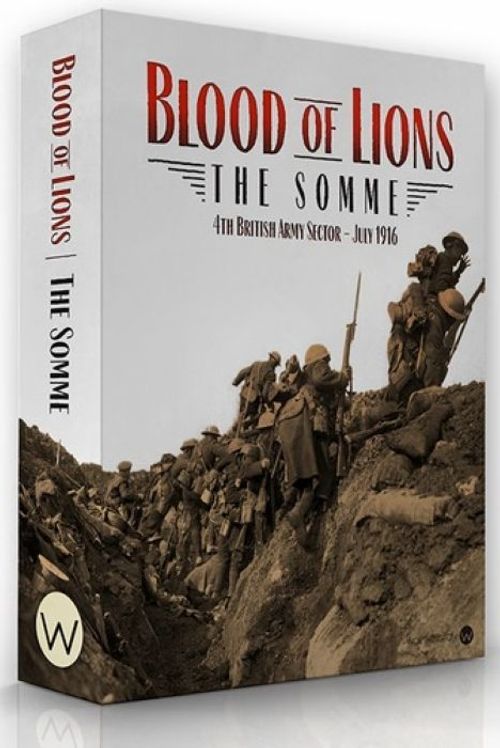
Blood of Lions: The Somme – 4th British Army Sector: July 1916
Blood of Lions: The Somme – 4th British Army Sector: July 1916 Rulebook
Table of Contents
Table of Contents
Introduction
Blood of Lions is a WWI solitaire wargame depicting the actions of the British 4th Army during July at the Battle of the Somme. The game's unit scale is Corps and Divisions, and uses a combination of dice, cards, generated Command and Leadership points as well as some push your luck mechanics in order to advance on objectives and obtain victory points. Players are allocated Command Points to undertake specific sets of actions each turn. The game's objective is to gain as many victory points as possible while reaching objectives defended by a German bot activated by player actions, event cards, and automatic defense values.
Components
- One Map
- 1 Rulebook
- 27 Event Cards
- 1 Sequence of Play Card
- 3 D12 Green Dice
- 1 D10 Orange Dice
- 4 D8 Blue Dice
- 4 D6 Yellow Dice
- 1 D6 Black Dice
- 13 Small Blue Cubes
- 4 Small Green Cubes
- 6 Small Orange Cubes
- 11 Small Yellow Cubes
- 1 Small Red Cube
- 5 Small Black Cubes
The Map
The map (as shown on the next page) contains all the areas to conduct the movement of Divisions (the colored playing pieces) within their assigned corps axis of advance, while also providing quick visual access to information related to gameplay.
- British Trenches/Assembly areas are where the player places each Corps Division during setup or when reinforcements are received.
- No Man's Land. The first area players must move to before any of the objective areas. There are no British attack attempts on this area. The player rolls one D6 for German machine gun fire. The die results in either casualties or retreats.
- Objective areas trigger event cards, provide victory points, and are occupied by enemy forces represented by German Defense Factors (GDF). Within each Corps' axis of advance objectives are the first, second, and third German trench lines.
Playing Pieces
Units are represented by cubes, which the player uses to conduct different actions during gameplay. Colored cubes correspond to the effectiveness of different units, and are color coded to match specific dice. Cards are used and drawn randomly during attacks on objectives to generate and influence gameplay.
Small color cubes represent British Army divisions and are used to move and gain ground on the map. The cubes are color coded to represent different levels of effectiveness, and attack strengths. Each cube uses a specific dice type/color which matches the cube's color.
| Symbol | Division | Die | Replacement |
|---|---|---|---|
| Green cube | 1st Line Division | Green D12 | – |
| Orange cube | 2nd Line Division | Orange D10 | Casualty Replacement for 1st Line |
| Blue cube | 3rd Line Division | Blue D8 | Casualty Replacement for 2nd Line |
| Yellow cube | 3rd Line Casualty | Yellow D6 | Casualty Replacement for 3rd Line |
In order of effectiveness, green cubes represent First Line Divisions, orange cubes represent Second Line Divisions, blue cubes represent Third Line Divisions, and yellow cubes represent a Third Line Division that has suffered casualties. Cube color and its level of effectiveness indicates the matching color die for use in combat – and reflects the decreasing effectiveness as Divisions take losses. These are referred to as such to facilitate casualty allocations and dice rolling since they are color coded to match specific dice types and color.
In order of effectiveness, green cubes represent 1st Line Regular British Army divisions, orange cubes represent 2nd Line Territorial British Divisions, blue cubes represent 3rd Line fresh newly formed British Army divisions, and yellow cubes represent Third Line Divisions that have suffered casualties.
Event Cards are used to generate random events and German actions before an attack on Objectives. The player draws one card before any attack action on an objective area. Cards are resolved and discarded at the end of an action or as otherwise stated on the card. One Attack-One card draw. Once all cards have been used, they are re-shuffled and placed face down to be used until the end of the game on turn twelve.
Dice are color coded and correspond to each British Army division type. Green D12s for First Line Divisions, Orange D10s for Second Line Divisions, Blue D8s for Third Line Divisions, and Yellow D6s for Third Line Divisions which sustains casualties.
- First Line Division – D12
- Second Line Division – D10
- Third Line Division – D8
- Casualty – D6
"Before the world grew mad, the Somme was a placid stream of Picardy, flowing gently through a broad and winding valley northward to the English Channel. It watered a country of simple beauty…Then came the pestilence." – A.D. Gristwood
Sequence of Play
- Check and Apply Casualties to Units in 'No Man's Zone.'
- Move Transfers.
- Roll (1D6 or 1D8) for Command Points.
- Conduct Action(s)
- A. Move any Unit(s)
- B. Conduct Attack(s) - Draw Event Card before Each Attack.
- C. Request Artillery
- D. Cancel a Retreat Result
- Use Leadership Action(s)
- End Turn
- Move Turn Marker one Space
Setup
The Player sets up the play area by placing the British Army's Divisions according to their respective Corps areas, which are color coded on the map. Player then places the red cube on the number "1" of the Turn Track and shuffle all the Event Cards placing them face down on the map area. The game begins by placing all the colored markers representing Divisions in their respective British Trench/Assembly areas of the map. The Player then rolls a D8 to obtain command points for the first turn and places a black cube on the Command Points Track on the map. Lastly place three black cubes on the three spaces of the Leadership Action track on the map.
Command Points
Command Points are used by the player to conduct actions. Command Points are generated at the beginning of each turn by rolling one D6 (D8 for the easy difficulty setting) and using the result as the number of available Command Points for one turn and placing the small black cube on the corresponding box on the Command Points track. Command Points are used to conduct one player action per point and may be used for; movement (no limit), attacks (no limit), artillery barrage (Once per turn), or to cancel a unit's retreat (Once per turn). First turn ONLY; re-roll a one (1) result.
Command Point Track (illustration on page 4 of the rulebook; its printed legend reads "Roll on D6 (D8 Easy) each turn" and lists): Move (1 Area with any/all units); Attack (1 Area with any/all units); Artillery (1 Attack per turn); Cancel Retreat (1 per turn).
Leadership Actions
The player can use up to four Leadership Actions during the game at any time without expending Command Points. Individual actions cannot be repeated. The actions are:
- Cancel Retreat and apply 1 casualty to retreating unit.
- Re-Roll any 1 die.
- Re-Roll 1 Artillery roll.
- Use one additional Command Point.
Each time a Leadership Action is used, remove the black cube over it to mark as exhausted.
Movement & Transfers
The Player moves his units by expending Command Points. One command point may be used to either move any or all divisions cubes in a Corps from one area to another which does not involve an attack. (An attack is a separate action.)
Movement is only allowed from area to area and only within its Corps Axis of Advance, denoted by thick black line connections. There's only one exception to this rule; if the player wants to re-assign one (and only one per game) division from one Corps to another, he may do so by expending one command point to remove the selected division and placing it in the Division Transfer Box. The division must remain there for three turns at the end of which the player must expend one command point to place it in any of the British Trench/Assembly areas.
British Trench/Assembly Area
The British Trench/Assembly Areas are the designated areas on the map where the player places their Corps' Divisions. These areas are considered safe and no hostile actions take place within them. They are also where the player places his units before the game begins and must correspond to each of the Corps Order of Battle.
No Man's Land
No man's land is the stretch of land between the British and German lines. Units first movement from the British Assembly areas is into No Man's Land where a D6 is rolled immediately for each Division determining casualties or retreats for divisions; a result of 1-3 results in a Casualty and a result of 4-6 results in the retreat of one Division, (player's choice). Units moving from No Man's Land into the British Trench/Assembly areas do not roll for casualties/retreats. Divisions that remain in No Man's Land at the end of any turn must roll for casualties before they can attack again. Division(s) that are located in the British Trench/Assembly areas which move into a No Man's Area already occupied by other British units do not roll for casualties/retreat.
Objective Areas
Objectives are areas designated as the target areas for a Corps. Each Corps has a track to which they may move towards the Objective areas – the Corps Axis of Advance. Corps may not move on any other objective track. Objective areas are divided into 1st 2nd, and 3rd Trench Lines, objectives within each Trench Line have a Victory Point Value of 5, 8, and 10 respectively. Objective areas have a specific German Defense Factor and require drawing one event card per attack. Vacated objective areas that do not have any British units on them but have been successfully attacked and occupied prior, remain in British control for the rest of the game provided that at least 1 division is active on the current Corps area track.
Attacks
Attacks are resolved by expending one Command Point allowing a Corps' Divisions to attempt to move into an objective area. Each objective area has a German Defense Factor (GDF) number corresponding to the cumulative number needed for an Attack roll to capture a particular objective area.
The player first draws and resolves an event card, the player then rolls the type and number of dice for the attacking divisions (Applying any card generated or other DRM). If the result is EQUAL or GREATER than the Objective's GDF number, the attack is considered successful and the British units move without expending a command point, to the attacked objective area at which point they effectively control it.
If the number rolled is LESS than the Objective's GDF the attack is considered a failure and the British units do not advance into the objective area, and remain on the last area occupied before the attack.
The player may attack Objective Areas as many times as they want as long as he has enough Command Points to do so per turn.
Support
During attacks, neighboring Corps/Divisions provide abstract support to units attempting to take objectives provided they:
- Control the neighboring Objective
- A white line is connecting the supporting unit's objective to the unit attacking/receiving the support.
Each supporting area provides a +1 DRM to each attacker. There are no support lines to/from No Man's Land.
Casualties
Casualties are sustained when the British player:
- Suffers hits from machine gun fire (D6 result 1-3) during movement into No Man's Land.
- If two ones (1) are rolled as a result of an attack action D6 dice roll against any objective.
Casualties are applied in the following order from the first casualty sustained, to the last and according to the color-coded divisions represented by cubes.
- Green First Line Division - Replace (Green) cube with Orange Second Line cube.
- Orange Second Line Division - Replace (Orange) cube with Blue Third Line cube.
- Blue Third Line Division - Replace (Blue) with Yellow cube.
- Yellow Cubes - Remove from play.
Retreats
Retreats are applied if the British player suffers hits from machine gun fire (D6 result of 4-6) during movement into a No Man's Land area.
Cancel Retreat
The British may expend one Command Point once per division, per turn to cancel the retreat of any one Division following a retreat result.
Artillery
The British may expend one Command Point to request an artillery barrage once per turn. The player rolls one D6 before drawing an Event Card, if the result is either 1-3 the player subtracts two GDF from the target objective area during one attack.
Reserves
On turns six and eight, the player rolls one D6 for Reserves. On a result of 1-3 the player receives one Third Line Division (blue cube) which may be placed on any of the British Trench Assembly areas.
Victory Points
The Player accumulates Victory Points by successfully attacking and defeating Germans at the Objective Areas. Each Objective area has a Victory Point number allocated; No Man's Land 0 points, 1st Trench Line Objectives 5 points each, 2nd Trench Line Objectives 8 points each, and 3rd Trench Line Objectives 10 points each. Additionally, if the player controls all the objectives in any one Trench Line, he receives a bonus of 5, 10 and 15 points respectively. [The printed rulebook reads "5, 1,0 and 15"; read here as 5, 10 and 15 to match the Trench Line values above.] Subtract two points for every British Loss.
At the end of turn 12, the player adds up the victory points of each objective and refers to the following table for the result:
| Victory Points | Result |
|---|---|
| 90 – 115 | Total Victory |
| 89 – 80 | Marginal Victory |
| 79 – 65 | Marginal Success |
| 41 – 64 | Failure |
| 20 or less | Abysmal Failure |
[The printed table is reproduced as printed. It lists "89 – 80" for Marginal Victory and has no entry for 21 – 40.]
"I have a rendezvous with Death / At some disputed barricade, / When Spring comes back with rustling shade / And apple-blossoms fill the air" – Alan Seeger
Designer's Notes
On July 1st, 1916, hundreds of thousands of young men went "Over the top" during the opening hours of the Battle of the Somme only to die a few meters from their trenches. The Somme is one of the bloodiest battles in the history of warfare. With over 1,200,000 casualties, the scope of the carnage was ghastly and difficult to imagine. Black and white photos, silent movies at speeds that make it look almost comical, fail to communicate the brutality that occurred on that small stretch of land. Attempting to recreate the Battle of the Somme on any game or media is a daunting task.
In "Blood of Lions" I wanted to give players a chance to experience, albeit in a simple manner, the frustrations, decisions and mistakes that were made during the initial month of the battle which lasted until November of 1916, and barely yielded 18 miles of ground to the Allies. I have tried to abstract almost every aspect of the battle without detracting from the central idea of the game, which is attempting to win, at all costs, and what 'cost' really means. The sheer number of casualties makes for a bleak outcome for the British, that said, the player can obtain a certain degree of operational success if the right decisions are made, and the right dice rolled. The genesis of the design came after reading accounts of the battle from both the British and German perspectives. I also wanted to create a simple WWI solitaire wargame system that could be setup, played and put away in less than 30 minutes.
I dedicate this humble endeavor to all men of honor who have fallen, far away from their homes.
"They shall grow not old, as we that are left grow old: / Age shall not weary them, nor the years condemn. / At the going down of the sun and in the morning / We will remember them." – Robert Lawrence Binyon