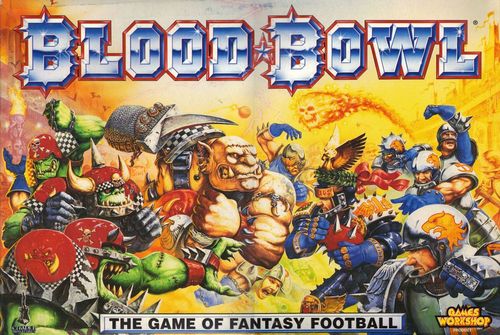
Blood Bowl (Third Edition)
Blood Bowl (Third Edition) Rulebook
Table of Contents
Table of Contents
- Components
- Setting Up the Game
- The Sequence of Play
- Movement
- Blocks
- Knock Downs & Injuries
- Throwing the Football
- Re-rolls
- Winning the Match
- Extra Rules
- Creating a Blood Bowl Team
- The Weather
- Handing-off the Ball
- Interceptions and Fumbles
- The Kick-Off Table
- Assisting a Block
- Throwing Team-Mates
- Going For It!
- Fouls, or Kicking Players That Are Down
- The Origins of Blood Bowl
- Recent Developments
- Star Player Profile: Morg'th N'hthrog "The Ballista" (Chaos All-Stars)
- The Collapse of the NAF
- Chaos and Confusion
- Star Player Profile: Griff Oberwald (Reikland Reavers)
- The Open Tournaments
- Major Tournament Schedule
- Star Player Profile: Mighty Zug (Reikland Reavers)
- Blood Bowl Today
- The Game Itself
- The Playing Field
- Blood Bowl Results, 2493
- The Game in Action
- Referees
- The Players
- Equipment
- Behind the Players
- The Blood Bowl Champions Hall of Fame
- Cheerleaders
- Chaos Cup Results, 2493
- The Old World
- The Teams
- Designer's Notes
- Team Rosters
Components
The Blood Bowl box contains the following components:
- 1 Handbook
- 1 Painting Guide
- 2 Reference sheets
- 1 Team roster pad
- 1 Blood Bowl field
- 2 Dugouts
- 4 Star Player cards
- 2 Team cards
- 1 plastic Range Ruler
- 1 plastic Throw-in template
- 1 plastic Scatter template
- 4 plastic footballs
- Dice: 2D6, 1D8, 3 Block dice
Counters:
- 16 Re-roll counters
- 2 Score counters
- 2 Turn counters
- 16 Randomiser counters
- 1 Kick-Off coin
Plastic Models
12 Human players: 6 Linemen, 2 Blitzers, 2 Throwers, 2 Catchers.
12 Orc players: 6 Linemen, 2 Black Orc Blockers, 2 Blitzers, 2 Throwers.
The Coaches
Don't look in the box for these, because there aren't any – you and your opponent are the coaches! To avoid confusion with the teams' players (the plastic playing pieces), we will refer to you and the other real-life players as the teams' coaches. All references to players are to the Blood Bowl pieces.
Playing Field
This is the field on which the game of Blood Bowl takes place. It's currently big and green (a bit like an Orc) but don't worry – it'll soon be flowing red! It is divided into squares to regulate movement and combat; each square can hold only one Blood Bowl player at a time.
The areas at either end of the field are called the End Zones. If a team gets the ball into their opponent's End Zone they score a touchdown. These are good things to score, as the team with the most touchdowns wins the match and can then dance around a lot!
In the centre of the field is the half-way line, and running along the sides of the field are the lines which show the boundaries of the wide zones. The rows of squares on either side of the half-way line and between the two wide zones (14 squares in all) are known as the line of scrimmage. The different areas of the field are shown on the diagram below.
Field diagram: an End Zone at each end of the field; a Wide Zone running down each long side; and, across the middle of the field either side of the half-way line, the Line of Scrimmage.
Kick-off Coin
You can use this 'coin' to determine which side kicks off first in the match. The coin has an Orc face on one side and an Imperial eagle on the other. The coach tosses the coin and while it is in the air the other coach calls 'Orcs' or 'Eagles'.
Throw-in Template
In Blood Bowl the ball is thrown back on to the field by the enthusiastic crowd if it ever goes out of bounds. The Throw-in template is used to determine where the ball ends up when it is thrown back in. To use the Throw-in template, position the square marked with the football over the last square the ball crossed before going off, with the centre arrow (the one marked 3-4) pointing towards the opposite sideline. Roll one six-sided dice. The result will show the direction the ball travels in. Then simply roll two dice to see how many squares the ball will travel in that direction, counting from the square marked with the ball.
Scatter Template
The scatter template is used when the ball is dropped or a pass misses the target square. To use the template (you'll be told when to do this by the rules), position the central square over the football. Roll the eight-sided dice, and move the ball to the square indicated by the score. (The eight-sided dice included with the game is only ever used with the Scatter template. Use it like a normal dice, reading the number on the upward facing side.)
Team Roster Sheets
The team rosters are only used if you use the optional rules for Creating Your Own Team (see the Extra Rules section). You won't need them for your first couple of games, so put them to one side for the time being.
Quick Reference Sheets
These handy pieces of card include all of the most regularly used charts and tables from the game, and will save you from flicking through the Handbook when you are playing a match.
Playing Pieces
The plastic playing pieces represent the 12 players from each team's squad, of whom eleven may be on the field at any one time. They should be carefully removed from the sprue, and then slotted into the plastic slotta-bases. There are four different types of player in Blood Bowl: Blitzers, Catchers, Throwers and Linemen. Different races' teams contain different combinations of players. An Orc team, for example, has no Catchers.
To get you started, the Blood Bowl box contains one Orc team and one Human team. The Orc team is made up of 2 Blitzers, 2 Black Orcs, 2 Throwers and 6 Linemen, while the Human team has 2 Blitzers, 2 Catchers, 2 Throwers and 6 Linemen.
Blitzers are just about the best all-round players on the field. They are quite fast and agile, but strong enough to smash their way through the opposing line when they have to. Ace Reavers player Griff Oberwald is a typical Blitzer: fast, strong and just a bit too flash!
Catchers are the opposite of Blockers. Lightly armoured and very agile, they can't afford to get into fights. In the open field, however, they are unmatched – and nobody is better at catching the football. Catchers specialise in waiting in the End Zone for that all important touchdown pass to come sailing in out of the blue. The only problem in being a Catcher is if someone should catch you!
Throwers are the most glamorous players on the field, able to throw an inch perfect Long Bomb to the waiting hands of a player far down the field. Or at least that's the theory; throwing the ball well takes real skill.
Linemen are the standard players of the team, not brilliant at any one thing, but capable enough to fill in for an injured player when necessary. Some teams seem to be made up of nothing but Linemen – which is why they are always at the bottom of the league!
Black Orc Blockers are very strong and wear extra armour to protect themselves in the powerful head-to-head blocks that are their speciality. However, they are not all that fast, and against an agile opponent with room to dodge they almost always come off second best. Black Orcs are a special sort of player unique to the Orc team.
The Orc Team models: Black Orc Blocker, Thrower, Blitzer, Lineman.
The Human Team models: Blitzer, Catcher, Thrower, Lineman.
Team Card
There are two team cards, one for the Orc team and one for the Human team. The team card lists the team's fan factor and team re-rolls, and shows the characteristics and skills of each of the different types of player in the team:
Movement Allowance (abbreviated to MA): This shows the number of squares the player may move in a turn.
Strength (ST): A player's Strength represents how physically powerful he is, and is used to block opponents.
Agility (AG): The higher a player's agility, the more likely they are to be able to avoid tackles attempted by other players, accurately throw the football, and catch a football that is thrown to them.
Armour Value (AV): This shows the amount of armour the player is wearing. The higher the number, the more armour the player has on. Catchers, for example, wear little or no armour.
Skills: In addition to their characteristics, a player may have one or more skills, which represent special talents or abilities. For example, all Throwers have the Pass skill to show their extraordinary ability at throwing the ball.
Rules Summary: On each team card there is also a short summary of the rules to save you from constantly flicking through the Handbook. The summary lists all of the vital information you need to know about the players, such as the number of squares they can move, the dice rolls they need to dodge out of a square or pass the ball, and so on.
Plastic Range Ruler
The ruler is used to measure the range when a player throws the ball. When you are instructed to measure the range, place the '0' at one end over the head of the player throwing the ball and the red line that runs up the middle of the ruler over the head of the player the ball is being thrown to. If the receiving player overlaps a boundary line between two different ranges on the ruler, you should take the longer of the two choices.
Star Player Cards
Like the pad of team rosters, the four Star Player cards are only used with the optional rules for Creating Your Own Team. You won't need them for your first couple of games, so put them to one side for the time being.
The Football
Possibly the most important component in the game! There are four plastic footballs included with the game, but only one is used at a time. The ball can be 'held' by a player by simply putting it on their base.
Block Dice & Six-sided Dice
As well as the eight-sided dice used with the Scatter template, Blood Bowl uses special Block dice and normal six-sided dice numbered 1 through to 6. The special Block dice are used when a player attempts to knock another player over (this is called 'blocking' another player). Exactly how the Block dice work is explained in the rules that follow. Extra sets of Block dice are available from Games Workshop stores or through Games Workshop mail order.
Dugouts
Each coach is given one Dugout at the start of the match. It is used to hold players that are in reserve or have been injured, and to keep track of how many turns have elapsed and the number of team re-rolls the team has left. Also included with the game are sets of counters which are used on the tracks on the Dugout. For example, the Turn counter goes on the Turn track (marked First Half and Second Half) on the Dugout.
Setting Up the Game
Before you start, it's a good idea to read through these rules at least once so you get some idea of what you are doing. Once you have done this, lay out the board and assemble the plastic players. One coach should take all of the Orc players, the other the Human ones. The owner of the game always gets the first choice as to which team he will play! Each coach will also need a Dugout, the appropriate team card and a set of counters. Each coach should place their Dugout behind one of the End Zones. This shows which half of the field belongs to each team. You score a touchdown by getting the ball into the opposing team's End Zone.
Each coach should place a Turn counter in the First Half square on the turn track, and a Score counter in the Score track on the board nearest their own End Zone. Finally, each coach should refer to their team card to see how many Re-roll counters their team is entitled to, and should place that many counters on the Re-roll track of the Dugout.
Flip a coin or roll a dice to see who will set up first. The team that sets up first is called the kicking team, because they will kick-off the ball. The other team is called the receiving team, because they will receive the kick-off. Each coach may set up 11 players between their End Zone and the half way line, and within the following restrictions:
- The kicking team always sets up first.
- No more than two players may be set up in each wide zone (ie a maximum of four players may be split wide, two on each flank).
- At least three players must be set up next to the half way line, on the line of scrimmage.
The Kick Off
After both teams have set up, the coach of the kicking team places the football in any square in the opponent's half of the field, including the opponent's End Zone if he likes. The ball will then scatter in a random direction. Using the Scatter template, roll the eight-sided dice once for the direction of scatter, then roll a six-sided dice to see how many squares the ball will go.
Important note: The kick-off is the only time that you roll a dice to see how many squares the ball moves when it scatters. This is because kicks are very inaccurate. When rolling scatter for a missed pass, or when the ball bounces, the ball only moves one square per scatter roll.
A kick-off must land in the opponents' half of the playing field. If the ball scatters off the field or into the kicking team's half, the receiving coach is awarded a 'touchback' and may give the ball to any player in his team. Assuming the ball lands in the receiving team's half of the field, then it will either land in an empty square or a square occupied by a player. If the ball lands in an empty square it will bounce one more square (see Bouncing Balls on page 13). If the ball lands on a square occupied by a player, the player may try to catch the ball (see Catching the Ball on page 13). Once the kick-off has been taken you are ready to proceed to the first turn of the game.
Slow Motion Replay
Jim: As any coach will tell you, Bob, a team's starting formation is vitally important. Here we can see an example of the Orcland Raiders' famous 5-4-2 or "Deep Defence" formation. This formation is normally used by the Orcs against fast moving or agile teams like Skaven or Elves.
Bob: You said it, Jim. Notice how the Raiders have made sure that there are no gaps in their line for opposing players to run through – every square is covered by an Orc player or his tackle zone.
Jim: That absolutely right, Bob. And as added insurance the Orcs have kept two players back deep, close to their own End Zone, so that they can catch any enemy players lucky enough to dodge their way through the Orc front line.
The Sequence of Play
Blood Bowl is split into two halves of sixteen turns each (ie, eight team turns per coach). At the end of the second half the team with the most touchdowns is the winner. The game is played using a simple but strict sequence of play, which runs as follows:
A. Receiving Team Turn
B. Kicking Team Turn
Repeat A and B, one after the other, until a touchdown is scored or the half ends.
During a team turn, the team in play may perform one action with each player in the team. A coach is only allowed four minutes to complete his team turn. The other team may do nothing until their own team turn comes round.
Moving the Turn Marker
Each coach is responsible for keeping track of how many turns his team has used, and must move the Turn counter one space along the track provided on his Dugout at the start of each and every one of his team turns. If he forgets to move the counter before taking an action with one or more of his players, then the opposing coach is allowed to call for an 'illegal procedure' penalty as soon as he spots the mistake. An action is considered to be moving one or more squares, or rolling the dice to throw a block, pass the ball or dodge.
A coach who is called for illegal procedure must either use up a re-roll or suffer a turnover. Turnovers are explained in more detail below, but basically a coach that suffers a turnover must end his turn immediately – even if part way through a player's action. If the coach uses up a re-roll, he is not allowed to use another re-roll counter in the same turn. What's more, if he has already used a re-roll when the penalty is called, or he doesn't have any re-rolls left, then his team turn automatically ends! If a coach forgets to move the turn marker, but can rectify his mistake before the opposing coach spots the error, then he cannot be called for illegal procedure.
Player Actions
In a team turn a coach may perform one of the following actions with each of the players in his team. When all of the players in a team have performed an action then the team turn ends and the opposing coach is allowed to take a turn.
Move: The player may move a number of squares equal to their MA. Players that have been knocked over may stand up at a cost of 3 squares from their movement.
Block: The player may make a single block against a player in an adjacent square. Players that have been knocked over may not perform this action.
Blitz: The player may move a number of squares equal to their Movement Allowance. Players that have been knocked over may stand up at a cost of 3 squares from their movement. He may make one block during the move. The block may be made at any point during the move, and 'costs' one square of movement.
IMPORTANT: This action may not be performed by more than one player per team turn. However, any player may perform a Blitz – the player doesn't have to be a Blitzer (Blitzers are just better at it than other players).
Pass: The player may move a number of squares equal to his MA. Players that have been knocked over may stand up at a cost of 3 squares from their movement. At the end of the move the player must pass the ball.
IMPORTANT: This action may not be performed by more than one player per team turn.
Players perform actions one at a time. In other words, the coach may perform an action with one player, then perform an action with another player and so on. This carries on until all of the players have performed an action, or the coach does not want to perform an action with any more players. Note that a player must finish his action before another player can take one. Each player may only perform one action per team turn. Only one player may take a Blitz or Pass action per team turn.
Turnovers
Normally a team turn only ends when all of the players in the team have performed an action. However, certain events cause the team turn to end before all of the players have taken an action. These events are called turnovers. The following events cause a turnover:
- A team is called for illegal procedure and doesn't have a re-roll counter or
- A player on the moving team is knocked down or falls over or
- The ball is passed and not caught by a player from the moving team or
- A player from the moving team attempts to pick up the ball and fails or
- A touchdown is scored or
- The four minute time limit for the turn runs out.
A coach that suffers a turnover must end his turn immediately – even if part way through a player's action. The only exception to this is that armour rolls and injury must still be made for players that have been knocked over.
Movement
A player may move a number of squares equal to his Movement Allowance. Players may move in any direction or combination of directions, including diagonally, as long as they do not enter a square that holds another player (from either team). Players do not have to use up all of their Movement Allowance in their turn; they don't need to move at all if their coach does not want them to.
Tackle Zones
All players exert a tackle zone on the eight adjacent squares, as shown in the diagram below.
Diagram: the player's tackle zone is shown by the shaded squares – the eight squares surrounding the player.
In order to leave a square that is in one or more opposing tackle zones, a player must dodge out of the square. The player only has to dodge once in order to leave the square, no matter how many opposing tackles zones are on it. Note that you must always make a Dodge roll when you leave a tackle zone, even if there aren't any tackle zones on the square you are moving to (see the slow motion replay).
Look up the player's Agility on the Agility Table below to find the score required to successfully dodge out of the square. For example, if the player had an Agility of 3 he would need to roll a 4 or more to dodge out of the square. Roll a dice, and add or subtract any of the modifiers that apply to the dice roll. A roll of 1 before modification always fails and a roll of 6 before modification always succeeds.
If the final modified score equals or beats the required roll, the player may carry on moving (and dodging if required) until he has used up his full movement allowance. If the dice roll is less than the required total, then the player is knocked down in the square he was dodging to and a roll must be made to see if he was injured (See Knock Downs & Injuries, below). If the player is knocked over then his team suffers a turnover and their team turn ends immediately.
AGILITY TABLE
| Player's AG | 1 | 2 | 3 | 4 | 5 | 6+ |
|---|---|---|---|---|---|---|
| D6 Roll Required | 6+ | 5+ | 4+ | 3+ | 2+ | 1+ |
Dodging Modifiers
| Modifier | |
|---|---|
| Making a Dodge roll | +1 |
| Per opposing tackle zone on the square that the player is dodging to | -1 |
Picking Up the Ball
If a player moves into a square in which the football is lying, they may attempt to pick it up, and – if they wish and are able – carry on moving.
Look up the player's Agility on the Agility Table to find the score required to successfully pick up the ball. Roll a D6, and add or subtract any of the modifiers that apply to the dice roll. A roll of 1 before modification always fails and a roll of 6 before modification always succeeds.
If the final modified score equals or beats the required roll, then the player succeeds in picking up the ball. Place the ball on the player's base to show that he has picked it up and carry on with the player's turn. If the dice roll is less than the required total, then the player drops the ball which will scatter one square. If the player drops the ball then his team suffers a turnover and their team turn ends immediately.
AGILITY TABLE
| Player's AG | 1 | 2 | 3 | 4 | 5 | 6+ |
|---|---|---|---|---|---|---|
| D6 Roll Required | 6+ | 5+ | 4+ | 3+ | 2+ | 1+ |
Pick-up Modifiers
| Modifier | |
|---|---|
| Picking up the ball | +1 |
| Per opposing tackle zone on the player | -1 |
IMPORTANT: The Agility Table is used to work out the success or failure of a number of different actions in Blood Bowl including dodging, picking up the ball, and throwing or catching the ball to name but a few. Each action has its own set of modifiers, and it is only these modifiers which apply to the dice roll (ie, do not use any of the Dodging modifiers when attempting to pick up the ball).
Slow Motion Replay
Jim: There goes Dieter Blunt, of the Reikland Reavers and it looks to me, Jim, like he's going to try to move through the tackle zones of two Orcland Raiders players! First he tries to move to square 1. Dieter has an Agility of 3, which means that he needs to roll a basic 4 or more to dodge successfully out of the square. He gets a +1 to the roll for making a dodge, but has to subtract -2 because there are two Orc tackle zones on the square he is moving to, for a final modifier of -1. Dieter makes the move – the crowd holds its breath – and the dice roll is a 5, which means that Dieter successfully dodges into the square!
Bob: Too right! Dieter moves to square 1 and decides to keep on going to square 2. Dieter must still make a Dodge roll, though there aren't any tackle zones on square 2, because he is leaving the tackle zones on square 1. There are no tackle zones on square 2, which means that Dieter gets a +1 modifier to his dice roll. OH NO! Dieter rolls a 1 and comes crashing down. Now he's lying prone in square 2, and what's more that counts as a Reavers turnover, so it's the Orcland Raiders to move next!!
Blocks
Instead of moving, a player may throw a block at an opposing player who is in an adjacent square. You may only make a block against a standing player – you may not block a player who has already been knocked over. A block is a very rough tackle, designed to really stop an opponent in his tracks! To see if a block works you will need to use the special Block dice included with the game.
Blitz Moves
Once per team turn a player on the moving team is allowed to make a special Blitz move. A blitz allows the player to move and make a block. The block may be made at any point during the move, but costs one square of movement for the player to make. The player may carry on moving after the effects of the block have been worked out if he has any squares of movement left.
Strength
The number of dice that is rolled depends on the strengths of the two players involved. Obviously, if one player is stronger than the other they are more likely to knock down their opponent when they make a block. To represent this the number of Block dice that is rolled varies depending on the relative strengths of the players. However, no matter how many dice are rolled, only one of them is ever used to decide the result of the block. The stronger player is allowed to choose which of the dice is used.
If the players' strengths are EQUAL, one dice is rolled.
If the one player is STRONGER, two dice are rolled and the stronger player may choose which one is used.
If one player is MORE THAN TWICE AS STRONG, three dice are rolled and the stronger player may choose which is used.
Note that the coach of the player making the block always rolls the dice, but that the coach of the stronger player may choose which is used.
| Players' Strengths | Roll |
|---|---|
| Both players equal strength | One block dice |
| One player stronger | Two block dice* |
| One player more than twice as strong | Three block dice* |
*The coach of the stronger player picks which block dice is used.
The Result
Roll the appropriate number of dice and look up the result on the table below. On the table, the player making the block is referred to as the attacker, while his target is the defender.
Skull (Attacker Down): The attacking player is knocked down.
Skull/Burst (Both Down): Both players are knocked down, unless one or both of the players involved has the Block skill. If one player that has the Block skill then he is not knocked over by this result, though his opponent will still go down. If both the players have the Block skill then neither player is knocked over.
Arrow (Pushed): The defending player is pushed back one square by the blocking player. The attacking player may follow up the defender.
Burst with exclamation mark (Defender Stumbles): Unless the defender has the Dodge skill he is pushed back and knocked over. If he does have the Dodge skill then he is only pushed back. The attacking player may follow up the defender.
Burst (Defender Down): The defending player is pushed back and is knocked down in the square they are moved to. The attacking player may follow up the defender.
Slow Motion Replay
Jim: And there goes Skurf Limbrender, the Orcland Raiders star Black Orc Blocker. He's just blitzed down the field and now he's going to throw a block at Jacob von Altdorf, the Reavers Thrower. Skurf's got a Strength of 4, compared to Jacob's 3, which means that Skurf can roll two Block dice and choose which one he will use. He rolls a skull (Attacker Down) and a burst (Defender Down), and uses the 'Defender Down' result to smash Jacob back a square and knock him flat on his back in the mud – KERRUNCH!
Knock Downs
A player that is knocked down should be placed on their side in the square, face up. The player may be injured (see Injuries, below). If the player who is knocked down comes from the moving team, then a turnover takes place and the moving team's turn ends immediately!
Push Backs
A player that is pushed back as a result of a block must be moved one square away from the player making the block, as shown in the diagrams. The coach of the player who made the block may decide which square the player is moved to. The player must be pushed back into an empty square if possible. If all such squares are occupied by other players, then the player is pushed into an occupied square, and the player that originally occupied the square is pushed back in turn.
Players may only be pushed off the field if there are no eligible empty squares on the field. A player pushed off the field is beaten up by the crowd and must roll on the Injury Table (see Injuries, below).
Note that no Armour roll is made for a player that is pushed off the pitch, they are automatically injured. If a 'Stunned' result is rolled on the Injury Table the player should be placed in the Reserves box of the Dugout, and must remain there until a touchdown is scored or the half ends.
Push back examples: the shaded squares in the diagrams show the squares a player can be pushed back into.
Follow Up Moves
A player who has made a block is allowed to make a special follow up move and occupy a square vacated by a player that they have pushed back. This move is free, and the player can ignore enemy tackle zones when he makes the move (ie, he does not have to dodge to enter the square). Players that are blitzing are allowed to make follow up moves, and the move does not cost them any of their movement (as they paid a square in order to make the block, they have effectively already paid for the move).
Knock Downs & Injuries
Players that are knocked down or fall over for any reason should be placed face up on the field in the square they were in when they fell over. While prone the player may do nothing except stand up at a cost of 3 squares of their movement when they next take an action. Players may stand up in an opposing player's tackle zone without having to make a dodge roll (they will have to dodge if they subsequently leave). Note that a player that stands up may not take a Block action, because you may not move when you take a Block action. The player may take a Blitz or a Pass action.
A player who falls over will drop the ball if he was carrying it, and it will bounce one square in a random direction (see Bouncing Balls, page 13).
Injuries
Any player that is knocked over may be injured; the opposing coach is allowed to roll two dice and add their scores together in an attempt to try to beat the knocked over player's Armour Value. If the roll succeeds, then the opposing coach is allowed to roll on the Injury Table below to see what injury the player has suffered.
Substitutes
You may not substitute fit players for injured players or players that have been sent off while the match is in progress. The only time that you may add reserves to the team is when you are setting up after a touchdown has been scored, or when setting up after half time.
The Injury Table
| 2D6 | Result |
|---|---|
| 2-7 | Stunned – Leave the player on the field, but turn them face down. All they may do for their next action is turn face up. Once face up, they may stand up on any subsequent turn using the normal rules. |
| 8-9 | KO'D – Take the player off the field and place them in the Dugout in the KO'd Players box. At the next kick-off, before you set up any players, roll for each of your players that have been KO'd. On a roll of 1-3 they must remain in the KO'd box and may not be used. On a roll of 4-6 you may return the player to the Reserves box and can use them as normal from now on. |
| 10 | Badly Hurt – Take the player off the field and place them in the Dugout in the Dead & Injured Players box. The player must miss the rest of the game. |
| 11 | Serious Injury – Take the player off the field and place them in the Dugout in the Dead & Injured Players box. The player must miss the rest of the game. (If you are playing a League match, then the player must miss all of the next game as well). |
| 12 | Dead! – Take the player off the field and place them in the Dugout in the Dead & Injured Players box. The player won't be playing Blood Bowl any more unless he joins an Undead team... |
Throwing the Football
Once per team turn a player on the moving team is allowed to make a Pass action. The player is allowed to make a normal move, and after he has completed the move he may throw the football. Note that the player does not have to be holding the football at the start of the action; he could use his move to run over and pick up a dropped ball and then throw it, for example.
Throwing
First of all, the coach must declare where the player is trying to throw the ball to. The player can throw the football to another player in his own team (or another player in the opposing team if he really wants to), or simply to an empty square, though obviously the first of these options will be the most useful – and may keep him from being attacked by his own team members! The ball may only be passed once per turn.
Next the coach must measure the range using the range ruler. It is perfectly acceptable to pre-measure the range to several players before you declare who you will throw the ball to.
Look up the player's Agility on the Agility Table to find the score required to successfully pass the ball. Roll a D6, and add or subtract any of the modifiers that apply to the dice roll. A roll of 1 before modification always fails and a roll of 6 before modification always succeeds.
If the final modified score equals or beats the required roll, the pass is accurate and lands in the target square. If the dice roll is less than the required total, then the pass is not accurate and will scatter. Roll for scatter three times, one after the other, to see where the ball ends up. Note that each of the scatter rolls is made separately, so it is possible for the ball to end up back in the target square (though it will be harder to catch). The ball can only be caught in the final square where it ends up – if it scatters through a player's square, then the player is not allowed to try and catch the ball.
AGILITY TABLE
| Player's AG | 1 | 2 | 3 | 4 | 5 | 6+ |
|---|---|---|---|---|---|---|
| D6 Roll Required | 6+ | 5+ | 4+ | 3+ | 2+ | 1+ |
Passing Modifiers
| Modifier | |
|---|---|
| Throwing a Quick Pass | +1 |
| Throwing a Short Pass | +0 |
| Throwing a Long Pass | -1 |
| Throwing a Long Bomb | -2 |
| Per opposing tackle zone on the player | -1 |
Slow Motion Replay
Bob: And there's Grishnak Goblin-Throttler for the Orcland Raiders, who has an Agility of 3 and is attempting to throw the ball 4 squares to Urgash Axebiter. The range ruler shows that this falls just on the boundary between a Quick and a Short Pass, so the longer of the two ranges must be used.
Jim: That's right, Bob. Grishnak's Agility of 3 means that he must roll a 4 or more to be on target. No modifiers apply to the dice roll because Grishnak is not in any tackle zones, and the modifier for a Short Pass is +0. Grishnak's arm goes back, and he throws a 6. Look at that ball go, bam!, right on target!! Now all Axe-Biter has to do is catch it...
Bob: You said it, Jim. It's an accurate pass so Urgash gets a +1 to his dice roll, but there's Griff Oberwald next to him, so his chances of catching suffers a -1 modifier, which means that Urgash needs a 4+ to catch the ball. The crowd goes quiet as the dice are rolled. A 3 – he's dropped it, and the ball bounces away one square.
Jim: And if I can just butt in here, Jim, that missed pass counts as a turnover, which ends the Orcland Raiders' turn...
Catching the Football
If the football lands in a square occupied by a standing player, then the player must attempt to catch the football. Prone players may never attempt to catch the ball. Either team's players may attempt to catch the ball (if a player from the other team manages to catch the football he can yell 'Interception!' and jump around a lot).
Look up the player's Agility on the Agility Table to find the score required to successfully pass the ball. Roll a D6, and add or subtract any of the modifiers that apply to the dice roll. A roll of 1 before modification always fails and a roll of 6 before modification always succeeds.
If the final modified score equals or beats the required roll, then the player succeeds in catching the ball. Place the ball on the player's base to show that they have caught it up and carry on with the team turn. If the player who caught the ball has not taken an action yet, he may do so as normal. If the dice roll is less than the required total, then the player drops the ball which will bounce (see Bouncing Balls, below).
AGILITY TABLE
| Player's AG | 1 | 2 | 3 | 4 | 5 | 6+ |
|---|---|---|---|---|---|---|
| D6 Roll Required | 6+ | 5+ | 4+ | 3+ | 2+ | 1+ |
Catching Modifiers
| Modifier | |
|---|---|
| Catching an accurate pass | +1 |
| Catching a missed pass, bouncing ball or throw-in | +0 |
| Per opposing tackle zone on the player | -1 |
Bouncing Balls
If the football is not caught, or the square where it lands is unoccupied (or is occupied by a prone player) then it will bounce. This is a technical term for the the thing jumping about all over the place while the players stumble about trying to grab it! To find out where the ball bounces to, roll for scatter one more time. If the ball bounces into an occupied square, then the player in the square must attempt to catch it, as described above. If the player fails to catch the ball, then it will bounce again until it is either caught or bounces into an empty square or off the field.
Throw-ins
When a ball scatters off the field it is immediately thrown back in by the eager spectators! Use the Throw-in template to work out where the ball goes, using the last square the ball crossed before going off as a starting point. (See the Components section at the beginning of the Handbook for a description of how the Throw-in template is used.) If the ball is thrown into a square occupied by a standing player, that player may attempt to catch the ball as described above. If the ball lands in an empty square or a square occupied by a prone player, then it will bounce. If a throw-in results in the ball going off the field again, it will be thrown-in again, centred on the last square it was in before it left the field.
Turnovers
If the ball isn't caught by a player from the moving team, a turnover takes place and the moving team's turn ends. The turnover does not take place until the ball finally comes to rest. This means that if the ball misses the target but is still caught by a player from the moving team, then a turnover does not take place. The ball could even scatter out of bounds, be thrown back in to an empty square, and as long as it was caught by a player from the moving team then the turnover would be avoided!
Re-rolls
Re-rolls are very important in Blood Bowl, as you will quickly discover. There are two types of re-roll: team re-rolls and player re-rolls. In either case, a re-roll allows you to re-roll all the dice that produced any one result. So, for example, a re-roll could be used to re-roll a dodge, in which case the single dice rolled would be thrown again, or a three dice block, in which case all three dice would be rolled again, and so on.
VERY IMPORTANT: No matter how many re-rolls you have, or what type they are, you may never re-roll a single dice roll more than once. So, for example, if you use the Dodge skill to re-roll a failed Dodge roll, and you fail it a second time, then you couldn't use up a team re-roll to have a third attempt!
Team Re-rolls
Team re-rolls represent how well trained a team is. A coach may use a team re-roll to force a re-roll of any dice roll that takes place in his own team turn. The result of the new roll must be accepted in place of the first, even if it is worse. A coach may not use more than one re-roll counter per team turn, and may not use a re-roll counter to force the opposing coach to re-roll a dice roll (if he makes an Armour roll, for example).
Each coach must keep track of the number of re-rolls they have left on the track provided on their Dugout. Every time a coach uses up a team re-roll he must remove a counter from the track. When there are no markers left the coach may not use any more team re-rolls that half. At half time the two teams get a chance to rest and recuperate, and so their team re-rolls are restored to their starting level.
Player Re-rolls
Some players have skills that allow them to re-roll the dice under certain circumstances. For example, a thrower has the Pass skill which allows him to re-roll the dice if he misses a pass. A coach may use any number of player re-rolls in the same turn, and a single player may use a skill any number of times in the same match. However, as noted above, a single dice roll may not be re-rolled more than once.
Skills
Many players are described as having one or more skills. These are special abilities that modify the player's performance. Some skills allow dice re-rolls as described above, while others allow a player to carry out a special action. A full description of each skill is given below, and reproduced on the back of the quick reference sheet. The reference sheet also includes a host of additional skills that are only used with the Extra Rules later in this rulebook. You'll need to refer to the sheet quite a lot during your first few games – but don't worry, the effects of the skills will quickly become very familiar.
Block: The Block skill affects the results rolled with the Block dice, as explained in the Blocking rules, above.
Catch: A player that has the Catch skill is allowed to re-roll the dice if he fails to catch the ball. If you are using the Extra Rules printed later, then the Catch skill also allows the player to re-roll the dice if he drops a hand-off or fails to make an interception.
Dodge: A player with the Dodge skill is allowed to re-roll the dice if he fails to dodge out of an opposing player's tackle zone. However, the player may only re-roll one failed Dodge roll per team turn. So, if the player kept on moving and failed a second Dodge roll, he could not use the skill again. Secondly, the Dodge skill affects the results rolled with the Block dice (see the rules for Blocks, above).
Pass: A player with the Pass skill is allowed to re-roll the dice if he misses a pass.
Sure Hands: A player with the Sure Hands skill is allowed to re-roll the dice if he fails to pick up the ball. In addition, if you are using the Extra Rules printed later, an opposing player who has the Strip Ball skill may not use it against a player who has Sure Hands.
Did you know...
That matches used to be played until one side scored three touchdowns, instead of to a time limit. The practice was ended following a match between the Kishargo Werebears and the Darkside Cowboys, which had to be abandoned after 19 days when the remaining member of each team killed the other in a mad scramble for the ball. The final score was 2-2, match abandoned owing to death of teams.
Winning the Match
Blood Bowl is split into two halves of sixteen turns each (eight team turns per coach, per half). Each coach is responsible for keeping track of how many turns his team has used, and must move the marker one space along the track provided on his Dugout at the start of each of his turns, as explained above. Play stops when both coaches have had eight turns each, giving the players the chance of a much needed rest, and for the coaches to replenish the team's full complement of re-roll counters on the team re-roll track. Play restarts with another kick-off at the start of the second half.
The team with the most touchdowns at the end of the last turn of the second half is the winner. If the match is tied at the end of the second half, then it goes into 'sudden death overtime'. Flip the Blood Bowl coin to see who kicks-off, and then play a third series of eight turns per team. The first team to score wins the match. If neither team scores, then the match is decided by a penalty shoot-out: each coach rolls a D6, high score wins, re-roll ties! Neither team gets any re-roll counters back in overtime because they are too tired to use them by this stage of the game.
Scoring Touchdowns
A team scores a touchdown when one of their players ends an action in the opposing team's End Zone while holding the football. As soon as this happens, play stops, the crowd cheers and whistles, and cheerleaders dance about waving pom-poms. The coach of the scoring team has our permission to leap about and cheer a bit too, while moving the score marker one space along the track on his Dugout.
Any player may enter either End Zone at any time, even if they are not carrying the ball. If the ball is thrown to them and they catch it, or they are able to pick up the football while in their opponent's End Zone, they score a touchdown. Note, however, that in order to score a touchdown the player must end his action standing in the End Zone; if the player failed to make a Dodge roll, for example, and thus fell over in the End Zone then he would not score a touchdown.
Restarting the Match
After a touchdown has been scored, and at the start of the second half, play is restarted and the match continues. Before the kick-off, however, each coach should roll one dice for each KO'd player. On a roll of 4, 5 or 6 the player is fit enough to return to play, but on any other result they must stay in the KO'd box in the Dugout.
Both coaches may then set up any fit players just as they did at the start of the game. When play is restarted after a touchdown, the scoring team is always the one to kick off. At the start of the second half, the kicking team is the one that did not kick off at the start of the first half.
Scoring in the Opponent's Turn
In some rare cases a team will score a touchdown in the opponent's turn. For example, a player holding the ball could be pushed into the End Zone by a block. If this happens then the team scores a touchdown, but must move their turn marker one space along the Turn track to represent the extra time the players spend celebrating this unusual method of scoring!
STOP! You have read all of the rules that you need to know in order to play a game of Blood Bowl using the teams and team cards provided with the game. Why not have a game or two before you go on to to the following extra rules sections...
Extra Rules
All of the following extra rules are optional. This means that both coaches must agree which extra rules (if any) they are going to use before the match starts. However, they are all highly recommended and you'll find that using them provides an even more exciting and interesting game without slowing down the mayhem and destruction much at all! Give 'em a try!
Creating a Blood Bowl Team
Apart from the teams you will read about in this rulebook, there are many others playing in leagues all over the Known World. There are many other Human and Orc teams, for example, which you can play using the plastic models from this set.
All the different races that play Blood Bowl (as well as specific teams and Star Players) will receive detailed coverage in future supplements. However, so you can get started with your very own Blood Bowl team straight away, this section presents basic rules for the most popular Blood Bowl playing races. You can either use the plastic playing pieces provided with the game to represent the players in your team, or collect the Citadel Miniatures from your local Games Workshop store or through Games Workshop's mail order service.
Team Roster Sheets
The pad of team rosters is used to record the playing characteristics of the team. Owners of Blood Bowl are given permission to photocopy team roster sheets for their personal use only.
Buying Players
In order to create your team you have a treasury of 1,000,000 gold pieces. This represents the cash you have managed to raise from sponsors or by other, more underhand, means to hire the players for your team.
The first step in actually creating the team is to study the team lists on the back page of the rulebook and decide which you want to use. All of the players in your team must be from the same team list. So, for example, a High Elf team may not include Human players because these players come from a different team list.
Having decided on which team list you will use, you must now hire the players for your team. Each of the players in your team will cost a number of gold pieces, as indicated on the lists. The team list also indicates the maximum number of each type of player you are allowed to take for your team. So, for example, a Human team may not have more than two Throwers. In addition, your team must have at least 11 players and may not have more than 16. Within these restrictions you may have any number and type of player, just so long as you have the cash to hire them.
Team Re-rolls and Fan Factors
When you create a team you do not get any team re-rolls or fan factors for free – you have to pay for them from your treasury. Each re-roll costs the number of gold pieces shown on the team list for the team that you have chosen, and allows you to re-roll one dice roll per half. If you've played any games using the core rules you will know just how important team re-rolls are, and it is a good idea to take at least one or two for your team.
Your team's fan factor represents how popular the team is, and can have important effects on the results you roll on the Kick-Off Table. Each fan factor costs 10,000 gold pieces, so a fan factor of 3 would cost 30,000 gp, for example. Your team must have a fan factor of at least 1, and may not have a fan factor of higher than 9.
Coaching Staff
A team's coaching staff provide vital back-up to the team's players. Coaching staff are never allowed on the field, they must stay on the sidelines during the match. Any team may include the following coaching staff on their roster, as long as each is represented by an appropriately painted Citadel Miniature. With the exception of cheerleaders, an 'appropriate' Citadel Miniature is any model of the same race (or one of the races) of the team that they belong to. This means that if, for example, you have a Orc Warhammer Fantasy Battle army you could use the army general's model as the head coach of your Orc Blood Bowl team.
Head Coach (AKA 'The Manager' or 'Da boss')
This model represents you, and so does not cost any gold to hire for the team! During a match your main job is to yell and shout at the players in your team in order to inspire them and, more importantly, to yell and shout at the referee if he makes a call against your team.
In order to represent this, every time the referee sends off one or more of your players, or issues an illegal procedure call against you, or bans the use of a secret weapon, you may argue the call with him. Roll a D6. On a roll of 1 he expels you from the game, so you may not argue any more calls for the rest of the match. On a roll of 2-5 he ignores you and his call stands. On a roll of 6 he accepts your argument and reverses his decision.
Assistant Coaches
Assistant coaches include offensive and defensive co-ordinators, special team coaches, personal trainers for Star Players and numerous others. As a team becomes more successful the number of assistant coaches on its roster just seems to grow and grow. The more assistant coaches you have on your team, the more likely you are to win the 'Brilliant Coaching' result on the Kick-Off Table (see page 22).
Each assistant coach you add to the team costs 10,000gp and must be represented by a different, appropriately painted Citadel Miniature. In addition, each assistant must be given a different job title. A full list of all the assistant coaches must be kept on the back of the team roster.
Cheerleaders
Most Blood Bowl teams have a troupe or two of cheerleaders both to inspire the team's players and their fans. It's the team's cheerleaders' job to whip the fans into a state of frenzy and lead the chanting and singing as the crowd's shouts and howls build up to a deafening crescendo. The more cheerleaders you have on your team, the more likely you are to win the 'Cheering Fans' result on the Kick-Off Table. Cheerleaders cost 10,000gp each and must be represented by an appropriately painted Citadel Miniature.
Star Players
In addition to the normal players shown on the team lists, you are allowed to buy special Star Players for your team. Star Players are the heroes of the Blood Bowl arena, the most resourceful and talented players in a team. Each Star Player has his own set of special skills and each is an individual, standing out from the rest of the regular team. Every team likes to include at least one or two of these valuable players: famous teams such as the Reikland Reavers or the Gouged Eye may have several Star Players in the team, ensuring their continued success and domination of their league.
Star Players will only play for certain teams – Griff Oberwald will only play for Human teams, for example, although Morg'th N'hthrog will play for anyone. You may only buy a Star Player for your team if it is one of the ones he will play for. Of course you will also need enough gold pieces in the treasury to pay the exorbitant fee required to get the Star Player to join your team!
Each card contains an illustration of the player and the following information:
Name: The Star Player's name.
Race: The Star Player's race.
Position: The Star Player's position: Blitzer, Catcher, Lineman or Thrower.
Will Play For: The races of the teams that the Star Player is willing to play for.
Characteristics: The Star Player's characteristics which are different from those of a normal player of the same race.
Skills: Any skills the Star Player may have.
Special: Any secret weapons or other special items the Star Player may have.
Cost: The cost to hire the Star Player.
Example Star Player card – Griff Oberwald, Human Blitzer: Movement 8, Strength 4, Agility 4, Armour 8. Skills: Block, Dodge, Leap, Sprint, Sure Feet. Teams: Humans. Special: None. 180,000 gold pieces.
Secret Weapons
Some Star Players are armed with special pieces of equipment that are called 'secret weapons'. Although the Blood Bowl rules specifically ban the use of any weapons, the game has a long history of teams trying to get weapons of some sort onto the field. Dwarf and Goblin teams, in particular, have a well-earned reputation for using secret weapons and fiendish inventions to give their team a slight advantage. None the less, the use of secret weapons is simply not legal, and referees have a nasty habit of sending off players that use them. More often than not, however, referees turn a blind eye to the use of secret weapons. After all, they are very popular with the fans, and more than one referee has been torn limb from limb by angry supporters after banning a Star Player and his popular secret weapon from a game...
If a Star Player has a secret weapon this will be noted in the 'Special' notes box on the player's Star Player card. For example, the Goblin Star Player Scrappa Sorehead has the pogo stick secret weapon and Nobbla Blackwart has a highly illegal chainsaw! The only way to get secret weapons is by hiring a Star Player who is armed with one – you cannot buy a secret weapon for other players on your team.
A player using a secret weapon will not be sent off by the referee while the match is in progress (unless he decides to foul a player that has been knocked down, in which case the normal rules for fouling prone players apply). Instead, the player remains in play until after a touchdown is scored or a half ends, and then the opposing coach is allowed to make a penalty roll to see if the referee kicks the player out of the game.
In order to make a penalty roll the opposing coach should roll 2D6. If the score equals or beats the secret weapon's penalty roll (listed below), then the referee sends the player off for the rest of the match. Place the player in the Dead and Injured Players box in the Dugout to show that he is not allowed to appear again for the rest of the game.
If the dice roll is less than the weapon's penalty roll then the referee does not take any action this time, and the player may carry on playing in the match (although another penalty roll will have to be made if the player is used again).
Note that you must make a penalty roll for a secret weapon if the player carrying it has been on the field, even if he doesn't actually use the weapon. In addition, if a Star Player armed with a secret weapon is used then he must take his secret weapon with him – you can't say that he has decided to leave the weapon in the Dugout in order to avoid the penalty roll.
Chainsaw — Penalty Roll: 8+
No one remembers when chainsaws were first seen on the Blood Bowl field. Some say that Man-Mangler McStone, the Dwarf engineer famous for his blood-chilling (and blood-spilling) inventions was the weapon's orginator. Others insist that he was simply the first victim of the weapon, brought on by an opposing team to stop the mad engineer before he did too much damage. Probably the most likely explanation is that McStone was both the weapon's originator and its first victim, coming to a sad end when he tripped up and sat on his own invention (very messy). Whatever the truth of the matter, it's clear that the ever popular chainsaw is here to stay.
A player can't enter the field with a running chainsaw (it's very difficult to sneak it past the ref!), so he must get the thing started before he is allowed to use it.
Turning the chainsaw on counts as an action, and the player may do nothing else that turn. To see if the player gets the chainsaw running, make an Agility roll for him. No modifiers apply to this dice roll. If the roll succeeds the player has managed to turn the chainsaw on, and is allowed to attack with it in any succeeding turn. If the player fails to start up the chainsaw he is not allowed to attack with it, though he can try to start it up again in a future turn.
Failing to start a chainsaw does NOT count as a turnover, and does not end the moving team's turn. The chainsaw must be restarted if it is used again after a touchdown has been scored or a half ended.
A player armed with a running chainsaw may never catch or carry the ball, and must drop the ball if he has it. He can move normally, however, and attack with the chainsaw instead of making a block. A running chainsaw is a dangerous thing to carry around, and so if a player holding a chainsaw falls over for any reason, the opposing coach is allowed to add +3 to his Armour roll to see if the player was injured.
A player armed with a chainsaw is allowed to use it to attack other players instead of making a normal block. When the chainsaw is used to make an attack, do not roll the Block dice. Instead simply make an Armour roll for the victim adding +3 to the score. If the roll beats the victim's armour value then they are injured – roll on the Injury Table. If the roll fails to beat the victim's armour value then the attack has no effect. A player armed with a chainsaw may take part in a foul on a prone player, and adds +3 to the dice roll instead of the normal +1.
Goblin Pogo Stick — Penalty Roll: 10+
Goblins have a well-deserved reputation for their inventive cruelty and their legendary ability to come up with diabolical (and often self-destructive) sneak plays. Goblins are the only Blood Bowl players insane enough to take to the field on a pogo stick, the fiendish creation of former Lowdown Rats coach Pogo Doomspider. Pogo, alas, was killed trying to improve his device with the addition of rocket propulsion...
Any Goblin equipped with a pogo stick is allowed to attempt to move up to four extra squares when he 'goes for it' (see the Going For It rules later in this section) rather than the normal two. In addition, the Goblin may use the pogo stick to leap over occupied squares in exactly the same way as if he had the Leap skill.
A player with the Leap skill is allowed to attempt to jump over an adjacent square, even those occupied by prone or standing players from either team.
Making a leap costs the player two squares of his normal movement. In order to make the leap, move the player to any empty square adjacent to the square that they are leaping over, and then make an Agility roll for the player. No modifiers apply to this dice roll at all.
If the player successfully makes the dice roll then they make a perfect jump and may carry on moving (and may leap again if they have enough movement remaining). If the player fails the Agility roll then they fall over in the square that they were leaping to, and the opposing coach may make an Armour roll to see if they are injured.
A failed leap counts as a turnover, and the moving team's turn ends immediately.
Did you know...
Skurfrik Stone-Sucker, Spike! Magazine's All-time Worst Player no. 3, was renowned for being the stupidest Hobgoblin player ever – and that's saying something! Skurfrik often turned up to matches several days early – because it took him that long to figure out how to tie up his boot laces!
New Skills
All of the new skills available to players from the team list or Star Player cards are also described on the back of the reference sheet.
Dauntless
A player with this skill is capable of psyching themselves up so that they can take on even the very strongest opponent. The skill only works when the player attempts to block an opposing player who is stronger than himself. If the player's Strength is the same as or higher than his opponent's, then he counts his normal Strength value.
When the skill is used roll two dice and add their scores together. If the total is greater than the opponent's Strength value, then the Dauntless player's Strength is counted as being equal to his opponent when he makes the block, before any bonuses are added for defensive or offensive assists. If the dice roll is less than or equal to the opponent's Strength value, then the Dauntless player must use his normal Strength value.
Frenzy
A player with the Frenzy skill is allowed to make an extra block if he pushes back an opposing player without knocking them over. A frenzied player must follow their opponent up if they fail to knock them over, and then must throw the extra block against the player who was pushed back. Each additional block made by a frenzied player costs them an extra movement point if they are taking a Blitz action. The extra blocks are free if the player is taking a Block action, but the player may not throw more blocks than he has movement points.
Jump Up
A player with this skill does not have to pay three squares of movement in order to stand up. Instead they may stand up for free at the start of an action. This means that a player with the Jump Up skill who is prone is allowed to take a Block action, because they can stand up for free at the start of the action.
Leap
A player with the Leap skill is allowed to attempt to jump over an adjacent square, even if it is occupied by a prone or standing player from either team. Making a leap costs the player two squares of his normal movement. In order to make the leap, move the player to any empty square adjacent to the square that they are leaping over, and then make an Agility roll for the player. No modifiers apply to this dice roll at all.
If the player successfully makes the dice roll then they make a perfect jump and may carry on moving (and may leap again if they have enough movement remaining). If the player fails the Agility roll then they fall over in the square that they were leaping to, and the opposing coach may make an Armour roll to see if they are injured. A failed leap counts as a turnover, and the moving team's turn ends immediately.
Mighty Blow
Add +1 to any armour and injury rolls made by a player with this skill.
Right Stuff
A player with this skill may be thrown by a large monster with the Throw Team-Mate skill. This skill may only be used by players with a Strength of 2 or less.
Sure Feet
The player may re-roll the dice if they fall over when trying to move an extra square.
Sprint
The player may attempt to move up to three extra squares rather than the normal two. You must still roll to see if they fall over in each extra square that they enter.
Strip Ball
A player with this skill forces any opposing player that he pushes back to drop the ball, even if the opposing player was not knocked over.
Thick Skull
Roll a D6 if the player is KO'd. On a roll of 4 or more then they shake off the injury and are treated only as being stunned. On a roll of 3 or less they are placed in the KO'd Players box as normal.
Throw Team-Mate
A player with this skill may throw team-mates who have the Right Stuff skill. This skill may only be used by players with a Strength of 6 or more.
The Weather
Blood Bowl players are a pretty hardy bunch, so it comes as no surprise that games have been played in all types of weather conditions. From the ice floes of the farthest north to the steamy jungles of Lustria, arenas open their doors on match days, and the combatants go about their business heedless of the climate.
At the start of the game, one coach should roll 2D6 and refer to the Weather Table to find out what the weather is like for the day.
Weather Table
| 2D6 | Result |
|---|---|
| 2 | Sweltering Heat: It's so hot and humid that some players collapse from heat exhaustion. Roll a D6 for each player on the field after a touchdown is scored. On a roll of 1 the player collapses and may not be set up for the next kick-off. |
| 3 | Very Sunny: A glorious day, but the blinding sunshine causes a -1 modifier on all attempts to pass the ball. |
| 4-10 | Nice: Perfect Blood Bowl weather. |
| 11 | Pouring Rain: It's raining, making the ball slippery and difficult to hold. This causes a -1 modifier on all attempts to catch the ball, including picking it up and handing it off. |
| 12 | Blizzard: It's cold and snowing! The ice on the field means that any player attempting to move an extra square will slip and fall on a roll of 1-2, while the snow means that only quick or short passes can be attempted. |
Handing-off the Ball
A hand-off is a type of very short pass, where the ball is simply handed to a player that is in an adjacent square. A hand-off may be carried out at any time, even part way through another player's move, and does not count as an action for either the player who hands off the ball or the player who receives it. However, the ball may not be handed off more than once per team turn, and the ball may not be handed off in the opponent's turn. A coach is allowed to both hand off and pass the ball in the same turn.
No dice roll is required to see if the hand-off is on target – it automatically hits the target square. However, the player that the ball is handed to must roll to see if they catch the ball (see Catching the Ball, p13). The hand-off counts as an 'accurate pass', so the player that the ball is handed to receives the +1 modifier to his Catch roll for an accurate pass.
Interceptions and Fumbles
When a player throws the football various things can go wrong. Usually the ball will be slightly off target or will be dropped by the intended receiver, and these events are handled by the normal throwing rules. Sometimes, however, the thrower may completely fumble the throw, dropping the ball in their own square, or the ball may be intercepted by an opposing player before it reaches the target square. Both of these events are handled by the new rules below.
Interceptions
One player on the opposing team may attempt to intercept a thrown ball. To be able to make an interception, the player must be between the player who threw the ball and the player who is meant to receive it, and the plastic ruler must pass over at least part of the intercepting player's base. Note that only one player can attempt an interception, no matter how many are eligible.
The coach must declare that one of his players will try to intercept before the thrower rolls to see if he is on target. Look up the player's Agility on the Agility Table to find the score required to successfully intercept the ball. Roll a D6, and add or subtract any of the modifiers that apply to the dice roll. A roll of 1 before modification always fails and a roll of 6 before modification always succeeds.
If the final modified score is less than the required total, then the player fails to intercept the ball and the pass can carry on as normal.
If the dice roll equals or beats the required roll, then the player succeeds in intercepting and catching the ball. Place the ball on the player's base to show that they have caught it up. A successful interception counts as a turnover, and the moving team's turn ends immediately.
AGILITY TABLE
| Player's AG | 1 | 2 | 3 | 4 | 5 | 6+ |
|---|---|---|---|---|---|---|
| D6 Roll Required | 6+ | 5+ | 4+ | 3+ | 2+ | 1+ |
Interception Modifiers
| Modifier | |
|---|---|
| Attempting an Interception | -2 |
| Per opposing tackle zone on the player | -1 |
Fumbles
Sometimes a player attempting to throw the ball will drop it in their own square. This is more likely if the player has any opposing players breathing down his neck! To represent this, if the dice roll for a pass is 1 or less before or after modification, then the thrower has fumbled and dropped the ball. The ball will bounce once from the thrower's square, and the moving team will suffer a turnover and their team turn ends immediately.
Slow Motion Replay
Jim: As we return to the match Grishnak Goblin-Throttler is about to attempt another pass. This time, however, Griff Oberwald is in a position to make an interception attempt.
Bob: The crowd holds its breath as Griff leaps for the ball. He has an Agility of 4, which gives him a basic Agility roll of 3 or more. However, a player making an interception attempt suffers a -2 modifier, which means that Griff will need a score of 5 or 6 to catch the ball. The dice is rolled and comes up with a 6! Griff picks off the ball – it's an interception!! And just listen to those Reavers fans, Jim, are they going wild!
The Kick-Off Table
All kinds of things can happen during a Blood Bowl match: one team or the other may make an inspired play, or raucous fans might throw a large heavy object (eg, a rock!) at one of the opposing team's players, or even invade the field!
The Kick-Off Table is used to recreate these unforseen but fairly common events. After both teams have set up, but before the football is placed on the field, the coach of the kicking team rolls two dice and looks up the result on the Kick-Off Table. After applying any results called for, the coach of the kicking team is allowed to place the football in any square in the opponent's half of the field, then the kick-off proceeds as normal.
Selecting a Random Player
Many of the results on the Kick-Off Table require that a coach 'select a random player'. In order to help you do this we have included a set of 'Randomiser' counters numbered from 1 to 16. Each counter corresponds to the player with the same number on the team roster. To select one or more players at random, simply place the counters for any players who could be affected in a mug or similar opaque container, and then draw one or more counters from the mug as or when required.
Kick-Off Table
| 2D6 | Result |
|---|---|
| 2 | Riot: The game is held up by a riot. Roll a dice, and each team moves their Turn counter this many spaces along the Turn track. If this takes the number of turns to 8 or more for both teams, then the half ends. |
| 3 | Get the Ref! Each coach rolls two dice and adds their team's fan factor to the score; the high scorer's fans decide the referee has been bought and exact vengeance! His replacement is so intimidated that for the rest of the half he will not award penalties against the team whose fans got his predecessor, even if he spots them making a foul. If the score is tied, both teams' fans get the ref and the replacement will not award penalties against either team! |
| 4 | Perfect Defence: The kicking team's coach may reorganise his players – in other words he can set them up again. The receiving team must remain in the set-up chosen by their coach. |
| 5 | Cheering Fans: Each coach rolls a dice and adds their team's fan factor and their number of cheerleaders to the score. Re-roll any ties. The side with the highest score is inspired by their fans cheering and gets an extra re-roll this half. |
| 6 | Bad Kick: The ball scatters a number of squares equal to the roll of two dice on the kick-off, instead of only one dice. |
| 7 | Changing Weather: Make a new roll on the Weather Table (see page 20). |
| 8 | Fooled Ya! The offence start their drive a fraction before the defence are ready, catching the kicking team flat-footed. All of the players on the receiving team are allowed to move one square. This is a free move and may be made into any adjacent empty square, ignoring tackle zones. It may be used to enter the opposing half of the field. |
| 9 | Brilliant Coaching: Each coach rolls a dice and adds the number of assistant coaches in their team to the score. Re-roll any ties. The side with the highest score gets an extra re-roll this half thanks to the brilliant training provided by the coaching staff. |
| 10 | Blitz! The kicking team gets a bonus team turn and may move before the receiving team. The bonus turn does not count against the kicking team's turn limit for the half, so their coach does not have to move the turn marker along a space, and he cannot be called for illegal procedure. |
| 11 | Throw a Rock: Each coach rolls two dice and adds their team's fan factor to the score; the high scorer's fans are the ones that threw the rock. Re-roll any ties. Decide randomly which player in the other team was hit (only players on the field are eligible) and roll for the effects of the injury straight away. No Armour roll is required. |
Assisting a Block
After a block has been declared the attacker and the defender have the option of adding extra players to give an 'assist'. This allows two or more attackers to gang up on a single defender, or for one or more defenders to aid a companion against a block. Each of these extra players adds +1 to the Strength of the player that they are assisting.
Assisting a block does not count as an action, and a player can assist any number of blocks per turn. A player is allowed to make an assist after he has moved or taken an action.
The attacking coach must declare if any of his players will give an assist first, then the defending coach may add defensive assists with players from his team. In order to make an assist, the player:
- Must be adjacent to the enemy player involved in the block, and...
- Must not be in the tackle zone of any other player from the opposing team.
- Must be standing.
The result of the block only affects the two players directly involved. Any assisting players are not affected. Similarly, only the skills belonging to the two players directly involved in the block may be used. Skills belonging to assisting players cannot be taken advantage of by either side.
Did you know...
The High Elf team the Dragon Princes, was made up exclusively of Elf Princes and High Lords, and were so haughty and proud that they refused to play anyone who was not of equal rank. Consequently they never got to play anyone at all, and were disbanded after five seasons without playing a single match!
Slow Motion Replay
Bob: Urgash Axebiter prepares to smash Ivan Kellhoofer out of the way. Both Urgash and Ivan have a Strength of 3, which means that normally Urgash would only get to roll one Block dice and would have to take whatever result he rolled on the dice.
Jim: That's absolutely correct, Bob, but in this case Urgash is getting an assist from Grishnak Goblin-Throttler which adds +1 to his Strength. That means that Urgash counts as having a Strength of 4 to Ivan's 3, and so Urgash gets to roll two dice and choose which one he will use. He rolls a skull (Attacker down) and an arrow (Push back), and so only manages to push Ivan back.
Bob: And if I could just jump in there, Jim, I think that we should point out to the fans that although Snagga Throttlesnot wanted to give Urgash an assist as well, he couldn't because he was in the tackle zone of Helmut Headreka.
Throwing Team-Mates
Some monsters are allowed to throw small players on their team instead of the ball. In order to do this the monster must have the Throw Team-Mate skill, and the other player must have the Right Stuff skill. The monster must take a Pass action, and may move before he throws the other player. After his move the two players must be in adjacent squares, and both must be standing. A monster may throw a team-mate who is holding the ball.
The throw is treated like a normal pass, except that the range is treated as being one band higher (a Quick Pass counts as a Short Pass, for example), which means that it is impossible to throw a team-mate out to Long Bomb range. In addition, the team-mate must be thrown to an empty square, and may not be intercepted by an opposing player – not even another large monster!
Apart from the changes noted above you must roll to see if the throw was accurate just as if the monster were throwing the football. If the monster has the Pass skill then he is allowed to re-roll the dice if he misses on his first attempt. If the throw is accurate the thrown player lands in the target square. If the throw misses, then roll three times for scatter to see where the thrown player ends up as normal.
As long as the thrown player lands in an empty square, then the next step is to make a roll to see if he manages to land on his feet (see Landing, below). If the thrown player ends up out of bounds then they are beaten up by the crowd just as if they had been pushed out of bounds. If they land on top of another player, then both they and the other player are knocked over, and the player that they hit is pushed back one square.
Landing
Look up the player's Agility on the Agility Table to find the score required to successfully land upright. Roll a dice, and add or subtract any of the modifiers that apply to the dice roll. A roll of 1 before modification always fails and a roll of 6 before modification always succeeds.
If the final modified score equals or beats the required roll, then the player lands on their feet and may take an action if they have not done so already. If the dice roll is less than the required total, then they fall over on landing and the opposing coach may make an Armour roll to see if they are injured. A failed roll does not count as a turnover unless the player was holding the ball.
Important: A player thrown into the End Zone must land on his feet to score a touchdown. If he falls over, a touchdown is not scored.
AGILITY TABLE
| Player's AG | 1 | 2 | 3 | 4 | 5 | 6+ |
|---|---|---|---|---|---|---|
| D6 Roll Required | 6+ | 5+ | 4+ | 3+ | 2+ | 1+ |
Landing Modifiers
| Modifier | |
|---|---|
| Pass was accurate | +1 |
| Per opposing tackle zone on the square where the player lands | -1 |
Throwing Team-Mates Diagram
Passing Modifiers (throwing a team-mate)
| Modifier | |
|---|---|
| Throwing a Quick Pass | 0 |
| Throwing a Short Pass | -1 |
| Throwing a Long Pass | -2 |
| Throwing a Long Bomb | Not allowed |
| Per enemy tackle zone on the player throwing the ball | -1 |
Landing Modifiers
| Modifier | |
|---|---|
| Attempting to land after an accurate throw | +0 |
| Attempting to land after a scattered throw | -1 |
| Per enemy tackle zone on the square the player is thrown to | -1 |
Slow Motion Replay
Bob: And as we enter the dying seconds of the match, the Raiders are 2-1 down and must score to send the game into overtime. Snagga Throttlesnot has the ball, but there's no way he can get past the line of Reavers players in front of him. Or is there?!?
Jim: There sure is Bob, 'cause here comes Morg'th N'hthrog, and from the look on his face he's set to prove how he's earned the nickname "The Ballista". He grabs his little Goblin pal and lobs him into the End Zone! Morg'th is making a short pass, but as the range is increased by one band when throwing a team-mate it counts as a long pass. Morg'th has an Agility of 3, which means that he has a basic agility roll of 4 or more, but he suffers a -1 modifier for making a long pass. The dice is rolled and comes up with a 5! Morg'th's throw is on target – but will Snagga be able to land on his feet???
Bob: That's the question, Jim, and no mistake. Snagga has an Agility of 3, which means he has a basic roll of 4 or more to land on his feet. However, he gets a +1 because Morg'th's throw was accurate, and he isn't in any opposing tackle zones so there are no negative modifiers. That means he only needs a 3 or more to land successfully – and his coach rolls a 6! Snagga makes a perfect pin-point landing and scores the touchdown that the Raiders needed. This match ain't over yet!
Going For It!
When a player takes a Move, Pass or Blitz action, they may try to move one or two extra squares over and above the number that they are normally allowed to move – this is called 'going for it'.
Roll a dice for the player after they have moved each extra square. On a roll of 1 the player trips up and falls prone in the square that they moved to. On any other roll the player makes the move without mishap. If the player falls over then his team suffers a turnover and their team turn ends immediately.
A player that is taking a Blitz move may 'go for it' in order to make a block. Roll a dice for the player after declaring that they will make the block. On a roll of 1 the player falls prone as described above. On any other roll the player makes the block without mishap. If the player falls over then his team suffers a turnover and their team turn ends immediately.
Fouls, or Kicking Players That Are Down
Attacking players that have been knocked over is, of course, strictly against the rules. However, despite the large number of ways in which a player can attack another legally, many resort to the time-honoured tradition of kicking a man when he's down. The referee is supposed to spot and penalise players who use such underhand tactics but unfortunately, when something nasty happens on the field, the refs are often looking the other way and miss the foul altogether. No wonder the referee is constantly harangued by the crowd!
Normally players that are prone cannot be attacked. However, when you use this rule, one player per team turn is allowed to take a Foul action. This allows the player to move a number of squares equal to his MA and then make a foul against an opposing player who is both prone and in an adjacent square. The coach nominates the victim, and then makes an Armour roll for him, adding +1 to the score. Other players that are adjacent to the victim may assist the player making the foul, and each extra player joining in adds a further +1 to the Armour roll. Note that players are not allowed to give defensive assists to help out the victim.
If the score beats the victim's Armour Value then he is injured and a roll is made on the Injury Table to see what has happened to him. However, if the coach rolls a double for the Armour roll then – no matter what happens to the victim – the referee spots the foul and sends off the player who committed it for the rest of the match. Assisting players are let off with a severe caution! If the ref spots a foul then the team suffers a turnover and their turn ends immediately. A coach may not replace a player who has been sent off until after a touchdown has been scored or a half has ended.
Did you know...
The most famous Skaven player of all was Tarsh Surehands. Tarsh had two heads and four arms, features which made him the leading pass receiver of his day. Sadly, a missed pass in a crucial game led to his two heads having a violent argument, and before anyone could stop him he had strangled himself to death!
The Origins of Blood Bowl
It all began long, long ago, on an ancient battlefield somewhere in the Known World. The battle ended in a grim bloodbath, and both sides slumped beneath the circling vultures on the reeking, gore-soaked battlefield, fickle Madame Victory remaining firmly out of reach of everybody. Mutual exhaustion led to a truce being called, whereupon the leaders of both sides attempted to parley.
As the leaders argued, the ordinary troops fell where they stood, thankful for any respite from the slaughter. Mungk, the leader of a small Orcish band, was sitting with his first sergeant, indulging in his favourite sport of bogey-flicking. Having won this absorbing competition with a deft over-under move, Mungk waved his scrawny companion away. The Orc leant back, wondering when this parley nonsense would be over so he could get back to the fun of wholesale slaughter. He gazed out over the battlefield, grinning with fond recollection at the piles of Dwarf corpses. Their last stand had taken place in a bowl-shaped depression. At the southern end of this stood a strange silver dome, undoubtedly another of the many ancient constructions left from a previous, more peaceful time. It was against this dome that Mungk now rested his head.
Bored with simply sucking his teeth and motivated by a thunderous rumbling in his belly, the Orc began scrabbling in the sodden earth in the hope of finding a juicy earthworm or two on which to snack. His battle-blunted claws hit something hard and smooth. He pulled, but to no avail. He scrabbled: nothing happened. Then he pushed. Something went in, something else clicked, and finally a third something let out an almighty hiss. This third something was the side of the ancient building, which slid upwards to let stale, dry air pour from the dark interior.
Mungk, who would have been in serious trouble with the washerwoman had he been wearing any form of underwear, gazed goggle-eyed into the glittering hall now revealed inside the dome. Strange armour adorned the walls, peculiar mosaics lined the floor, and at its centre, on a great bejewelled pedestal, sat an enormous book...
After the parleying leaders of the two great armies had been informed of the Orc's peculiar discovery, they adjourned their so-far-fruitless meeting in favour of this new mystery. Since none of the generals could actually read, however, they were unable to establish much beyond the fact that the building was obviously an ancient temple. Messengers were despatched with utmost speed in an effort to find some literate being who could reveal the secrets the dome held. Eventually, a half blind Dwarf was led up and introduced as an expert in all languages, both current and arcane. The book thrust before his warty nose, the Dwarf sat crosslegged on the floor and began poring through its forgotten secrets.
Three days passed, during which time the Dwarf hardly moved from his chosen spot. At last, he was ready to make his report. A podium was hastily erected before the silver temple, and the stunted fellow hoisted up onto it to deliver his findings to the assembled multitude.
"This book," wheezed the ancient seer, blinking his heavy-lidded eyes, "appears to be the religious text of a group of warriors who came from a land called Amorica. The book is dedicated to the lost god Nuffle. The head priests of the various sects of this deity, known as coaches, led their bands of warriors into great arenas, and attempted to exterminate each other. The object was not, however, violence simply for violence's sake. No! It was in truth of great ritual significance!"
Did you know...
"Spike!" Magazine's number 1 All-time Worst Player Award goes to 'Speccy' McGroan of the Evil Gits – one of those truly incompetent cretins that Blood Bowl need if it is to retain its prime-time status. He played for only one season (2488-89) but over the year he managed to fumble the ball over 30 times, averaging more than two fumbles per match. Speccy's finest hour, however, was in his final match when he managed to fumble the ball a record nine times before he was pulled off (and then pulled apart!) by the Gits head coach.
Number 2 position goes to Halfling thrower Rondo Magoo of the Bluebay Crammers, by far and away the worst thrower of all time. Rondo was reputedly so shortsighted that he had to get someone else to pick his nose for him. His record of 0 completions 1271 attempts has stood for thirty-two years and is unlikely ever to be beaten!
There was a subdued murmur from the crowd as they attempted to absorb this outlandish concept. The Dwarf continued: "A pig's bladder was inflated and carried or thrown from one end of the arena to the other, in an effort to, erm, score. Carrying the bladder over an opponent's end line gave a sect a number of things called points. The battle lasted a set time. At the end, the sect who had amassed the most points was declared the victor. Apparently, you didn't even have to maim all your opponents, although the coaches seem to have encouraged this practice as much as they could. Furthermore, the book also states that Nuffle's sacred number was eleven, and that only eleven warriors from each side could be on the field of battle at one time."
At this there was a great deal of shuffling in the goblinoid ranks as they removed their footwear in a desperate attempt to find out just what the number 'eleven' was. Typically, this degenerated into brawling after a Goblin discovered what a great joke it was to keep his boots on and stamp on all his mates' bare feet with his hobnails. Ignoring the infrequent howls of pain, the Dwarf continued.
"This does not mean that there were only eleven members of a sect, or team, as they were also known. Warriors could go off and come on at will, as long as the sacred number was not exceeded. One could also hit an opponent at any time, as long as one did not use a weapon! Nuffle said that one's body was one's weapon, and – although he allowed armour – all weapons were forbidden from the arena. It is also written that the arena for this conflict was a rectangular field, set within a huge bowl!"
All eyes turned to regard the shape of the battlefield in which they had gathered, where large squadrons of over-stuffed vultures were making feeble attempts to get airborne again.
"It seems to me," continued the Dwarf in a loud voice to regain their attention, "that Nuffle has seen our dilemma and is trying to resolve it. I suggest that a team is put forward from each side, and that our differences be resolved in this fashion." A murmur of assent rippled through the crowd, soon rising to a roar of agreement; except, that is, for the corner in which the Goblins were standing, since they were all still exploring the intriguing new possibilities of foot-stomping!
And so it was that the first game of Nuffle Amorical Football, as it soon became known, took place. A pig's bladder was inflated, much to the pig's consternation we must add. Armour was taken from the temple, and placed on chosen warriors from either side. The teams lined up, a shaman 'umpire', dressed in fresh zebra skin for the occasion, blew a whistle and the game was away.
There was no proper pitch, no lines and very few rules, and to this day no-one is quite sure who actually won. There was a suitably large amount of carnage, however, and everyone agreed that they had really enjoyed themselves. The battle was forgotten, and the various sides dispersed to carry the exciting news to their homelands, where every tribe quickly rushed to field a team.
It was while those who remained swept up the mess that they discovered a strange green surface just under the bloody mud of the battlefield, a surface engraved with peculiar symbols and lines. The field was scrubbed clean. The workers were hushed, aware of the significance of their find. At last, the sacred Gridiron spoken of in the Book was revealed. The Dwarf seer, who had adopted the name of Sacred Commissioner Roze-El, after a priest of high standing mentioned in the Book, offered a prayer to Nuffle and began to organise the first sect meeting. His mind burned with plans for the future, plans that would culminate in the toughest sects meeting in a physical offering to the great god – the Blood Bowl!
Did you know...
The highest score in a Championship game in 2493 was the Marauders 7-0 defeat of the Bugman's Best Dwarf team in the Blood Bowl play-offs. Many blame the defeat on the fact that the Dwarf players had been sampling the brew after which their team is named (the renowned Dwarf beer known as Bugman's XXXXXX) before the match started. Consequently most of the Dwarf players could barely stand up, let alone play Blood Bowl!
Recent Developments
During his time as Sacred Commissioner, Roze-El made many great strides in recreating Nuffle's original rites. In the darker recesses of the temple, piles of remarkably well-preserved pamphlets and scrolls were found, giving further details of the ancient game's rituals. A team of seers and scribes was set to work translating and retranslating these, until a vast body of knowledge was assembled about the game. These quickly helped clarify the rules of the game. Soon, games were being played within set time limits and on properly-marked pitches. By the time of Roze-El's death, at the grand old age of 196, there were sixteen teams competing in a season which culminated in the glorious excesses of the Blood Bowl final.
There were initially some problems, as teams developed their own unique rules of play, and a match between the Dwarf Giants and the Reikland Reavers in 2399 almost started a full-scale war when neither side could decide whose rules to use. Eventually, though, the NAF resolved the situation, and a set of rules for everyone to use was published in 2409. The arrival of Bloodweiser Beer as sponsors of the Blood Bowl cup in 2461 was the final transformation which made the competition into what it is today.
Roze-El was succeeded by his acolyte and apprentice Djimm Thorp, and then by the infamous Jorge Hellhound. Hellhound is known for many things, but his most important innovation came when he realised that he could sell far more tickets for games than he could ever hope to pack spectators into any stadium in the New World. And so he contacted the various Guilds of Magick, asking them to find a way to transmit an image of the game all over the continent.
The result was the invention of a device, named after the Campaign for Real Arcanery – the Camra. A bound spirit
Star Player Profile: Morg'th N'hthrog "The Ballista" (Chaos All-Stars)
For all their bizarre magic and weird rites, the Chaos All-Stars are very popular with the Blood Bowl-watching public. This popularity is due, at least in part, to the success of their hulk-like Ogre blocker, Morg'th N'hthrog. Morg'th, or 'The Ballista' as tongue-tied commentators have nicknamed him, is a huge, lumbering juggernaut of a player. With his half-shaven head and grim, tusky visage he looks very frightening, but off the field he's as gentle as a lamb and a great hit with children. As a result of his award-winning series of road safety adverts, accidents have been cut by more than a quarter, and he's sold more soft toilet paper than anyone in history!
On the Blood Bowl field, though, Morg'th is the accident; at least, he always leaves the objects of his tackles looking like they've been in a road smash! His play tactics are effective in their simplicity – either he bludgeons his way through the opposition and scores, trampling everyone in his way; or he gives the ball to one of his Goblin team-mates and throws them into the End Zone to score!
Club historians still aren't quite sure where Morg'th came from; legend has always had it that he simply walked into a practice session one day and signed himself up. Wherever he came from, he was a natural Chaos All-Stars player, being both calculating and cruel, and blessed with a brutal-looking exterior. He's always been very shy of revealing details of his personal history to sports reporters, and has been known to demonstrate his shyness to the more irritating of them. Incidentally, Morg'th is the only player in the history of the game to be elected to the Hall of Fame before he has retired from the game.
Age: Unknown — Height: 7 ft 11 in — Weight: 390 lbs — Position: Blocker; team captain
Career Totals: 42 passing touchdowns. 43 rushing touchdowns, 512 kills/serious injuries inflicted
Awards: 46 Most Valuable Player Awards. Services to Organ Transplants Medal 2479, 2491. Anti-violence Watchdog Committee Worst Tackle of the Year 2479, 2480, 2485, 2486, 2491. NFC Player of the Year 2485. Chaos Cup winners medal 2471, 2487
Spike! Magazine Star Player Rating: 685 points
in a box was allowed to look out in one direction only, at the Blood Bowl field, and his mental image could then be transmitted by teams of magicians using the spell Cabalvision. Anyone could buy a licence to have these thoughts transmitted into their own minds. The idea was a huge success. When Hellhound sold the franchise to Channel 7 for the princely sum of 714 gold crowns, it was just the beginning. Rival Guilds set up counter-bids. The Necromancers' Broadcasting Circle coverage began with Blood Bowl X, but they are normally thought to be dead boring. The Crystal Ball Service have been more successful. Most recently, however, the Association of Broadcasting Conjurers won the franchise when it was renewed for the thirtieth time in 2486 (incidentally, the sum had risen to a staggering 12 million!).
The Collapse of the NAF
By the late 80's the original sacred site discovered by Mungk was the ultimate shrine for all followers of Blood Bowl. The NAF moved its headquarters to a prestigious new complex next to the site, and two years later built the Blood Bowl Museum and Hall of Fame nearby. This remarkable building had a permanent exhibition detailing the history of the game and the careers of many of its most brilliant past players.
The NAF league was carefully organised and run. There were twenty Blood Bowl teams, divided into divisions of five teams each and all competing for the Blood Bowl championship. The two conferences were supported by a huge array of lesser teams from all nations and races, with their own national and local leagues, inter-guild championships and so on. From his office at the NAF headquarters, the NAF commissioner Nikk Three-horn governed every aspect of the game, from the tops of the highest mountains to deep below the surface of the earth.
And then disaster struck! The '88-'89 season was incredibly successful, and huge amounts of cash poured into the NAF headquarters. Unfortunately the temptation proved just too much for Nikk Three-horn. While the 2489 Blood Bowl final between the Darkside Cowboys and the Reikland Reavers was taking place, Nikk, the entire NAF treasury and most of the Darkside Cowboys cheerleader squad vanished and were never seen again! What became of Nikk no-one knows, although rumours persist of a secret fortress hidden deep in the Worlds Edge Mountains, and of the outrageous and perverted goings on there...
The NAF, meanwhile, was thrown into turmoil. For the remainder of 2489 it was run by a rapid succession of corrupt or plain incompetent officials, who only succeeded in making matters worse. The start of the '89-'90 season was a fiasco, and before the year was out the entire NAF organisation was declared bankrupt and went into receivership.
Chaos and Confusion
Following the collapse of the NAF, Blood Bowl teams were thrown back on their own resources. Unfortunately most teams were run by coaches not noted for their financial ability, and so not surprisingly many rapidly went bankrupt and had to be disbanded. Almost half the teams in the old NFC and AFC conferences went under, including such famous names as the Asgard Ravens (who were forced to take up raiding and pillaging to supplement their income and were wiped out at the Battle of Slamford Bridge), the Albion Wanderers (who gave up Blood Bowl and set up their own version of the game that involved kicking the ball instead of carrying it), the Bright Crusaders (who were so honest that they allowed accountants to look at their books and were promptly shut down!), Nurgle's Rotters (who simply fell apart), and the Lustria Croakers (who croaked!).
Did you know...
Vermink Stink of the Skavenblight Scramblers was voted "Most Unpopular Opponent of 2493" by a panel of Blood Bowl players. This has less to do with Vermink's skill as a player than with a particularly unpleasant mutation which has left him with such severe personal hygiene problems that most opposing players can't stand to get within 10 feet of him!
Star Player Profile: Griff Oberwald (Reikland Reavers)
It isn't often that head coach of the Reikland Reavers, Harry Zwimmer, has a nice word to say about any other human being, but it is recorded that when he first saw the young Griff Oberwald play, he actually declared: "Zat boy is almost above average!" Such immense praise from the tightlipped coach was only the first in a great many compliments paid to the young superstar from Streissen, who has since been called "Griff the godlike!" (Spike! magazine), "Phew! what a scorer!" (Middenheim Mirror) and "The greatest single gift to our profession since Morg'th N'hthrog first bit a Goblin's head off in the Chaos Cup!" (Undertaker's Gazette).
The young Oberwald came to the attention of Reavers fans in his first game for the team at the end of 2483, in which his ferocious tackle play garnered him three ears, a nose and a two-match suspension. Undaunted by this minor set-back, Griff gained a permanent place in the Reavers first team, where he battled his way through the lines alongside his half-cousin and team captain Orlak Sturmdrang. A quite remarkable second season for the Reavers earnt him a precious Best Newcomer medal, and culminated in his scoring the winning touchdown against the Darkside Cowboys in the full-scale rout that was Blood Bowl XXV.
Oberwald's qualities are those of the classic Blood Bowl hero. He's tall, superfit and strong, with a grace and co-ordination that can leave most other players standing. Instantly recognisable across a murky Blood Bowl field by the splattering of gore across his kit, Oberwald cuts a very dashing figure and it's no surprise the girls go wild when he has the ball in his capable hands.
Oberwald became team captain at the start of the '87 season and immediately made his mark on the team, driving them harder than ever with startling results. Reikland finished the year as Blood Bowl champions yet again, and Oberwald was voted AFC Player of the Year. Since then Griff has gone from strength to strength, and is now one of the most respected (and feared!) Blood Bowl players in the Old World.
Height: 6 ft 4 in — Weight: 168 lbs — Position: Blitzer; team captain
Career Totals: 65 catching touchdowns, 96 rushing touchdowns, 69 kills/serious injuries inflicted, 4 interceptions
Awards: 9 Most Valuable Player Awards, Bloodweiser Best Newcomer medal 2484. AFC Player of the Year 2487. Blood Bowl winners medal 2485, 2487, 2491.
Spike! Magazine Star Player Rating: 463 points
Almost all of the other teams were forced to sell their stadiums and take to the open road, travelling from town to town and playing matches against any opponent, any place, any time, and for any money they could get! At the end of what had been the regular season nearly all the surviving teams were still strapped for cash, so rather than rest up over the summer they simply kept on playing throughout the year.
Meanwhile the Cabalvision networks where desperate to increase the falling rating figures for the game. For the first time in the history of the game there had been no Blood Bowl championship, and without the excitement of semi-finals and large championships Cabalvision viewing figures were well down on what they had been before. In order to try to overcome this trend the Necromancers Broadcasting Circle joined forces with Orcidas and hosted the first 'Chaos Cup Open Tournament'.
The Open Tournaments
As its name implies, the Chaos Cup Open was open to all teams. The first three weeks of the tournament were an anarchic and confusing affair called the play-offs. During the play-offs it was up to the teams taking part in the tournament to arrange matches for themselves, there was no regular schedule as such. A team could play any number of matches in this period, against any opponent (although they couldn't play the same opponent more than once). Teams scored points for winning matches, and at the end of the play-off period the four teams with the most points went through to the semi-finals.
The winners of the semi-final matches went through to the Grand Final for the Chaos Cup trophy and (more importantly) a big money cash prize. The event proved a huge success. The play-offs, which had been organised because neither Orcidas or NBC could be sure which teams would turn up and so couldn't organise a regular schedule even if they had wanted to, proved surprisingly popular. The wild and wooly play-off period generated a huge number of games and an enormous amount of excitement. NBC's viewing figures went through the roof, and the audience for the final between the Marauders (who had shortened their name from the Middenheim Marauders after they were forced to sell their stadium) and the Dwarf Giants, rivalled that of the '89 Blood Bowl Championship.
Having enviously watched the success of the Chaos Open, the Association of Broadcasting Conjurers joined forces with Bloodweiser to host the '91 Blood Bowl championships using the new 'open' format. The Blood Bowl Open proved every bit as popular as the Chaos Cup Open, and soon networks and sponsors were falling over themselves to set up their own open tournaments. Four tournaments quickly established themselves as the most important and eagerly anticipated Blood Bowl events of the year, and were soon being referred to as 'the Major Tournaments' or simply 'the Majors'.
The use of weapons is strictly against the rules...
Major Tournament Schedule
| Tournament | Sponsors | Prizes and Other Notes |
|---|---|---|
| The Blood Bowl | Bloodweiser | The Blood Bowl trophy and a 500,000gp prize split 350,000gp to the winner and 150,000gp to the loser. For the players, however, the most important prize is the Blood Bowl player's medal awarded to each player that participates in the final. |
| Spike! Open | Spike! Magazine | The mithril Spike! trophy and a 300,000gp prize split 200,000gp to the winner and 100,000gp to the loser. In addition, after the match the awards for Team of the Year and Player of the Year, as voted for by the readers of Spike! magazine, are declared. |
| Chaos Cup Open | Orcidas | The Chaos Cup and a 350,000gp prize. The amount of prize money awarded to each team varies depending on the whim of the sponsors. Last year the losers (the Orcland Raiders) received more prize money than the winners (the Dwarf Giants). However, Orcidas insist that all accusations of bias are completely unfounded... |
| Dungeonbowl | Colleges of Magic | The Dungeonbowl trophy and a 250,000gp prize split 150,000gps to the winner and 100,000gps to the loser. In addition, the winning team receives the services of a master wizard for the coming year. The Dungeonbowl is played in special underground stadiums built and maintained by the Colleges of Magic, and watched on crystal balls throughout the Old World via Cabalvision. |
Star Player Profile: Mighty Zug (Reikland Reavers)
Under an ancient charter, each year the Reikland Reavers are beholden to take on a young orphan from Altdorf's schools as an apprentice. This practice has often paid off, as most of the young foundlings have grown up to be real tough cookies who'd bite an Orc's leg off as soon as tackle him. However, when in 2468, a hulking great, useless, whimpering lump known only as Zug arrived as that year's selection, the Reavers suspected they'd been sold a dummy. He was huge, overweight and unfit, ugly, brutish and apparently very stupid. As a result, he was also very unhappy and made life a living hell for the rest of the apprentices with his uncooperative behaviour.
After several months of nonsense from the mountainous lump, head coach Helmut Zwimmer could stand the disruption no longer and decided to take Zug in hand. Zwimmer has never been known for his gentle approach to coaching, and gradually he managed to penetrate the clouds surrounding his pupil's brain. A new, happier Zug began training with the rest of the team. Everyone soon realised just what an achievement their head coach had made, for the new Zug was a revelation. His immense bulk was offset by a very skilful co-ordination; this guy had size and strength, and he knew what to do with them!
Zug played his first game for the Reavers' first team in the autumn of 2476, and succeeded in making his presence felt by severely injuring eight Middenheim players in the first half. Over the years, he has become a firm favourite with the fans, for he can be a most exhilarating player to watch. Sure, he doesn't do all the fancy stuff – he rarely breaks out of a walk, for example; but he's an expert at incapacitating an opponent with a simple backhand swipe of one of his great paws. One interesting result of this technique is that he has the largest collection of Orc teeth in the Empire.
Age: Unknown — Height: 7 ft 2 in — Weight: 325 lbs — Position: Anywhere he likes
Career Totals: 5 rushing touchdowns, 266 kills/serious injuries inflicted
Awards: 33 Most Valuable Player Awards. McMurty's Spamburgers Footballer of the Year 2482, 2484, 2485. Anti-violence Watchdog Committee Worst Tackle of the Year 2484, 2487. Blood Bowl winners medal 2479, 2485, 2487. Blood Bowl players medal 2483
Spike Magazine Star Player Rating: 374 points
Blood Bowl Today
Blood Bowl in year 2493 is very different to the highly structured and organised game that was run by the NAF until 2488. Now Blood Bowl teams travel freely round the Old World, moving from venue to venue to play games. In a way, Blood Bowl teams are now much more like a travelling company of actors, or a mercenary regiment (or a combination of the two!), than the Blood Bowl teams of the NAF period. Teams are accompanied by a large gathering of retainers, showmen, hangers-on, assorted ne'er-do-wells, loyal fans and dedicated supporters. The arrival of two teams to play a match brings with it a carnival atmosphere, and is eagerly looked forward to by the local population.
The stadiums where the games are played are usually owned by the town or city where the stadium is built, more often than not bought on the cheap from an impoverished team following the collapse of '88. It is very rare for a Blood Bowl team to own their own stadium these days, although not completely unheard of (the Lowdown Rats still own their own stadium, though this owes more to the refusal of anyone to buy the mouldering deathtrap than any desire of the Rats to hang on to the place). Blood Bowl teams are usually paid by the owner of the stadium to play there, the amount of money they receive depending on the number of fans who turn up to watch the match, whether or not the match will be shown by a Cabalvision network, and whether the team wins or loses.
And then, of course, there are the tournaments. The major tournaments are held in large cities and attract dozens of teams, and hundreds of thousands of followers and fans. Most of the big teams will play at all four major tournaments and carefully plan their travel route so that they arrive at the tournament venue well in advance to become acclimatised.
The major tournaments are watched by countless numbers of humans, Orcs, Elves, Ogres, Dwarfs, Trolls, Goblins, Halflings and many more esoteric viewers besides. Just how many watch and play the game is difficult to determine, because it is so widespread. Rumours persist that the game has permeated the lower levels of the astral and daemonic planes and hopes are still high that in a few years we shall witness exchange teams of daemons and elementals joining all the regulars in the Blood Bowl! As the long departed Commissioner Three-Horn famously said on many occasions: "This is Blood Bowl, buddy, anything could happen!" You better believe it!
Did you know...
"Spike!" Magazine number 3 All-time Most Violent Player Award is currently held by Max "Kneecap" Mittleman. Although a referee rather than a player, Max was always a big hit with the fans for his refusal to follow the NAF referees' guidelines. Instead Kneecap dispensed summary justice with the aid of a pair of pliers, a branding iron and a chainsaw. His record for the Most Players Dismembered by a Referee stands to this day.
The Game Itself
Despite the appalling chaos that seems to reign whenever the whistle blows, there are a great many rules in the game of Blood Bowl. You may not be surprised to hear that many of them are forgotten most or all of the time, but there are some teams who try to uphold some of them. The Heroes of Law are renowned for being so goody-goody that they play to all the rules; as a consequence, of course, they are almost always beaten by their opponents, and are terribly boring to watch too! However, here are some of the basic principles of the sport; if you wish to know more we recommend you look at Mutilate & Slaughter's exhaustive handbook on the subject "Genocide the Blood Bowl Way".
The Playing Field
In honour of the very first football site, every field must measure 100 by 60 paces, with a further 5 paces of End Zone at each end. The field is then usually divided by lines across it every five paces. However, since different races have longer or shorter legs, fields vary in size quite considerably. It is wisest not to play at the Storm Giants Asgard stadium unless you absolutely have to, since each of their steps can be up to a league in length; you'll be travelling for days just to get from the bench to the coin toss! On the other hand, of course, playing at the Halfling Green Acres stadium is definitely to your advantage if you are the size of a Troll.
Blood Bowl Results, 2493
SEMI-FINAL — The Evil Gits vs The Marauders — Score 2-0 (Match Abandoned)
Highlights: In the most controversial game of the season the Evil Gits pulled off a surprise win against the much fancied Marauders. The game was abandoned at half time when the Marauders refused to go back on to the pitch, claiming that the Gits had used sneaky, underhand tactics to get their team up to scratch. NAF officials are undertaking an extensive investigation into claims of illegal banking practices to hire players, and the use of players 'borrowed' from other teams that were desperate to see the Marauders lose the match. At present, however, the Gits go through to the final. The last word goes to the head coach of the Marauders: "I'll have me revenge." he spat out from between gritted teeth. "Those Evil ******* Gits ain't heard the last of this..."
SEMI-FINAL — Skavenblight Scramblers vs Orcland Raiders — Score 3-0
Highlights: The Scramblers overcome an impressive Orcland Raiders team to pull off a big win. The Scramblers victory was marred by tragedy, however, when famed Goblin player "Spikey" Norman died after landing head first in the Scramblers End Zone. Grunk H'thon, the Ogre who threw Spikey, was beside himself with grief, and explained after the match "I always thought 'is 'ead was the 'ardest part of 'im. Poor old Spikey. Sniff".
FINAL — Skavenblight Scramblers vs The Evil Gits — Score 3-2
Highlights: In one of the great come-back matches of all time the Skavenblight Scramblers manage to overcome a 2-0 deficit at half time to win the match 3-2 with a last-minute touchdown by Varmit Evileye, the Scramblers star mutant Blitzer, in the dying seconds of the match. Asked about the loss after the match, the coach of the Evil Gits only had time to say "I'm gutted..." – before irate Evil Gits fans got to him and made sure that he really was! Some questions were asked about a powerful laxative that appeared to have been added to the Gits barley water at half time, but the Scramblers were cleared of all charges. However, many witnesses reported seeing a mysterious figure in the Gits dug-out just before half-time who bore a striking resemblance to the manager of the Marauders...
The Game in Action
As the ancient tome found by Mungk revealed, the object of Nuffle's game is to carry the ball into the opposing team's End Zone, while they try to stop you. The team that manages to do this the most times during the match wins. That sounds simple enough, doesn't it? If that were true, though, games would be a lot less fun than they plainly are. So why is the average game of Blood Bowl such a mind-mangling spectacle of fun and fear?
A typical game is preceded with a coin toss to decide which side starts with the ball. It's here that the cheating generally starts: bribed referees, double-headed and weighted coins, skilful palming and simply punching out the referee and the opposing captain have all been frequently used. A more ingenious tactic, perhaps, was that employed by the Hobgoblin team in a quarter-final several years ago: they ignored a coin toss which went against them and started play with a ball of their own. This move would be on record as possibly the only even vaguely intelligent thing the Hobgobs ever did, were they not 2-0 down after only eight minutes!
As soon as one side has the ball, it's the job of the players on the other side to take it off them. In fact it's probably this which is the real problem with the game as far as a referee is concerned, because players just can't seem to control their enthusiasm when faced with an opponent who's holding the ball. Actually, they can't control it when faced with another player. Period. Which brings us to the...
Referees
Those hard-faced, zebra-striped officials with the funny trousers and the piercing whistles are the NAF's representatives on the field of play. As such, they have a very important job to perform. It's a pity, then, that the good name of Blood Bowl referees has gone down so much in the public's estimation. Many pretend they are rat gutters or sewer sweepers rather than admit their real profession.
Fifty years ago, the average game of Blood Bowl would be officiated over by a team of seven referees and line judges. These days, you're considered extremely lucky if two turn up. The trouble is that referees seem to – erm – die rather easily. Since they don't wear padding or armour, and since they are often frail and wizened ex-players, they really don't stand a chance against players like Vurner Vinkler. Vinkler, nicknamed the Refkiller, made a habit of celebrating each touchdown by flattening a referee, until he was lynched after a particularly successful game by eighty members of the Referees and Allied Rulekeepers Guild.
Bribery is another uncontrollable problem; the attractions of taking a hefty cut of a game's gate takings in return for not seeing certain rules infringements have been worked out by many officials. The persuasion of the hulking brutes doing the bribing in the first place can often be quite an inducement to corruption as well. Bribery is now so common that the RARG have set official union rates for bribing a referee, and under an agreement signed last season, clubs are not allowed to offer less than the going rate.
Did you know...
According to the rules of the original game, a match started with the ball being tossed up between the teams by a hapless referee. The upshot of this was usually a dead referee, of course, so the practice was stopped and a kick-off used instead. Now, at least, the referee can stay out of the way and not get flattened!
The Players
A Blood Bowl team consists of a large squad of players. However, according to the rules, only eleven players may be on the pitch at one time, in deference to Nuffle's sacred number. Unsurprisingly, this rule has not always been adhered to as closely as it might.
During the first half of the Blood Bowl final of 2476, the Severed Heads (now playing as the Orcland Raiders) managed to sneak a grand total of 27 players onto the field. This despicable cheating was only spotted when there weren't enough oranges to go round at half-time! When asked why they hadn't noticed it earlier, their opponents, the Creeveland Crescents, claimed they didn't notice because all Orcs looked the same to them, especially those who were battering them to the ground.
There was also something of a dispute during a famous match between the Greenfield Grasshuggers and the Underworld Creepers, when it was discovered that the Grasshuggers' new star Blitzer was in fact two Halflings in an Ogre's kit, one standing on the shoulders of the other! Still, the matter was settled when the Creepers' Troglodyte captain ate both offenders, and play could continue.
Of the eleven noble warriors legally allowed on the field at any one time, some will be standard Linemen, but others will be more specialised. These are the most common Blood Bowl specialist players:
Blitzers
These highly-skilled players are usually the stars of the game, combining strength and skill with great speed and flexibility. All the most glamorous Blood Bowl players are Blitzers, since they are always at the heart of the action and doing very impressive things! Their usual job is to burst a hole through their opponent's lines, and then run with the ball to score. Team captains are usually Blitzers, and all of them without exception are bossy, big-headed show-offs (please don't tell a Blitzer we said that, though, or we'll get in trouble; well, we'll get in hospital, which is much the same thing).
Throwers
There is more to Blood Bowl than just grabbing the ball and charging full tilt at the other side (though this has worked for most teams at one time or another). If you can get a player on the other side of your opponent's line, why not simply toss the ball to him and cut out all that unnecessary bloodshed. This, of course, is where the special Thrower comes in! These guys are usually lightly armoured (preferring to dodge a tackle rather than be flattened by it), but with strong arms and a good sense of direction.
The infamous 'bodyline' tactic of the joint Giant-Snotling team of the '60s, the No Hawk Jets, whereby the Giant Thrower used to launch a Snotling and the ball into the End Zone at the same time was temporarily outlawed. But, then, what hasn't been?
Catchers
And of course if you are throwing the ball, it would be nice if there was someone at the other end to catch it! This is where the specialist Catcher comes in. Lightly armoured for speed, they are adept at dodging around slower opponents and heading for the open field ready for a long pass to arrive. The best Catcher of all time is generally reckoned to be the legendary Tarsh Surehands of the otherwise fairly repulsive Skaven team, the Skaven Scramblers. With his two heads and four arms, the mutant Ratman plainly had something of an advantage over less... er... gifted Catchers!
Blockers
If one side is trying to bash its way through the opposing team's lines, you will often see the latter's Blockers come into action to stop them. These lumbering giants are often slow and dim-witted, but they have the size and power to stop show-off Blitzers from getting any further up the field! Black Orcs, Ogres and Trolls make especially good Blockers, but this fact has hampered the chances of teams like the Oldheim Ogres, who, with nothing but Blockers and Linemen in their team, have great trouble actually scoring a touchdown!
Linemen
While a good deal of attention is paid to the various specialist players, every true Blood Bowl fan would agree that the players who do most of the hard work are the ordinary Linemen. These are the guys who get bashed out of the way while trying to stop a hulking great Ogre from menacing their Thrower, who are pushed out of the way when their flashy Blitzer sets his sights on the End Zone, or who get beaten and bruised by the Linemen of the opposite side while the more gifted players skip about scoring touchdowns. "Moaning like a Lineman" is a common phrase in Blood Bowl circles for a bad complainer, but if it wasn't for the Linemen whingeing about their flashier team-mates, the newspapers would often have nothing to fill their sports pages with!
Did you know...
That Storm Giant Galak Starscraper was a key part in the experimental 'eye in the sky' telepathic vision system when he carried a sorcerer on his shoulder who transmitted what he saw to crystal balls and magic mirrors all over the Old World. The experiment ended in disaster when the sorcerer fell off Galak's shoulder during a particularly exciting match and was impaled on the helmet spikes of a passing player.
Equipment
It can cost upwards of 150,000 gold crowns to outfit a professional team for a season – and to look at the way players treat their kit you'd think the money grew on trees. However, all that padding and armour comes in very useful for keeping a player alive long enough to maybe make a few yards or to toss the ball to another player. The cost of equipment is now so high that some teams, especially those from the poorer goblinoid races, insist a player supply his own equipment from whatever he can find. Some players have become remarkably inventive at making Blood Bowl gear from other objects.
The very first ball, history tells us, was made from the inflated bladder of an unfortunate pig called Dennis. Sorry to say, the ball used that day has not survived to the present, but the Blood Bowl Museum does contain a lot of balls from the early days of the game. In those days a ball could be just about any shape, and made from just about any material that could stand up to the punishment of a Blood Bowl match, but still be light enough to be thrown.
These days, all balls are made by the BBBC, the Blood Bowl Ball Company, of Rock Rapids near Middenheim. Game standard professional balls cost around 30 gold crowns. The rules state that the home team must provide 25 footballs for every game. The typical Blood Bowl ball weighs around a pound, and is filled with air. On that note, Goblin players, especially, seem to delight in sneaking a ball filled with lighter-than-air marsh gas into the hands of an opposing Thrower before a vital pass, just to see the expression on his face as his world-beating pass goes floating up and away into the void! In recent years, teams have been experimenting with spiked balls which will stick to a player after being thrown; these allow a team to circumvent the rules banning weapons from the field of play!
Behind the Players
Behind every good (and bad!) Blood Bowl team there's a large team of very highly skilled professionals who handle everything except the actual playing of the game. The Reikland Reavers, for example, include the following 'backroom boys':
MANAGEMENT: At the very top there's owner and president JJ Griswell Jr, together with his staff of eleven directors, yes-men and secretaries. These follow JJ everywhere, noting down any important decisions, ideas or pearls of wisdom which may fall from his lips as he strides through the stadium sacking people. Behind this lot are a further ten financial, legal and administrative staff who handle the day-to-day running of the club.
COACHING: Helmut Zimmer has the responsibility of getting the team in peak fitness, assisted by ten further specialist coaches and two assistants. The specialists each teach and train the players in one particular aspect of the game, be it throwing, catching, maiming, throttling or whatever.
HEALTH: The Reavers employ a medical team of four apothecaries and healers, and also have a full-time counsellor and lawyer whose job it is to look after the players' well-being between matches, or in the Reavers' case, to bail them out so they can play the next day!
PUBLIC RELATIONS: This department employs eighteen people, whose various jobs include producing the programmes and club magazines, and selling tickets. They also organise the half-time entertainment and train the team of 26 cheerleaders, the Reavettes (and their two bodyguards).
Add to this number all the locker room boys, equipment cleaners, washerwomen, crowd security men, bar staff, merchandise sellers, rat-on-a-stick vendors and general hangers-on and dogsbodies, and you've got much more than just a team of eleven battle-trained psychos!
The Blood Bowl Champions Hall of Fame
| I Darkside Cowboys | XVII Skavenblight Scramblers |
| II Dwarf Giants | XVIII Skavenblight Scramblers |
| III Vynheim Valkyries | XIX Reikland Reavers |
| IV Gouged Eye | XX Elfheim Eagles |
| V Worlds Edge Wanderers | XXI Darkside Cowboys |
| VI Champions of Death | XXII Bluchan Berserkers |
| VII Chaos All-Stars | XXIII Orcland Raiders |
| VIII Nurgle's Rotters | XXIV Dwarf Giants |
| IX Orcland Raiders | XXV Reikland Reavers |
| X Galadriath Gladiators | XXVI Champions of Death |
| XI Reikland Reavers | XXVII Reikland Reavers |
| XII Arctic Cragspiders | XXVIII Darkside Cowboys |
| XIII Gouged Eye | XXIX No Championship Held |
| XIV Vynheim Valkyries | XXX Orcland Raiders |
| XV Oldheim Ogres | XXXI Reikland Reavers |
| XVI Creeveland Crescents | XXXII Skavenblight Scramblers |
Cheerleaders
Where would we be without those beauties of the Blood Bowl battlefield, those cuddly cuties of the Chaos Cup confrontation, the cheerleaders? You know, every team gets demoralised at some time or another, but there's nothing like a happy chant from a posse of pretty girls to turn a 2-0 deficit at half-time to the Lowdown Rats into a triumph for modern pest-control! Every team has its own cheerleading squad, from the stark Elven beauty of the Darkside Cowgirls to the roly-poly homeliness of the Greenfield Gigglers. Even Nurgle's Rotters have a gang of cheerleading lovelies who are probably very pretty if you happen to be a ten foot blob of putrescent disease like the rest of the Rotters players.
Most teams have very strict rules about cheerleaders, especially where relations with players are concerned. Some teams forbid any form of contact between the stars and the squad, with infringement punishable by instant dismissal. The most important off-duty task of any cheerleader who knows her stuff, though, is creating those incredible chants and cheers. Here is a selection from some of today's top teams:
The Gouged Eye
We are Orcs and dat's no lie We'll make yoo screem an' make yoo cry We'll pull yore hair an pinch yore thigh An' if dat don't work we'll gouge your eye! Gissa G, gissa O, gissa W, gissa J... (etc)
The Evil Gits
"We're the * ! *! Gits, we'll * !! * * * and !! * *! and * !!! *! on you!"
or
"G.I.T.S. - We're EVIL through and through We're so incredibly nasty this is what we like to do We'll poke our grimy fingers into all your nooks & crannies And when we've gotten bored with that we'll set light to your grannies."
Other well know Gits chants include their famous variation of "You'll Never Walk Again" and the intimidatory cry "There's Gonna be a Fatal Accident!"
Chaos Cup Results, 2493
SEMI-FINAL — The Skavenblight Scramblers vs The Evil Gits — Score 4-0
In a re-run of the Blood Bowl final the Scramblers thrashed the Gits in one of the most vicious matches of the year. By the end of the game a total of nine players had been killed or seriously injured (four Scramblers and five Gits). The Scramblers' head coach later insisted that the referee had been bought, citing the fact that he did not award a single penalty against the Evil Gits in the entire match, something that has never happened before in the 90-year history of the Gits team!
SEMI-FINAL — Da Deff Skwadd vs The Reikland Reavers — Score 3-2
In the shock result of the season the Deff Skwadd managed to pull off a surprise win against the Reavers, who were clear favourites to win the Chaos Cup for a record 20th time. In the event, however, the Deff Skwadd's defence, led by Troll Blocker 'Ripper' Bolgrot, managed to hold the powerful Reavers' offence to only two touchdowns. Meanwhile, star Goblin player Scrappa Sorehead and his trusty pogo stick managed to keep the Deff Skwadd in the match by pogoing over the Reikland front line to score two touchdowns and send the game into sudden-death overtime. It looked as if neither team was going to be able to score the vital winning touchdown in the overtime period (in which case the match would be decided by penalty shootout), when star Orc Blitzer Urgrain Kneebender managed to grab a desperate last second hail mary-pass in the Reaver End Zone to win the match for the Deff Skwadd.
FINAL — The Skavenblight Scramblers vs Da Deff Skwadd — Score 4-0
The Deff Skwadd got off to a fine start when a hand grenade lobbed by star Goblin fanatic Fungus the Loon flattened four Skaven players and gave Da Deff Skwadd the ball. The Skwadd were unable to capitalise on this success, however, coughing up the ball within yards of the Scramblers' End Zone when Orc Blitzer Urgrain Kneebender slipped over trying to score. The Deff Skwadd never got back into the game after this early disaster, and the Scramblers came away with an easy win. The Scramblers' impressive record through the play-offs, semi-finals and finals (they scored an average of 4.5 touchdowns per match and did not let a single opponent score against them throughout the championships!) mark them as the 'team to beat' for the forseeable future.
The Old World
Blood Bowl is played on a mammoth continent that is known to its inhabitants as the Old World. The Old World is a wild and dangerous place – let's face it, it has to be if people are going to play Blood Bowl for fun! The land is bounded by the Worlds Edge Mountains to the east and by the Great Western Ocean to the west. The northern coast lies against the Sea of Claws, on the other side of which is Norsca, the home of fierce sea-fighting warriors and raiders. The southern coast lies against the Southern Sea which divides the Old World from the mysterious Southlands and the realms of Araby.
In the Old World life is often short and death sudden and unexpected. Considering the similarities between everyday life and Blood Bowl, then, it is hardly surprising that the game has proved so hugely and enduringly popular. Brought up amidst constant wars, dark forests full of horrible monsters, and the ever present reality of plague and other incurable diseases, the people of the Old World are natural Blood Bowl players, willing to risk all to win fabulous riches or fame in a world where their future is never certain.
The Old World is home to Men, Dwarfs, Elves and Halflings. These civilised folk are numerous and powerful, and their cities are large and well fortified. And they need to be, for the Old World is also home to many of the evil creatures that are their enemies: Orcs, Goblins, and the followers of Chaos in their various guises. The high mountains and deep forests are infested with many monsters, and the northern regions are so wild and dangerous they are known as the Troll Country. Away to the east lie the lands of the evil and demented Chaos Dwarfs, while beyond the Troll Country lie the Northern Wastes, from where the armies of Chaos advance southwards to threaten the Old World.
The Old World also lies within striking distance of the raiding fleets of the Dark Elves of Naggaroth, who sweep through the Seas of Chaos and attack the northern coasts of the Old World, and the Undead fleets from the Land of the Dead which raid the southern and western coasts.
Considering the vast number of races that hate each other's guts, it is hardly surprising that war between the different races is a frequent state of affairs in the Old World, while rebellions and uprisings can overturn nations and plunge them into civil war. Ancient feuds and bitter hatreds are common and run very deep. None the less, when two Blood Bowl teams arrive at a city to play a match a special truce is declared which lasts until after the match is over. This means that, no matter what the race of the team or its supporters, and barring all-out warfare, nothing will interfere with the playing of the all important game of Blood Bowl!
Did you know...
The top two "Spike! Magazine All-time Most Violent Player Awards" are:
- The late Engel "The Exterminator" von Evilstein was probably the most violent player ever. Just before he was killed during an explosive attempt to wipe out the entire Underworld Creepers team at one go, he was reckoned to have killed or seriously injured an unbelievable 824 players!
- The great Minotaur player Mad Bull Chainspleen was the most famous and violent player of his day. Not content with just smashing an opponent into the turf and jumping up and down on the body, Mad Bull had a nasty habit of devouring the battered opponent afterwards! An average of two players a match went down (both gravitationally and culinarilly), earning Mad Bull a fearsome reputation on the field and making him a sure-fire hit with all right-thinking Blood Bowl fans!
Map of the Old World
The rulebook prints a two-page map of the Old World and the lands east of it (artwork by Simon Smith).
The western half shows the Sea of Claws to the north, Bretonnia, Estalia and Tilea to the west and south, and routes off-map to the Dark Elf Realm of Naggaroth and the High Elf Realm of Ulthuan. Marked settlements include L'Anguille, Couronne, Gisoreux, Mousillon, Bordeleaux, Brionne, Bilbali, Magritta, Tobaro, Skavenblight, Miragliano, Remas, Luccini, Sartosa, Quenelles, Karak-Norn, Karak-Izor, Ekrund, Marienburg, Middenheim, Altdorf, Parravon and Nuln, alongside features such as The Wasteland, Loren Forest (Wood Elf Realm), The Vaults, the Grey Mountains, the Dragonback Mountains, the Blighted Marshes, Fools Point Rocks, the Black Gulf and the Pirates Current.
The eastern half covers The Empire, Kislev, Troll Country and the route to the Realm of Chaos in the north; The Moot, the Border Princes, the Black Mountains and the Badlands to the south; and beyond the Worlds Edge Mountains the Dark Lands — Zorn Uzkul (The Great Skull Land), Uzkulak (Place of the Skull), the Road of Skulls, the Plain of Zharr, The Blasted Wastes, The Wolf Lands, the Ash Ridge Mountains, the Tower of Gorgoth and the Desolation of Drakenmoor. Named holds and lairs include Karaz-a-Karak (Everpeak), Karak-Kadrin (Slayer Keep), Karak-Varn (Cragmere), Karak-Ungor (Red Eye Mt), Karak-Vlag, Karag Dron (Thunder Mt), Karag Haraz (Fire Mt), Karak Drazh (Orc Fort of Black Crag), Karak Eight Peaks, Karak-Azul, the Ruins of Karak-Azgal, the Dwarf Sea Fortress of Barak-Varr, Zhufbar, The Iron Rock, Mount Gunbad (Goblin Lair), Mt Grey Hag (Goblin Lair), Gnashrak's Lair (Goblin Lair), Crookback Mountain (Skaven Lair) and Mt Silverspear (Mt Grimfang), linked by the High Pass, Peak Pass, Mad Dog Pass, Death Pass, Black Fire Pass, Deadrock Gap, the Silver Road and the Old Dwarf Road, with the Skull, Howling, Blood, Blind and Upper Reik rivers and Black Water.
Map Key:
- Major Stadium*
- City
- Lair
- Dwarf Hold
- Ruined Hold
* Stadiums with a crowd capacity of 100,000 or more.
Scale: 0–500 miles.
The Teams
Orc Blood Bowl Teams
Orcs have been playing Blood Bowl since the game was discovered – indeed it was an Orc who discovered the shrine where the sacred book of Nuffle was hidden. Orc teams are very hard-hitting, concentrating on pounding the opponent into the turf to create gaps through which the excellent Orc Blitzers can run. Indeed, if any fault can be found with Orc teams in general it is that they sometimes spend a little bit too much time pounding the opposition, and not enough time running the ball to score!
Orcs have always respected brawn over intelligence, and so they frequently make use of Black Orcs and Ogre players in their teams, to add even more weight to the front line. In addition, the Orc race has close links with other green-skinned races such as Goblins and Trolls, and it is not uncommon to find Goblin and Troll players in Orc teams.
Famous Orc Teams
Gouged Eye: Over the last few years the Gouged Eye have changed from being a laughing stock to become arguably the best Orc team around. Now under the leadership of long-serving Varag Ghoul-Chewer they continue to improve and a major tournament title cannot be far off.
Orcland Raiders: The Raiders started out as the Severed Heads, but changed their name following a relocation to Orcland after financial trouble. Under the fierce coaching of Ogre ex-torturer Cruel-Eye, the Orcland Raiders won the first Blood Bowl open championship, and they are now looking for their second open title.
Da Deff Skwadd: Da Deff Skwadd were a small club playing in a Badlands minor league, until the rich pickings on the Open tournament circuit inspired them to take a shot at the majors. In their first season they were soundly beaten by every team that they played, but they didn't give up, and the inspired signing of four Black Orc players, a Troll blocker and star Goblin player Fungus the Loon has made the Deff Skwadd a team to watch.
Team Profile: The Orcland Raiders
Team Colours: Black and yellow Head Coach: Cruel-eye Players: Orcs
The Orcland Raiders started out as the Severed Heads, but changed their name in 2486 following a relocation to Orcland after franchise and financial trouble. Sadly the Raiders had little time to settle into their new home before the collapse of the NAF in 2489 forced them to sell up their stadium and take to the open road.
- 2435 — After a visit from AFC champions the Gouged Eye, the warriors of the Severed Heads tribe decide that football would be a great way of establishing their supremacy over all the lily-livered Elves and humans who were constantly annoying them with their raids. The team is accepted into the conference in 2437, its owner registered as the Severed Head tribe.
- 2459 — After a short period of near-misses, the Heads beat off all challengers and meet the Schaffen Stallions in what was then the equivalent of today's Blood Bowl final. Unfortunately, they lose 3-0 in seven minutes. After a lengthy enquiry it's revealed that the Stallions' sorcerous coach mindwiped the entire Heads team as they lined up for the kick-off. The result stands, but the Stallions are closed down.
- 2469 — After almost a decade spent carefully rebuilding their ruined team, the Severed Heads finally make it to the top, decimating Middenheim in the Blood Bowl. Man of the match that day was new arrival Grishnak Goblin-Throttler, who got two touchdowns and three fatalities.
- 2487 — The Severed Heads unexpectedly go bankrupt after some corrupt dealing by tribal chieftains and a half-orc property speculator. A short period of uncertainty comes to an end when King Ironclaw of Orcland invests some of the profits from his healthy Elf-stabbing operation and buys himself a football team.
- Present — The collapse of the NAF forces King Ironclaw to sell the Raiders and their newly built stadium. Perhaps because they had never really settled in their new home the Raiders take to life on the road very easily, and are rewarded by winning Blood Bowl XXX, the very first of the open tournaments. A second open title must be on the cards in the near future.
Team Honours: Blood Bowl winners 2469 (IX), 2483 (XXIII), 2490 (XXX). Orcidas Team of the Year 2483 Hall of Fame: Gorbag 'Rabid' Foamface, Urgar Rancid, Coach Lefthand Wolfstab Spike! Magazine Team Rating: 302 points
Dwarf Blood Bowl Teams
Dwarfs were one of the very first races to play Blood Bowl. Many Dwarf teams can trace their history to the early years of the game. Dwarfs tend to use a running game, grinding their opponents into the ground as they go and working on the principle of high casualty rates opening up the game. Weakness both with and against the passing game has been a feature of the Dwarf game for many centuries. There are, however, so many Dwarf teams around that it is possible to find one to suit any taste. One Dwarf team (Durum's Destroyers) have even built up a good passing game, thanks to the inspired leadership of Bran 'Long Bomb' Ironson.
It is, however, the Dwarfs' reputation for flamboyant illegality that makes them such a big hit with the fans. Since it was a Dwarf, now immortalised by the name Roze-El, who first discovered Nuffle's sacred laws and brought the game into being, most Dwarf teams believe they have a lasting right to alter the laws as they choose.
The Dwarf Warhammerers, for example, frequently bend the rules of the game, and then claim Roze-El authorised their illicit amendments.
Famous Dwarf Teams
Dwarf Giants: The Giants are an old team with a very long and distinguished history. Under the tuition of youthful new head coach Wolfric, and the inspired leadership of Grimwold Grimbreath, the Giants are regularly setting new records.
Dwarf Warhammerers: Arch-rivals of the Dwarf Giants, the Warhammerers are most interesting because of their perpetual insistence in breaking the rules in the most obvious and flamboyant way possible. Their latest exploits include mining under the opposing team's dugout and blowing it up at half-time, using a hot-air balloon to get past the opponents' front line, and using, not one, but eleven Dwarf Deathrollers on the same play!
The Grudge Bearers: The Grudge Bearers are another one of the new teams that have proved successful since the collapse of the NAF. The Grudge Bearers were formed in 2492 entirely from members of the Dwarf Scribes and Book-Keepers Guild, who had become fed-up simply writing about the game and wanted to take part. All of the years hunched over books and manuscripts paid off, however, and the Grudge Bearers quickly become famous for their intricate and well-planned plays, as well as never forgetting an insult or dirty trick carried out by an opponent, of course!
Team Profile: The Dwarf Giants
Team Colours: Red Owner: Thorn Durinsgold III Head Coach: Gudrun Wolfric Players: Dwarfs
The Giants are an old team with a very long and distinguished history. They were one of Roze-El's original Blood Bowl sects, and they have been present for every major development in the game's history. In more recent times, thanks to the motivation of team owner and patron King Durinsgold, they have consolidated their talents and relaunched themselves into the fully-modernised, up-to-the-minute, high-tech Blood Bowl game of today.
- 2381 — When they realise their religion is getting in the way of having a good time, the Illuminated Seers of the Sacred Orb of Nuffle change their name, update their rather stuffy image, and become the Dwarf Giants. Retiring captain Varak Varaksson becomes Head Coach, and sets about instituting a ruthless retraining program.
- 2400 — After numerous modest successes, the Giants' good fortunes reach a peak when they end the season as league champions. However, a long and bloody underground war against various Orc and Goblin armies by Argvak Pentel begins soon after and the entire team are drafted. When the war ends – 36 years later – the team is all but forgotten. However, thanks to some serious determination from new coach Karrag (Varaksson died heroically in the war), the team are soon ready for action again, winning the NFC league championship in 2438.
- Present — In more modern times the Giants have consolidated their skills with typical Dwarf patience. Under the tuition of youthful new coach Wolfric, and the inspired (and some would say quite crazy) captaincy of Grimwold Grimbreath ("The Helmsmasher"!), the team are regularly setting new records for fatalities and touchdowns alike.
Team Honours: Blood Bowl winners 2462 (II), 2484 (XXIV); Orcidas Team of the Year 2484 Hall of Fame: Durgul 'The Killer' Hilliman, Coach Farakhan Karrag, Varak Varaksson Spike! Magazine Rating: 289 points
Skaven Blood Bowl Teams
Skaven society is highly stratified and bound up in complex rituals, but on the Blood Bowl pitch all barriers drop away as every player gives his all for his team's complete and utter victory. The game has become very popular in all fields of Skaven society – the Skaven love any opportunity for mindless violence. In fact, it has been very difficult to persuade them that there is any other purpose to the game once they are on the field, or even when they are just spectating in the stands! Some of the great all-time Player Death and Crowd Death records have occurred in games in which the Skaven have appeared.
True to their warped nature the Skaven have adapted the game to their own special ways. A new clan has been formed to govern and control the game – the Clan Rigens. The Clan Rigens consists of over 20 teams. The most famous are the Skavenblight Scramblers, twice winners of the Blood Bowl trophy. Several other teams have achieved successes in other, lesser leagues and competitions, and there are mixed teams with a large proportion of Skaven competing at various levels. Of course, the Skaven's close association with warpstone and the resulting mutations has helped with this success, but even the basic Skaven player has a lot going for him. It's only a matter of time before a Skaven team makes it to the top again.
Famous Skaven Teams
The Skavenblight Scramblers: The Skavenblight Scramblers are the only team ever to have won the Blood Bowl trophy two years in succession, winning Blood Bowls XVII and XVIII back to back. Since then, however, the Scramblers had proved a fairly lack-lustre side until they were taken over by new head coach Sandch Blackpelt, that is! Under Blackpelt's exacting leadership the team has proved almost unbeatable, winning the last three Open tournaments one after the other, and being elected Team of the Year for 2493 by Spike! magazine.
The Underworld Creepers: The Creepers are not a pure Skaven team, but an unlikely combination of Skaven and Goblins. The Creepers are famous for the innovative dirty tricks and dastardly tactics they use in order to try to win, and for the acrimonius and violent arguments that break out in their dugout when the over ambitious plans back-fire (as they almost invariably do). These two qualities have made the Creepers a big hit with the fans, even if their large following is not rewarded by much success on the Blood Bowl field itself!
Human Blood Bowl Teams
Human players are the best all-round Blood Bowl players in the Old World. They may lack the sheer strength of the Orcs, the agility of the High Elves, the toughness of the Dwarfs, the frenzy of the Dark Elves, or the speed of the Skaven, but they do not suffer any of these players' weaknesses either. It is hardly surprising, then, that humans account for over 50% of all Blood Bowl players – so long as you include Skeletons, Ghouls and Vampires playing for Undead teams and mutants playing for Chaos teams!
Famous Human Teams
Bright Crusaders: The Crusaders could be a truly great Blood Bowl team, if it wasn't for one serious handicap – they never, ever, cheat! While other teams are preparing for the match by bribing referees, the Crusaders are performing charity matches, a fact that will stop them winning a major tournament until they shape up and learn to play dirty!
The Marauders: The Marauders used to be known as the Middenheim Marauders, but they changed their name when they were forced to sell their stadium and take to the open road following the collapse of the NAF in '89. Many say that this has been the making of them, and there is no doubt that the Marauders are now one of the top Blood Bowl teams playing the game. A return match against arch-rivals the Reikland Reavers (who defeated the Marauders at Blood Bowl XXXI) is eagerly anticipated by Blood Bowl fans throughout the Old World, and in quite a few places beyond!
The Reikland Reavers: The Reavers are the finest all round team in the sport, with no other team coming close to matching their consistent winning record (4 times Blood Bowl winners, 19 times Chaos Cup winners). Under the captaincy of star Blitzer Griff Oberwald the team continues to go from strength to strength.
The Vynheim Valkyries: The Valkyries are, to be brutally honest, a pack of raving maniacs. Only on the field of play, you understand, for they are berserkers, initiates of an obscure Norse religion who work themselves into a killing frenzy which usually only lasts the length of the match. If it lasts longer then fans are warned to avoid attempting to collect autographs after the game!
The Evil Gits: The Evil Gits are an evil team made up mainly of evil human players, though they do occasionally field evil Hobgoblins, evil Orcs, evil Dark Elves, or in fact any other players just so long as they are EVIL! The Gits are followed everywhere by their evil unofficial supporters club, the Evil Gits Unofficial Supporters Club, who are if anything even more evil than the evil team they evilly support!
Did you know...
The Craggen Counts, a team from the Vampire-infested Sylvania, were banned from the league in 2485. Why? Well, when everyone else was sucking an orange at half-time the Counts were usually helping themselves to the crowd!
Team Profile: The Reikland Reavers
Team Colours: Blue and white Owner: JJ Griswell Jr Head Coach: Helmut Zwimmer Home Stadium: The Altdorf Oldbowl (capacity 71,411, surface astrogranite) Players: Humans
The Reavers were formed over a century ago, in 2389, when a vacant franchise came up in what was then the Oldlands Conference. Known during their first few years as the Altdorf Acolytes, the team quickly established their reputation for great skill and ability, as original owner DD Griswell Snr poached and bought up the best players throughout the western lands! This policy of marrying awesome buying power with the best money can buy has seen the Reavers in good stead throughout their long life. Today, under DD's great-grandson JJ Griswell Jr, the Reavers are probably the finest all round team in the Known World.
- 2389 — Altdorf Acolytes formed by business consortium in association with the people of Altdorf. Make their base at the Griswell Memorial Stadium. Thanks to the sterling efforts of head coach Johann Weisshaupt and the large treasury of DD Griswell, in their first season they come fourth in the Whiteskull Challenge Cup (now the Chaos Cup).
- 2396 — When the Griswell Memorial Stadium collapses during a storm (amid rumours of paybacks and cost-cutting by the firm who built it), the team changes its name to the Reikland Reavers and sets up home at the new Altdorf Oldbowl. No-one is quite sure where either of those names comes from, but both help the Reavers to their first cup win, beating the Wuppertal Wotans in the final.
- 2399 — Legendary match against visiting Dwarf Giants team ends in uproar when it's discovered that each team is using its own version of the rules. Game abandoned at 17-4.
- 2411 — DD Griswell Jr takes over as owner of the team on death of his father. Head coach at this time now Blind Willy Muller. Reavers slump to their worst placings ever. Muller reputed to have got the job through blackmailing DD Jr over some rather indiscreet moments with the entire Reavers cheerleading squad.
- 2432 — Reavers start the first season of a fourteen-year low patch when eleven members of the first team are infected during an injudicious Nurgle's Rotters game. Transfers of eight players to the Subterranean Slimeballs helps ease the crisis, but the loss hits the Reavers hard. DD Griswell Jr replaced by son JJ Griswell Snr.
- 2468 — JJ Griswell dies after getting too close to the sidelines during an Asgard Ravens fixture, and is replaced by current owner JJ Griswell Jr. New head coach Helmut Zwimmer arrives soon after, and institutes his 'New Order' of training and preparation.
- 2485 — Reikland thrash the Darkside Cowboys to win Blood Bowl XXIV, but only after surprise substitute Orlak Sturmdrang replaces fatally-injured captain, Wolfram von Beck, after only ninety seconds. The legendary Zug sets up his still-unbeaten Most Opponents Bitten In One Match record.
- 2487 — Griff Oberwald (incidentally, Sturmdrang's half-cousin!) replaces Orlak as team captain after his predecessor finds the pressures of running the team and posing for the girls as an all-round Blood Bowl megastar too much. The team go from strength to strength, winning their fourth Blood Bowl.
- 2489 — The Reavers are one of the few teams to survive the collapse of the NAF unscathed, thanks mainly to the astute financial planning of team owner JJ Griswell Jr.
- Present — The Reavers silence sceptics who said they couldn't adjust to the new style of the open tournaments by coming storming back to win Blood Bowl XXXI in a hard fought final against the Marauders. As Griff Oberwald stated after the match "Why did we win? Because we're simply the best Blood Bowl team there is. That's why." He could well be right...
Team Honours: Blood Bowl winners 2471 (XI), 2479 (XIX), 2485 (XXV), 2487 (XXVII), 2491 (XXXI). Chaos Cup winners 2396, 2399-2405, 2412, 2422-2427, 2448, 2461, 2463, 2470 Hall of Fame: Walter damm Kempft, Erdrich Holstein, Coach Johann Weisshaupt, Jules Winder Spike! Magazine Team Rating: 321 points
Dark Elf Blood Bowl Teams
Over five thousand years ago, the High Elf kingdoms underwent a costly civil war brought about by a group of renegades known as the Dark Elves. Greedy for worldly power, the Dark Elves forsook their traditional deities to worship the darker gods of evil magic. The war lasted for seven centuries and resulted in the banishment of the Dark Elves from the Elf kingdoms. Embittered by their enforced exile, the Dark Elves became even more decadent and are now counted amongst the most useful of all servants of Chaos, still concentrating their considerable and malevolent powers against their kin above all others.
And, by Nuffle, can they play Blood Bowl!
Dark Elf teams use similar tactics to their Elven cousins, being equally suited to a throwing game. But sheer spite makes the Dark Elves enjoy the running game, particularly when a team includes a remarkable player like Jeremiah Kool. In fact, it is hard to believe that the Flashing Blade won't be tempted out of retirement – if not by the Darkside Cowboys, then by some other team.
Famous Dark Elf Teams
Darkside Cowboys: The Cowboys are, many say, the best of the Dark Elf teams. Their combination of high intelligence, natural grace, degenerate violence and hatred of all living things (or unliving things, for that matter!) has helped them to the top several times.
Naggaroth Nightmares: The Naggaroth Nightmares are a new team that was founded after the collapse of the NAF. Many of the players come from the disbanded Naggaroth Nightwings, who went bankrupt when the head coach took flight with the team treasury. With such a wealth of talent the team has already proved to be a living nightmare for more than one opponent!
Team Profile: The Darkside Cowboys
Team Colours: Black and blue Owner: Prince Derren ar-Lolovia Head Coach: Luxen Tuentir Players: Dark Elves
The twisted, degenerate Dark Elf race is infamous for the worship of weird and deviant violence, and Blood Bowl fits into their religious beliefs very well indeed. The Cowboys are a cruel, ultra-violent team, and consequently do very well at the game. The combination of high intelligence, natural grace, degenerate violence and hatred of all living things has helped them to the top several times.
- 2422 — The Old World first learns of the existence of the Darkside Cowboys when the Halfling Pinkfoot Panthers visit them for a friendly match and don't return!
- 2438 — Several teams threaten to boycott the Cowboys when they apply to join the official NAF league, but the pale-skinned assassins are admitted anyway. Instantly, sordid revelations started to appear about their peculiar habits, such as using small trussed-up Troglodytes as balls to save wear on expensive imported ones. These rumours only seem to heighten the Cowboys' mystique with thrill-starved fans.
- 2461 — The Cowboys play in the very first Blood Bowl, beating the Chaos All-Stars in a very sloppy game (literally – the Cowboys used illegal magic to turn most of the All-Stars front row into slugs!).
- 2473 — The Cowboys nearly disband after the infamous match against the Kishago Werebears (which lasted for 19 days before being abandoned at 2-2 on the death of the last player on either side). New NAF rules limiting the time of games come too late to save the Werebears, but the Cowboys manage to reform and rebuild their team under the skilled leadership of Jeremiah Kool. Their drive culminated in glory when they win Blood Bowl XXI, during which Kool set his unbroken passing record.
- Present — Although Kool retired in 2487, his place was more than filled by Hubris Rakarth, the latest in a long line of glamorous Darkside players. In his first season as team captain Hubris earned immortal fame by leading the Cowboys all the way to the Blood Bowl championships that were to prove to be the last organised by the old NAF league. While the match was in progress the NAF commissioner disappeared, along with the entire NAF treasury and most of the Cowboys cheerleaders! The Cowboys recovered from their loss very quickly – the NAF, unfortunately, did not and went into receivership before the next Blood Bowl championships were held.
Team Honours: Blood Bowl winners 2461 (I), 2481 (XXI), 2488 (XXVIII), Orcidas Team of the Year 2481 Hall of Fame: Rokudan Fey. Jeremiah 'Flashing Blade' Kool Spike! Magazine Team Rating: 294 points
Ogres
Ogres are by far the most common large monster seen on the Blood Bowl pitch, and there have been a great number of famous Ogre players over the years, including many who hold All-Time records, particularly in the Player Fatalities and Halfling-Eating categories.
Most famous of all, of course, is Morg'th N'hthrog of the Chaos All-Stars, the first Ogre to become a team captain and the only player to be elected to the Hall of Fame before retirement. Rumour has it that he may be the first player ever to win the Blood Bowl trophy without the rest of his team, given the – uh – influence he seems to be able to exert over officials.
Ogres are principally useful for attacking plays; they are fearsome Blockers, and some make frighteningly efficient Blitzers. A straight-arm jab from an Ogre has been likened to being run over by a coach and horses at a gallop. However, their bulk does count against them in the tackle, where they are easily tripped when running, and their poor co-ordination makes their catching dreadful.
But these small disadvantages are easily over-looked by keen Blood Bowl fans. Ogres are most often the first players to land a blow, and quite often the last. They have great staying power, a tremendous appetite for the game, and their height makes them popular with Goblin and Snotling fans, who love to see the Big 'Uns get their come-uppance.
Famous Ogre Teams
Oldheim Ogres: Ogres usually play as mercenaries for other teams, rather than in teams made up exclusively of their own race. The Oldheim Ogres, however, are the one exception to this rule. This ferocious bunch have found it difficult to find many opponents on the Open tournament circuit for two reasons. Most people are afraid of their terrible reputation – tales of how how they eat their opponents abound. But more often than not, it's simply a case of them getting lost on the way to the match.
Did you know...
The limit of 16 players per team was only introduced in the 2482. Previously, a team could swap players as often as it wished. The rule was finally introduced after the deaths of 743 Halflings from the Greenfield Grasshuggers at the hands of the Asgard Ravens Norse berserker team.
High Elves
When Blood Bowl was first played, High Elves disdained the game. They believed there was no more to Blood Bowl than two teams of uncivilised yobs pummelling each other senseless in a display of mindless violence. It didn't take them long, however, to realise that there is nothing to beat seeing your team wipe out the opposition and win a hard-fought Blood Bowl game!
High Elf teams, of which there are now quite a few in the NAF, are renowned for their passing game. Elf teams seem to have so many advantages when it comes to winning the game (as opposed to slaughtering the opposition, which isn't always the same thing...), and their fine players seem to be the epitome of the more graceful side of the game.
The only real problem with High Elf teams is that they can be very picky about who, when or where they will play – who can forget the Eagles refusing to play the Bright Crusaders because a) it was raining, b) the pitch was rather muddy, and c) the Crusaders' costumes were designed in the worst possible taste! Still, it's a miracle the Elves play the game at all, so we must be thankful. After all, the High Elves find such close proximity to other teams so galling...
Famous High Elf Teams
Galadrieth Gladiators: Renowned as being the first High Elf team to have a truly effective running game, the Gladiators are close to regaining the form that led to their Blood Bowl X win in 2470. Still, with Lucien Swift (arguably the best High Elf player ever) at the helm, it can only be a matter of time before they get to a final once again.
Elfheim Eagles: The Eagles are a young team (young in Elf terms, of course; many players are 250 or over!), but this hasn't stopped them realising their potential as one of the finest passing play teams in the world. None the less the Eagles have remained dangerously vulnerable against an opponent who will run the ball, and until the Eagles overcome their distaste of getting stuck in and mixing it they will never win a major tournament.
Caledor Dragons: The Dragons are another team who used to play in a minor league until the collapse of the NAF opened up the game to all-comers. The Dragons have proved remarkably successful in the major tournaments, beating several of the old established teams and almost making it into the Blood Bowl semi-finals last year.
Designer's Notes
"Blood Bowl has changed a lot from my original prototype of the game..."
So began my designer's notes for the first edition of Blood Bowl some six years ago. Little did I realise then that Blood Bowl would keep on changing and evolving over the years, becoming ever more exciting and playable thanks to the dozens of Blood Bowl coaches that have spoken or written to me with their comments and ideas. In many ways I feel that Blood Bowl is not 'my' game any more, it has developed a life of its own over which I have very little control!
So how has the game changed over the years? Well, the first edition combined elements of American Football with the Warhammer Fantasy Battle rules to provide a game that was fun, and very, very bloody! The second edition used a whole new set of rules mechanics specifically for the Blood Bowl game (rather than borrowing them from Warhammer!). It also benefited from the huge amount of feedback I had received from Blood Bowl coaches, and so had lots of special rules to cover all the sneaky ideas and dirty tricks that people had come up with.
All in all, the second edition was far better than the first, but it did suffer from a couple of problems (as far as I was concerned, at least). First of all, the game had a distressing tendency to get bogged down in long-winded 'blocking battles' where nothing very much happened. And secondly, if all of the special rules were used the game got very complicated indeed! These two factors combined meant that a game of Blood Bowl could take quite a long time to play.
So, when I started work on the third edition what I wanted to do was find some way to stop the 'wars of attrition' that had slowed down the earlier versions of the game, while at the same time making the game mechanics quite simple so that the game would play as quickly as possible. Although it may appear to some veteran coaches that I have changed the game out of all recognition, in fact most of the changes I have made are cosmetic and do little to affect the way that the game is actually played compared to previous editions. However, there are some major new rules which do affect the way that the game plays.
Turnovers. This is probably the single most important change in the game. Basically, it means that if anything goes wrong during a turn (a missed pass or failed block, for example), then that team's turn ends immediately. This has a number of important effects. First of all, it's exciting, because every dice roll becomes important. Secondly, it concentrates the coach's attention on the important actions in the turn, because if you decide to do something not all that important and blow it, then your turn ends before you've had the chance to do the vital stuff like moving the football! It also speeds the game up.
The Turn Track & Illegal Procedure Penalties. In the previous two editions of Blood Bowl the game was won by the first team to score three touchdowns, and the game carried on until this happened. Dividing the game into two halves of eight team turns per coach makes the game more exciting and means that most games will take roughly the same amount of time to play (about two to two and a half hours once you know the rules). It also opens up a whole range of new tactics. This was something I've long wanted to do, and the new turnover rule speeded the game up just enough to make it viable for the new edition.
The Illegal Procedure rule came about early in playtesting, because without it coaches just kept on forgetting to move the turn marker along the track. For a while it looked as if I might have to give up on the turn track altogether. Fortunately, however, the Illegal Procedure rule cured the problem, and is also very entertaining in play.
All in all, then, the latest edition of Blood Bowl plays faster and is more tense and exciting than the previous editions. The Turnover rule in particular means that every single dice roll is exciting, and that even the very best laid plans can go wrong – as I have found out to my own cost more than a few times! Which brings me rather neatly on to the playtesters at the Studio who have honed the latest edition of the game to a razor sharpness over the past year. There have been up to 14 teams playing in the Studio League at any one time, and the resulting games have seen no dirty trick left untried or secret weapon unused! There are far too many playtesters to mention them all by name, but thanks one and all.
I'll round off these notes by making a blatant promotion for 'Death Zone', the first supplement for the game. Death Zone includes rules for six new Blood Bowl playing races (including Wood Elves, Undead and Chaos teams), numerous new Star Players, and has a deck of over 100 'Special Play' cards which allow you to include all manner of tricks, traps and magical items in your game. Most important of all it tells you everything that you need to know to set up and run your own Blood Bowl league, based on the league that we have run at the Studio for the last year. Your Blood Bowl games will never be the same again! And that's it... now get out on that field and fight!
Team Rosters
Orc Teams
Orcs have been playing Blood Bowl since the game was invented, and Orc teams such as the Gouged Eye and Severed Heads are amongst the best in the league. Orc teams are tough and hard-hitting, grinding down the opposition's line to create gaps for their excellent Orc Blitzers to exploit.
| Qty | Title | Cost | MA | ST | AG | AV | Skills |
|---|---|---|---|---|---|---|---|
| 0-12 | Linemen | 50,000 | 5 | 3 | 3 | 9 | None |
| 0-2 | Throwers | 70,000 | 5 | 3 | 3 | 8 | Sure Hands, Pass |
| 0-4 | Black Orc Blocker | 80,000 | 4 | 4 | 2 | 9 | None |
| 0-4 | Blitzers | 80,000 | 6 | 3 | 3 | 9 | Block |
Re-roll counter: 60,000 gold pieces each
Skaven Teams
They may not be all that strong, they certainly aren't tough, but boy oh boy are Skaven fast! Many an opponent has been left in the starting blocks as fast-moving Skaven players scamper through a gap in the line and run in for a lightning fast touchdown.
| Qty | Title | Cost | MA | ST | AG | AV | Skills |
|---|---|---|---|---|---|---|---|
| 0-12 | Linemen | 50,000 | 7 | 3 | 3 | 7 | None |
| 0-2 | Thrower | 70,000 | 7 | 3 | 3 | 7 | Sure Hands, Pass |
| 0-4 | Gutter Runner | 80,000 | 9 | 2 | 4 | 7 | Dodge |
| 0-2 | Storm Vermin | 90,000 | 7 | 3 | 3 | 8 | Block |
Re-roll counter: 60,000 gold pieces each
Dark Elf Teams
Dark Elves are generally quite superb Blood Bowl players, combining agility and amazing athletic ability with low cunning and an evil temeprament. Although best suited to the throwing game, sheer spite makes the Dark Elves enjoy the running game, especially when a side throws up a remarkable Blitzer like Jeremiah Kool.
| Qty | Title | Cost | MA | ST | AG | AV | Skills |
|---|---|---|---|---|---|---|---|
| 0-12 | Linemen | 70,000 | 6 | 3 | 4 | 8 | None |
| 0-2 | Throwers | 90,000 | 6 | 3 | 4 | 8 | Pass |
| 0-2 | Blitzer | 100,000 | 7 | 3 | 4 | 8 | Block |
| 0-2 | Witch Elves | 110,000 | 7 | 3 | 4 | 7 | Frenzy, Dodge, Jump Up |
Re-roll counter: 50,000 gold pieces each
Human Teams
Although Human teams do not have the individual strengths or outstanding abilities available to other races, they do not suffer from any outstanding weaknesses either. This makes Human teams extremely flexible, equally at home running the ball, passing it, or ignoring it and pounding the opposition into the turf instead!
| Qty | Title | Cost | MA | ST | AG | AV | Skills |
|---|---|---|---|---|---|---|---|
| 0-12 | Linemen | 50,000 | 6 | 3 | 3 | 8 | None |
| 0-4 | Catchers | 70,000 | 8 | 2 | 3 | 7 | Catch, Dodge |
| 0-2 | Throwers | 70,000 | 6 | 3 | 3 | 8 | Sure Hands, Pass |
| 0-4 | Blitzers | 90,000 | 7 | 3 | 3 | 8 | Block |
Re-roll counter: 50,000 gold pieces each
Dwarf Teams
Dwarfs seem to be ideal Blood Bowl players, being short, tough, well-armoured, and having this stubborn knack of refusing to die! Most successful Dwarf teams work to the principle that if they can take out all of the other team's potential scorers, and wear down the rest, then there won't be anybody left to stop them scoring the winning touchdowns!
| Qty | Title | Cost | MA | ST | AG | AV | Skills |
|---|---|---|---|---|---|---|---|
| 0-12 | Long Beards | 70,000 | 4 | 3 | 2 | 9 | Block, Tackle, Thick Skull |
| 0-2 | Runners | 80,000 | 6 | 3 | 3 | 8 | Sure Hands, Thick Skull |
| 0-2 | Blitzers | 80,000 | 5 | 3 | 3 | 9 | Block, Thick Skull |
| 0-2 | Troll Slayers | 90,000 | 5 | 3 | 2 | 8 | Block, Frenzy, Dauntless, Thick Skull |
Re-roll counter: 40,000 gold pieces each
High Elf Teams
More than most teams, High Elves rely on the accuracy of their Phoenix Warriors and the icy calm of their Lion Warriors. The unglamourous linemen simply hold off the other side's more homicidal players until the pass is thrown – and they don't appreciate it if this takes too long...
| Qty | Title | Cost | MA | ST | AG | AV | Skills |
|---|---|---|---|---|---|---|---|
| 0-12 | Linemen | 70,000 | 6 | 3 | 4 | 8 | None |
| 0-2 | Phoenix Warrior | 80,000 | 6 | 3 | 4 | 8 | Pass |
| 0-2 | Lion Warrior | 90,000 | 8 | 3 | 4 | 7 | Catch |
| 0-2 | Dragon Warrior | 100,000 | 7 | 3 | 4 | 8 | Block |
Re-roll counter: 50,000 gold pieces each