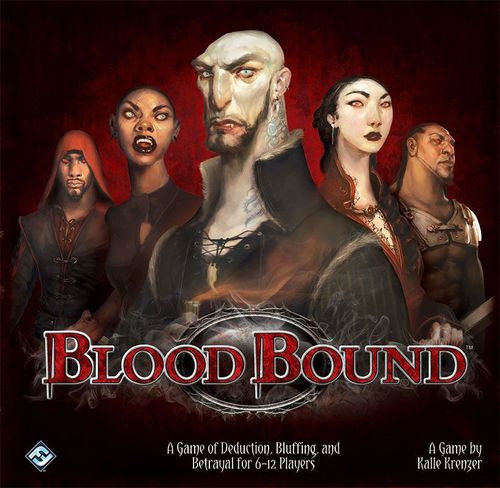
Blood Bound
Blood Bound Rulebook
Table of Contents
Table of Contents
Overview
Blood Bound is a game for six to twelve players, each of whom belongs to one of two rival vampire clans. As players attack one another, they uncover clues about their opponents' identities, which they can use to identify their rival clan's leader and capture him.
Object of the Game
If a player captures the rival clan's leader, the capturing player and his clan win the game. However, if a player captures anyone except the rival clan's leader, the capturing player and his clan lose and the other clan wins.
Game Components
- 9 Rose Clan character cards
- 9 Beast Clan character cards
- 2 Inquisitor character cards
- 12 reference cards
- 19 rank tokens
- 13 Rose affiliation tokens
- 13 Beast affiliation tokens
- 20 unknown affiliation tokens
- 4 Shield ability cards
- 2 Sword ability cards
- 4 Fan ability cards
- 4 Curse ability cards
- 2 Quill ability cards
- 6 Staff ability cards
- 1 cardboard dagger
Ability card text
- Shield — Players cannot force you to suffer wounds, but you may intervene. When the player with the matching-colored "Sword" suffers his third wound, return this card to the supply.
- Sword — You are protecting any player who has a matching-colored "Shield." When you suffer your third wound, return this card to the supply.
- Fan — When a player attacks you, other players cannot intervene.
- Quill — The lowest ranking player of your clan is now your clan's leader.
- Staff — When you take an affiliation token, you must take an unknown affiliation token.
- True Curse — If the victorious clan's leader has this card, the Inquisitor wins the game instead of the victorious clan. When the game ends, flip this card faceup.
- False Curse — The Inquisitor uses this card as a decoy; it has no effect. When the game ends, flip this card faceup.
Character Identity
Each player in Blood Bound assumes the role of a character whose identity consists of several pieces of information, shown on his character card:
- The clan icon indicates which clan the character belongs to: the Rose clan, the Beast clan, or the Secret Order.
- The rank icon indicates which rank token matches the character's specific role. It also indicates this character's place in his clan's hierarchy; the character with the lowest number is his clan's leader.
- The affiliation icons indicate which combination of affiliation tokens matches this character's specific role.
- The clue icon typically shows which clan this character belongs to, but not always.
On the card, the clan icon sits in the upper left, the rank icon in the upper right, the three affiliation icons below the rank icon, and the clue icon in the lower right corner.
Setup
The following setup steps are for games with an even number of players. If there is an odd number of players, see "The Inquisitor" below.
- Prepare the Supply. Place the numbered rank tokens in the center of the play area and arrange them in two rows in numerical order. Place each ability card faceup near its corresponding rank token. Sort the affiliation tokens by type into three piles and place them near the rank tokens.
- Distribute Reference Cards. Deal one reference card to each player.
- Separate Character Cards. Return the Secret Order character cards to the game box. Then take all Rose clan character cards, shuffle them facedown, and set aside a number of them equal to half the total players in the game. Return the remaining Rose clan character cards facedown to the game box without looking at them. Then follow the same procedure with the Beast clan character cards.
- Distribute Character Cards. Combine all character cards previously set aside, shuffle them, and deal one card facedown to each player. Each player then discreetly looks at his character card, being careful not to let any other player see it.
- Show Clue Icon to Player on Left. Each player takes his reference card and places it over the face of his character card so that the lower-right notch of the reference card displays his character's clue icon. Then each player shows his clue icon to the player on his left, being careful not to show any other information on the card or let anyone else see the clue icon.
- Determine Starting Active Player. Randomly assign the dagger to a player. This player is the active player and takes the first turn of the game.
The play area is laid out with the rank token row in the middle, each ability card beside its matching rank token, and the affiliation token piles to one side. Each player keeps his character card facedown in front of him with his reference card at hand.
Playing the Game
Players take turns attacking each other until one player becomes captured. The player with the cardboard dagger is the active player. During his turn, the active player must perform one of the following actions:
- Attack. The active player attacks any other player. Then the active player gives the dagger to the player he attacked, who becomes the new active player and takes his turn.
- Pass. The active player gives the dagger to any other player, who becomes the new active player and takes his turn.
Attacking
Attacking is the primary means of obtaining information about other players' identities. To attack, the active player points the dagger at another player and declares that player as the target of the attack. The targeted player suffers one wound.
Then the active player gives the dagger to the targeted player, who becomes the new active player and takes his turn. Players proceed taking turns in this way until one player becomes captured, causing the game to end.
Suffering Wounds
When a player suffers a wound, he must disclose a portion of his identity. To do so, he takes one token from the supply and places it next to his facedown character card so that the other players can clearly see the icon on the token.
The targeted player must take a token with an icon that matches one of the three icons in the upper-right corner of his character card. For each icon on his character card, he may have only one token bearing that icon.
Before suffering a wound, the targeted player may ask if another player would like to intervene and suffer the wound instead.
When suffering wounds, a player cannot attempt to deceive other players by taking tokens that do not match his character's identity. The only exception to this rule is the Inquisitor's wild affiliation icons.
Example: the active player attacks the player on his right. Early in the game she does not want to disclose her rank, so she suffers the wound by taking an affiliation token. As the Rose clan Berserker she could take either an unknown affiliation token or a rose affiliation token (as shown in her row on the reference card); to keep her clan allegiance secret she takes one unknown affiliation token from the supply and places it next to her facedown character card.
Capturing
When a player suffers his fourth wound, he becomes captured. He flips his character card faceup, and the game immediately ends.
Intervening
If a player wants to protect a fellow member of his clan, or perhaps advance a nefarious strategy, he can intervene on behalf of a targeted player during an attack.
Any player whose rank token is currently in the supply may offer to intervene. If more than one player offers to intervene, the targeted player may accept only one offer; he is not required to accept any offer. If the targeted player accepts an offer of intervention, the intervening player suffers the wound on the targeted player's behalf.
When suffering this wound, the intervening player must disclose his character's rank by taking his rank token from the supply. Then the active player gives the dagger to the intervening player, who becomes the new active player and takes his turn.
Example: the active player attacks the player on her left. Before suffering the wound, the targeted player asks if anyone would like to intervene, and two other players make an offer. He already has two wounds, so he accepts intervention from one of them. The intervening player must disclose his rank to suffer the wound: he takes one of the "4" rank tokens from the supply, revealing that he is the Alchemist (though not which clan he belongs to). The Alchemist then uses his ability, forcing the player for whom he intervened to suffer a wound. Since she has already suffered two wounds, she must take her rank token as her third wound — the "7" token, revealing that she is the Beast clan Berserker. Finally the active player gives the dagger to the Alchemist.
Abilities
Each character has a unique ability he can use to protect a teammate, obstruct an opponent, or turn the tide of the game in his own favor. Immediately after a player takes his rank token to suffer a wound during an attack, either as the target or the intervener, he may use his character ability. See "Summary of Abilities" below for the full explanation of each one.
Note: an ability that forces a player to suffer wounds is not an attack.
Winning the Game
The game ends when one player becomes captured, after which all players flip their character cards faceup to disclose their full identities. If the active player captured the leader of the rival clan, the active player and his clan are victorious and win the game. If the active player captured anyone other than the leader of the rival clan, the active player and his clan lose; the rival clan is victorious and wins the game.
Note: the player with the lowest number is his clan's leader.
Additional Rules
Tabletalk
Players may freely discuss the game, conspire with other players, or make open accusations against one another. However, players cannot converse with one another in secret; all such communication must remain public for all players to hear.
Ability Cards
Some abilities cause a lasting effect. When an ability instructs a player to take an ability card, he takes that card from the supply and places it next to his character card. When an ability instructs a player to give an ability card to another player, he takes that card from the supply and gives it to the player of his choice, who places it next to his own character card.
Most ability cards are open information and remain faceup. The Inquisitor's curse cards are an exception to this rule.
Reference Card
The reference card contains important gameplay reminders, including each character's ability, each character's combination of tokens, and a summary of each ability card. Each row of the card lists a character name and ability alongside its rank icon, with a Beast clan column and a Rose clan column showing which affiliation tokens that character may take in each clan. The lower-right notch of the card is used to display a single clue icon from the character card beneath it.
The Inquisitor
To play Blood Bound with an odd number of players, include a character from the Secret Order, the Inquisitor. Although each Inquisitor character card shows either a rose or beast clue icon, the Inquisitor belongs to the Secret Order.
Changes to Setup
When playing with the Inquisitor, place the rank token showing the fleur cross near the rows of numbered rank tokens. Next, consult the "Setup Ratio of Curse Cards" table below and place the appropriate number of curse ability cards near the fleur cross rank token.
Then replace step 3 of setup with the following step:
- Separate Character Cards. Take all Rose clan character cards. Shuffle them facedown and set aside a number of them equal to half the total players in the game, rounded down. Return the remaining Rose clan character cards to the game box without looking at them. Then follow the same procedure with the Beast clan character cards. Then take both Inquisitor character cards and shuffle them facedown. Set aside one card and return the other card facedown to the game box without looking at it.
Unique Characteristics
The Inquisitor differs from other characters in the following ways:
- The Inquisitor cannot attack a player who has already suffered three wounds.
- The Inquisitor's affiliation icons are wild; when he suffers a wound, he can take any type of affiliation token.
The Inquisitor's Ability
When the Inquisitor uses his ability, he takes all curse cards from the supply, looks at them, and gives them facedown to players of his choosing. The Inquisitor must give each curse card to a different player, and he may give these cards in any order. Players cannot look at any curse cards given to them, and all curse cards remain facedown until the game ends.
The Inquisitor's goal is to give the "True Curse" ability card to the eventual victorious clan's leader, thereby cursing that leader and winning the game.
Winning as the Inquisitor
Determine the victorious clan as normal. Now flip all curse cards faceup. If the victorious leader has the "True Curse" ability card, the Inquisitor steals the victory away from that clan, and he alone wins the game. If any player other than the leader of the victorious clan has the "True Curse" ability card, the card has no effect.
Additionally, if the Inquisitor becomes captured, he alone wins the game.
Summary of Abilities
Elder (1)
The Elder takes the "Quill" ability card from the supply and places it faceup next to his character card. The Elder is no longer the leader of his clan. The new leader of his clan is the character with the highest number.
Assassin (2)
The Assassin forces any player to suffer two wounds. Then the Assassin gives the dagger to that player.
Harlequin (3)
The Harlequin chooses any two players. Then he secretly looks at each of their character cards and returns them facedown to their respective owners, being careful not to let anyone else see them.
The Harlequin may share the information he learned, but he is not required to do so. If he does share information, he does not have to be honest about what he saw, leaving other players to second-guess any accusations he makes.
Note: the Harlequin's clue icon is of the rival clan.
Alchemist (4)
The Alchemist can use his ability only when he intervenes. After the Alchemist intervenes, he forces the player for whom he intervened to either suffer one wound or heal one wound (this choice lies with the Alchemist). To heal a wound, the player for whom the Alchemist intervened returns any one of his tokens to the supply.
If the healed player returns his rank token to the supply, then he may use his ability again the next time he takes his rank token.
Mentalist (5)
The Mentalist forces any player to suffer one wound; that player must take his rank token to suffer this wound. Then the Mentalist gives the dagger to that player.
If that player currently has his rank token next to his character card, then he must take an affiliation token instead. If that player currently has three wounds, then he becomes captured.
Guardian (6)
The Guardian gives one "Shield" ability card to one player and takes the matching-colored "Sword" ability card for himself. The player with the "Shield" card is protected; players cannot attack him or use an ability to force him to suffer wounds. However, he may intervene and, by choosing to intervene, suffer the wound as he normally would.
The protected player remains protected while he has the "Shield" card. When a Guardian with a "Sword" card suffers his third wound, he and all players he is protecting return their matching-colored "Sword" and "Shield" cards to the supply.
Berserker (7)
The Berserker forces the player who just attacked him to suffer one wound.
Mage (8)
The Mage gives a "Staff" ability card to another player and takes a "Staff" ability card for himself. If a player with a "Staff" ability card takes an affiliation token when suffering a wound, he must take an unknown affiliation token.
If the Mage chooses to use his ability, then both players must receive "Staff" ability cards. If the Mage uses his ability a second time, he does not take a second "Staff" ability card.
Courtesan (9)
The Courtesan gives a "Fan" ability card to another player. During an attack against a targeted player who has a "Fan" ability card, other players cannot intervene.
Quick Reference
Attack Steps
- Declare target.
- May request intervention.
- May accept one offer of intervention.
- Suffer wound (must disclose rank if intervening).
- May use ability (only if rank was disclosed).
- Give dagger to player who suffered wound.
Setup Ratio of Character Cards
| Number of players | 6 | 7 | 8 | 9 | 10 | 11 | 12 |
|---|---|---|---|---|---|---|---|
| Rose clan cards | 3 | 3 | 4 | 4 | 5 | 5 | 6 |
| Beast clan cards | 3 | 3 | 4 | 4 | 5 | 5 | 6 |
| Inquisitor cards | – | 1 | – | 1 | – | 1 | – |
Setup Ratio of Curse Cards (Inquisitor only)
| Number of players | 7 | 9 | 11 |
|---|---|---|---|
| True Curse | 1 | 1 | 1 |
| False Curse | 1 | 2 | 3 |