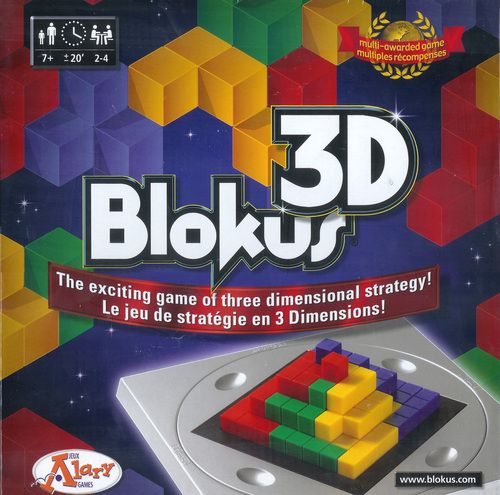
Blokus 3D
Blokus 3D Rulebook
Table of Contents
Table of Contents
List of Parts
The game consists of the following parts:
- rotating turntable with 100 squares
- 44 Blokus pieces in 4 colors
- 4 masks
Each of the 11 pieces in a given color has a different shape (see fig. 1).
Goal
Place your pieces so you have the most visible on top of the stack.
Getting Ready to Play
- Each player chooses a set of 11 pieces, all the same color.
- Place the turntable on a flat surface.
- Choose one of 4 masks corresponding to the structure A, B, C, or D (see fig. 5) and put it on the rotating turntable.
Starting the Game
The First Round
- The first player starts by placing a piece on the game board. The piece must stay within the perimeter of the mask and not violate the shape or height limitation of the structure (see fig. 2 and 5).
- The remaining players place their first pieces, staying within the shape of the structure (as defined in fig. 5), so that they touch at least one face of any previously placed piece(s) and the game board (see fig. 3).
Subsequent Rounds
- After the first round, all pieces must be placed so that they touch at least one face of a piece of the same color (see fig. 4).
For example, a yellow piece must be placed so that it touches at least one face of another yellow piece.
Important: This piece can also touch the faces of red, blue or green pieces as long as at least one yellow face touches another yellow face.
Note: Rotate the turntable before placing pieces to see all placement options.
Height Restrictions
Depending on the structure you have chosen to build and the number of players, the following restrictions are placed on the maximum height and shape of each structure (the height is given in number of cubes):
| Mask | Structure | 2 players | 3 players | 4 players |
|---|---|---|---|---|
| Mask A | Structure A (Tower) | 4 | 6 | 8 |
| Mask B | Structure B (Wall) | 2 | 3 | 4 |
| Mask C | Structure C (Stairs) | 4 | 6 | 8 |
| Mask D | Structure D (Pyramid) | 4 | 4 | 4 |
Additional Rules for Placing Pieces
- Pieces must be placed so that they fit within the shape of the structure (as defined in fig. 5).
- No part of any piece may extend beyond the perimeter of the structure or mask.
- No part of any piece may exceed the height limitations of the structure.
- Pieces should be placed so that no gaps, holes or tunnels are created that could not be filled by pieces placed from above (see fig. 6).
Correct Placement: Open spaces can be filled by pieces from above.
Incorrect Placement: Hole cannot be filled by a piece from above.
- Pieces should only be placed from above.
- If a player has a move, he or she must make the play. Players cannot "pass" if a move is possible.
- If at any point in the game a player cannot place a piece on the game board, he or she may not place any more pieces in that game.
End of the Game
The game ends when players are unable to add any more pieces to the structure.
Each player receives one point for each face (square) of their pieces visible from above.
After counting visible faces, players must deduct a point for each piece that could not be placed by game's end.
The player with the most points is the winner.
In fig. 7, blue earns 5 points, red earns 6 points, yellow earns 4 points and green earns 4 points (5 points minus a remaining piece). Red wins!
Duration of a Game
Games typically last 15 to 20 minutes.
Variants
a) 2 Players
- 2 Players with 2 Colors: Both players choose a set of 11 pieces and take turns placing them. No piece may exceed the height limitation of the structure (see fig. 5).
- 2 Players with 4 Colors: Each player uses two colors, alternating their colors. Game play is the same as with 4 players, but when calculating scores, each player adds up the points for both of his/her colors. The winner is the player with the highest score.
Alternate rule: Players only score their color with the most points. The other color's points are not counted.
b) 3 Players
Each player chooses a color. The remaining color is not played. Players use their pieces to build as normal, while adhering to the height limitation for three players.
c) Solitaire
Blokus 3D can be played alone in a variety of ways. Try to build a multicolored cube in various sizes: 3x3x3 or 4x4x4 or 5x5x5.
Using pieces of only one color is trickier. How many ways do you think there are to build a 3x3x3 cube with one color?
Strategy Tips
- Try to place the complicated "3D" pieces at the beginning of the game and keep the small ones for the end when it will be more difficult to place pieces. Remember that each piece you don't place reduces your score!
- Throughout the game, place your pieces in the central area. In that way you always have many possibilities to place additional pieces and you avoid getting locked in a corner.
- When playing, keep in mind not only your own remaining pieces, but also those of your opponents. Near the end of the game, the other players may not be able to place a piece if they do not have the correct pieces.
Blokus 3D is based on the original concept of Stefan Kögl.