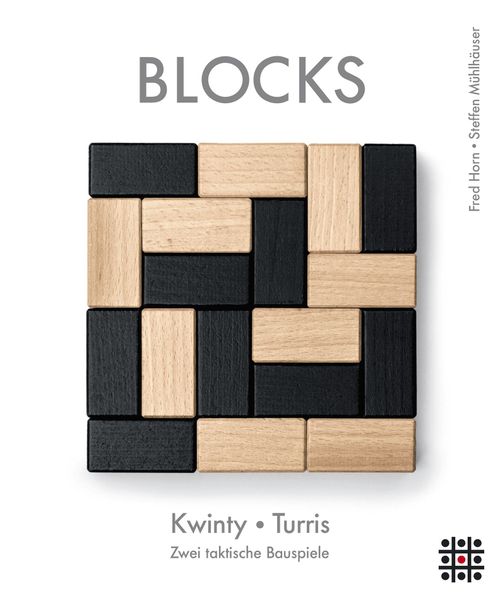
Blocks
Blocks Rulebook
Table of Contents
Table of Contents
Kwinty
Game materials
40 blocks in two colours.
Game tile
Even if the blocks show no central markings, we always treat the sides of one block as if it were two individual squares. The side of one block is equal to 2 squares.
Object
Together, the players use their blocks to build an upright wall. The object of the game is to be the first player to build a continuous row comprising 5 squares of a personal colour.
Preparation
Each player chooses a colour and receives all 20 blocks. The first player is nominated.
How to play
The wall is erected between both players in the middle of the game area. Players take turns to place one block of their personal colour.
The width and height of the wall must not exceed 9 squares.
General construction rules
a) Players are free to choose where to place the first block. A newly placed block must make contact with at least one block already in position.
b) A block can be built upright (vertically) or laid flat (horizontally). Building over empty spaces is not allowed.
c) The short sides of the same-coloured game blocks may not make contact with each other.
End
The first player to build a continuous straight series of 5 blocks wins the match. The row of blocks can be arranged horizontally, vertically or diagonally. The loser begins the next round.
If all the blocks have been placed without any player having created a 5-series, the winner is the player who could build more rows consisting of four squares. If the players have built the same number of 4-series, the match is a draw.
(The rulebook's diagrams show a vertical win for white, a horizontal win for black and a diagonal win for white.)
Turris
Game materials
40 blocks in two colours.
Block
Even if the game blocks show no central markings, we always treat the sides of one block as if it were two individual squares. The side of one block is equal to two squares; the cross section equals a square.
Object
The players build a tower together. Each player aims to construct a continuous area of his/her personal colour as big as possible on each side of the tower.
Preparation
Place the game surface between the players. Each player chooses a colour and receives all 20 blocks. The first player is nominated.
How to play
The tower is built on a "foundation" (felt surface). The players take turns to place a block of their personal colour.
The layout of the tower must not extend 3 x 3 squares.
The players are allowed to turn the tower around on the felt game surface to view it from all sides.
General construction rules
a) The players are free to choose where to place the first blocks. A newly placed block must make contact with at least one block already in position.
b) A game block can be positioned upright (vertically) or laid flat (horizontally). Building over empty spaces is not allowed. [sic: printed as "alloud"]
c) A vertical block must always be erected making side contact with a block that is already in place. (Exception: the first block of the game.)
d) A horizontal block must be placed so that it overlaps (rests flat across two other blocks).
e) For the entire tower construction: a maximum of three unfinished levels is allowed at any one time. Construction of a new level can only begin when all the gaps are filled on the lowest level.
f) The middle of a new level may only be built when at least one block at the edge of this level is already in position.
Bonus
A bonus is awarded to a player who uses a horizontal block so that one half of the block is in the middle of the tower, or who erects a vertical block in the middle of the tower.
He can either immediately place another of his blocks or remove an opposing block from the tower and give it back to his fellow player. (Exception: the last block put down by his opponent.) The opponent is not permitted to rebuild the free space during his next go.
Restriction: a block may not be removed, if this is in breach of construction rule e).
Example sketches for bonus move: White plays Block A, now in contact with the middle and is allowed to place the bonus block (B).
End and scoring
The game ends when all the blocks have been used. (If a player has no more blocks, the other player may use all his remaining blocks in succession.)
Now, the four sides of the tower and the roof area (top) are scored separately. All the visible squares on one side of the tower are counted as part of the review, and the scores are calculated. This also applies for recessed areas of blocks that are only connected optically with the front blocks.
On each side of the tower and the rooftop, only one (the biggest) continuous group of a single colour is identified and the points are awarded to the corresponding player. (Each block square counts as 1 point.)
This gives five separate totals per player that are added together to make a grand total. The winner is the player who scores the higher number of points.
Example of a finished tower (the scoring example from the rulebook):
| Area | Black | White |
|---|---|---|
| Roof | 4 P | 5 P |
| Side A | 10 P | 12 P |
| Side B | 10 P | 9 P |
| Side C [sic: printed as "Seite C"] | 7 P | 20 P |
| Side D [sic: printed as "Seite D"] | 15 P | 10 P |
| Grand total | 46 P | 56 P |