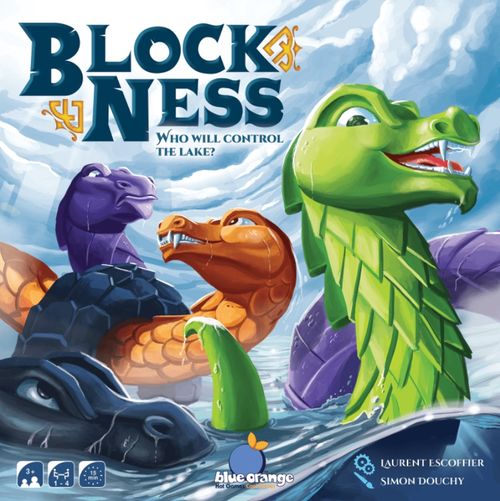
Block Ness
Block Ness Rulebook
Table of Contents
Table of Contents
Game Contents
- 1 Loch board
- 4 different coloured monsters made up of 12 segments each:
- 1 head
- 10 body segments
- 1 tail
Object of the Game
Place as many segments as possible on your monster to make it longer.
Setup
- Remove the Loch board from the box. Each player picks one colour of monster to play and places the 12 parts that make up its body in front of them. This is the reserve pile.
- Place the Loch board onto the cardboard insert from the box and place the board so that it is in the middle of all the players.
- Each player takes the starter body segment from their reserve. This should be the segment that is lowest in height.
- The youngest player starts. They place their starting segment wherever they wish within the dark blue area in the centre of the loch where the water is deepest.
Attention: throughout the game, the monsters' segments must be placed horizontally or vertically on the loch, never diagonally. Once they have been placed on the loch, segments must stay in the same place until the end of the game.
- The first player attaches their monster's head and tail to their starter segment. The head and tail are always placed on the two ends of the monster.
- In clockwise turns, the other players must each place their starter segment, with its head and tail, into the deep waters of the loch.
How to Play
The surface of the loch being used in the game depends on the number of players:
- for a 2 player game, only play on the dark blue area (deep waters).
- for a 3 player game, also play on the medium blue surface.
- for a 4 player game, use the entire surface of the loch.
Starting with the first player and continuing in clockwise turns, each player chooses a segment from their reserve and uses this to make their monster longer according to the following rules:
-
Each new segment should be placed on a space that is adjacent to the monster's head or tail. The other side of the segment must sit on a free space. This side becomes the new end of the monster: the player must move the monster's head or tail to this side depending on which end of the monster has been elongated.
To make their monster longer, the orange player must choose from one of the 6 spaces colored in orange to place their next segment.
Example: the orange player places their new segment by their monster's head (1). They move the head to the newly added segment at the end of the monster's body.
Example: the player places their new segment by their monster's tail (2). They move the tail to the end of the newly added segment.
-
A player can place a segment that crosses over their own head or tail as long as they move their head or tail to the new segment during their turn.
Example: the orange player makes their monster longer by adding a segment that passes over the space its head was just on.
-
If they are able, a player can directly cross another segment of theirs.
Example: the black player passes over their own segment with their next segment. The monster does a half turn over itself.
-
A player can cross over one or more of their opponents' segments.
Example: here, the purple player can make their monster longer by extending the end with its head in different ways. Here are two possible examples: the purple monster crosses an orange segment and one of its own segments (1); the purple monster crosses an orange segment and a green segment (2).
-
A player cannot place their segment under another segment, including one of their own, even partially.
Example: even though it would be physically possible, the black player cannot place their segment under the orange monster's segment.
-
Monsters cannot cross over an opponents' head or tail.
End of the Game
The game ends when all the players are blocked or everyone has placed all their segments on the loch. The player with the least segments remaining in their reserve wins the game!
In the event of a tie, the winner is the player whose monster has the tallest head.
If a tie persists, the players who are tied share the victory.
Example: at the end of the game, the orange and black players have 2 segments each remaining. The purple and green players each have 1. The green player wins because their monster has the tallest head.
Expert Variation
These rules are identical to the original rules, with the following exception:
- Segments can only be placed exactly 2 spaces away from the head or tail of monsters (horizontally or vertically). This means there is another way to cross over segments, making your game even more strategic!
Example: from their starting position, the orange player must choose where to place their next segment from the 6 spaces shown.
Extra Game Experience
Try a new game experience by challenging the Block Ness Monsters in Solo Mode. To do this, check out the levels available on our BO COMPANION App!