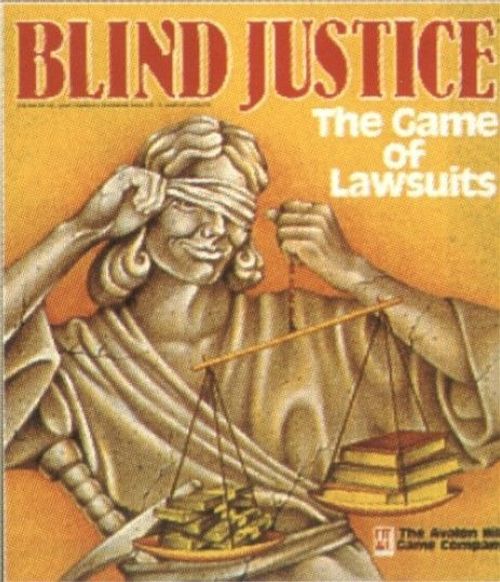
Blind Justice
Blind Justice Rulebook
Table of Contents
Table of Contents
Object
OBJECT: The winner is the first player or team to reach the Supreme Court with three million dollars. If there are more than four players, divide the participants into teams. If time is of the essence, a playing period may be established at the start with the winner being the player with the most money when the time limit expires.
Contents
- one 16" x 16" gameboard
- four pawns
- one six-sided die
- one Verdict Book
- a deck of red Superior Court Case cards
- a deck of gold District Court Case cards
- a deck of red Superior Court Chance cards
- a deck of gold District Court Chance cards
- play money
Prepare to Play
- Each player rolls the die. The player rolling the highest number has the first turn and selects a pawn and places it on the Recess space. Each player in clockwise order around the table then does likewise.
- Shuffle the respective Case and Chance decks and place the four decks in separate piles near the board.
- One player is selected to be the Court Clerk for the game and is referred to hereafter as simply the "Clerk". The Clerk distributes $50,000 to each player to start his own law firm. During play, the Clerk distributes or collects money as required. The Court's money is kept separate from the player's personal holdings.
How to Play
The first player rolls the die and moves his pawn the number of spaces indicated in the direction shown by the Recess arrow.
There are five different types of spaces; each requiring a different type of action. Brown Jury squares indicate a Jury case on the Superior or District Court level respectively. The blue spaces indicate an out-of-court settlement. The green spaces represent a Windfall/Pitfall Chance opportunity. The orange space is the starting and re-entry point.
After finishing his turn, play then proceeds clockwise around the table. Pawns may pass over or occupy the same space as other pawns.
JURY TRIALS: When a pawn lands on a Jury space, the player draws a card from the District or Superior Court Cards and acts as the attorney on behalf of his client, the plaintiff. The attorney reads the case aloud. He may find it to his advantage to embellish his case in an effort to win the sympathy of the jury, but he may not change the facts presented. The amount of money being sought in damages is indicated on each card in red type, but is only a guide. The attorney should not read this amount as printed, but instead should feel free to ask for more or less based on his appreciation of the merits of the case. He never reads the Appeal Cost aloud.
VERDICT: The other players now act as the jury and decide the outcome of the case. They must decide among themselves both the verdict and the award, if any, within a one-minute time limit. All awards must be in multiples of $1,000. If the jurors cannot agree on the award in the allotted time, the jury must compromise and offer the lowest amount tendered by any of the jurors (including no award at all if any of the jurors finds for the defense). If the attorney is satisfied with the decision, he collects any money due him from the Clerk and play continues with the next player's move. The case is not looked up in the Verdict Book.
APPEAL: If the attorney does not feel justice has been done, he has the option to appeal the jury's verdict and therefore declines their award. To do so, he pays his clients' court and legal fees as indicated on that Case card to the Clerk. If he lacks sufficient money to pay the indicated Appeal costs he may not appeal. Having paid the Appeal costs, the player refers to the Verdict Book and looks up the actual outcome of that Case. If an award was made, the Clerk pays it to the player. In addition, if the game jury's award was less than the Verdict Book figure, the player's Appeal costs are refunded by the Clerk and he may take another turn. However, if the game jury's award was more than the Verdict Book's figure, the player gets neither his Appeals cost back nor another turn.
SETTLEMENTS: When a pawn lands on a blue space, that player becomes the plaintiff and chooses any other player to become the defendant. The plaintiff rolls the die to see who wins the out-of-court settlement. If the die roll is an odd number (1, 3 or 5), the defendant wins, owes nothing, and play continues with the next player's turn. However, if the die roll is even (2, 4 or 6), the plaintiff wins and the defendant must pay to the plaintiff the amount of money marked on the space, multiplied by the number on the die. For example, the space on the board is marked $4,000 and the die roll is a "4"; the defendant owes the plaintiff $16,000. If the defendant does not have that much, he must declare Bankruptcy. Whenever the plaintiff wins a settlement case he immediately takes another turn.
CHANCE: When a pawn lands on a green Chance (Pitfall/Windfall) space, that player must draw a Chance card of the same color as his current court level and read it aloud. All payments must be made to the player or Clerk before play resumes. If a player cannot pay any amount owed, he must declare Bankruptcy. Certain cards with specific instructions may be held by a player and used during a later turn. Such cards are considered part of his Assets should he become bankrupt. Once a card is used, it is returned to the bottom of its respective deck.
RECESS: A player landing on the orange space must wait until his next turn to take any legal action. No player can bring suit against him while he occupies that space. He does continue to participate in any jury decisions, and can be affected by chance cards drawn by other players.
BANKRUPTCY: A player who cannot pay his debts must surrender all of his assets (both cards and money) to the player who has bankrupted him, or to the Clerk if no specific player was owed a debt. He must remove his pawn from the board. During his next turn he starts the game anew in another law firm with another $50,000 stake, but is limited to placing his pawn back in play on the Recess space. In subsequent turns he may proceed normally.
ADVANCEMENT: The board is divided into three Court levels. The first is the District Court. Play begins and continues on this level for each player until he accumulates $300,000 and occupies one of the four District Court squares containing an entrance arrow to the Superior Court at the end of his move. On his next die roll he may move into Superior Court (provided he still has $300,000). If his assets ever fall below $300,000 while in Superior Court, he must immediately return his pawn to the Recess space. Once in Superior Court, the player moves around that level until he amasses $3,000,000 and occupies one of the two Superior Court spaces containing an entrance arrow to the Supreme Court at the end of his move. On his next die roll (provided he still has $3,000,000) he may move to the Supreme Court and victory.
Court is now in session. Let the game begin!