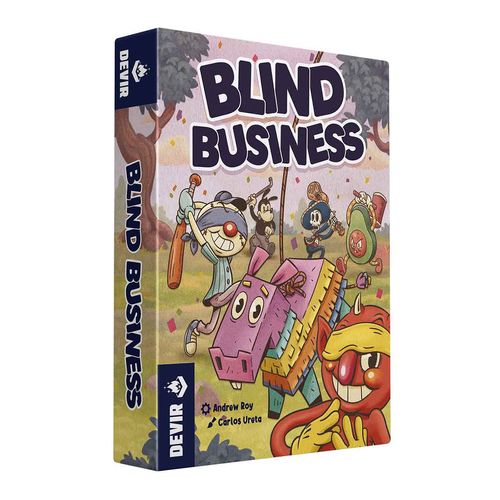
Blind Business
Blind Business Rulebook
Table of Contents
Table of Contents
Components
- 50 cards (from 1 to 11 and one "the Versatile" of each color, plus two "Trainer" cards)
- 1 "Trophy" / "Active Player" card
- 10 help cards (2 per player)
- 4 "OK" cards
- 1 rulebook
Setup
At random, determine which player starts playing. This player takes the active player card and places it in front of them, in their play area. Set the OK cards aside, give each player their two help cards (leave the rest in the box), and shuffle the remaining 50 cards. Depending on the number of players, remove a certain number of cards at random, without looking at them. Then play the indicated number of rounds (also based on the number of players):
| Number of players | Number of cards removed | Number of rounds |
|---|---|---|
| 2 | 18 | 6 |
| 3 | 8 | 5 |
| 4 | 2 | 4 |
| 5 | 0 | 3 |
Form a deck with all the remaining cards and deal four to each player. Each player looks at their hand to see which cards they are starting with, after which they must shuffle them (until they no longer know how they are arranged) and then show their hand to everyone else. Keep your hand this way, so that all the other players can see it, but you cannot.
The Game — Let's Pop This Piñata!
On their turn, the active player (the "requester") looks at all the cards in their opponents' hands and asks any rival (the "recipient") for a card, touching it. The recipient can accept or reject this proposal by saying "yes" or "no":
-
If the recipient rejects the proposal, the recipient wins the card the requester asked for and places it in their play area (to score at the end of the game). Then, the requester chooses one of the recipient's remaining three cards, whichever they want, and places it in their play area.
-
If the recipient accepts the proposal, they immediately ask in exchange for a card from the requester's hand, touching it. The requester can accept or reject this proposal:
-
If the requester accepts (so that both have accepted each other's proposals), each player wins the card they asked for and places it in their play area.
-
If the requester rejects, each player wins the card the other player asked for (that is, the requester wins the card from their own hand, and the recipient wins the card from their hand that the rival had touched).
-
Each player leaves the card they have won in their play area. Arrange them in rows by color; you will score them at the end of the game.
After finishing this turn, the players draw a new card from the deck, without looking at it, and add it to their hand to have four cards again.
The game continues clockwise, with the turn of the player seated to the left of the previous requester. This player takes the active player card and is now the new requester.
Who Wins the Grand Trophy?
There are two ways to take home the grand trophy of Ricky Town:
- Landing the perfect blow, or
- Demonstrating the best technique.
The Perfect Blow
Automatic victory: five consecutive cards
During any player's turn, after they have won a card and applied its ability, if any player has five consecutive numbers of a single color (e.g., 4, 5, 6, 7 and 8 of the playground), the game ends immediately and that player is the winner.
The "the Versatile" card of each color can help you achieve this (see the section on each card's abilities). If two players manage to form a series of five consecutive cards at the same time, they both share the victory. If nobody achieves an automatic victory during the game, keep playing until it concludes and proceed to calculate the final score.
The Best Technique
Scoring at the end of the game
The game ends when there are no cards left in the deck, which happens after a set number of rounds depending on the number of players (see Setup). So, at the end of the last turn, players who have won a card during that turn will replenish their hand, and then the deck will be exhausted and you can proceed with the final scoring.
Players score the cards present in their play area (cards in hand do not score). For each color, multiply the number of cards you have of that color by the value of the highest-value card of that color (the "Trainer" and "the Versatile" cards have no value). For example, if you have four cards of the playground, and among these the highest value is 11, you get 44 points for the cards of that color. Add up your score from the four colors: whoever has the most points is the winner!
Important: you can download the Devir app on your phones (available for Android and iPhone); it will help you calculate your score, and it's free!
Scoring example
- Four cards of the playground (highest value 11): 11 × 4 = 44 points
- Three cards of the boardwalk (highest value 5): 5 × 3 = 15 points
- Two cards of the central station (highest value 3): 3 × 2 = 6 points
- Two cards of the downtown (highest value 4): 4 × 2 = 8 points
Total score: 44 + 15 + 6 + 8 = 73 points
Special Color Abilities
The four districts of Ricky Town
While you can play simple, family-friendly games with the rules we have seen so far, we recommend that you play with the special abilities of each color (and also those of each card). When you reach the end of the game, before counting the points, apply the following color abilities, in the order indicated. "Trainer" cards count as if they were of the color they have been assigned. "1" cards count only as one card when determining who has the most cards of that color.
If several players tie when determining who has the most cards of the playground or the boardwalk, all those players receive the bonus that would correspond to the lower position. So, two players who tie for most cards of the boardwalk receive the bonus corresponding to the second position, which in a game for 2-3 players is zero, and in one for 4-5 players, is 10 points each. If two players tie for second position, they take the prize for third position: nothing.
The playground
2/3 players: whoever has the most cards of the playground at the end of the game may examine their hand and add one card from their hand to their play area. This ability is applied before the abilities of certain individual cards are activated. Also, if it causes someone to have five consecutive cards, that player wins the game immediately.
4/5 players: in addition to the above ability, whoever has the second-highest number of cards of the playground at the end of the game gets 10 additional points.
The boardwalk
2/3 players: whoever has the most cards of the boardwalk at the end of the game gets 10 additional points.
4/5 players: whoever has the most cards of the boardwalk at the end of the game gets 20 additional points, and whoever has the second-highest number gets 10 points.
The central station and the downtown
Each player counts how many cards they have from the central station and how many from the downtown. From these amounts, the player gets 7 additional points for each matched pair of cards from these two districts. For example, if you have 4 cards from the central station and 2 from the downtown, you get 7 × 2 = 14 additional points.
Abilities of Each Card
The different team members
When you win a card, leave it in your play area. Then you must carry out that card's specific effect, according to its value. These abilities are the same for every color.
Trainer: this is considered a card with no set value and you can assign it to any color. When you win it, leave it in the row of a color of which you already have at least one card, or leave it on its own (until the moment you decide to assign it to a new color's row, when you win the first card of that color). In short, it is a wild card with no number and no color.
1 – The Twins: during final scoring, when multiplying the number of cards by the value of the highest-value card of that color, the "1" counts as two cards of that color. For example, if you have the "1" and the "10" of the same color, you get 3 × 10 = 30 points, since the "1" counts as two cards.
2 – The Positive Type: when you win a "2", immediately take an "OK" card. At any time, you can discard this "OK" card when asking a rival for a card (before they answer "yes" or "no") to force them to accept your proposal. If for some reason you discard the "2" before spending the "OK" card, you do not lose the "OK" card.
3 – The Swindler: when you win a "3", once the players have drawn a card to replenish their hand, you can exchange your hand for that of another player. Players who have exchanged hands must shuffle their new cards before showing them to everyone else. On the same turn, if both players win a "3", the active player exchanges their hand first, and then the other player.
4 – The Little Cheater: when you win a "4", you can examine your hand after drawing a card; then shuffle your cards.
5 and 6 – The Lovers: during final scoring, if you have the "5" and "6" of the same color, you get 5 additional points (note: you get 5 in total, not 5 for each card of the pair of lovers).
7, 8 and 9 – The Passers-by: during final scoring, if you have the "7", "8" and "9" cards of the same color, you get 10 additional points (note: you get 10 in total, not 10 for each passer-by card).
10 – The Right Tool: when you win a "10", if you are the player with the most cards in total in your play area (without tying with anyone), you must discard any one card (of your choice) from those you have in your play area. Compare the number of cards after both players have won a card from the play, but before anyone discards a card due to a "10" or an "11". If you must discard a card, do so before checking for the formation of a series of five consecutive cards.
11 – The Free Spirit: when you win an "11", if you are the player with the most cards in total in your play area (even if tied with another player), you must discard any one card (of your choice) from those you have in your play area. Compare the number of cards after both players have won a card from the play, but before anyone discards a card due to a "10" or an "11". If you must discard a card, do so before checking for the formation of a series of five consecutive cards.
The Versatile: you can use it as any number of its color, but only for the purpose of achieving five consecutive cards. You do not need to assign it a specific number when you win it, since you can decide later and use it as the number you need for that, and thereby achieve the series of five cards and win the automatic victory; in any other case, it counts as one more card of its color. For example, if you have the "5", "6", "8" and "9" cards of the central station and the red Versatile, you win the game automatically, since you use the Versatile as if it were a "7". If you do not use it to achieve the automatic victory, consider the Versatile as a card of its color, but with no number.
Strategy Tips
- Accept the deal your rival proposes if you want any of the cards they have in their hand. Reject it if you believe what you have in your hand is better than what you see in theirs.
- If you have a high-value card of a certain color, try to win many cards of that color, regardless of their value.
- If you have a Versatile card, try to obtain an "OK" card; it will help you win the game by securing five consecutive cards.
- Towards the end of the game, avoid asking for cards from players who already have many cards in their play area, so as not to increase their chances of winning.
- You can play Blind Business without saying a word, or the complete opposite, arguing and bluffing as much as you like when asking for cards. Try it both ways and play however you like it best.