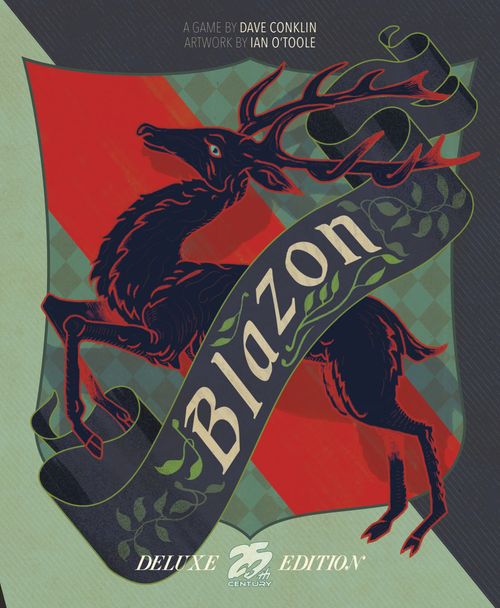
Blazon
Blazon Rulebook
Table of Contents
Table of Contents
Objective
Players score Prestige by placing Element cards on their Shield board. Players can score bonus Prestige by earning distinctions for their shields. The player with the most Prestige at the end of the game wins and is crowned the King of Arms.
Components
- 1 Centerpiece board
- 120 Element cards (40 Tincture cards, 80 Device cards)
- 4 Shield boards
- 20 Distinction markers (5 in each of 4 player colors)
- 4 Prestige counters
- 5 Animal achievement tokens
- 25 Distinction cards (in categories A, B, C, D, E)
- 20 Herald tokens
- 4 Abatement tokens
Setup
- Place the Centerpiece board in the middle of the table.
- Shuffle all Device cards and place them face down in the indicated space on the Centerpiece board. This forms the Device Element card deck. Deal 4 Device cards face up to form a display below the Centerpiece board.
- Shuffle all Tincture cards and place them face down in the indicated space on the Centerpiece board. This forms the Tincture Element card deck. Deal 2 Tincture cards face up to form a display below the Centerpiece board.
- Separate the Distinction cards into their respective categories (marked A through to E). Shuffle each deck of five cards and draw one distinction card from the bottom of each deck. Orient these cards so that the correct player count is showing in the top corners, and tuck them under the top of the Centerpiece board as shown, lining up the squares on the card with the cuts in the Centerpiece board. Return the other cards to the box.
- Place the Animal achievement tokens near the board.
- Place all the Herald tokens in a pile accessible to all players. Each player takes one Herald token.
- Each player chooses a player color and places the matching Shield board in front of them.
- Each player places their Prestige counter on "0" space of their Prestige track, which runs around the outside of their Shield board.
- Each player takes the 5 Distinction markers in their color and places them on the indicated space on their Shield board.
- Each player draws 2 cards from the top of the Tincture deck, and 2 cards from the top of the Device deck, to form their starting hands.
Note: If any player's hand totals 5 Prestige Value or less during setup, that player returns their cards to the bottom of the respective decks and redraws their hand (see Element Cards below for Prestige Value).
- Optional (see Optional Rules below): Each player places the Abatement token in their color, on the indicated space on their Shield board.
Element Cards
Element cards represent the 9 types of heraldic Elements. In Blazon, these are divided into two main categories: Tincture cards (with a circle icon in the corners and on the back) and Device cards (with a square icon in the corners and on the back).
Each Element card displays the Element's type, category (Tincture or Device), one of five Augmentations, its Prestige Value, and the possible positions on a Shield board that the Element card can be placed.
Heraldic Shields
The primary display of heraldic achievement is the shield. The shape of the shield was often at the discretion of the heraldic artist. The whole surface of the shield is known as the field and may consist of a single Tincture or, as was more common, be divided into multiple areas and decorated with multiple Tinctures, Devices, and Augmentations.
Augmentations
Augmentations are modifications to a coat of arms, bestowed upon the holder by a monarch in recognition for an act or bravery of service. For example, the fleur-de-lis or "Chief of France" as it is also known, was bestowed on those faithful to the King.
Tinctures
Tinctures refer to the limited use of a palette of colors and patterns. Traditionally three categories of Tincture were used: metals, colors and furs. Metals were "or" and "argent", representing gold and silver respectively, depicted as yellow and white. Five other colors were used: "gules" or red, "sable" or black, "azure" or blue, "vert" or green and "purpure" or purple. Certain patterns called "furs" are also used. Two basic types of heraldic fur exist: "ermine", which represents the fur of the stoat or weasel in its white winter coat, and "vair", which represents the winter coat of the squirrel, which is blue grey on top and white underneath. Over time, several variations of ermine and vair were added, including erminois, countervair and potent.
Devices
Devices represent either the field or the symbols on the field. The symbols were often very simple bold rectilinear shapes that could be recognized from a distance and easily remembered, called ordinaries. As more complex shields came into use, these bold shapes were separated into different classes. Less abstract charges were used to represent divine beings, human anatomy, creatures, monsters or inanimate objects. One of the most famous charges is the lion rampant, used by some of the great families and empires of Europe in their arms.
Playing Blazon
Blazon is played in sequential turns. On your turn, you must take either an Acquire action OR a Blazon action.
Acquire Action
If performing this action, you may draw two Element cards from either the Tincture deck, Device deck, or one from each. You may keep both of these cards or exchange one (or both) for cards from the face-up display. When carrying out an exchange, you may only exchange like type for like type. For example, you may exchange a Tincture card taken from the Tincture deck with a Tincture card taken from the face up display.
Note: you must take both cards before deciding whether or not to exchange them. You may only exchange the cards that were drawn, not other cards from your hand.
Blazon Action
This action allows you to place Element cards from your hand onto your Shield board. You choose which card to place, ensuring that you meet the matching Device or Tincture requirement on your Shield board (see Placing Cards, below).
To place a card, you must discard any number of cards from your hand, the combined Prestige Value of which equals or exceeds the Prestige Value of the Element card that you wish to place on your Shield board. These discarded Element cards form a face up discard pile next to their respective Element card deck. After placing your Element card onto your Shield board, score the Prestige indicated on the placed card.
You may place more than one Element card on your shield Blazon action if you can pay for it.
Note: if you overpay for an Element card, you do not receive any change. This includes placing more than one card on a single turn. Each Element card is paid for separately, with change not being applied to any further card placement.
The Heraldic Formula
The blazon of an armorial bearing follows a very rigid formula. Every blazon begins by describing the field. In many cases this is a single Tincture (color), e.g., "gules" (red) or "azure" (blue). Sometimes the field is divided. If it is divided, the division is described with an appropriate modifier (partition) beginning with the viewer's left (called the dexter side) of the upper edge of the shield (known as the chief edge) followed by the Tinctures of the subfields. Following the description of the field, the principle ordinary(ies) or charge(s) are named along with an appropriate modifier (partition or attitude) and Tincture. Then, any sub-ordinary Devices are listed, along with their arrangement placed on or around the previous Devices. Finally the blazon may optionally include the listing of a cadency, augmentation, or distinction. If no Tincture is listed for these, any previously mentioned Tincture may be used.
Rule of Tinctures
The Rule of Tinctures is one of the most basic rules of Heraldic design. It states that metal should not be put on metal, nor color on color. The rule's origin was based on avoiding the difficulty of distinguishing certain pairs of Tinctures, like dark colors on dark or light metal on metal. The rule does not apply to furs or in the case when charges are placed on divided fields.
Placing Cards
Each space on the Shield board has two possible alignments: top and bottom. Element cards must be placed so that the visible Device or Tincture symbol on the Shield board matches that of the Element card placed. The other Device or Tincture symbol on the Shield board should be covered by the Element card. Once an Element card has been placed it cannot be moved.
Once an Element card has been placed on a row, all other cards in that row must be placed into the same alignment (top or bottom).
The exception to this is a Shield space with a Tincture symbol in both the top and bottom alignments. A Tincture card in this space may be shifted from top to bottom or vice versa as long as no other card has been placed in the same row.
Note: Any Tincture card can be placed on a wild Tincture symbol on the Shield board.
Element Card Placement Override
When placing Element cards, new cards may be placed over the top of old cards. This allows you to change a row from one alignment to another in a single turn if the entire row is legal by the end of your turn. You still score the new Element card at the time of placement. This can be combined with the Abatement optional rule as well, which will let you fix the violation in a subsequent turn.
Tincture Placement Restrictions
Identical Tincture Elements cannot be played on the 1st, 2nd and 3rd columns within the first row of the Shield board. Nor can identical Tincture Elements be placed in both the 2nd and 3rd rows within the 3rd column of the Shield board. These restrictions are indicated by symbols on the Shield board.
Placement Example
A player has five cards in their hand. First, they place the blue Nebuly Device card in the center space of their Shield board, in the bottom alignment, so that the symbols match. To pay for this, they discard another Element card with a Prestige Value of 3. They immediately score 3 Prestige for the Nebuly Device card.
The Unicorn Device card cannot be played in the same row, as it must occupy the top alignment so that the symbols match, but all further Element cards placed in this row must occupy the bottom alignment, to match the blue Nebuly card.
Instead, the player decides to play the magenta Bend Device card, which can be placed so that it matches the symbol on the Shield board, and is also in the same alignment as the previously placed card. The red Per Fess Device card is discarded to pay for this. Although this overpays by 1 Prestige, no change is given to the player. The player scores 1 Prestige from the Device card placed.
Herald Actions
Once per turn, at any time during your turn, regardless of which action was taken, you may discard one of your Herald tokens to take any one of the following Herald actions:
- Place 1 Element card of any Prestige Value from your hand onto your Shield board (using the usual placement rules) and pay only 1 Prestige Value cost from your hand (you may overspend).
- Take 1 Element card from the face up display or from the top of either the Device or Tincture decks. If a card is chosen from the face up display, refill the display.
- Discard all cards from the display into their respective discard decks and refill the display.
- Take the top card from the discard pile from either the Tincture or the Device deck.
Scoring Prestige
You score Prestige when placing Element cards on your Shield board. After placing, you immediately move your Prestige counter on the Prestige track the number of spaces indicated by the Prestige Value on the Element card placed. If your Prestige counter is the first to land on or pass a milestone (10, 20, 30, 40, and 50 Prestige), immediately take one of the Animal achievement tokens for scoring at the end. There is no difference between the different Animal achievement tokens. All other players will immediately receive one Herald token.
Cadency
Cadency is used as a system to mark junior branches of a family. These small differences represent variations in the original arms of a family and provide a systematic way to distinguish descendants of a holder of a coat of arms who have not inherited the senior line's shield. To make these distinctions, small inconspicuous marks called "brisures" were added to represent first, second, third, fourth, and subsequent heirs. These were like charges but smaller.
Refresh the Display
If at least three different cards with an identical Element symbol (Tincture and Device) or Augmentation symbol are ever in the display, you MAY immediately refresh the display (discard all cards and place new cards as during setup). This may be done only once on your turn.
Hand Limit
At the end of your turn, if you have more than 7 cards in your hand, discard down to 7 cards.
Distinction Cards
Distinction cards allow you to gain extra Prestige by achieving goals. If, at the end of your turn, your Shield board consists of Element cards matching the requirements for a distinction (a wild symbol can count as any single Augmentation symbol and a single card can count for more than one requirement), then immediately place one of your Distinction markers in the leftmost unoccupied award space on the relevant Distinction card.
Note: Each player can only place one Distinction marker per turn and can have only one Distinction marker on each Distinction card.
Once placed the Distinction marker can never be removed even if your Shield board later no longer matches the requirements. Prestige for achieving Distinctions is awarded at the end of the game. If you are the first person to complete a particular distinction all other players immediately receive one Herald token.
Note: Only the first person to complete a distinction triggers the award of a Herald token to the other players.
Your Blazon
A completed blazon is written as a single cohesive description made up of a series of lines (rows on the Shield board) reading left to right, top to bottom. The blazon you create during the game is a real blazon. Use the blazon created in the game as a starting place to customize your own personal blazon.
Note: For any card with a number, the number portion should be moved to the front of its line. For example, "roundel four in bend argent" would actually be written "four roundels in bend argent" for a real blazon.
End of Game
The end game is triggered immediately when any one of the following happen:
- A player lands on or passes 50 Prestige on their Prestige track.
- A player fills every space on their Shield board.
- A player claims their final Distinction award.
Once a player triggers the end game, then all other players take one final turn.
Final Scoring
In addition to the Prestige already recorded on your Prestige track, make the following modifications:
-
For each of the five Augmentations, award the player with the most of that Augmentation symbol on their Shield board 2 Prestige. If two players are tied for the most symbols, each player receives 2 Prestige. If more than two players are tied for the most symbols, then no Prestige is awarded for that Augmentation. Wild symbols do not count towards the Augmentation total.
Exception: In a two-player game, if both players are tied for the most symbols, no one scores for that Augmentation.
-
Each player scores Prestige for their Distinction markers placed on Distinction cards during the game. The number of Prestige awarded for each marker is shown directly above it.
-
Award 1 Prestige for each unused Herald token.
-
Award 2 Prestige for each Animal achievement token.
-
Award 2 Prestige to each player who filled every space on their Shield board.
-
Optional (see Optional Rules below): Subtract 8 Prestige for any Abatement tokens that are actively in use on your shield.
The player with the highest Prestige is declared the King of Arms and is the winner. In the event of a tie, the player who has the most Prestige awarded from Distinction cards is declared the winner. If there is still a tie, the player with the highest Prestige on Element cards in their hand is declared the winner. If the tie still cannot be broken, the players share the victory.
Optional Rules
The following rules are optional, and we suggest only adding them when you are more familiar with Blazon.
Abatement Tokens
At the start of the game, each player receives one Abatement token. Using the token allows a player to break one of the placement rules below:
- An Element card may be placed in a different alignment from that of an already placed Element card in the same row (e.g. place an Element card in the top alignment when there is already an Element card in the bottom alignment).
- An Element card may be placed so that the icon on the Element card does not match the icon on the Shield board.
Note: a Tincture card still cannot be placed in a space reserved for a Device or vice versa.
When using the Abatement token, a player places their card and scores Prestige as normal. They place their Abatement token on the card.
If the Abatement token remains on the card at the end of the game, then that player loses 8 Prestige.
During the game, a player may place an Element card in the correct position over the Element card that has the Abatement token on. They must meet the normal placement requirements. In doing so they remove the Abatement token and score the newly placed card as normal. The player now has the Abatement token to use again on subsequent turns, if they so wish.
An Abatement is a modification of a coat of arms, representing a less-than honorable Augmentation, imposed by a Heraldic authority for misconduct.