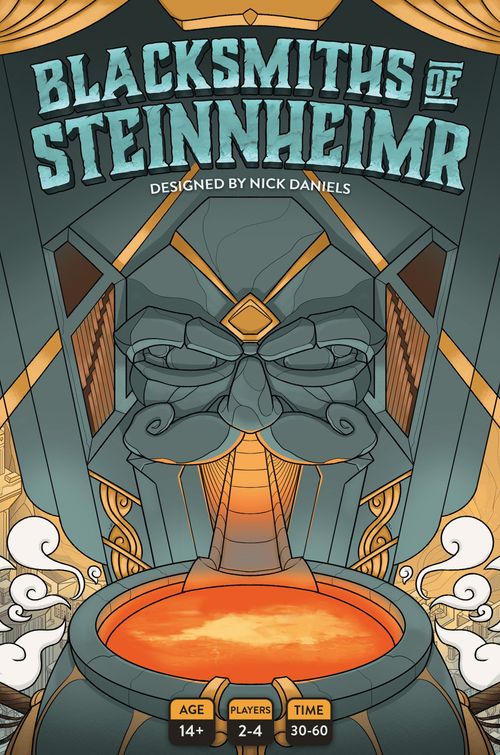
Blacksmiths of Steinnheimr
Blacksmiths of Steinnheimr Rulebook
Table of Contents
Table of Contents
Objective
The objective of Blacksmiths of Steinnheimr is to become the best blacksmith in the kingdom, which is achieved by being the player with the most victory points at the end of the game. Victory points are gained by crafting items and contributing to the town's development. The game will end once a set number of items has been crafted, or the town deck runs out of cards.
Components
- Game Board
- 7 Dwarves
- 54 Item Cards
- 30 Coins
- 80 Resource Tokens
- 26 Guild Cards (Upgrade Cards)
- 1 First Player Token
- 8 Bonus Objective Cards
- 20 Town Cards
Setup
- Place the Game Board in the center of the playing area.
- Shuffle the Item Cards and place them to the right of the board. Deal one Item Card onto each of the item spaces of the board, for a total of four items.
- Shuffle the Town Cards and set them to the right of the board. Deal one Town Card onto each of the town spaces, for a total of three Town Cards.
- Shuffle the Upgrade Cards and place them to the right of the board. Deal one Upgrade Card onto each of the guild upgrade spaces, for a total of three Upgrade Cards.
- Shuffle the Bonus Objective Cards and randomly select two. Place these face up next to the board, for all players to see. Return all other bonus objective cards to the box; they will not be used.
- Place a Dwarf on the board in each of the following locations: Furnace, Silver Mines, Market.
- Give each player a Dwarf and two Coins.
- Place the remaining Coins and all Resource Tokens into a general supply within reach of the players.
- Finally, the player who most recently worked in a forge is the starting player and takes the First Player Token. Alternatively, randomly decide a starting player and give them the First Player Token.
You are now ready to start playing Blacksmiths of Steinnheimr.
Gameplay Overview
Blacksmiths of Steinnheimr is a card collection, resource management and worker placement game with nine possible worker locations. Proceeding clockwise from the starting player, each player will take their turn in full before moving to the next player. On their turn a player will always do the following two actions in order:
- Place their Dwarf onto an open location and resolve the associated action
- Remove a Dwarf from a different location and resolve the associated action
All locations on the board can contain only one worker at a time. Players may optionally place or remove a worker without taking the associated location's action. Players will always start their turn with one worker and end their turn with one worker.
Board Locations
Mines
Steinnheimr is a kingdom rich in natural ores, allowing artisans to prosper. By taking the mining action players receive the indicated amount of ore from the chosen space.
- Iron - Three ore
- Silver - Two ore
- Gold - Two ore
- Mithril - One ore
Players can have a maximum of eight total resources (ore and ingots) at the end of their turn. If they go over this amount, they must discard down to a total of eight after resolving both of their worker actions.
If a Mine is ever out of ore, workers can still visit the location but cannot take the associated action.
Furnace
Essential to crafting items, the furnace will allow players to refine their collected ore into ingots. When using the furnace, a player can refine only one type of ore at a time. However, there is no limit to the number of ore that can be put into the furnace.
Once the ore has been refined, flip the associated resource to the ingot side of the token.
Anvil
The Anvil is the final step in crafting an item. The Anvil action allows players to craft only one item.
Return the ingots required to the general supply and acquire the associated Item Card.
A minimum of one ingot is always required to craft an item, regardless of the number of upgrades a player may have.
Once an item is crafted, fill its spot on the board with a card from the Item Deck.
Market
Visiting the Market allows players to exchange either their ore or ingots of a single type for a different type. Resources can be traded upwards at a 2:1 ratio or downwards at a 1:2 ratio. When taking the Market action you can trade as much as you can afford of a single resource type if desired.
Resources being traded must be the same and this means a player can not trade both ore and ingots in the same action. You cannot skip a level when trading resources, and you can only trade up or down one level per action.
Players may never trade among each other.
Blacksmith's Guild
The Blacksmith's Guild offers upgrades and lessons for a price. By visiting the Guild, players can purchase one of the available Upgrade Cards by paying its cost in coins, and acquiring the Upgrade Card.
The upgrade goes into effect immediately and can be used that turn during the player's second action.
Once an upgrade has been purchased, fill its spot on the board with a card from the Upgrade Deck. The benefits of upgrades can stack with each other, including duplicates of the same type (for example, you can have two Armorsmith's Tools upgrades, which would grant +4 victory points per Armor Piece). There is no limit to the number of Upgrade Cards a player can have.
Once per turn, players may pay two coins to discard all available upgrades and draw three new ones from the deck. This does not count as an action, and the player does not need to have a Dwarf at the guild to do this.
If the Upgrade Deck runs out, shuffle the discarded upgrades to form a new deck. In the event all upgrades have been purchased, players can still visit the Guild but not take the associated action.
Town
Steinnheimr has a constant need for labor and raw materials to expand the kingdom. By visiting the town square players can either work to earn three coins, or they can donate their excess materials to the expansion effort and acquire a Town Card. There is no limit to the number of coins a player may have.
Once a Town Card is acquired, fill its spot on the board with a card from the Town Deck. There is no limit to the number of Town Cards a player can have.
End of Game & Scoring
The end of the game will start once a set number of items has been crafted by a single player, based on player count, or when the Town Deck runs out of cards.
- 2 Players - 10 Items
- 3 Players - 8 Items
- 4 Players - 6 Items
Finish out the current round of play so that all players have an equal number of turns, then move to scoring.
Scoring
- Award the Bonus Objective Cards to the appropriate players. In the event of a tie, neither player is awarded the Bonus Objective Card.
- Total up all victory points across your Item, Town, and Bonus Objective Cards.
- Add in additional victory points from any upgrades purchased during the game.
- Convert unused resources to victory points based on the chart below. Ore and ingots are considered the same when calculating unused resource totals:
- 2 Coins = 1 VP
- 3 Iron = 1 VP
- 2 Silver = 1 VP
- 2 Gold = 1 VP
- 1 Mithril = 1 VP
The player with the most victory points is awarded the title of the best Blacksmith in Steinnheimr and claims victory.
If there's a tie, the player with the most total Item, Town, and Upgrade Cards wins. If still tied, the player with the most Coins wins. Finally, if still tied, the players share the victory.
Reference
- Item card: item name, item type, victory points, ingot cost, ore cost.
- Town card: card name, victory points, effect.
- Upgrade card: upgrade name, coin cost, effect.
- Bonus Objective card: card name, victory points, effect.
- Icons: iron ore, silver ore, gold ore, mithril ore, refresh; iron ingot, silver ingot, gold ingot, mithril ingot, victory points; Anvil, Town, Blacksmith's Guild, Furnace, Market.