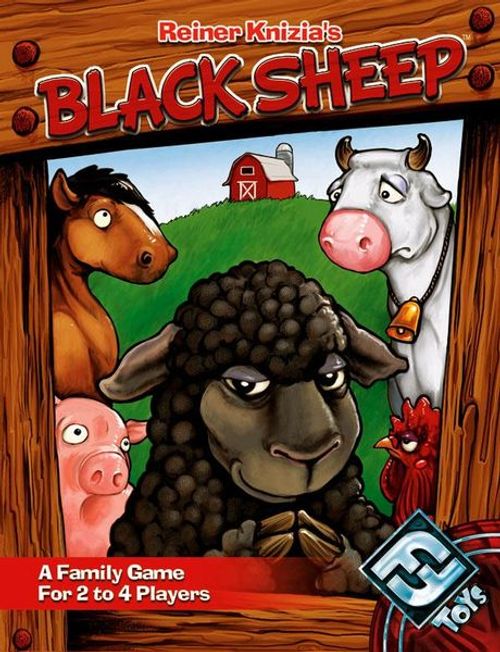
Black Sheep
Black Sheep Rulebook
Table of Contents
Table of Contents
Game Components
- This Rulebook
- 36 Plastic Animals (6 of each animal)
- 3 Field Mats
- 4 Corral Mats
- 4 Reference Cards
- 12 Task Cards
- 12 Six-point Bonus Cards
- 84 Animal Cards (14 of each animal)
Setup
- Place the three field mats in a row in the center of the table so all the barns of the same color face the same player, as shown in the Setup Diagram below.
- Place one corral mat in front of each player as shown in the Setup Diagram below.
- Mix up the animal figures so no player knows the value of any particular animal. Then separate the figures by type and place them where all players can reach them.
- Shuffle the animal cards into a facedown draw deck and place it where all players can reach it.
- Place the six-point bonus cards to the side until the end of the game. Remove the task cards from play unless the "task card" variant found at the end of these rules is being used.
- Draw two animal cards and place corresponding animal figures on one of the three field mats (it doesn't matter which one). For example, if a pig and horse were drawn, a pig figure and a horse figure would be placed on the field. Do the same for each of the other two fields so that each field is stocked with two figures. Place all animal cards drawn in this way faceup on a discard pile next to the draw deck.
- Each player takes three animal cards from the draw deck as his starting hand. Then all players moo. The loudest moo'er will play first. The game is ready to begin!
Placing Cards
Players take turns placing cards from their hands on the table. Cards are always placed adjacent to one of the three fields.
Players always (and only) play their own cards to the sides of the fields that face them. That is, the player who is faced by the red barns always (and only) plays cards to the sides of the fields where the red barns are, and never to any other sides of any fields.
Cards are always placed faceup, so all players can see which cards have been played.
When a player's turn to place cards comes, he must make two choices: Which field he will play cards to, and which cards from his hand he will place. Then, he might have the option to discard a card. He ends his turn by drawing one or more cards and checking to see whether any of the fields must be scored.
Which Field
Each side of a field can only "hold" three cards. If the side of a field a player already has three cards on it, he cannot choose that field. Otherwise, the player may choose any field to play cards to.
If three cards face the player on all three fields — an unlikely but possible circumstance — he skips his turn.
Which Cards
Any time a player places cards, either one card or two cards must be placed. If a player places two cards, he must place them adjacent to the same field. The options available depend on how many cards have already been placed on the chosen field.
- If there are no cards on the player's side of the chosen field, either one or two cards may be placed, as the player wishes.
- If there is one card on the player's side of the chosen field, two cards must be placed.
- If there are two cards on the player's side of the chosen field, one card must be placed.
Whether he places one or two cards, the player may always choose freely which of the three cards from his hand he will place.
Placement Strategy
When placing cards, a player's goal is to create the best combination of animals he can on each field, among the two figures already present and the three cards he will eventually play. The different combinations that can be made are described under "Scoring Fields," below. In general, the more similar animals in a player's combination, the better.
Discarding
If a player only played one card this turn, for whatever reason, he has the option to discard one (but not both) of the remaining cards from his hand to the discard pile.
Drawing
Once a player has placed cards (and discarded, if he wishes), he refills his hand to three cards by drawing from the draw pile.
If the draw pile is ever exhausted, the discard pile is shuffled to form a new one.
Check for Scoring
After drawing, a player checks to see if any of the fields must be scored. See "Scoring Fields," below. Players may also look at fields that have completed sides but are not yet ready to score and turn facedown any completed side that is already beaten. This makes it easier to keep a good overview of the game.
Play Proceeds
Once field scoring has been checked (and completed, if necessary), the next clockwise player's turn begins (or the winner of the field if scoring occured). Play continues in this fashion until the game ends (see "End of Game").
Scoring Fields
A field must be scored whenever three cards have been played to each player's side of it.
A field's winner is the player who created the best combination of animals there. Remember, combinations consist of a combination of the player's cards and the animal figures in the field.
There are seven different ranks of animal combinations. From best to worst, they are:
- Five of one animal type (highest)
- Four of one animal type
- Three of one animal type and two of another
- Three of one animal type
- Two of one animal type and two of another
- Two of one animal type (one pair)
- Highest single animal (lowest)
The different animal types are also ranked. From best to worst, they are:
- Horses (highest)
- Cows
- Pigs
- Sheep
- Roosters
- Black Sheep (lowest)
Breaking Ties
If two or more players tie for the best combination of animals, the winner is determined by the type(s) of animals in the tied group. For example, if two players each have a four-of-one-type animal combination, but one player has four cows while the other player has four pigs, the player with cows wins the tie-breaker.
For the "three of one, two of another" combination (#3 in the list above), the sub-group of three takes precedence over the sub-group of two. For example, if two players each have that type of combination, but one player has three horses and two black sheep while the other player has three pigs and two roosters, the player with the horses and black sheep wins the tie-breaker.
For the "two of one, two of another" combination (#5 in the list above), if two of more players tie for the highest pair, those players compare their second-highest pair as a tie-breaker.
For all combinations, if the animal types within the combination are tied, then the animal cards that are not part of the combination serve as tie-breakers. For example, if two players each have a three-of-one-type combination, and both of them have three cows, players look at their remaining two animals. If each player's next highest card is a horse, they must compare their final cards. If one player has a pig and the other player has a black sheep, the player with the pig wins.
For two or more identical combinations, the first completed combination wins over subsequent combinations with the same animals.
Awarding the Animals
The player who wins a field takes the two plastic animals from it and places them on his corral mat in in the appropriate area(s). Players may look at the values of the animals in their corrals at any time.
Continuing Play
Once the plastic animals are awarded, all cards played to the just-scored field are removed to the discard pile.
Then, two animal cards are drawn from the draw pile and corresponding animal figures are placed on the just-vacated field mat.
If one of the two cards drawn corresponds to a type of animal for which there are no remaining plastic animals in the stock, place a plastic animal of the type that remains and then draw a replacement card for the animal type that has been exhausted. Draw replacements one at a time until a card is drawn for which a plastic animal remains; that animal is then stocked to the field. For example, if a horse and rooster are drawn, and there are remaining plastic horses but not remaining plastic roosters, place a horse on the just-vacated field and draw new animal cards, one at a time, until the field can be filled. If drawing cards to re-stock a field mat exhausts the draw deck, shuffle the discard pile to form a new one and continue drawing, if necessary.
If both of the two cards drawn correspond to a type or types of animals for which there are no remaining plastic animals in the stock, no new plastic animals are placed and the game will end soon. See "End of Game," below. For example, if a sheep and rooster are drawn but there are neither sheep nor rooster plastic animals remaining, the field is not filled and the game will end soon.
In any case, once the field is either filled, or it has been determined that it will not be filled (because the end-game has been triggered), place all of the drawn cards in the discard pile. Then, play resumes, with the player who won the field taking the next turn.
End of Game
When both of the cards drawn to re-stock a scored field correspond to plastic animals whose supply is exhausted, the game is about to end. Instead of re-stocking that field, turn the corresponding field mat upside down. Cards may no longer be played there.
Then, play continues normally, save that only two fields remain. When either of these fields must be scored, this is done normally, except that once the field's winner has been determined, the field mat is turned facedown rather than being restocked, no matter how many plastic animals remain available. Then, play continues normally with just one field, until it, too, must be scored. Once a winner has been determined for that field, the game ends and the overall winner is determined.
Determining the Winner
After the game ends, each player adds up the values of the animal figures in his corral. Each animal is worth one, two, or three points depending on the number shown on the bottom of the animal. Remember that the black sheep figures subtract their point values from a player's total.
The bonus cards are also awarded at this time. There are two ways to earn bonus cards: for majorities, and for sets. Each bonus card a player collects, whether from a majority or set, adds six points to his overall score. A majority is awarded to the player who collected the most animal figures of a given type, regardless of their point values. For example, the player who corralled the most horses takes a bonus card. If two players tie for a majority, no player gets a bonus for that animal type. A set is a collection of one animal of each type (i.e., one horse, one cow, one pig, one sheep, one rooster, and one black sheep). For each set a player has, he takes a bonus card. There is no limit to the number of set bonuses that can be claimed.
The player with the highest overall point total is the winner. If there is a tie, the player with the most animals wins. If there is still a tie, all tied players are joint winners.
Task Card Variant
Variant Designed by Fantasy Flight Games
Task cards represent jobs assigned to the farmhands. A player who fulfills the conditions on the task cards is rewarded at the end of the game with points.
During Step 5 of "Setup," remove the six-point bonus cards from play (they will never be used), and instead deal one task card per player (or two per player in a two-player game). The task card is kept secret from the other players. In addition, a number of additional task cards are placed faceup on the table so that the total number of task cards in play equals six.
The task cards with scales represent tasks that require a player to gain the majority of animals of a certain type. The player with the most animals of the indicated type scores the number within the sunflower. The only difference between task card majorities and bonus card majorities (as described above) is that if multiple players tie, having the same number of animals, all tied players score the sunflower bonus.
The tasks with animals in a field represent tasks that require a player to corral the combination of animals on the card. If successful, the player scores the number within the sunflower for each matching combination.
The task represented by an exclamation point in the sunflower and a flock of black sheep is to be the only player to collect any black sheep. If successful, that player wins the game regardless of points.
After the game ends, players reveal the task cards that were previously kept secret and place them in the row with the "community" task cards that have been faceup throughout the game. Each card is then evaluated, with the player who completed the task gaining the points listed on the card. If two or more players both meet the conditions on the card, they each receive the amount of points on the card.
The points from the task cards and the points from the animals collected are added together to form a player's score. No additional bonus points are awarded.