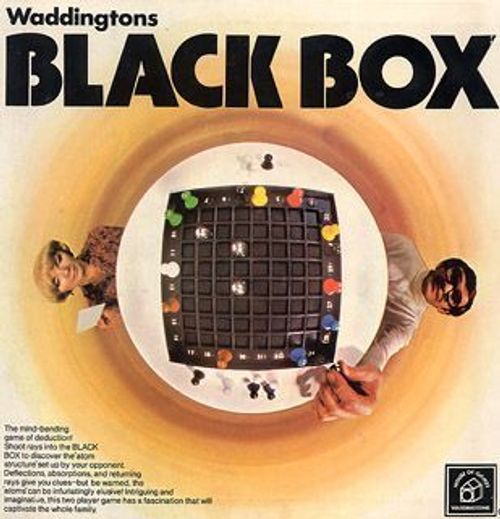
Black Box
Black Box Rulebook
Table of Contents
Table of Contents
- Equipment
- A Strategy Game
- Hide and Seek
- The Rays
- The Movement of Rays: Hit, Detour, Reflection and Miss
- Marking
- Ray Movements/Special Effects
- Ray Movements/Multiple Detours
- Playing/An Outline
- Scoring
- Winning
- A Practice Game
- Solitaire Play
- Examples of Basic Ray Movements and Proper Markers (Quick Reference)
Equipment
In the box you'll find 5 balls, 48 markers, 1 pattern/score card and a crayon. Not included, but needed to erase the pattern card, is a tissue or piece of soft cloth.
A Strategy Game
This is a strategy game for either 1 or 2 players. Whether you play alone or against an opponent, the game play is the same. First let's look at the 2-player version; this version presents the basic information that's also needed for solitaire play.
Hide and Seek
This is a game of hide and seek. One player hides; the other player looks for it. The hiding is done on the pattern card, the seeking is done in the box.
Place the pattern card next to the box. You'll see that both are exactly the same design. Both show numbers from 1 to 32 on the outside.
Decide between you who will hide and who will seek.
Hider. Without showing your opponent what you're doing, make four marks on the pattern card. You may make these marks in any four of the squares.
Seeker. Your task is to find each hidden location inside the box. You try to do this in as few tries as possible.
During a real game you would not see the pattern card until you finished your search. Now, however, take a look at the card. Place it next to the box. Then place a ball into the box to match each mark on the card.
This is the object of the game: to find each hidden location and mark it with a ball. After you've done this, you and your opponent then change sides: you do the hiding; your opponent does the seeking. The one to find each other's hidden locations in the fewer tries is the winner.
How do you find the hidden locations? This is where the fun and the challenge come in. In seeking the hidden locations, you're like a detective looking for clues. Your tool: imaginary rays.
The Rays
By sending rays into the box you — the seeker — gain clues about the hidden locations.
To send a ray into the box, simply announce the number of the square where the ray enters. Once the ray enters the box, the ray does one of three things:
a) it stays inside the box; b) it comes out exactly where it entered; or c) it comes out somewhere else.
Your opponent is able to observe the ray's movement with the pattern card and tells you exactly what happens to the ray.
Here's what the rays look like and what kinds of clues they offer.
The Movement of Rays: Hit, Detour, Reflection and Miss
HIT: If a ray travels directly into a hidden location, it does not leave the box. When the seeker's announced entry point sends a ray straight into a hidden location, the hider answers HIT and the seeker places a red marker at the entry point.
DETOUR: A ray cannot travel past a hidden location that lies directly next to its path. Instead, the ray detours 90° away from the nearest corner of the hidden location's square. If the ray approaches from the left, it detours to the left; if it approaches from the right, it detours to the right. A DETOUR takes place at the nearest corner of a hidden location's square, and the seeker marks the entry and exit points with a pair of matching orange symbols.
REFLECTION: If a ray leaves the box at the same point from which it entered, a REFLECTION has taken place. A REFLECTION can take place in either of two ways:
a) Two DETOURS can cancel each other out, forcing the ray to travel back along its path. This happens when a ray is forced to detour toward a second hidden location's nearest corner, and that detour cancels the first, sending the ray back the way it came.
b) A ray that tries to enter the box right next to a hidden location cannot travel past the nearest corner of the hidden location. As a result, it is forced to remain at its starting point. This is a REFLECTION, too.
When a REFLECTION takes place, the seeker places a yellow marker at the entry/exit point.
MISS: If a ray does not encounter a hidden location, it travels through the box in a straight line. A MISS gives one clear path between the ray's entry point and its exit point on the opposite side of the box, and the seeker marks both the entry and exit points with a pair of matching orange symbols.
Marking
To keep track of your rays, you — the seeker — place ray markers on the box. There are three kinds: red markers, yellow markers and orange markers with symbols on them. Notice that the symbols are in pairs. You use the markers in this way:
a) A HIT requires a red marker at the ray's entrance point.
b) A REFLECTION requires a yellow marker at the ray's entrance/exit point. (A yellow marker is like a mirror image of a yellow ball — an easy way to remember how to mark a REFLECTION.)
c) A DETOUR or MISS each requires orange markers with matching symbols at the ray's entrance and exit points.
Ray Movements/Special Effects
A ray is forced to DETOUR because a hidden location lies closer to the ray's entrance point than to the point where the ray would otherwise leave the box; the ray cannot travel past that hidden location's nearest corner.
Compare a DETOUR with a HIT: a HIT takes place when a hidden location is directly in line with the ray, so the ray travels straight into it. A REFLECTION, by contrast, takes place when the hidden location that would otherwise cause a HIT is further away from the ray's entrance point, so a second hidden location's DETOUR sends the ray back the way it came instead.
Ray Movements/Multiple Detours
Sometimes a ray encounters a number of hidden locations on its path. When this happens, the results can be misleading — the ray may DETOUR around more than one hidden location in turn, or two DETOURS may combine into a REFLECTION, before the ray finally leaves the box (or stops, in the case of a HIT).
Playing/An Outline
You're about to play a practice game. Before you do, look over this outline. It should give you a complete understanding of game play.
- You and your opponent decide who will hide and who will seek.
- The two of you then decide whether to play with 4 hidden locations or with 5. A game with 5 hidden locations is usually more difficult.
- The hider marks the hidden locations on the pattern board.
- The seeker then looks for the hidden locations by sending rays into the box: a) By using the pattern card, your opponent — the hider — tells you the result of each ray's travel. b) You place appropriate marker(s) for each ray.
- When you — the seeker — find a hidden location in the box, mark that point with a ball. If further clues tell you that you've placed a ball incorrectly, you may move that ball as often as you want.
- When you think you've found the exact position of each hidden location, announce that you're finished.
- Compare your final ball placement with your opponent's pattern card.
Scoring
a) Your base score is the total number of ray markers that you've used. Each marker — whether red, yellow or orange — counts as 1 point.
b) 5 points are added to your score for each incorrectly placed ball.
c) 5 points are subtracted from your score for each time that your opponent — the hider — gave you incorrect information. Therefore, if you've placed a ball incorrectly, check your ray markers to see whose fault it was. If an incorrect placement was not your fault, you are not penalized; only the hider is.
Example: Let's say that the hider said HIT when he or she should have said REFLECTION, and thus caused you to place a ball incorrectly. Let's also say that you used 17 ray markers during the game. In this case your final score would be 17 minus 5, or 12.
Winning
You and your opponent then reverse roles: the hider becomes the seeker and the seeker becomes the hider.
The one to find the other's hidden locations with the lower score is the winner.
A Practice Game
To help confirm what you've learned, it's important that you play this game.
First decide who will hide and who will seek. The hider should then pick up this booklet and read the next few lines orally.
Hider: In secret, mark the pattern card as shown in Figure 1 (four hidden locations).
Seeker: Look for the hidden locations in as few tries as possible.
Hider: You may, if it's necessary, consult the following list. It shows each ray's entrance point, travel result and proper marker(s).
Either Player: For information on basic ray patterns and markers, you may consult the illustrations on the booklet's back cover.
Seeker: To start playing, send a ray into the box from any numbered location.
(If you're playing alone, you play the roles of hider and seeker at the same time. Therefore, do not look at Figure 1 until you've made your final ball placement. To start playing, send a ray into the box from any numbered location. Consult the middle column to learn each ray's travel result. Consult the right-hand column if you have any questions about ray markers. Instructions for Solitaire Play follow this Practice Game.)
The practice game's hidden locations produce this sequence of rays, results and markers:
| Seeker Says | Hider Responds | Seeker Places |
|---|---|---|
| 1 | Hit | A red marker at 1. |
| 2 | Reflection | A yellow marker at 2. |
| 3 | Reflection | A yellow marker at 3. |
| 4 | Hit | A red marker at 4. |
| 5 | 13 | Matching symbols at 5 and 13. |
| 6 | Hit | A red marker at 6. |
| 7 | Hit | A red marker at 7. |
| 8 | 10 | Matching symbols at 8 and 10. |
Solitaire Play
On the following pages of the original booklet are 80 games for single-person play. Each of these games has been developed, tested and refined with the aid of a computer. The pages are divided into two sections: Look-Up Tables and Game Solutions.
To play:
- Choose one of the 80 numbered games. Games 1-70 require you to look for 4 hidden locations; the final 10 games present 5 hidden locations each.
- Select a numbered location for a ray's entrance and turn to the page in the Look-Up Tables that shows this number on the top.
- Look down the page for your game's number. Next to it you'll see the result of the ray's movement.
- Place your ray marker(s).
- Continue to send out rays, and to place markers and balls, until you're satisfied that you've found all of the hidden locations.
- Check the results of your final ball placements. To do this, find your game's number in the Game Solutions section.
In this section you can also check your score. Next to a game's diagram you'll see a NORM reference. The NORM represents the number of ray markers which, as determined by computer, the average player should use to find the hidden locations.
The original booklet's Look-Up Tables (one table for each of the 32 possible ray-entrance points, each listing the ray's result for all 80 games) and Game Solutions (a hidden-location diagram plus NORM score for each of the 80 games) are omitted here as bulk reference data rather than rules of play.
Examples of Basic Ray Movements and Proper Markers (Quick Reference)
- HIT — Seeker says 13; Hider says HIT; Seeker places a red marker at 13.
- DETOUR — Seeker says 2; Hider says 5; Seeker places matching symbols at 12 and 5.
- REFLECTION — Seeker says 4; Hider says REFLECTION; Seeker places a yellow marker at 14.
- MISS — Seeker says 3; Hider says 2; Seeker places matching symbols at 15 and 26.
Remember these effects, too:
- HIT — Seeker says 9; Hider says HIT; Seeker places a red marker at 9.
- REFLECTION — Seeker says 10; Hider says REFLECTION; Seeker places a yellow marker at 10.
- DETOUR — Seeker says 10; Hider says 17; Seeker places matching symbols at 10 and 17.