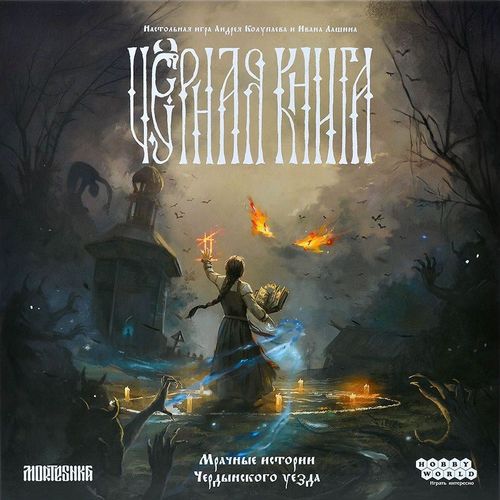
Чёрная книга (Black Book: The Board Game)
Чёрная книга (Black Book: The Board Game) Rulebook
Table of Contents
Table of Contents
- Contents
- The Game Campaign
- Setup
- The Story Book
- Description of Gameplay
- Goal of the Game
- Character
- The Game Day
- Night
- Check
- Combat
- Special Character States
- Other Rules
- Enemy Effects
- Special Enemies
- Symbols and Description of Game Actions
- Demon Effects
- Campaign Envelope
- Achievement Sheet
- Icon Glossary
Contents
- 1 game board
- 1 story book
- 2 tile bags
- 25 natural-item tokens
- 25 crafted-item tokens
- 4 character standees and plastic stands
- 7 white dice
- 7 black dice
- 4 character sin counters
- 1 special-enemy health counter
- 4 character boards
- 30 ruble tokens (15 of value 1, 15 of value 3)
- 36 wound tokens (18 of value 1, 18 of value 3)
- 1 discontent marker
- 4 request-marker tokens
- 2 discontent-track event tokens
- 1 achievement sheet
- 1 time token
- 1 first-player token
- 1 rulebook
- 24 job cards
- 8 useless-job cards
- 20 black word cards
- 20 white word cards
- 5 helper cards
- 14 numbered story cards
- 15 enemy cards
- 8 reminder cards
- 10 deal cards
- 32 main request cards
- 15 strong-enemy cards
Assemble the counters before your first game. The discs for the sin counter have a larger diameter, and their values go up to 13. The discs for the special-enemy health counter are a bit smaller, and the left disc differs from the right one — check that they are oriented correctly before you finally secure the plastic axle.
Story Components
- 52 story-specific request cards
- 23 story boards
- 6 location tokens
- 16 scenario-marker tokens
- 1 campaign envelope
- 6 "Agronomist" tokens
- 6 "Bell" tokens
- 1 "Rooster Horse" token
- 1 "Field Mistress" token
- 1 "Horse" token
- 1 "Funeral" token
The Game Campaign
In the box with the game, you will find six different stories, each of which can be played as many times as you like. You can also combine them into a single campaign. All the stories are available to play from the very start, but we recommend playing them in a specific order, one after another. The outcome of each story will affect the finale of the whole campaign. You may, but are not required to, always play with the same characters in the same lineup. You will begin each story of a campaign with a "clean slate," carrying out the usual game setup. Characters do not carry word cards, items, sins, or helpers over between stories. However, in every game you will be able to unlock and use additional job cards and starting word cards for your characters.
As you progress, you will regularly need to make choices, the results of which will bring about changes in later games — for example, adding new components to the game from the campaign envelope. You will also make marks on the achievement sheet, which will influence how the overall plot develops.
Stories and Their Symbols
- Progress
- Blight
- Wolves
- Rusalka Week
- Master of Frog Affairs
- End of the World
It is recommended to play the stories in the order listed above. If you wish, you may swap the stories around, but the "End of the World" story must be played only after all the others have been completed.
For the Chosen Knowers
If this is not your first campaign in Black Book, or if you want to raise the tension at the finale of each story, mark the "Chosen One" achievement on the achievement sheet.
Setup
-
Place the game board in the center of the table. Place the discontent marker on the starting space of the discontent track at the bottom of the board. Place the 4 and 7 tokens number-side up on the corresponding spaces of this track.
If you want to raise the game's difficulty, place the discontent marker one (hard) or two (very hard) spaces to the right of the starting space on the discontent track.
-
Shuffle the deal-card deck, the useless-job-card deck, and the regular- and strong-enemy decks separately, and place them next to the game board.
-
Within reach of all players, lay out the dice, rubles, wound tokens, and the health counter for special enemies.
-
Next to the board, set up the market, as shown in the illustration:
- Shuffle the black word cards and the white word cards that carry the market symbol in their top-right corner separately, forming two decks. Reveal three cards face up from each deck.
- Put all the natural-item tokens in the green bag and all the crafted-item tokens in the brown bag. Then lay out three tokens from each bag face up on the market.
-
Each player chooses a character and takes that character's components: a character board, a character standee with its stand, a personal-request token, job cards, starting word cards, and two reminder cards. If you are playing solo, instead choose any two characters.
The letter printed on a card shows which character it belongs to: А – Alexander, В – Vasilisa, Д – Grandpa Yegor, Е – Evgenia.
-
Each character takes a sin counter and sets it to the starting value shown on the back of their board.
-
Each player places their character standee in the location shown on the back of their board, along with the starting resources shown there as well (rubles and items). Items are placed on the corresponding spaces of the board, and rubles next to it.
-
Each character takes the set of dice shown on their board.
-
Each character places 2 starting word cards in the special slots beneath their board. If during the campaign you have unlocked new starting cards for your character, you must choose 2 of them. Put any unused starting cards back in the game box. (Note that all unlocked job cards stay with the character for the entire campaign.)
-
When playing with two characters, each character also takes 1 random helper card. Put the remaining helper cards back in the box.
-
Put the components of unused characters back in the box.
-
Determine the first player. The first player is whoever sinned most recently. They take the corresponding token. If there is a dispute over who gets the token, determine the first player randomly.
Story Setup
Choose the story you will play. Read the prologue and carry out the instructions given there.
During this setup, you always place:
- the board of the chosen story next to the game board,
- the main-request and special-request card decks of the chosen story next to the story board,
- the story's scenario-marker tokens and other story components.
Note that word cards, sins, and items (other than "starting" ones) that players accumulated during previous games do not carry over into the next game.
The Story Book
The story book is the main component of the game, immersing players in the world of Black Book. Read it carefully and follow all the instructions given on its pages. The book's text may prompt you toward one game decision or another.
Before each story begins, players will read a prologue, which contains the story's special setup, brings players up to speed on events, and introduces the story's special rules.
Prologue (example): "Progress does not stand still — a Mister N. has arrived from the capital, a great enthusiast of technical novelties. He has decided to build a power station, so as to supply the whole district's factories with energy. But not a common power station..." (the example text fades out here in the printed book).
During the game, players will frequently refer to the text in the story book's numbered paragraphs. Each time a game action sends players to a specific paragraph, they must find that paragraph in the current story in the story book and read it.
Paragraph example: "Father Nikolai of Vilgort is troubled by recent events. The people are very unhappy about the construction of the power station. Perhaps it is worth listening to..." (the example text fades out here in the printed book).
Description of Gameplay
Each story consists of days, and each day consists of morning, noon, evening, and night. In the morning, at noon, and in the evening, the players' characters move around the game board — the Cherdyn district — and carry out various actions. These can be actions provided by the location itself, by the story board, or by fulfilling a request. In the night phase, the game refreshes: new requests are drawn, events tied to the population's discontent are resolved, the story advances, and characters interact with their personal demons. Throughout a story, characters grow stronger, learning new word cards and gaining useful items needed to succeed at checks and fights.
Goal of the Game
Black Book is a cooperative game. This means all the players win or lose together. Your task is to achieve the goal you learn about in the story's prologue.
The players lose if, at night, the discontent-track marker is on the final space, or if they have not fulfilled the story's special conditions. In campaign mode, the players will then need to replay that story.
As a rule, at the end of a story you will face a special enemy, whom all the players will fight according to special rules. The players are defeated if they fail to overcome the special enemy in the final battle; even so, they may continue on through the campaign.
Character
A character's board reflects that character's capabilities in the game.
- Information about the attack and defense dice used in combat and at checks.
- Information about the character's ability, which can be used in certain locations in addition to the main action.
- The character's health value.
- 3 demon slots, which carry a permanent negative effect if the player does not send them to work (see "Deal with the Demons" on page 13).
- Conspiracy — 4 slots for word cards used in combat or at checks.
- Inventory — 6 slots for placing item tokens.
- The back of the character board shows information about starting setup and the character's backstory.
- Each character also has a personal sin counter.
Character Health
If the total number of wounds on a character's board equals or exceeds the character's health, the character is defeated. In that case, the player draws a deal card, which states the condition for ransoming that character's life, and all players receive a negative effect. For more, see "Defeated Character" on page 20.
Sins
Each character has a sin counter. If a character's sin count reaches 13, the player draws a deal card and makes a choice. One option is to refuse the deal (in which case the character applies a negative effect and lowers their sin count); the other option is to accept the Unclean One's gifts and become a "cursed character." For more, see the "13 Sins and the Cursed Character" section on page 20.
Demons
Each character is accompanied by personal demons, which make their life harder. At night, the player may send their character's demons to work in order to reduce their negative influence. While working, the demons bring benefit to their master, but at the same time also increase that character's sin count.
The Game Day
A game day consists of 4 phases: morning › noon › evening › night.
Morning, Noon, Evening
Starting with the first player and proceeding clockwise, players each take one turn. When the turn order comes back around to the first player, they advance the time token one space forward, and a new phase of the day begins.
A player's turn in the morning, at noon, and in the evening consists of 2 steps — movement and action.
1. Movement
Move your character's standee 0, 1, or 2 locations. Movement cannot be "interrupted" to perform actions, use items, or trade with other characters. All actions are carried out only after movement.
Locations
There are three types of locations on the game board:
- Settlements, where during story events and while fulfilling requests, players generally interact with the local population.
- Enterprises, where events tied to people's economic activity take place, and where conflict between man and nature often arises.
- Wildlands, where you will most often encounter the fearsome and mysterious world of Cherdyn's evil spirits.
Vasilisa wants to reach the Mill location during the day. In the morning, at the start of her turn, she may either stay at the Salt Works, or move one location to the Station, or move two to Bondyug, in order to get closer to the Mill.
2. Action
Choose one of 3 possible actions, if available in the current location. You may also choose not to perform any action.
A. Perform a Location Action
While in a location, apply each effect shown at the bottom of the location. Location effects can be either mandatory or optional (see "Symbols and Description of Game Actions" on page 24). If a location shows several effects, carry them out in any order.
Grandpa Yegor performs the actions of the Cherdyn location. He may buy one white or black word card from the word-card market, and one natural item and one crafted item from the item market.
Alexander performs the actions of the Mill location. He takes a useless-job card from the useless-job pile into his hand and heals all wounds on his board.
Evgenia is not a cursed character, so she can perform the action of the Lake location. Evgenia must reduce her sin counter by one and fight a regular enemy.
B. Fulfill a Personal Request
If your character is in the location shown on a request card, you may perform the action that card provides. Before doing so, you read aloud the card's flavor text and state the conditions for successfully fulfilling the request.
Most often you will need to fulfill one of three types of requests: enter combat with an enemy, pass a check, or discard items/rubles. Some cards require that you fulfill the request during a specific phase of the day (morning, noon, or evening). You may receive the reward for fulfilling a request only if you have fully met the card's condition — that is, if you defeated the enemy, successfully passed the check, or discarded the stated items/rubles. In that case, you always discard the request card. The discard pile for request cards sits next to the corresponding deck.
Personal request cards are tasks that players receive each day. Request cards state the conditions a character must meet in order to fulfill the request and receive the reward shown on the card. Only the character who received the request may fulfill it. Some requests are special story cards, and they can affect how the plot unfolds. Failing to fulfill requests increases the population's discontent, and this can lead to defeat in the game.
The player takes the request card into their hand and reviews its conditions. They also place a request marker on the location shown on the card. The player may ask other players for help by stating the conditions for successfully fulfilling the request (for example, that a strong enemy must be defeated, or a difficult defense check passed), but may not read the card's flavor text aloud at the moment of receiving the request card. That text is read aloud at the moment the request is fulfilled during play. On some request cards, the player will be offered a choice between one of two ways to resolve the situation. (In all cases, if instructions in the story book, a story board, or a request card conflict with these rules, the instructions in the story book, story board, or request card take priority.)
If a request card offers several ways to fulfill it, choose one of them. If you fail to fulfill the request with the option you chose, you may return to the second option only on your next turn.
If you fail to fulfill the request (you failed the check, did not defeat the enemy, or did not discard the items/rubles), you do not discard the card unless the card's own text states otherwise. However, you may fulfill its conditions on any of your following turns. If a request is attempted again, its flavor text does not need to be read aloud again.
Some request cards may require players to meet their conditions during a specific phase of the day, for example in the morning or at noon. If a player does not fulfill such a request card in time, the card's text will require the player to discard it in the evening and apply a negative effect.
On her turn, Evgenia came to Bondyug to fulfill a request. To succeed, she must either pass a check of 12, or discard a valuable item from her inventory.
Evgenia decided not to tempt fate and not attempt the check, since she has a valuable item she can discard.
As a reward for fulfilling the request, Evgenia takes two random natural items from the bag and places them in her inventory. She then discards the fulfilled request card.
C. Perform a Story Action
The story board contains the story's special rules, which supplement the game rules.
For example, in the first chapter of the "Progress" story, as soon as there are 9 tokens on the game board, players immediately read paragraph 23.
If reading a paragraph instructs something to be lost or gained, it refers to the active player, unless the paragraph's text states otherwise.
The story board may list actions available to players in certain locations. As a rule, performing these actions advances players through the story's plot and, most often, leads to reading a specific paragraph in the story book.
As a story action, players may, in a location with an anchor icon and without a checkmark token, read the paragraph in the story book corresponding to the current location's number.
Sometimes a story action carries a "lightning" mark. In that case, you may perform the story action as a separate action, or in addition to another action. In that case, you choose the order in which to perform the actions.
Character Ability
If, after moving, the active character is in the location shown on their board, the player may use the character's ability before or after their main action.
After moving, Grandpa Yegor is in Vilgort. He can use his ability — return a job card to his hand — to move to any location. After that, he can perform an action in that location. Or, he can perform his action in Vilgort first, and then use his ability to move.
At Any Time
-
Any character may discard an item from their board into the bag in order to use its property.
For example, a non-active player may discard an item that lets them move their character to an adjacent location, in order to take part in a fight or a check (even if that fight or check has already begun).
-
Any character may give rubles and items to other characters of their choice in the same location. This can be done at any time, including at night or during a failed check (but not during movement).
For example, during a fight, Grandpa Yegor may give Alexander 2 rubles so that Alexander can use them to activate a property of his word card. After the fight, Alexander may return those rubles, though he is not obligated to.
Night
When the time token moves to the "night" space, players carry out the instructions in the "Night" section of the story board, in the order given. As a rule, these actions "refresh" the game, and players do not need to make decisions at night. Some night actions are stated briefly on the story board and are explained in this section of the rules.
Night steps (example): 1. Discard request cards from hand — increase discontent by 1 for each discarded card and by 1 for each cursed character. 2. Increase discontent by 1. 3. Resolve the discontent-track event. 4. The first player takes a special request card; the other players each take 1 main request card. Pass the first-player token. 5. Deal with the demons. Restore helpers.
In the first chapter of the "Progress" story, during the night phase players carry out 5 steps in order. Every story differs in the number of night-phase steps and the actions players must perform.
Discard Request Cards from Hand
Increase discontent by 1 for each discarded card, and increase discontent by 1 for each cursed character.
If a player did not fulfill a request during the whole past day, that request card is discarded in the night phase. For each card discarded this way, the discontent marker must move one space to the right on the discontent track. Players also move the discontent marker one space to the right for each cursed character. If a character becomes cursed during a later step of the night phase, players do not move the marker for them.
Resolve the Discontent-Track Event
If, over the course of the day, the marker on the discontent track passed over a token or ended up on a token bearing a paragraph number from the story book, players must read that paragraph. If the marker passed over several numbered tokens at once, players read only the last one. After reading, the story book will instruct players to flip the passed tokens on the discontent track face down. Players read each paragraph on the track at most once per game.
Reading paragraph 10 always means the players are defeated.
Note that you do not read the discontent-track event text during other phases of the day — only at Night. This means that if you reach the paragraph-10 marker outside the night phase, you can still win if you finish the game before night falls.
Take Request Cards
Players take main- and special-request cards according to the instructions on the story board. If a player must draw a card from a request deck and no cards remain in it, players read paragraph 10, unless the story board states otherwise.
Deal with the Demons
Each player applies the effect of the job cards lying in the corresponding slots of their board. The more advantageous a job is for the player, the more sins it brings their character. Used job cards are set aside. The player then places other job cards from their hand onto their board. Afterward, players return to their hand all the used job cards set aside earlier. All players perform this action simultaneously. (At the start of the game, while reading the story's prologue, there are no job cards on players' boards. They must be placed following the normal rules.)
If a job card requires a character to discard a ruble or gain a sin, and the character does not have enough rubles, they must gain a sin instead.
A player may fill any number of the slots on their board with job cards, but for each slot not filled with a job card, the character suffers a negative effect throughout the entire following day. If a slot holds a job card, that effect does not trigger; however, at night the player gains sins from each job card placed there. Such is the path of a Knower — between profit and sin.
If, during this night phase, any character reaches 13 sins, they draw a deal card (see "Special Character States" on page 20). If several players reach 13 sins at the same time, deal cards are resolved starting with the first player and proceeding clockwise.
Example: during the "Deal with the Demons" step, Vasilisa applies the effects of all the job cards lying in the demon slots above her board. The "Snatch Carol Gifts" card lets Vasilisa take three natural items from the bag, choose one to keep, and return the rest to the bag. "Steal a Duckling" lets her heal 2 wounds, and "Con the Card Players" earns Vasilisa 2 rubles. She also gains a total of 4 sins from these job cards. The player then sets aside the used job cards from Vasilisa's board. Into the now-empty slots, the player places 0 to 3 job cards from hand. The player decides not to place a job card in the "Musya" demon's slot, so throughout the following day, the cost of buying items at the market for Vasilisa is increased by 1 ruble. The job cards set aside earlier are returned to the player's hand.
Check
A check is a special game action that occurs when the active player takes this action as a result of reading the story book, or while fulfilling a personal request.
Each check has its own type (attack or defense) and difficulty. If a check's difficulty is high and many players are taking part in it, use the special-enemy health counter to track the check's results.
A check consists of the following steps:
- Each player may swap their word cards in the conspiracy for others from their hand.
- All players whose characters are in the location roll their dice, apply properties that let them change the number of dice or their values, and place dice on their word cards. Also at this step, players apply item properties to improve their result.
Order Cards
Order cards are used only if a die is placed on them. Only then does their effect trigger. (For more, see "Word Cards and the Conspiracy" on page 21.)
Key Cards
Key cards do not require a die to be placed on them. (For more, see "Word Cards and the Conspiracy" on page 21.)
- Add up the check results of all characters.
- Determine the result:
- Success — if the combined result of all characters is greater than or equal to the check's difficulty, the check is passed successfully. In this case, the story book or the request card states what to do.
- Failure — if the combined result is less than the check's difficulty, the players fail. In this case, the story book or the request card states what to do.
Grandpa Yegor moved to the Salt Works location to fulfill a personal request, attempting to pass a defense check of 11. ("The thief's hat is on fire" — the salt works manager asks you to find the petty thief who has been stealing salt from the warehouse. You could talk to the local spirit — he will point out the culprit. Pass a check of defense 11, or discard a ruble. If you did, receive 5 rubles.)
Grandpa Yegor rolls his dice. He gets 2 defense and 5 attack. By placing the 4-attack die on the "Whale-Fish" order card, Grandpa Yegor converts that 4 attack into 4 defense. In total, he now has 6 defense — not enough to pass the check.
Fortunately, Vasilisa has an item that lets her instantly move to a location with the anchor icon. She discards a token from her inventory and moves from her own location to the Salt Works, to Grandpa Yegor, so she can now help him pass the check.
She rolls her dice and gets 4 defense, plus 2 defense from the "Slave" key card, for a total of 6 defense. The characters now have a combined total of 12 defense. Grandpa Yegor has successfully passed the check and fulfilled his personal request.
Combat
Combat is a special game action that occurs when the active player, while performing a location action, triggers the "enemy encounter" or "strong enemy encounter" effect, or when it results from reading the story book or from fulfilling a request.
Assign Enemies
Players reveal the stated number of evil-spirit cards from the corresponding decks and lay them out next to the game board. Players then review each enemy's property. Note that some enemy properties have a persistent effect; in that case, they apply during specific rounds of combat, as stated on the enemy card. The active player then assigns at least one enemy to their own character, and must assign the rest to themselves or to other characters in the location, if any are present. If there is only one enemy in the fight, it is always assigned to the active player's character. A character with no enemy assigned to them usually takes no damage in this fight, but may still deal damage. All characters in the location take part in the fight, whether they wish to or not (a Knower is always considered to help another Knower fight an enemy).
Swap Word Cards in the Conspiracy
Each player may swap their word cards in the conspiracy for others from their hand. If a character enters the fight during the second or third round of combat, the player may still swap the cards in the conspiracy on the character's board.
If, at the end of the first and second rounds of combat, the characters have neither won nor lost, the fight continues into the next round.
Enemy Effects
Apply the enemies' "at the start of combat" effects. If a character enters the fight during the second or third round, the enemies' "at the start of combat" effects also trigger for them.
Feral Susedko — 6 attack / 11 health. At the start of combat: discard 1 item. Reward: an item.
Three Rounds of Combat
Combat takes place over three rounds, each consisting of three sequential steps: dice roll, character step, and enemy step. All steps are carried out simultaneously for every participant in the fight.
A. Dice Roll
All players whose characters are in the location simultaneously roll their dice, apply properties that let them change the number of dice or their values, and place dice on their word cards.
If this is not the first round of combat, players re-roll all their dice, regardless of whether those dice were placed on word cards in the previous round.
B. Character Step
Each player deals damage to enemies using word cards and attack dice that are not placed on cards, items, and helper cards. Each die, each card with a die on it, each key card, each helper card, and each item is a separate source of damage.
The player may choose any enemy (even one not assigned to them) to receive damage from each source. For example, dealing damage from 2 attack dice to the sorcerer, and damage from a key card and a used item to the ovinnik.
Damage from a single source cannot be split. For example, if you deal 4 damage with a die, and the enemy has only 2 health remaining, you cannot deal the remaining 2 damage to another enemy.
Players track damage dealt by placing damage tokens on the enemy card. If the damage total equals or exceeds the enemy's health value, the enemy is defeated. Its properties and attack no longer count in the fight. The player to whom the defeated enemy was assigned immediately receives the reward shown on the enemy card. If all enemies are defeated, the fight ends.
Feral Susedko — in the 1st round of combat: does not attack. Reward: 2.
C. Enemy Step
At this step, the player may use word-card effects that raise their own character's defense. You may only defend your own character. You may also use items that grant defense or heal characters. Item properties may be applied to any character in the location.
Add up the attack values of the undefeated enemies assigned to a character. Subtract the character's defense value from that attack total — the resulting difference is the damage dealt to the character. If at any point the number of wounds becomes equal to or exceeds the character's health value, the character is considered defeated, and their attack no longer counts in the fight. If there are other characters in the location, one of them assigns the defeated character's enemies to themselves starting with the next round of combat. If a dispute arises among the players, the first player assigns the enemies.
If, at the end of the first and second rounds of combat, the characters have neither won nor lost, the fight continues into the next round.
Alexander and Evgenia entered combat with two enemies due to an event from the story book. Alexander is the active character, and he must assign at least one enemy to himself, and may assign the rest to any characters as he sees fit. He decides to assign the Drowned One to himself and the Winged Bisyak to Evgenia.
Drowned One — 7 attack / 17 health. In the 1st round of combat: does not attack. Reward: 2.
Winged Bisyak — 5 attack / 13 health. If it dealt damage: discard 2 items. Reward: an item and 4 rubles.
By its property, the Drowned One will not attack characters in the first round of combat. The Winged Bisyak, on the other hand, will attack, and by its property can take an item from characters it deals damage to.
Because Alexander did not send Pierre to work at the end of the previous day, he is being tormented by that demon — so at the start of combat, Alexander takes three wounds.
Now the characters may swap the word cards in their conspiracy. Evgenia has no cards she wants to swap, while Alexander decides to return the "Castle" card to his hand and place the "Tryasovitsa" card into his conspiracy instead.
First Round: The first round of combat begins, and the characters roll their dice. Alexander placed a 3 die on the "Tryasovitsa" order card, converting that 3 defense into 4 attack, and got 7 attack in the first round of combat.
Evgenia uses the "Blue Stone" key card and places a white 1-defense die on the "Shchekotukha" order card, which has a value of 3 defense. The card's effect converted that 3 defense into 3 attack. Evgenia got 7 attack and 2 defense this round.
Even though the enemies are assigned to specific characters, damage can be dealt to any enemy. Alexander and Evgenia decide to aim their entire attack at the Winged Bisyak, since it has 13 health and their combined attack is enough to defeat it. The enemy card is discarded, and Evgenia receives the reward.
She places 4 rubles on her board and a random natural item from the bag into her inventory. Evgenia received the reward from the "Winged Bisyak" card because it was assigned to her at the start of combat.
By its property, the Drowned One does not attack in the first round, so the players move on to the second round of combat.
Combat Result
Victory — if all enemies are defeated, the players win. Sometimes the story book or a request card grants the character an additional reward for winning. Only the active player receives it, or the next player clockwise if the active player was defeated in the fight.
Defeat — if all characters in the location are defeated, the players lose.
Draw — if, after the third round of combat, there are both undefeated enemies and undefeated characters, the fight ends in a draw. In some cases, according to the conditions of the story book or a request card, a draw may count as a victory or a defeat. This is stated explicitly on the request card or in the story book.
Regardless of the fight's outcome, enemy cards are discarded to the discard piles next to the corresponding deck.
After the fight, for each defeated character, reveal and resolve a deal card (see "Special Character States" on page 20) and apply its defeat effect. Deal cards are never resolved during combat. If several characters were defeated, resolve the deal cards starting with the active character and proceeding clockwise.
Second Round: Alexander decided to place a 1-attack die on the "Chur" order card, knowing that the Drowned One would attack him this round. As a result, Alexander got 3 attack and 4 defense, since the "Chur" card converts a die placed on it into 3 defense if the character has 3 rubles.
Evgenia managed to get 5 attack and 1 defense. She is not too concerned with defense this round, since no one will attack her.
In the second round of combat, the characters dealt 8 damage to the Drowned One, but unfortunately that is not enough to defeat him. After taking damage, the Drowned One attacks Alexander for 7.
Alexander has 4 defense this round, and if nothing is done, he will take 3 damage.
Evgenia decides to give one of her natural items to Alexander. He immediately discards it to add 3 defense to his total this round. Alexander now has 7 defense in total, enough that he takes no wounds from the enemy's attack.
Third Round: Alexander got 3 attack and 2 defense, and Evgenia got 4 attack and 2 defense. Together they deal 7 damage to the Drowned One, who has 2 health remaining.
Before moving to the enemy step, Alexander discards a natural item, giving him 2 additional damage.
In total, the damage dealt is enough to defeat the Drowned One, who will not attack in return. The enemy card is discarded, and Alexander receives the reward.
He places 2 rubles from the supply on his board.
Special Character States
Defeated Character
A character can be defeated in combat, or as a result of reading a story paragraph. This happens if the number of wounds they have received becomes equal to or greater than their health value.
If a character was defeated during combat, they are out for the rest of the fight — they no longer roll attack or defense dice, and no longer use the properties of their word cards. They may still give rubles and items (but not word cards or helpers) to characters taking part in that fight. Any effects that restore health cannot be applied to a defeated character.
At the end of the fight, or after reading the paragraph in which the character was defeated, the player moves their character's standee to the location underlined in the properties section of the character's board, and discards all wound tokens from the board.
Example: Grandpa Yegor's board underlines "At Vilgort, the Lake, or Vetlan" as his move-when-defeated location. His "Buy Back" property reads: Increase discontent by 1.
The player then reveals the top card of the deal deck, which states the condition for ransoming the character's life. All players receive the negative effect shown on the card. This effect cannot be refused. As a rule, the effect requires losing items, rubles, or word cards, or moves the discontent marker. A player cannot lose more than they have.
If the effect states "in total," the players agree among themselves who loses how much. In case of a dispute, the first player decides. The revealed deal card is returned to the bottom of the deal deck.
If a character is defeated during a fight with the special enemy at the end of the game, do not carry out the defeated-character instructions after the fight.
Such a character is out of the fight under the normal rules, but not out of the game. At the end of the story, the player can still earn the character's achievement if the necessary conditions have been met.
13 Sins and the Cursed Character
If a character's sin count reaches 13, the player draws a deal card. If this happens during combat, while taking a check, or as a result of reading a story paragraph, the player draws the deal card once that event is finished.
Example deal card, "Forbidden Knowledge": Accept the Gift — take an item from the market, increase discontent by 1, move the sin marker to the cursed mark. Refuse the Gift — discard an item, -5 sins.
Upon drawing a deal card, the player chooses one of the two options stated on the card:
- Accept the Gift. The character applies the effect and becomes cursed, moving the sin counter to the cursed mark. From this point on, the character is considered a "cursed character."
- Refuse the Gift. The character applies a negative effect and reduces their sin count by the stated amount. If the character does not have the necessary amount of money, items, or word cards, they cannot choose "refuse the gift."
After the choice is made, the revealed deal card is returned to the bottom of the deal deck.
If a cursed character performs an action that would cause them to gain, lose, or set their sin count to a specific value, the value on the sin counter remains unchanged. The rest of the action's effect still applies as normal, including effects from job cards.
Other Rules
Word Cards and the Conspiracy
Acquiring word cards is the main way to strengthen a character. Word cards can be used in combat and at checks to change the values on rolled dice, gain additional attack or defense, heal characters, and much more. Black word cards, as a rule, let you deal more damage to enemies, while white word cards let you defend against damage.
Cards are divided into orders and keys.
Order Cards
Orders let you place attack or defense dice on them, thereby changing the type or strength of those dice. If the player does not place a die on an order card, its effect does not apply.
If the player places an attack die with a value of "4" on the "Needle" card, it gives 5 defense. The player may also immediately heal 1 wound on their character. If no die is placed on this card, you cannot gain the defense or heal the wound.
Key Cards
Keys are permanently active effects, whose strength depends on the specific situation. You do not need to place a die to activate their effect.
"Raging Winds," while in a character's conspiracy, adds 3 attack to the character's total attack value during checks.
After a check or a round of combat ends, return your dice to your reserve. You may use them again later, unless a card says otherwise.
Conspiracy. When a player gets a word card, they place it in their conspiracy, or take it into their hand if the conspiracy has no free slots. The conspiracy is the 4 slots beneath the character's board that hold active word cards. If a character has more than 4 word cards, the player chooses which cards to keep in the conspiracy and which to hold in hand. At the start of any fight or check, the player may swap the cards in their character's conspiracy.
If the game requires a word card to be discarded for any reason, that card is removed from the game. The player may discard a card from the conspiracy or from their hand. A card discarded this way goes into the box.
Flip a Card. Sometimes an effect requires flipping a card in the conspiracy. In that case, the player must turn the card named in the effect face down. If a die was placed on the card, it remains on the card. All flip effects require the player to turn the card face down. Such an effect cannot be used to turn a card that is already face down back face up.
The card remains flipped for the rest of the check or fight. The player turns the card back face up after the check or fight ends. A flipped card keeps its color (black or white) but loses its type (order or key).
The word-card market consists of 3 black and 3 white cards. If, at the end of a player's turn or at the end of the day, fewer cards remain on the market, replenish the market from the corresponding decks.
Items
When a player gets an item token, they place it in one of the six slots on their character's board. A player can hold no more than six items on their character's board at a time. If a character would receive a seventh item, the player must decide to discard either the new item or one of the items already on the board, to make room for the new item. If another character is in the same location, the player may instead give them the extra item rather than discarding the token.
All item properties can be used only once. To use a property, the player always discards the item token. If a game situation requires you to discard an item, the player always discards it from their character's board into the bag. A character can always give an item to another character in the same location, either before or after moving and performing any action.
During a defense check, Grandpa Yegor can use the property of an item in his inventory. To do so, the player discards that item token from Grandpa Yegor's board and adds to the check a defense value equal to the amount shown on the item.
Sometimes the game asks you to use an item not by its property, but by a specific type. If a request card or the story book states that, to get a positive outcome, the player must discard such a symbol, this means they must discard any item token bearing that symbol.
The item market consists of 3 natural and 3 crafted items. If, at the end of a player's turn or at the end of the day, fewer item tokens remain on the market, replenish the market from the corresponding bags.
Items
Items are divided into 2 categories: natural and crafted. Natural items cost less than crafted ones, and their effect is, as a rule, weaker. Items may carry 1 or 2 additional symbols that define the item's type.
- Plant
- Sorcerous
- Incendiary
- Valuable
- Church
Helpers
Helpers are useful in combat or while taking checks. Each helper card is unique and gives the character the ability to use its power once per day. As a rule, characters receive helper cards at the start of the game if the game has 1 or 2 players, but you may also receive a helper card while playing through a story. After using a helper's property, the player turns its card face down (unless the card itself says otherwise). They can restore the helper at the end of the day, during the night phase, by turning the card back face up.
Characters cannot trade helpers with each other.
Resolving Disputes
If, during the game, several characters are eligible to receive a reward or, conversely, some penalty, the players jointly decide which character it will be. If the players cannot resolve the situation together, the final decision belongs to the player holding the first-player token.
If, in a solo game, the player needs to determine the active character for receiving penalties or rewards, it is the character who acted most recently.
Enemy Effects
Each enemy has an effect that triggers at a specific moment in combat.
By Timing, Effects Are:
- During Combat — the effect triggers every round of combat, at the stated moment.
- If It Dealt Damage — the effect triggers only if the character took damage from this enemy.
- At the Start of Combat — the effect triggers once, before players roll their dice in the first round of combat.
- In the First Round of Combat — the effect triggers only in the first round of combat, at the stated moment.
By Type of Effect:
- Attacks First. This property changes the order in which damage is dealt. Players first resolve the enemy step for enemies with this effect, then the character step, then the enemy step for all remaining enemy cards. Characters therefore take damage from the enemy and may be defeated before they act — a defeated character cannot then deal damage in return.
- Takes No Damage — players cannot deal damage to this enemy by any means.
- Does Not Attack — this enemy skips the enemy step.
- You Are Defeated — the character becomes defeated, regardless of how much damage they took.
- Blocks the Use of Crafted/Natural Items — players in the location cannot use the stated type of item. This property affects all players in the location until this enemy is defeated.
- Deals Damage to All Characters — this enemy deals damage to all characters in the location, regardless of who it was assigned to.
- All Characters Have 1 Fewer Die — this property affects all players in the location until this enemy is defeated. Once the enemy is defeated, players get their set-aside dice back starting the next round of combat.
- Flees After Attacking — this property triggers at the end of a round of combat, after the character has taken damage. The player does not receive the reward for victory in this case. However, fleeing still counts as a victory if that matters for successfully completing the game event in the story book or on a request card.
- Discard Items/Rubles — the player must discard the stated number of items/rubles. If the player does not have enough, they must discard all the items/rubles they have.
Special Enemies
Special enemies are powerful opponents that players will encounter as they progress through a story. Each one is unique and has its own set of additional rules, stated both on the enemy's board and in the story book. When fighting a special enemy and dealing it damage, do not place wound tokens on its board — instead, use the special-enemy health counter.
A fight with a special enemy is the final battle for the characters. Losing such a fight results in losing the story. Some helper cards state "only in the final battle." You may use these helpers only in a fight with a special enemy.
Important: a special enemy is not assigned to a character. It is considered to attack all characters, unless the rules for fighting that enemy state otherwise.
A special enemy's board shows: 1. the special enemy's name; 2. the enemy type; 3. the paragraph in the story book with the fight's rules; 4. differences from the normal combat rules; 5. additional rules for fighting the special enemy; 6. the special enemy's attack value; 7. the paragraphs from the story book to read upon victory or defeat.
Symbols and Description of Game Actions
The symbols listed here describe location effects on the board, but they are also used on other game components — request cards, job cards, and in the story book. Whenever you encounter one of these symbols, you apply the stated effect.
Buy Cards — The player may discard rubles from their personal supply to take a word card from the market into their hand. In Nyrob you may buy up to 3 cards; in Cherdyn, only 1 card. The card market is replenished at the end of each player's turn. A player may hold any number of cards in hand, but only 4 active cards in the board's slots (the conspiracy).
Transfer a Card — The player may give one of their word cards to another player, even one not in the same location. This is the only way to transfer a word card from one Knower to another.
Buy Items — The player may discard rubles from their personal supply to take an item token of the stated type from the market onto their board. The item market is replenished at the end of each player's turn. A player may hold only 6 items. If the player receives a 7th item, they must either immediately give 1 item to another character (if one is in the location), or return 1 of their items to the bag, including the one just received.
Receive Items — The player receives the stated random items free of charge from the bag. In some locations, the player receives 1 item chosen from several. In that case, take the stated number of items from the bag, choose one, and return the rest to the bag.
Sometimes, as a reward, the player must receive an item of a specific type (for example, "plant"). In that case, the player draws tokens from the bag one at a time until they draw a token of the needed type. The player keeps that token, and all other drawn tokens are returned to the bag. In rare cases, if the bag contains no token of that type, the player receives nothing.
Healing — The player heals the stated number of wounds.
Gain Money — The player receives the stated number of rubles.
Change in Sin Count — The player changes their character's sin count on the sin counter by the stated amount. A character cannot have more than 13 sins. If a character's sin counter reaches 13, the player must draw a deal card (see "13 Sins and the Cursed Character" on page 20).
Receive a Useless-Job Card — The player takes a useless-job card into their hand. This card can be used at night, alongside the job cards the character has. Such job cards have no effect, but they also spare the character from gaining sins. If no useless-job cards remain, the player receives nothing.
Movement — The player moves to the stated location.
Port Location — Some locations are port locations, shown by an anchor symbol in the location's lower-left corner.
Travel from the Docks — Using the Docks action, the character moves to any port location on the board. This does not trigger an action in the destination location. The action is spent on movement.
Enemy Encounter — Reveal a card from the corresponding deck and resolve a fight (see "Combat" on page 16).
Strong Enemy Encounter — Reveal a card from the corresponding deck and resolve a fight (see "Combat" on page 16).
Number of Characters — If any effect contains this symbol, it refers to the number of characters in the game.
Paragraph — If an effect's text says "read [paragraph]," players must find the stated paragraph for the current story in the story book and read it. On the game board, each location has its own number (in the lower-right corner). If the text tells players to "read the location's paragraph," they must read the paragraph shown on their current location.
Choice — On some components, players may find several choice symbols placed next to each other. In that case, players must choose one of the options offered by the card's text or the story book.
Demon Effects
- Lose a die (defense / attack / any, until end of day). The character loses a defense die, an attack die, or any die of their choice until the end of the day. The player sets that die aside until they send the demon to work at night during the "Deal with the Demons" step.
- Checks are harder by 2 (attack/defense). The player adds 2 to the difficulty of all checks their character takes part in.
- Items/word cards cost 1 (or 2) more rubles. The cost of buying items or word cards at the market for this character increases by the stated number of rubles.
- 1 card flipped in the Conspiracy. The character turns the card named in the effect face down in their conspiracy, and cannot use its effects until they send the demon to work at night during the "Deal with the Demons" step.
- Moves 0 or 1 location. The character's movement range during the day is reduced by 1 location.
- At the start of combat: take 3 wounds. At the start of combat, the character takes 3 wounds. Even if the character joins the fight in the second or third round, this effect still triggers.
Campaign Envelope
The campaign envelope contains additional components that you can unlock while playing through the stories. Do not add components from the envelope until the story book asks you to. When that happens, open the envelope and find the needed components, then put the rest back in the envelope.
If you decide to start the whole campaign over from the beginning, return to the envelope all components marked with the campaign icon, and erase all marks from the achievement sheet.
Envelope Contents:
- 8 job cards
- 8 starting word cards
- 4 word cards (white)
- 4 word cards (black)
- 7 enemy cards (4 regular-enemy cards and 3 strong-enemy cards)
Achievement Sheet
You will need the achievement sheet while playing through the campaign. The sheet is double-sided. One side is devoted to story achievements, the other to character achievements. Each time the story book says "gain an achievement," players mark that achievement on the achievement sheet. Each time the story book says "gain character achievements," players carry out the following actions:
- They mark the unmarked box with the lowest number next to the name of each character who took part in the story. If all boxes are already marked, the player moves on to the next action.
- If the condition stated on the character's achievement sheet has been met, players take the corresponding card from the campaign envelope. Cards received this way can be used in later games of the campaign.
Character Achievements:
- the character completed one story;
- the character completed three stories;
- the character completed a story with 0 sins;
- the character completed a story with 13 sins.
Icon Glossary
- Defense / Attack die
- Any die
- White / black word card
- Any word card
- Buy a word card from the market
- Give a word card to another character
- Useless-job card
- Ruble
- Natural item
- Natural item from the bag
- Crafted item
- Crafted item from the bag
- Buy an item from the market
- Sin — the number of sins is tracked on the character's sin counter
- Cursed character
- Attack
- Defense
- Strong enemy
- Regular enemy
- Wound
- Health
- Movement
- Paragraph in the story book
- Story board or story card
- Story-marker token
- Discontent
- Number of characters
- Choice symbol
- Key card
- Order card
Item Types
- Plant
- Incendiary
- Church
- Sorcerous
- Valuable