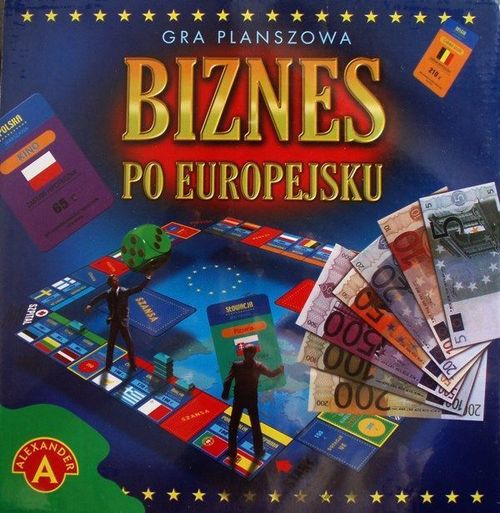
Biznes po europejsku
Biznes po europejsku Rulebook
Table of Contents
Table of Contents
Components
The box contains:
- Game board: 1
- Pawns: 5
- Development buildings in colour "A": 50
- Development buildings in colour "B": 20
- Title Deed cards ("Akt własności"): 25
- CHANCE cards ("Szansa"): 25
- SHARES cards ("Akcje"): 5
- Die: 1
- Euro banknotes: 25 of each denomination 5, 10, 20, 50, 100, 200 and 500 euro
- Rulebook
Setup
One of the players is chosen to be the banker. The banker's role is to manage the cash held in the Bank. The banker pays each player their starting capital and bonuses, pays out EU subsidies, collects taxes, sells Title Deeds and development buildings, runs auctions, accepts mortgages, and so on. The Bank can never go bankrupt. If the Bank runs out of cash, the banker may write cheques on plain paper and use them in the game. If the banker also takes part in the game, they must keep their own cash (as a player) clearly separate from the money and cards belonging to the Bank.
Before the game begins, place the board in the middle of the table. Each player chooses a pawn. Place the CHANCE cards in two stacks inside the board, in the places matching their colours. The Title Deed cards ("AKT WŁASNOŚCI"), the SHARES cards ("AKCJE") and the development buildings (Fig. 1) remain in the Bank.
[Fig. 1: development buildings in colour "A" and colour "B". Note: the colours in the box may differ.]
Each player receives from the banker 2155 euro in banknotes: 2 x 500 €, 3 x 200 €, 3 x 100 €, 3 x 50 €, 3 x 20 €, 3 x 10 € and 3 x 5 €. During the game, players may exchange money at the Bank or between themselves whenever needed. Arrange the banknotes in front of you in an orderly way, which will make the rest of the game easier.
Starting the Game
First, decide who starts the game. All players roll the die. The player who rolls the highest number starts the game. In the event of a tie, a play-off is held (repeated until the starting player is determined). The remaining players then roll in clockwise order.
Playing the Game
The starting player places their pawn on the space marked "START" and rolls the die. They then move their pawn (in the direction of the arrow) by as many spaces as the die shows. The spaces that make up the track have different meanings. Most of them represent the member states of the European Union and their capitals. In the capitals (on the corresponding spaces), players may buy plots of land and build income-producing buildings.
The countries are grouped on the board into groups of 2 or 3 countries. Each group is identified by a shared colour at the top of its spaces (Fig. 2). The spaces of these countries are next to one another on the board, and in each one a player may invest in a particular type of building and business activity. For example, in Portugal and Spain you can build a restaurant and earn profits from running it. In Estonia, Lithuania and Latvia, which are coloured green, you can invest in building and running a clothing store.
[Fig. 2: common colour for a group of countries; plot price.]
[Fig. 3: the Title Deed for SWEDEN, with the labels "country name", "colour of the country group" and "investment name". The example card reads as follows:]
- Country and capital: SWEDEN, STOCKHOLM
- Investment: DISCOTHEQUE ("DYSKOTEKA")
- Purchase cost of the plot: 450 euro
- Fees for a stay on the investment:
- no development buildings: 45 euro
- with 1 building: 180 euro
- with 2 buildings: 360 euro
- with 3 buildings: 700 euro
- with 4 buildings: 1400 euro
- with 5 buildings: 2200 euro
- Cost of 1 development building: 140 euro
- Mortgage value: 225 euro
The note printed at the bottom of the card reads: "A player who owns all the Title Deeds of one colour, without development buildings, collects a double fee for a stay by an opponent on the corresponding spaces."
Buying Plots
Each player has the right to buy from the Bank any plot in a country on whose space they stop first. If the player does not wish to buy the plot at that moment, the banker puts it up for auction.
For players buying immediately (without an auction), the price printed on the space of that country applies (Fig. 2). All purchases are made directly before your die roll. After the payment has been made, the banker hands the player the Title Deed ("AKT WŁASNOŚCI") (Fig. 3). The card handed over must bear the name of the country and a colour matching the colour of the space it corresponds to.
A Title Deed shows the name of the country and its capital, the name of the "investment" (the business), and a price list of fees payable by other players who stop on the space corresponding to that deed. The fees depend on the level of development, that is, on the number of development buildings the owner has.
Auctions
Players may bid on a plot at auction. Everyone has the right to bid on the auction, including the player who initially declined to buy the plot. The auction always starts at half of the plot's value. The first bid is made by the player to the left of the player who did not buy the plot immediately. The player who buys the plot pays the agreed price to the Bank.
Development Buildings
A player may buy development buildings from the Bank for the investment on their plot. The right to purchase development buildings only arises once the player has become the owner of all plots of the same colour. The owner of all plots of one colour may collect a double fee for a stop on those plots, provided there are no development buildings on them.
When buying development buildings, the rule of even development applies. This means that the number of buildings on each plot may differ from the others by at most 1 building. For example, if there is 1 building in Spain, Portugal may have 2 buildings, 0 buildings, or 1 building, but it may not have 3, 4 or 5 buildings.
During one round, a player may buy at most 3 development buildings (1 per plot). The price of 1 development building for a given investment is shown at the bottom of the Title Deed.
A player may expand their investment up to 5 development buildings. When a player places the fifth building on their plot, the banker gives them a piece of a different colour (the colour "B" pieces, 20 in the box) and takes the 4 colour "A" pieces (50 in the box) back to the Bank. A player who places their pawn on an opponent's plot showing the piece representing 5 buildings pays the owner the fee for 5 buildings.
Insolvency and Mortgages
If a player becomes insolvent to the Bank or to another player, they may obtain money by selling their development buildings to the Bank at half price. The fifth piece is returned at half the price of five buildings. Development buildings may not be sold to another player.
If a player needs even more money, they may mortgage a Title Deed to the Bank. They turn the card over to its other side (Fig. 4) and receive half of its value from the Bank.
[Fig. 4: mortgage price.]
To mortgage a plot, the player must first sell to the Bank, at half price, all development buildings on the plots of the same colour group. No fees may be collected for an opponent's stop on a mortgaged plot. A mortgaged plot may not be redeemed by another player until its owner has gone bankrupt. If the mortgagor later obtains the appropriate amount, they may redeem their mortgage, but they must pay the mortgage price plus 10%.
Shares
Players moving along the track also stop on spaces marked "SHARES – TRADE NETWORK" (Polish: "AKCJE – SIEĆ HANDLOWA"), for example as in Fig. 5.
[Fig. 5: the SHARES card of the MARS network; fee for a stop when owning 2 shares.]
There are 4 trade networks: "TYTAN", "KARO", "MARS" and "MERKURY". The player who first stops on a SHARES space has the right to buy it. The buyer receives from the banker the card bearing the name of the purchased SHARES network. The owner of a SHARES card collects the fee for a stop on its space according to the price list printed on the card. The more SHARES the player manages to buy, the higher the fee they can collect from an opponent who stops on one of the SHARES spaces belonging to the player. For example, if a player owns SHARES of the networks "MARS" and "KARO", and an opponent stops on the "MARS" SHARES space, the fee for the stop on that space will be 120 euro according to the price list (Fig. 5). The purchase cost of SHARES is given on their card and on their space. The card also states the amount that can be obtained from the Bank by pledging it.
The fee table printed on each trade-network SHARES card reads as follows (example: "MARS"):
- Purchase cost of shares: 250 euro
- Mortgage value: 125 euro
- Fees for the owner of the shares for a stop at a hypermarket of the network, depending on the shares owned:
- 1 share: 40 euro
- 2 shares: 120 euro
- 3 shares: 250 euro
- 4 shares: 300 euro
A player who mortgages SHARES turns their card over, with the word "ZASTAW" (mortgage) face up (Fig. 6).
[Fig. 6: SHARES card turned over to its mortgage side.]
The method of mortgaging SHARES and redeeming them is the same as for Title Deeds, except that development buildings do not apply to SHARES. Mortgaging SHARES or Title Deeds means that the player may not collect any fees for stops on the spaces whose cards are mortgaged. Those cards nevertheless remain the property of the player, and only that player has the right to redeem them. If the owner of mortgaged cards goes bankrupt, the mortgage is taken over by the Bank or by the player to whom the bankrupt owes money. A player who takes over mortgaged plots or SHARES must redeem them from the Bank at the mortgage price plus 10%.
The first player to stop on the space marked "SHARES – AIRCRAFT INDUSTRY CORPORATION" (Polish: "AKCJE – KORPORACJA PRZEMYSŁU LOTNICZEGO") (Fig. 7) may buy it for 250 euro. These shares cannot be combined with the trade-network shares. A stop on their space collects a fixed fee of 150 euro.
[Fig. 7: SHARES – aircraft industry corporation space.]
Tax
Stopping on the space marked "TAX" ("PODATEK") (Fig. 8) requires the player to pay 100 euro to the Bank.
[Fig. 8: TAX space.]
Chance
Stopping on a CHANCE space ("SZANSA") requires the player to draw the top card from the CHANCE stack inside the board, the stack matching the colour of the space they stopped on (Fig. 9). The player reads the text of the card aloud and carries out the instruction.
[Fig. 9: CHANCE stack and space.]
After the card has been read, it is slipped under the bottom of the stack from which it was taken, with the text facing down, unless the card's instruction says to keep it.
Start Bonus
During the game all participants move around the track, passing the "START" space many times (Fig. 10). By passing through this space or stopping on it, the player is entitled to a bonus of 250 euro, which they receive from the Bank. However, the banker pays the bonus only if the player claims it. If the player does not claim it and the next player rolls the die, they lose the right to the bonus (the bonus payment does not apply to the player who begins the game).
[Fig. 10: START space.]
A similar rule applies to fees for stops on a space owned by a player. If the owner does not claim the fee before the next player rolls the die, the fee is forfeited.
Hospital
If you land on the corner space "HOSPITAL" (Fig. 11), you are unfortunately ill (waiting) for 1 turn. At the same time, you pay 200 euro. You do not have to pay if you own an "INSURANCE CARD" ("KARTA UBEZPIECZENIA") and show it. You may lucky-draw such a card from the CHANCE stack and set it aside for this occasion (you place it in front of you on the table). Once the INSURANCE CARD has been used, it is slipped under the bottom of the appropriate CHANCE stack.
[Fig. 11: HOSPITAL corner space.]
A player may reach the HOSPITAL by moving along the track or by drawing a CHANCE card with such an instruction.
Jail
A player may reach the corner space "JAIL" ("WIĘZIENIE") in the same way as the HOSPITAL: by moving along the track, or by drawing a CHANCE card with such an instruction. Staying in JAIL (Fig. 12) obliges the player to skip two turns, or to pay a bail of 300 euro to get out immediately.
[Fig. 12: JAIL space.]
A player may also leave jail immediately if they draw a CHANCE card reading "court ruling ordering your release from prison ...". If the player draws such a card, they place it in front of them. Once it has been used, the card is slipped face down under the bottom of the appropriate CHANCE stack.
Lottery and EU Subsidies
The corner space "LOTTERY" (Fig. 13) is a popular space for players to visit. Every player who places their pawn on it receives 100 euro from the Bank. A similar stroke of luck awaits the player who places their pawn on the "EU SUBSIDIES" ("DOTACJE UE") space: a player who stops on it receives 150 euro from the Bank.
[Fig. 13: LOTTERY corner space.]
Selling
The player may sell their development buildings only to the Bank. However, their Title Deeds and SHARES may be resold to other players at any price agreed between them. Plots may be sold only without development buildings on them. Before selling a plot, all development buildings on the plots of the same colour group must be sold to the Bank (at half price).
Bankruptcy
If a player is obliged to pay a debt to the Bank or to another player, does not have the required amount, and has no way of raising it by mortgage or sale, they must declare bankruptcy and withdraw from the game.
If a player declares bankruptcy in favour of the Bank, the Bank takes over all of the player's property. The Bank keeps the development buildings for future resale, and it puts the Title Deeds and SHARES up for auction among the remaining players.
If a player goes bankrupt in favour of another player, the Bank takes all of the development buildings, and the creditor receives the Title Deeds and SHARES (the buildings must be bought gradually from the start). The creditor may take over any mortgages of the bankrupt player only by redeeming them, at the mortgage price plus 10%. Mortgages belong to the creditor, who does not have to redeem them immediately.
End of the Game
The game ends when only the winner remains at the table, and the other players have gone bankrupt. The players may also agree that the game will end after a set amount of time. In that case the winner is the player who has accumulated the greatest wealth. To determine it, the players add up their money, the value of their unmortgaged Title Deeds and SHARES, and the value of their development buildings. The player with the greatest total wealth is the winner.
During the game it is not allowed to help other players (for example, by reminding them to claim a bonus), nor to lend cash, and so on.