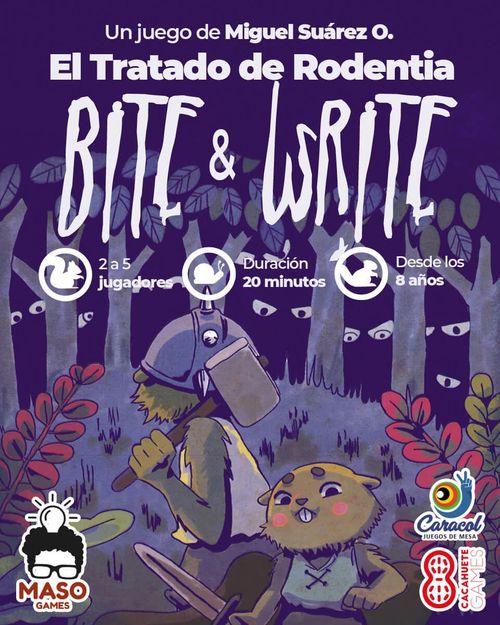
Bite and Write: The Treaty of Rodentia
Bite and Write: The Treaty of Rodentia Rulebook
Table of Contents
Table of Contents
Goal
Control Rodentia's most valuable territories by choosing dice, while exploring with your leader and avoiding sneaky attacks by wolves.
Components
- 1 or 2 game sheets (contains map of 26 hexagons: 5 forests, 5 mountains, 5 rivers, 5 swamps, 5 grasslands and 1 wolf, dice indications, objective marker, bonus zone, wolf capture zone, victory points zone).
- 6 dice
- 5 different colored pencils (suggested to use: squirrels-green, marmots-red, otters-blue, beavers-brown and moles-purple)
- 7 pawns (represent the leader of each species: squirrels, marmots, otters, beavers, moles and 2 of wolves)
- 1 starting player token
Setup
- Place in the center of the table 1 player's sheet (2-3 players) or two sheets (4-5 players) according to the number of players joining, as indicated in the figure (map 1 above, map 2 below). For assembly, you need to cut map 2, as indicated by the red zone.
- Distribute a different colored pencil to each player.
- Choose 2 of the 6 common goals for the players. For that we can roll 2 dice. Note: At the end of the game, whoever achieves these 2 goals gets additional victory points.
- Give a pawn to each player; it represents the species leader (ideally the same color as the pencil).
- Choose starting player: the last one to have brushed his teeth receives the starting player token.
- Each player draws a burrow in one of the hexagons of the type of terrain on the map corresponding to their species (squirrels-forest, marmots-mountains, otters-rivers, beavers-swamps and moles-grasslands). These burrows are placed in reverse order of turn, ending with the starting player. To differentiate them, they can make a geometric figure or another shape using their colored pencil. Note: Only one burrow of each species per game. (Example: whoever controls the moles draws his burrow in the grassland.)
- Place the pawn of each species on its burrow and the wolf pawn on its hexagon (two wolves with 4-5 players).
- Place a number of dice on the table equal to the number of players plus 1.
How to Play
The game unfolds over several rounds, each one consisting of 4 phases:
- Choose territories.
- Take control of territories.
- Leader or wolf movements.
- Bonus lands.
1. Choose Territories
The starting player rolls the dice and chooses one, then the player on his left chooses another among the rest, and so on; all the players choose dice, always leaving a free die.
The results of the dice mean:
| Die | Terrain |
|---|---|
| 1 | Forests |
| 2 | Mountains |
| 3 | Rivers |
| 4 | Swamps |
| 5 | Grasslands |
| 6 | Wolves |
2. Take Control of Territories
Each player, following the turn order, based on the type of terrain on the chosen die, places 1 to 3 rodents in one or more hexagons, filling with their color the circles that are in each hexagon.
Note: You can place 3 rodents in one turn, but you are limited to a maximum of 2 rodents in the same hex per turn.
Example: If we choose die 5 (grasslands) we can place 2 rodents in a grasslands hex and the remaining one in another of the same. Or, place the 3 rodents in 3 different grasslands. We will not be able to place 3 rodents in a grassland in a single turn.
Rules for positioning rodents
-
Adjacent: Place up to 3 rodents, coloring, in hexagons adjacent to: a) Our burrow b) Hexagons of the map containing other of our rodents, including hexagons where our rodents are.
Note: We cannot place rodents in hexes that are occupied by other leaders, by the wolf, or controlled by some species, including burrows.
-
Advanced: If we cannot place rodents following the rule of adjacency, we can choose any other hex of the map of the type of terrain chosen on the die to locate 1 rodent. Additionally, we can move the pawn of our leader to the space where we just positioned the new rodent.
In every hexagon it is possible to place a maximum of 5 rodents among all players. Whoever has more rodents positioned controls the hexagon, and for this, it is enough to have 3 of a single color. To differentiate controlled terrain from one that is not, the edge must be painted with the color of who dominates it.
New rodents CANNOT be located in a controlled hex.
3. Move the Leader and Wolves
Leader
In turn order, players can optionally move their leaders to an adjacent hexagon. The destination terrain may be controlled by another player (majority), may be another player's burrow, and may even be occupied by another leader, but not by the wolf.
Leaders will allow players to:
a) Reserve NON-controlled hexagons. No player can paint rodents there as long as the leader is there. b) Have more areas of the map where you can draw. c) Add 3 victory points to a controlled hex at the end of the game, if your leader is positioned on it.
Wolves
The wolf pawn will move through hexagons adjacent to its current location. When the dice are rolled and there is one or more results of "6", the following conditions apply:
- If a player chooses a die that represents wolves (face 6), they can move the wolf 1-2 hexagons adjacent to its location. With two wolves in the game you can move one wolf two hexagons or each wolf one hexagon.
- If no player chooses the wolf die, the starting player will move the wolf 1-2 hexagons adjacent to its location. Similarly with two wolves.
- In the same round, more than one player may move the wolf(ves) if the preconditions are met, in turn order.
If the wolf reaches a hex occupied by a leader, it catches him and sends him to his burrow, marking a catch (a circle) of the wolf in the game sheet: this will give negative points to the player caught. For each capture the negative points increase.
Wolf catches (each species: 1st / 2nd / 3rd capture):
| Species | 1st | 2nd | 3rd |
|---|---|---|---|
| Squirrels | 3 | 5 | 7 |
| Groundhogs (Marmots) | 3 | 5 | 7 |
| Otters | 3 | 5 | 7 |
| Beavers | 3 | 5 | 7 |
| Moles | 3 | 5 | 7 |
If the wolf still can move, it can continue moving, being able to catch more than one leader at a time.
Leaders are considered safe in any of the burrows.
4. Bonus Land Type
When every player has placed their rodents in territories and has moved their leaders / wolves, mark an X in the player's sheet on the terrain type of the free die, thus giving a bonus to all hexagons of that type of terrain for the victory point count at the end of the game.
Each type of terrain can have a bonus more than once. Each X on each type of terrain will provide 1 point extra to each hex of that type.
Finally, the player to the left of the current starting player takes the starting player token and dice. Next, a new round begins.
End of Game
The game ends when one of the following situations occurs:
-
A player cannot choose a die that allows him to position rodents in hexagons, since they are complete or another player took the die that allowed it before. This round concludes in phase 1.
If the player chooses a die-type of terrain, intentionally, that does not allow him to position rodents in a hex, having dice that allow it, that player agrees not to place rodents in that turn; this means that nobody will position rodents. In this case, the game does not end.
-
The wolf has caught all the leaders at least once, two players at least twice, and one player three times. In this case, the game round ends, concluding in phase 4.
Score
Add Victory Points (VP), considering who has the most rodents in each hexagon. Don't forget how many times we have bonus on each terrain:
- 2 VP + bonus per terrain hex corresponding to the species. Squirrels will receive 2 VPs for each hex of forest they control (plus bonuses for forests).
- 1 VP + bonus for terrain that doesn't belong to the player's species.
- VPs for goal achievement.
- Negative points are subtracted for wolf catches (1 capture: -3, 2 captures: -5 and 3 captures: -7).
- 3 VP per leader in a controlled hex.
- In the event of a tie in the control of a hexagon by two or more players, the hex is considered uncontrolled.
At the end of the game, if you have a majority of rodents in a hexagon, even with only one rodent, it also counts as a dominated hex; for that, paint with your own color the edges of the hexagons for scoring.
The player with the most victory points is the winner. In case of a tie, whoever controls the most hexagons of its kind. If the tie remains, the winner is the one who obtained the most points without goals, finally, who was captured least.
Score Goals
Two are selected at the start of the game, and victory points are added at the end of the game. These are obtained by controlling the largest number of hexagons according to the conditions of the objective; in case of equality in the number of hexagons controlled, all players get VP.
- Control a row. Control the most terrains in the row; all rows are considered, 3 VP for each row controlled.
- Separated areas of the map. Each player gets 3 VP for each separate controlled zone, considering that one zone is made up of at least two contiguous controlled hexagons. Note: Goal not recommended for 2 players.
- Largest area of the map. Control the area with the greatest number of hexagons. 1st 8 VP, 2nd 4 VP. If there is a tie in first place, both get 8 VP, and there is no score for 3rd. If there is a tie in 2nd place, both get 4 VP.
- Master a diagonal. At the beginning of each game you define whether the diagonals of the map will be ascending (one that runs from a southwest side of a hex to the northeast side) or descending (one that runs from a northwest side of a hex to the southeast side). The diagonals are considered on 3 hexes; 3 VP for each diagonal. Remember that at the beginning of the game, the diagonal that will be scored at the end must be defined.
- Connect burrows. Through controlled land, link 2 or more burrows in one zone. 4 VP for each connected burrow. They are considered "connected" if a player links, by controlling continuous adjacent hexagons, two or more burrows. Attention: Avoid locating adjacent burrows when selecting this goal.
- Control the edges. If a player controls the most hexagons on one edge, 1 VP for each hex controlled in one of the outer areas of the map. Considering 4 zones: upper, lower, left and right. Considering for each edge the hexagons of the corners of the map.
Solo Mode: The Story of the Wolves and the Groundhog King
In this mode, the King of the Groundhogs finds himself caught up in a head-to-head duel, competing against the wolves who attempt a fleeting attack for control of the Rodentia territories.
Components
- 1 game sheet.
- 2 dice (white and black).
- 2 pawns (Groundhog King and Wolf leader).
- 2 pencils of different colors.
Preparation
- Draw your burrow in a mountain hexagon.
- Locate the wolf pawn in its location and the leader pawn in your burrow.
- In this mode we will not use the objectives.
How to Play
The game takes place over a maximum of 14 rounds. In each game round you will have to: choose territories, take control of territories, move your leader and change initiative.
1. Choose territories
- Roll both dice and choose one die; the other die will be for the wolf. Record the assigned results in some free area of the game sheet; record the initiative (see later).
- If both dice are the same, roll them again.
- You cannot choose result 6, it is for the exclusive use of the wolf; you have to choose the other die.
2. Take control
Consider the initiative for the order of actions. Be careful: if the wolf has initiative it moves and takes control first.
- For the active player the rules of Bite and Write are followed.
- For the wolf, considering the wolf's die, it moves to the closest hex of that type, preferring hexes close to the Mammoth King's pawn. If the wolf gets a 6 it moves two hexagons towards the Mammoth King's pawn.
- When the wolf reaches its destination, fill in 2 circles on the hex control circles (if any hexagon has 3 wolves in it, it gets controlled by wolves) or scare up to two previously located rodents (strike out with an X), or as a third option scare 1 rodent and place 1 wolf.
- The hexagons already controlled by rodents are safe areas for drawn rodents, but not for the leader.
- Write down in the land bonus section the number of rodents scared by the wolf in each type of terrain; draw one "|" for each rodent that was scared off.
- If at any time the wolf catches the leader: mark in the section "Wolf Catches" and return the leader to your burrow (safe area for your King pawn).
3. Move your leader
- You can move your leader to a hex adjacent to his location. Attention: The groundhog king would not stay hidden in the burrow while the wolves take away his lands. Don't play with his honor. Move on!
4. Switch initiative
- The next turn the first to take control will be the wolf. Switch the initiative at the end of that turn, and so on. Consider the initiative when recording the results of the dice.
- If, at the moment of switching initiative, among the results of the dice that have been assigned to the wolf, have been recorded:
- 3 equal numbers: move the wolf pawn two hexes towards the groundhog king. Finish by crossing out the numbers.
- 4 different numbers: draw up to two new wolves in different hexes where wolves are found. Finish by crossing out the numbers.
End of the Game
The game ends under different conditions.
- After 15 rounds.
- If the wolf caught the leader 3 times.
- If neither the active player nor the wolf can take terrain, since all their hexes have been controlled.
You must count victory points (VP) considering:
- 2 VP per hex you control. The hexes where you have a majority are considered controlled, even with a single rodent, at the end of the game.
- 2 negative VP per wolf-controlled hex. Hexes where the wolf has a majority, even a single wolf, are considered controlled at the end of the game.
- Negative VPs for wolf catches (1st: -3, 2nd: -5, 3rd: -7) and scared rodents.
You win if you have positive victory points, controlling at least 10 hexes.