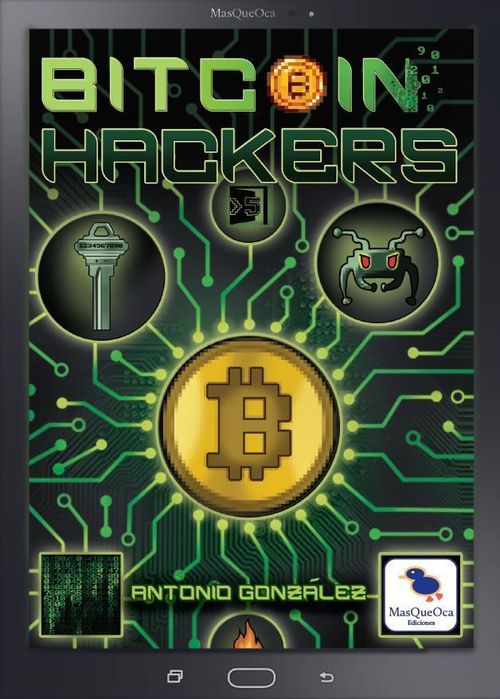
Bitcoin Hackers
Bitcoin Hackers Rulebook
Table of Contents
Table of Contents
Components
- 3 rulebooks (Spanish, Portuguese, English)
- 110 cards, separated by:
- 13 access cards (Blockchain)
- 7 master codes (MasterCode)
- 5 numbered cards 1+
- 5 numbered cards 9-
- 35 positive numbered cards (+), 5 of each from 2+ to 8+
- 35 negative numbered cards (-), 5 of each from 2- to 8-
- Coded numbered cards (names on the cards do not affect game play, as they have been added only for thematic purposes). These are part of the numbered cards and are called coded cards. They have special effects that are used in the expert and advanced game modes:
- 6 malicious code cards (Exploit, Adware, Ransomware, Malware, Spyware, Phishing)
- 6 code alteration cards (Keylogger)
- 4 backdoor cards (Backdoor)
- 10 special skill cards (multilingual)
Setup
- Place the 13 access cards on one side of the table.
- Shuffle the cards you need to form the game deck and place it face down in the middle of the table, within reach of every player.
- Basic mode: master codes + numbered cards (the special effects on the coded cards are ignored).
- Advanced mode: master codes + numbered cards (the special effects on the coded cards are used).
- Expert mode: master codes + numbered cards (the special effects on the coded cards are used) + skill cards.
- Each player receives 5 cards from the game deck without showing them to the other players. How many cards each player has in their hand at any given time is public knowledge.
- Randomly select one player to draw the top card from the game deck. This will be the first card on the code deck, which will be placed face up in the middle of the table, next to the game deck. From the player who took the card (but not including them), count as many players to the right (+) or to the left (-) as the number shown on the revealed card (from 1 to 9, whether it's a coded card or not). That player will be the new active player. If a master code card is drawn, discard it and draw another one.
Players are allowed to know how many cards are in the code deck at any time.
Example: If the revealed card shows a 4+, the fourth player to the right of the one who revealed it (excluding the latter) becomes the active player. If it had shown a 2-, then it would have been the second player to their left.
Aim of the Game
Obtain three access cards to break into the Bitcoin account and win the game. To obtain an access card, you must get rid of all the cards in your hand. During your turn as the active player, you may play a card from your hand that complies with the requirement of the code deck. This card will determine the next active player. Take advantage of the numbers that will make you the active player again, so that you can take several consecutive turns. Slow your opponents down by playing the coded cards at the right time. The game continues until one player obtains three access cards and, with them, takes control of the account.
Summary
Each game consists of an indeterminate number of turns. During their turn, the active player may play a card from their hand that complies with the requirement of the top card on the code deck. If they do this, the card they played will determine the next active player. If they can't or choose not to comply with the requirement of the code deck, then they have been hacked (see "Hacked" below). When a player manages to play the last card in their hand, they will get an access card and take a new hand of 5 cards from the game deck. The game continues until one player obtains 3 access cards, immediately winning the game.
The Game Cards
Every card in the game deck (except the master code cards, which are wildcards) shows a (+) or a (-) sign and a number from 1 to 9. The number and the sign work differently depending on how the card is played.
When played from a player's hand
- Sign: it tells you in which direction the players must be counted to determine the next active player; a "+" sign, towards the right; a "-" sign, towards the left. There is a triangle on the cards' upper right or left corner to remind you of this.
- Number: it tells you how many players must be counted in the direction shown by the sign, starting from the active player (not including themselves).
When face up on the code deck
Only one card at a time (the top card) can be visible on the code deck. We refer to this card as the code deck requirement.
- Sign and number: these tell the active player if they must play a card of a greater (+) or smaller (-) number than the one shown.
- Code deck requirement: the top card on the code deck always shows a number and a sign (it can be a coded card, but every element except the number and the sign is ignored). If the active player plays a card from their hand showing a number higher (+) or lower (-) than the one on the visible card on the code deck, they will have complied with its requirement. Now, you must count, to the right (+) or left (-), as many players as the number shown on the played card (it's possible to go around the table several times as you count. It's even possible for the current active player to become the active player again).
Other card types
- Coded cards: only used in advanced and expert mode. Apart from the number and sign, they may have other elements that affect the game when played from a player's hand. Check the advanced mode section for more details on coded cards.
- Skill cards: they are only used in expert mode. Check the expert mode section for more details on skill cards.
We recommend that you play your first few games in basic mode only. At first, counting players and trying to optimise your plays may appear complicated, but soon you'll discover that it's really not. Of course, when you have enough experience, we recommend moving on to the advanced mode. The expert mode adds skill cards that make each game different, allowing for new strategies.
Example: the top card on the code deck is a 7-. Alberto, the active player, decides to play a 4+ (it complies with the code deck requirement; to play under 7) and places it on top of the code deck (a). Now, the fourth player to the right of Alberto, which is Samuel (a 4+ card from a player's hand indicates you must count 4 players to the right), becomes the active player and must play a card of a higher value than 4. Samuel plays a 6+ card (b). He counts the sixth player to his right, which is himself. As the active player, he now plays a 9- (c), which is higher than 6, the code deck requirement. Once again, after counting 9 players (to the left now, due to the symbol on the card being a "-"), Samuel is the active player. He plays the last card on his hand, a 4+ (d), which is lower than 9, and obtains an access card (e). Samuel draws 5 new cards, and now Daniela (fourth player to Samuel's right) is the new active player and must play a card of a higher value than 4, etc.
During the Game
-
Master codes: a master code card is a wildcard that can be used to comply with any code deck requirement. If the active player plays a master code card, every card on the code deck must be discarded (including the wildcard). Then, a new card from the game deck is revealed to form a new code deck. The revealed card determines the new active player counting to the left or right of the player that used the wildcard, according to the number and sign on the revealed card. If another wildcard is revealed, it's discarded and another one revealed. If a coded card is revealed, all its effects are ignored except the number and the sign.
Example: Samuel is the active player. The code deck requirement is a 5+. He decides to play a master code and automatically comply with the requirement. Every card in the code deck is discarded. Samuel reveals a 5+ card from the game deck. The fifth player to Samuel's right is now the new active player, who must comply with the code deck requirement.
-
Hacked: If the active player can't or chooses not to comply with the code deck requirement, then they have been hacked. They must count every card in the code deck and draw half that number of cards (rounding up) from the game deck, adding them to their hand. Every card on the code deck is then moved to the discard pile. The player that performed the hack (the previous active player) becomes the active player again*. Since there will be no cards in the code deck, they can play any card from their hand to begin a new code deck. Again, this card will determine the next active player and the requirement this player must comply with.
Example: Alberto is the active player. The requirement on the code deck is a 5+. He plays a 7+ and meets the requirement. Now, Samuel is the new active player, but he's not holding a card with a number larger than 7. There are 5 cards in the code deck, which are moved to the discard pile. As a penalty, Samuel draws 3 cards from the game deck and now Alberto is the active player again. He may play any card from his hand to begin a new code deck.
*Important exception: If a player hacks themselves (because they play a card that makes them the active player, allowing them another turn), they are considered to have been hacked, but don't automatically become the active player. Instead, this player must reveal the first card on the game deck to form a new code deck and the next active player is determined at random, as in the beginning of the game (see Setup, point 4).
Hint: depending on the number of players, there are cards that make you the new active player when you play them, allowing you to discard several consecutive cards. For example, in games with 4 players, the numbers 4 and 8 will make you the active player again (no matter the sign). In games with 3 players, multiples of 3 (3, 6, or 9), will make you the active player again. In games with 5 or 6 players, the numbers 5 or 6, respectively, will allow you to become the active player again. Playing these cards at the right time is vital to achieving victory, but remember that when you are the active player, you must always comply with the requirement! If you don't, you will hack yourself.
It's very important to save the cards that make you the active player until you are able to discard your entire hand in one play. In contrast, there are very bad cards that you don't want to hold in your hand (for example, the 8+ in 4 player games, since only a 9- will save you from hacking yourself). In both cases, the master codes will be of great help.
Game Modes
There are 3 game modes: basic, advanced and expert. At the beginning of the game, you should choose one game mode. Read below for a detailed explanation of each mode:
- BASIC MODE: Only the numbered and master code cards are used to form the game deck. The special effects on the coded numbered cards are not used.
- ADVANCED MODE: In addition to the cards used in the basic game, the special effects on the coded numbered cards are also in play. The additional rules for these cards are the following:
- EXPERT MODE: use all the rules detailed in the advanced mode, but now, at the beginning of the game, each player receives two skill cards along with their initial hand. After studying them, choose one skill card and return the other to the game box. Finally, all players must reveal their skills at the same time, announce them and explain them to the other players, and then the game begins. In 3 player games, the information expert card is removed and then each player gets 3 cards. In 6 player games, each player gets only one random card.
Advanced mode: coded numbered cards
-
Malicious code cards: these are special cards that work just like the other numbered cards in the game, except with additional effects. The player (or players) sitting to the right and/or left of the player who plays this card (according to the arrows on the card) must immediately draw one card from the game deck.
- Firewall: players may ignore this effect if, before drawing a card, they show the other players a pair of numbered cards with different signs but identical number, in which case they don't draw a card but instead discard that pair. The effect of the malicious code card always takes place, whether the player who played it wants to or not.
Example: Alberto is the active player and, to comply with the code deck requirement (6+), he plays the malicious code card (7-), which affects Daniela and Samuel (sitting to the left and right of Alberto). Daniela immediately discards a pair of cards of the same number but different sign, thus avoiding the malicious code. Samuel is not holding a pair that allows him to do the same, so he is forced to draw a card from the game deck.
Save the malicious code cards to prevent players on your left and right from finishing their hands. Also, consider playing them when they have few cards left, so that they can't use the firewall.
-
Code alteration cards: these are special cards that work just like any other numbered cards but that can also be used in conjunction with another card from your hand to change the value of its accompanying card. This will allow you to comply with a requirement that otherwise you could not. These cards don't change the value or sign of the card that's played along with them, they simply allow you to temporarily modify the value of the other card to meet a requirement (the code alteration card is placed on the code deck, underneath the card it modifies). Important: a code alteration card always fully modifies the value of another card, and this value can never go over the upper or lower limit (1+/9-), meaning that a +/-3 code alteration card can't be played along an 8 card to raise its value (because it would turn into an 11), although it can be used to lower its value (temporarily changing it to 5). Code alteration cards can never be played alongside the first card of the code deck. If there are no cards on the code deck because you have hacked another player and must start a new code deck, you may play this card as if it were a regular numbered card, but not in conjunction with another card. You can't play more than one code alteration card along with another card.
Advanced example (continuing from the previous example): the top card on the code deck (where there are 5 cards) is a 4+. Daniela is the active player. Since Alberto has nearly finished his hand, she plays the coded card 7- with malware (a). The card affects Alberto and Samuel. Alberto draws 1 card from the game deck (b), but Samuel manages to use firewall: he shows a pair of cards with the same number and different sign (c), which he discards. Since Daniela played a 7-, Samuel is the new active player. Samuel has a +/-2 code alteration card, which he plays along a 7+ to lower its value by 2 and meet the requirement (the card momentarily acts as a 5) (d). (He could have played the 2- by itself, but this way he gets rid of two cards at the same time). The top card on the code deck is now the 7+, which means Daniela is now the active player again. She only has a 5+ left, so she can't comply with the requirement and is hacked by Samuel. Daniela draws 4 cards from the game deck (for there are 8 cards in the code deck) (e). The code deck is discarded, and Samuel becomes the active player again (since he hacked Daniela).
Expert Mode: Skill Cards
The expert mode uses the 10 special skill cards. Each skill card is listed below, as printed in the rulebook.
- Antivirus expert: the effects of malicious code cards do not affect you. You can't use Firewall.
- Firewall expert: after being the target of a malicious code card, if you are able to use the Firewall, you may discard an additional card of your choice from your hand.
- Cyber attack expert: when you play a malicious code card, double its effect. Affected players draw two cards rather than 1.
- Keylogger expert: you can add an additional +/-1 to any code alteration card you play to modify the value of an accompanying card. Note that the numbered cards' upper and lower limits must still be respected (1+, 9-).
- Backdoor expert: when you play a backdoor card (>7 or >5) and discard your hand, you can choose to draw only 1 card from the game deck (rather than half the number of discarded cards). You must comply with the requirement on the code deck with this new card.
- Master code expert: when you play a master code card, you become the active player again, rather than randomly determining it by revealing the top card on the game deck.
- Back-up copies expert: when any other player obtains an access card, if you have more than two cards in your hand, you may discard one of them.
- Blockchain expert: when you obtain an access card, instead of drawing 5 cards from the game deck, you may draw only 4.
- Exploits expert: if you can accumulate in your hand 4 cards of the same number (no matter the signs), when you become the active player you can show them to the rest of the players, discard your entire hand onto the discard pile and obtain an access card. Then, you draw 5 new cards and start a new code deck as the active player.
The skill cards are an excellent way to ensure that each game is different than the one before. With experience, you'll learn to make the most out of each skill and how to counter their effects.
Appendix
Brief description of game-related terms.
- Adware: a program that automatically shows the user unwanted advertising, either through pop-ups, graphics, or the installation of unwanted software.
- Backdoor: a special sequence within programming code. It can be used to ignore the security system and gain access to it.
- Bitcoin: one of the most famous and widely used cryptocurrencies today. Currently, 1 bitcoin is valued at approximately 6800 dollars (around 5146 pounds).
- Blockchain: a distributed database in which blocks link to form a chain, keeping information secure and stored in a way that is impossible to modify. Due to the security it offers, blockchain's popularity will soar in the next few years on every level. Cryptocurrency operations are based on blockchain technology.
- Cryptocurrencies: a digital interchange medium (like real currency). Bitcoin was the first one, but there are many others, such as DeepOnion, Ethereum, Litecoin, Moreno, Solarcoin, Dash, and many more. Colloquially, these coins are mined (as if they were virtual gold) using computers.
- Exploit: a data sequence, commands or actions that allows you to take advantage of security gaps in a computer program.
- Firewall: the first line of protection against cyber attacks.
- Keylogger: a computer program that registers every keystroke a user performs. They can be used to obtain all kinds of personal information such as passwords.
- Malware: a malicious program that aims to damage a computer or network. Among the better known malwares, we can find Trojan horses, worms, backdoors, etc.