Bitaak
Bitaak Rulebook
Table of Contents
Table of Contents
Components
- 6 copies each of ranks 1 2 3
- 5 copies each of ranks 4 5 6 7 8
- 3 copies each of 9
- 2 copies each of 10
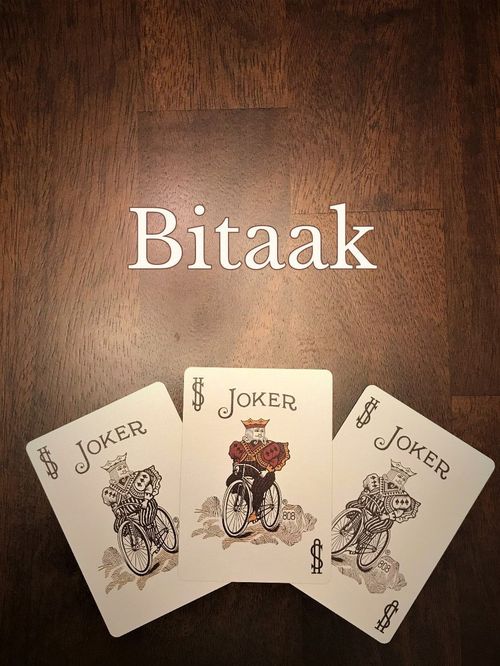
- 1 red joker & 2 blue jokers
Ranks
(Blue joker) 1 2 3 4 5 6 7 8 9 10 (Red joker)
Red joker is the highest rank (above 10) when played as a single. Blue joker is the lowest rank (below 1) when played as a single. Red & blue jokers can be played as any rank from 1 to 10 in any combination, even to form bombs.
The source prints the joker paragraph in the right-hand column beside the component list; it is placed here under Ranks, where it belongs.
Setup
A game of Bitaak is played over several deals.
Select a Dealer at random to start the first deal.
Dealer shuffles all the ranked cards and deals 15 to each player. (Printed as "deals 15 to the each player".) There are 3 cards leftover. Jokers are set aside for now.
Auction phase
There is an auction to determine which player will be the solo player, and plays alone against the other two. The possible bids are 1, 2, & 3.
The Dealer bids first and has to bid a value. Each player in turn order may either bid higher than the highest bid or pass. The auction continues until two consecutive players pass or someone bids 3.
The final highest bidder is the solo player. The solo player reveals the top 3 cards from the leftover stack for everyone to see and adds it to their hand.
The solo player gets the red joker and the other 2 players get a blue joker each.
Play phase
The solo player plays first and may play any combination. Each subsequent player in turn order must either pass or beat the previous play by playing a higher ranked combination of the same number of cards and same type.
There is an exception to this: a bomb can be played, in turn order, to beat any combination except a higher ranked bomb. After a bomb has been played, it may only be beaten by a higher-ranked bomb. A bomb can also be led.
The play continues until two consecutive players pass. Passing does not prevent you from playing on a future turn.
Combinations
- Single – A single card.
- Set of 2-4 cards – 2, 3, or 4 cards of the same rank.
- Sequence of 3-5 cards – 3, 4, or 5 cards of consecutive ranks.
- Sequence of 2 pairs – 2 sets of consecutive ranks. For example, 1122.
- Bomb:
- Set of 5 cards – 5 cards of the same rank.
Scoring
If the solo player sheds out all of their cards first, then the solo player gets the 3 times the bid amount as points and other players get 0 points.
If the solo player didn't shed out first, then the player that sheds out first gets the 2 times the bid amount as points and the other player in the defending team gets the bid amount as points.
Bonus points: For each player having 12 or more cards in their hand, the player that sheds out first receives a bonus of 3 points.
Continuing the game
Repeat the setup steps for a new deal. The new Dealer is the player with the lowest score in turn order from the previous solo player.
Play to 25 points for a standard game. Play to 15 points for a short game. The player with the highest score wins. If, after the final deal, there is a tie, play one additional deal.