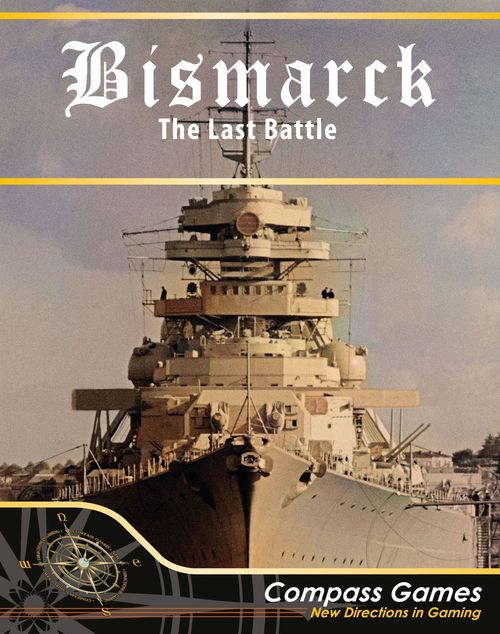
Bismarck: The Last Battle
Bismarck: The Last Battle Rulebook
Table of Contents
Table of Contents
Components
- 1 Rules Booklet
- 1 Map 17.5" x 17.75"
- 1 Sheet of 9/16" Counters (130)
- 1 Strip of Large Ship Counters (17) (Contains larger versions of the ships counters found on the main sheet, either size may be used)
- 15 Enemy Ship Cards
- 12 Enemy Aircraft Cards
- 4 Event Cards
- 1 Bismarck & Prinz Eugen Ship Display 8.5" x 11"
- 1 Player Aid Card 8.5" x 11"
- 12 D6 Dice (4 Red, 4 Yellow, 2 Blue, 1 Black, and 1 White)
Component Notes
Ship Counter
Each ship counter shows the ship's name, its Ship Type, its Speed (Movement Factor), its Damage Factor, its Main Guns and its Torpedo.
Ship Types:
- BB: Battleship
- BC: Battlecruiser
- CA: Heavy Cruiser
- DD: Destroyer
- CV: Aircraft Carrier
Ship Card
- Damage points equal to this Damage Factor causes the ship to sink. When Damage Points equal half the Damage Factor, attack dice are halved and Ship Speed is reduced to 1.
- Victory Points: the callout on the card showing the ship's Victory Point value.
- Bonus: may include bonuses for combat and/or repair. If a medal symbol is present, randomly select one medal.
- Main Guns*: number of dice to roll for a Main Gun attack.
- Torpedo*: number of dice to roll for a torpedo attack.
- Add card to Contact deck on this date: the date on the card (for example 23 May).
- *Indicates number of dice to roll (3 main and 1 torpedo on the example card).
Ship Display Card
- Bismarck Hull box can take 10 Damage points before ship sinks.
- Prinz Eugen Hull box can take 8 Damage points before ship sinks.
- FLAK GUN: the Flak Gun boxes.
- Each Turret is identified by the first letter of its name ("Anton" = Turret A, etc.).
- Each collection of boxes is a "Compartment".
- Each box holds 1 Damage Point or fire marker. Once the Damage Points equal the number of damage boxes, the compartment is destroyed.
Weather Markers, Damage Markers, Medals, Fire Markers and Speed Markers
- Weather markers are used to show Calm, Rough or Storm weather.
- Damage markers have a Front and a Back, showing damage values (8, 10, 1 and 2 are the printed values shown on the markers). Damage markers on British ship cards are transferred to the corresponding ship counter (see Escape Procedure).
- Speed marker: placed on a ship when the speed has been reduced to "1".
- Fire marker: not damage themselves, fire results in additional damage until put out.
- Medals: one Medal counter (combat DRM) is selected randomly each time a designated ship is sunk and each time Bismarck moves into a hex on the map that contains a Medal symbol. All Medal counters are DRM, not Damage Points.
Getting Started
You take command of the Bismarck and Prinz Eugen, with orders to breakout into the Atlantic Ocean and destroy enemy shipping.
To win the game, Bismarck must survive combat and breakout into the Atlantic Ocean by exiting the map from hex G11 or by reaching the safety of Brest in G21. The game begins on 23 May 1941 and ends 5 days later, after 27 May. Each Game Turn represents one full day. To get started, lay out the map and position the Bismarck and Prinz Eugen display card next to it.
Collect the ship counters for Bismarck and Prinz Eugen and place them on the map in hex A13 (Port of Bergen). Collect all ship cards, excluding Destroyers (DD), and separate them into decks by date.
Shuffle all aircraft cards and randomly add 2 to the decks for 23 May, 24 May, and 25 May. The rest of the aircraft cards become their own Aircraft Draw Deck and are put face down next to the board.
Shuffle all Destroyer cards and randomly set aside 2 as a Destroyer Draw Deck. The rest are added to the deck for 26 May. Add the 4 event cards to their corresponding decks (2x 25 May, 2x 26 May). Event cards must be played immediately if drawn.
Shuffle the 23 May deck and place it face down next to the map. This deck is referred to as the Contact Deck. The other decks are added to the Contact Deck as the game progresses. At the end of each turn, all non-revealed cards from that turn's Contact Deck are added to the 27 May deck and reshuffled.
Place the Turn marker (on the A.M. side) in the 23 May box in the Turn Track on the map. Place the British ship counters and the other game markers near the map so they can be used during the game.
Contact & Aircraft Decks
- 23 May: Norfolk, Suffolk, 2 Aircraft cards
- 24 May: Hood, Prince of Wales, 2 Aircraft cards
- 25 May: Victorious, Sheffield, 2 Aircraft cards, 2 Event Cards
- 26 May: Ark Royal, Dorsetshire, remaining 3 DD's, 2 Event Cards
- 27 May: King George V, Rodney
- Aircraft Draw Deck: Remaining 6 Aircraft cards
After every turn, all non-revealed cards from each Contact deck must return to the 27 May deck and be reshuffled.
Eliminated enemy ships and aircraft are kept in the player's hand for the rest of the game. After combat, if an enemy ship's movement factor is less than that of the Bismarck, it is removed from play and not added to the player's hand.
Otherwise, the ship's corresponding counter is placed on the map in the hex where the combat took place, along with any damage counters it incurred. The ship card is returned to the Contact Deck, which is then reshuffled, and remains there until eliminated or removed from play. Damaged aircraft have all damage removed at the end of the battle and are added/returned to the Aircraft Draw Deck.
Destroyers and Aircraft Carriers may have instructions to draw additional cards. These instructions are ignored if the corresponding Draw Deck is already depleted. If the additional drawn cards also have instructions, these must also be followed if possible.
The bonuses on enemy cards may be used by the player as soon as the enemy is eliminated. If the card offers a medal draw, this is a one-time effect and cannot be repeated. One combat bonus may be used per round of combat (either medal or card). Any number of repair bonuses may be used in a given Repair segment or round of combat.
Event cards are added to the Contact deck on 25 and 26 May and must be played immediately if drawn. If not revealed, event cards are also added to the 27 May deck.
Playing the Game
The rules for the game are presented in the same order as the Sequence of Play. The Sequence is printed on the map in abbreviated form for easy reference as you play the game.
Note the information in the rulebook and on the player aids take precedence over the summarized information on the map.
Patrol Phase
The engine of the game is the Patrol Phase, with different segments: Weather, Movement, Repair, and Progress. In the Weather segment, a die is rolled to determine the current Weather condition as Calm, Rough Sea, or Storm. After determining the weather, another die is rolled to see if Bismarck may move ahead or must stop and resolve battle with enemy ships and/or aircraft.
When contact is made, play proceeds to the Detection DR, and then the Patrol Phase is interrupted with the Battle Phase for one or more rounds of combat. When no contact occurs, repeat movement DR until contact is made or until Bismarck has moved 4 hexes. Then, the Patrol Phase continues normally with the Repair segment.
Finally, the progress of Bismarck and Prinz Eugen is noted by flipping the Turn marker to the P.M. side or advancing the Turn marker to the next Game Turn.
A) Weather
Roll one die to determine the Weather. Listed DRMs are applied during combat this turn.
| DR | Weather | Effect |
|---|---|---|
| 1-2 | Calm | +1 DRM |
| 3-4 | Rough | -1 DRM |
| 5-6 | Storm | Skip DR and move 1 hex |
B) Movement
Roll one die to check for Movement or Contact.
| DR | Result |
|---|---|
| 1-2 | Movement (up to 2 hexes*) |
| 3 | Movement 1 hex |
| 4 | Contact! draw one enemy card |
| 5 | Contact! draw two enemy cards |
| 6 | Contact! draw three enemy cards |
*Based on the current lowest Movement factor between the Bismarck and Prinz Eugen. MF=1, move 1 hex. MF=2, move 2 hexes. In Storm weather, skip the DR and move 1 hex.
4 hexes without contact ends turn after the repair phase.
Bismarck & Prinz Eugen always move together.
On a Contact! result, draw one Card from the Contact Deck for each Contact and proceed directly to the Detection Phase. (Event cards count as a Contact! draw. Play the Event card immediately and proceed to Repair phase if no other enemy cards are drawn. Events are played prior to battle).
C) Detection DR
| DR | Result |
|---|---|
| 1-4 | Detected |
| 5-6 | Not Detected (Player gains initiative) |
Enemy rolls once to detect both Bismarck and Prinz Eugen. If detected, player must roll higher than the enemy's detection roll to gain attack initiative. Ties or lower enemy gets initiative. Proceed to Battle Phase.
D) Repair
Make 2 die rolls to repair damage on Bismarck, and 1 die roll to repair damage on Prinz Eugen. After applying the results, any Fire marker remaining adds 1 Damage Point and remains in compartment.
| DR | Result |
|---|---|
| 1-2 | No repair |
| 3-4 | Remove 2 Damage Points from any compartment. |
| 5-6 | Remove all Damage from all compartments on the ship. |
- Repairs are not allowed in the first turn.
- Any number of cards may be used to repair damage on Bismarck and Prinz Eugen.
- Each Fire marker counts as 1 Damage Point to remove. Fire must be removed before any Damage Points in the same compartment may be repaired. If not removed during this phase, each fire adds 1 damage point.
- Destroyed compartments cannot be repaired. A compartment is destroyed if the number of Damage Points fills the available boxes of that compartment (not counting Fire markers).
E) Progress
Flip the Turn marker to the P.M. side and return to step B) Movement.
If the Turn marker is already on the P.M. side, conduct the following steps:
- Flip the Turn marker to the A.M. side.
- Advance the Turn marker to the next Date.
- Add non-revealed cards from the Contact Deck to the 27 May Deck and shuffle.
- Add Ship Cards corresponding to on-map counters to the next date's deck. Shuffle together to create the next Contact Deck and place beside the map.
- Continue to repeat the Patrol Phase steps starting with A) Weather.
- The game ends after the 27 May Turn.
Battle Phase
When enemy contact occurs (Ship or Aircraft card is drawn), Battle must be resolved between opposing units. Battles are resolved by conducting one or more rounds of combat.
Initiative lasts for the entirety of a given battle. In each round, if the player has initiative, they fire first. Ships fire Main Guns and Torpedoes at enemy ships and Flak at enemy aircraft. Aircraft fire on ships with Torpedoes.
After each round of combat (when both sides have shot once), Bismarck and Prinz Eugen must attempt to Escape the battle. In each round of combat, one combat bonus may be used (card or medal) to affect the result of a combat die roll from either side and any number of repair bonuses may be used.
- If an aircraft carrier is drawn, draw the indicated number of Aircraft cards from the Aircraft Draw Deck. The carrier may not attack or be attacked. At the end of combat, if the ship's drawn aircraft have been destroyed, the CV is eliminated and Victory Points are awarded. If 1 or more of the ship's aircraft are not destroyed, the CV is removed from the game and no VPs are awarded.
- Aircraft cards may be drawn as contacts, only during Patrol phase, from the specific date deck. Otherwise, if a ship card clearly indicates to draw an aircraft card, then it must be drawn strictly from the Aircraft deck.
Combat Summary
A) Aircraft Attack. The first aircraft must attack the Bismarck. If more than 1 aircraft is present, additional attacks may be made on either ship of the player's choice. Bismarck and Prinz Eugen each roll 2 dice to fire Flak at each attacking aircraft.
B) Main Gun Attack. Bismarck and Prinz Eugen may attack ANY non-CV enemy ships, splitting their Main Gun Attack Dice between targets as desired. British cruisers (CA) must fire on Prinz Eugen if she is present, otherwise they fire on the Bismarck. All other British ships fire on Bismarck.
C) Torpedo Attack. Each Ship with torpedoes may attack one enemy ship. Prinz Eugen may attack ANY enemy ship. British ships always attack Bismarck. Torpedoes are not effected by DRM's.
D) Escape. Escape is successful on a die roll of 4, 5, or 6. When successful, follow the steps in the Escape Procedure. Otherwise, conduct another round of combat as described in steps A through D. If the speed factor of Bismarck or Prinz Eugen is lower than the highest enemy speed factor, Escape is only successful on a roll of 6. If roll is successful, Escape is mandatory.
- Escape is automatic if no enemy ships remain or the only remaining ships are aircraft carriers.
All enemy ships remain in play for each round of combat unless sunk or until Escape ends combat.
Combat Procedure
- Refer to the Combat Results Table and Damage Location Table on the player aid. British ships within the 4 outlined hexes of Bergen and Brest (Air Zone) add a +3 DRM on Main Gun attacks in favor of Bismarck & Prinz Eugen.
Attack Dice. Each card shows the number of dice to roll for each type of attack. Bismarck and Prinz Eugen roll one die for each Turret when making a Main Gun attack and two dice for each Flak attack on enemy aircraft. Prinz Eugen also rolls one die to make a Torpedo attack. On Torpedo hits, a second die is rolled to determine the damage.
Attack Procedure. The order of attack type and which enemies are attacked first is up to the player. Roll the dice for each type of attack and determine the result on the Combat Table for Main Guns, Flak, or Torpedo. For each result, record the number of Damage points by placing markers on the Ship or Aircraft card. For Bismarck and Prinz Eugen, roll another die for each Damage or Fire result and refer to the Damage Location Table to determine a specific location (compartment) for the Damage. Place markers in the specific compartment box on the Display Card.
Damage Effects. On British ships and aircraft, when the number of damage points equals or exceeds half the Damage Factor, the number of attack dice is reduced by half (round down, player's choice of which weapons are affected) and ship speed is reduced to one. All ship counters are flipped when they reach half damage. When the total number of damage points equals or exceeds the Damage Factor of a ship or aircraft the unit is eliminated. Excess damage points can not be transferred to other ships.
When enemy units are eliminated, keep the card in your hand to use for combat, repairs and totaling Victory Points at the end of the game.
On Bismarck and Prinz Eugen, damage and fire applies to specific compartments, represented on the Display card for each ship. Both ships have compartment boxes for each Gun Turret, for the Bridge, and for Hull damage. When the number of damage points for a Turret reaches the maximum number printed in the box, the Turret is destroyed and the number of dice rolled for a Main Gun Attack is reduced by one.
Damage results on a destroyed compartment must be applied to another compartment that is still functional (player may choose the compartment).
Hull & Flooding Damage. On the Damage Location Tables, any combat result for "Hull" indicates that the damage is applied to the Hull of the ship. In this case, add the Damage Points to the Hull box on the Display Card. When the Hull box is destroyed, the ship sinks.
Fire. When a Fire occurs in any Turret compartment, it is prevented from firing and player must roll 1 less die when attacking. As long as the Fire is still active in this specific compartment, the 1 less die function is a necessity to increase the challenge of combat. If Fire is not repaired in the following Repair segment, it automatically adds 1 Damage point to the compartment it is in.
Fire markers carry over turns and add damage after each repair phase until repaired.
Fire results on British ships add 1 Damage Point per battle round when Bismarck and Prinz Eugen make their attacks. Fire is removed from British ships at the end of the battle.
Escape Procedure
Bismarck moves 1 hex after a successful Escape and Prinz Eugen always stays with Bismarck.
Aircraft cards are returned to the Aircraft Deck and the cards are shuffled.
Damage markers on British ship cards must be transferred to the corresponding ship counter and placed on the map. Enemy ships whose current Movement Factor is equal to or greater than the current Movement Factor of Bismarck are returned to the Contact Deck. All other enemy ship cards in the current combat are removed from play. Ship counters remain in the hex where battle occurred, as it's the last known position, until drawn as a Contact again.
Continue on to the Repair segment (if not playing the first turn) and then to the Progress segment.
Flip the turn marker and return to the Patrol Phase or advance marker to next Game Turn.
When the 27 May Turn has been completed the game ends and the Victory Level is determined.
Victory
Victory Points (VP)
| Event | Victory Points |
|---|---|
| Prinz Eugen sunk | -25 |
| Bismarck sunk | -100 |
| Bismarck at Brest* | +100 |
| Bismarck in Atlantic* | +100 |
| Prinz Eugen in Atlantic | +100 (if not damaged) |
| BC Hood sunk | +100 |
| BB sunk | +50 |
| CA sunk | +25 |
| DD sunk | +10 |
| Aircraft/CV destroyed | +10 |
*Bismarck must start any turn in hex G11 or G21. If G11, Bismarck must also move out of the hex by normal Movement or by Escape from combat to enter Atlantic. Deduct 30 VP for each Gun Turret destroyed and 75 VP if Bismarck speed has been reduced to one.
Victory Level
To determine the level of victory, total the Victory Points accumulated during the game and compare the final total to the chart below.
| Victory Points | Level |
|---|---|
| 300 or more | Germany Rules the Waves! |
| 200 to 299 | Major German Victory |
| 100 to 199 | Minor German Victory |
| -25 to 99 | Draw |
| -26 to -99 | British Victory |
| -100 or more | Britannia Rules the Waves! |
Optional Rules
- Once per turn, after making contact, the player may make one additional roll on the movement table at a -2 DRM.
- Players may choose to continue into additional days to reach their target victory hex, but receive a -50 VP modifier for each day played after 27 May.
- If the first Movement die roll for a given AM/PM phase is Contact!, the player may move 2 hexes in the Escape Procedure. If the only Contact for the phase was an Event Card, the player may move 1 hex before proceeding to the Repair Phase.
Special Notes
All cards for destroyed ships & aircraft are placed in the player's hand for the remainder of the game to provide bonuses and for easier VP scoring.
Aircraft Carriers (CVs) are not enemy targets. When drawn, the player must follow the on-card instructions. CVs are always removed from the game after the battle in which they are drawn, but VPs are only earned if their corresponding on-map aircraft are destroyed.
Note: If the Aircraft Draw Deck is depleted when a CV enters play, the player is considered to have eliminated the CV's aircraft.
Bismarck is classified as a BB (battleship) and Prinz Eugen as a CA (heavy cruiser).
The information in the rulebook and on the player aids take precedence over the summarized information on the map.
Example of Play
May 23, 1941
Orders came straight from Kriegsmarine High Command, for both Bismarck & Prinz Eugen, to depart from Bergen, Norway, and head to the Atlantic, to intercept enemy supply vessels...
Game 1
First Turn
Turn marker into (AM) side & place it on 23rd May box (map).
Patrol Phase
Roll 1d6 to determine the weather.
a) Weather. Dice 1, Roll 2: Calm Sea. Roll 1d6 to move both warships.
a) Movement. Dice 1, Roll 2: Move 2 hexes. Move 2 hexes forward both warship markers into hex A11, but still no Contacts! Proceed into another movement roll.
b) Movement. Dice 1, Roll 4: 1 Contact. A single Contact occurs. We draw 1 enemy card from Contact deck date 23rd May. Norfolk heavy cruiser revealed. Proceed directly to Battle Phase.
Battle Phase
Roll 1d6 to define detection of our ships by the enemy.
a) Detection. Dice 1, Roll 4: Detected. The roll result reveals our position to the enemy. We roll again to define the initiative to attack.
Roll 1d6 to gain initiative.
b) Initiative. Dice 1, Roll 4: Initiative Lost. Enemy attacks first against Prince Eugen heavy cruiser.
Enemy Attack. The enemy may roll 3d6 (red) & 1d6 (yellow).
- a) Main Guns (Red dice): Dice 1st, Roll 1: Miss. Dice 2nd, Roll 4: 1 Damage. Dice 3rd, Roll 1: Miss.
- b) Torpedoes (Yellow dice): Dice 1, Roll 2: Miss. Add +1 DRM (Calm Weather). New results are as follows:
- b) Main Guns (Red dice): Dice 1, Roll 2: Miss. Dice 2, Roll 5: 2 Damage. Dice 3, Roll 2: Miss.
- c) Torpedoes (Yellow dice): Dice 1, Roll 2: Miss (No DRM).
Roll 1d6 to apply damage (incoming hits) in Prince Eugen heavy cruiser.
d) Incoming Damage (hits). Roll 6: Compartment Hull. Apply 2 Damage Point markers on Hull. Time to return back fire to the enemy.
Player Attack (Prinz Eugen).
- a) Main Guns (Red dice): Dice 1, Roll 4: 1 Damage. Dice 2, Roll 6: 3 Damage. Dice 3, Roll 2: Miss. Dice 4, Roll 3: Fire. Add +1 DRM (Calm Weather). New results are as follows:
- b) Main Guns (Red dice): Dice 1, Roll 5: 2 Damage. Dice 2, Roll 6: 3 Damage. Dice 3, Roll 3: Fire. Dice 4, Roll 4: 1 Damage.
- c) Torpedoes (Yellow dice): Dice 1, Roll 6: Hit! Roll for damage (No DRM). Dice 1, Roll 6: 4 Damage (No DRM).
Apply damage to Norfolk heavy cruiser. Flip Norfolk marker on the map (opposite side with 8 damage points left. Speed reduced to 1). Fire in the enemy ship add 1 Damage point per battle round.
Player Attack (Bismarck).
- a) Main Guns (Red dice): Dice 1, Roll 6: 3 Damage. Dice 2, Roll 3: Fire. Dice 3, Roll 4: 1 Damage. Dice 4, Roll 4: 1 Damage. Add +1 DRM (Calm Weather). New results are as follows:
- b) Main Guns (Red dice): Dice 1, Roll 6: 3 Damage. Dice 2, Roll 4: 1 Damage. Dice 3, Roll 5: 2 Damage. Dice 4, Roll 5: 2 Damage. We sunk the enemy cruiser.
The Battle is over.
No repairs are allowed in the First turn. Flip Turn Marker to PM and continue to Movement DR.
Game Turn completed
Flip Turn marker into AM and advance to 24 May box (map). Now the next Contact deck is 24th May.
Add all unrevealed enemy cards, both SHIPS and AIRCRAFTS from previous deck into the last 27th May Contact deck.
Shuffle all the cards.
Repeat this step each time a Game Turn is over.
Clarifications
Official "Bismarck Clarifications" sheet, dated 3/29/24, published by Compass Games. Transcribed in full below.
Clarifying Torpedo Attack Procedures vs. British Targets & Bismarck/Prinz Eugen
- Torpedo attacks against British Targets:
- Roll for a miss or hit on the Torpedo Combat Result Table.
- Roll for the amount of damage inflicted on the lower table of the Torpedo Combat Result Table.
- Torpedo attacks against Bismarck/Prinz Eugen:
- Roll for a miss or hit on the Torpedo Combat Result Table.
- Roll on the Damage Location table to determine the damage result. Fire results are applied to the location listed, so all Torpedo Fire results are applied to the Hull.
Clarifications
- Page 6 of the rulebook specifies that the side with initiative fires first. These attacks are fully resolved before the other side fires. There is no simultaneous combat.
- Event cards do count as an "enemy card" drawn. If only Event cards are drawn in a given Contact, no Battle occurs and you may proceed to the Repair segment.
- Bismarck and Prinz Eugen may use a card damage bonus even if their attack roll resulted in a "Miss" or inflicted only a "Fire" result. (Remember: Only one card or medal bonus can be used per round of combat.)
- If a Card Bonus references a specific weapon (Flak Guns, Main Guns, etc.), it can only be applied to attacks with that weapon. If the Card Bonus does not specify a weapon type, it can be used with Flak or Main Gun attacks. No DRMs may be applied to Torpedo Attacks. Each card bonus affects a single die roll of your choice, within the abovementioned restrictions.
- Repair Bonuses are used only in the Repair Phase.
- Regarding the special note on page 8, "If the Aircraft Draw Deck is depleted when a CV enters play, the player is considered to have eliminated the CV's aircraft": In this rare case, the player would receive VPs for the CV and these eliminated aircraft.
- The player does not automatically lose if they fail to reach Brest or break out into the Atlantic. While achieving these goals will grant the player significant VPs, it is still possible to reach the thresholds listed in the Victory Level table through other means.