Birth of the Roman Republic
Official rulebook: Up & Away Games · PDF
Birth of the Roman Republic Rulebook
Table of Contents
Table of Contents
I. Introduction
Now you can play two new periods before the Early Republic period. The game begins with the Latin period (Era A) deck followed by the Italian period (Era B) deck before entering the Early Republic of the original game.
II. Components
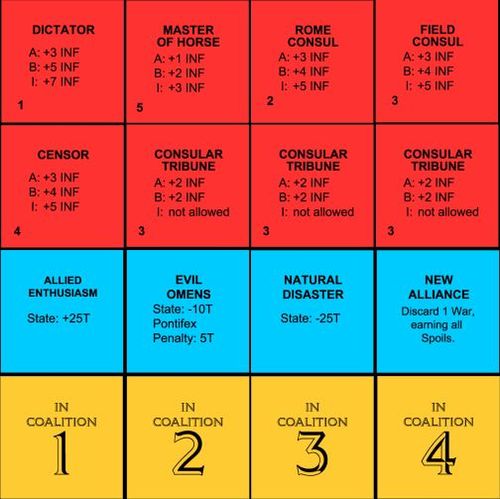
To play this expansion, use the board and other components of the original game, adding these cards and tiles. The card backs differ, but as there are multiple cards, there is still sufficient mystery about the identity of a hidden card.
- 25 Latin (A) period cards:
- 6 Statesman
- 6 Event
- 6 Intrigue
- 5 War
- 1 Senator
- 1 Enemy Leader
- 10 Italian (B) period cards:
- 6 War
- 2 Event
- 1 Statesman
- 1 Enemy Leader
- 1 Intrigue
- 16 square tiles:
- 7 Offices
- 4 Table Events
- 4 Coalition markers
- 1 Random Events Table reference card
Transcriber's note: the printed counts above do not add up as printed. The Italian list sums to 11 cards (the heading says 10) and the tile list sums to 15 (the heading says 16). They are transcribed as printed; check the physical components.
III. Setup
Treasury: 30T (with 5+ players begin with 40T)
Annual Revenue: 30T
Recruited: 2 Legions
Force Pool: 5 Legions, 0 fleets
Forum: 1st Latin War (Active) and the Enemy Leader, Tarquinius Superbus
HRAO: Senator with most Influence (Oratory breaks ties)
Initial Cards:
- Shuffle together the following Senators: from the original game, numbers 1-11, 13-16, 18 and 24, and from this set, Atilius, #12. Making sure that #10 Junius is dealt to a player, with 5 players, randomly remove 3 of these and place them in the Curia. With only 4 players, randomly remove 2 of these and place them in the Curia.
- Deal 3 (4 in a 3-player match) of these cards to each player.
- The player who has #10 Junius, takes the #10A Junius Brutus Statesman, who they must play immediately.
- Start the Latin Period red cards deck by shuffling the following cards:
a. From the original game, unless playing with exactly 5 players, in which case make an exception for Harbor Fees and Mining and place them in the Forum instead.
- Harbor Fees
- Mining
- Tax Farmers 1-6 b. From this set:
- #5A Appius Claudius
- #8A M. Furius Camillus
- #18B Quinctius Cincinnatus
- #24A Spurius Cassius Viscellinus
- Legate
- Form a different 14-card deck with the following:
a. From the original game:
- Blackmail
- Influence Peddling
- Seduction
- 6 Tribunes b. From this set:
- Appian Way
- Circus Maximus
- Marriage
- Scandal
- Spolia Opima
- Shuffle this second deck and divide it into two decks of 7 cards each.
- Shuffle one of these sub-decks into the A period red cards deck, except omitting Statesman #12A.
- From the Latin Period red cards deck deal 2 cards to each player, unless playing with exactly four players, in which case deal 3 cards to each player.
- Shuffle the remaining Latin Period red cards into the Latin Period deck. Place this deck on the board.
- Form a deck from the following:
- The 5 Early Republic Statesman from the original game
- #12A M. Atalius Regulus from this set (the source prints "Atalius" here and "Atilius" for the same card elsewhere; the card is Atilius Regulus)
- Shuffle 3 of these Statesmen with the 7-card Italian Red Card deck and save the remaining 3 for the Early Republic deck.
- Shuffle into the Italian Red Card deck all the remaining Era B cards. This forms the starting Italian Period deck.
- Add a Rebel counter to the Mortality cup to represent Statesman #31A. Remove it again when the Statesman leaves play.
- Consider the 1st Latin War as having been unsuccessfully prosecuted on the previous turn.
- It is recommended that you use the Pontifex Maximus optional rule as there are cards that impact that office.
IV. Special Rules
Play of this game covers two eras:
- A. Latin – 509-390 BCE
- B. Italian – 390-264 BCE
After you complete these eras, play the Early Republic of the standard game.
Several rules are inactive at the start and only come into play as the game proceeds. Modify the original game rules as follows.
Start of Play:
- You may not play Tax Farmer concessions. These cards become playable after Rome defeats certain wars.
Revenue Phase:
- The State Revenue changes during the course of play. Use any marker to track it.
- Wars cost the State 10 rather than 20T.
- Land Bill costs are the same as in the original game.
Forum Phase:
- Instead of the Random Events Table on the board, use the player aide for both the Latin and Italian periods.
- Halve the monetary effects of Evil Omens, Natural Disaster and Allied Enthusiasm during the Latin and Italian periods. Also, in this period, the fine to the Pontifex Maximus from Evil Omens is only 5T (if he is unable to pay the 10T for the Omens). The event tiles support these changes.
- Treat New Alliance events as Another New Alliance for all wars from the Latin and Italian periods (that is, discard the War with all spoils). In addition, treat a New Alliance rolled during the Early Republic as Another New Alliance when applied to a Latin or Italian period War.
- There is a new type of card, the Event card. When a player draws one of these, play it and apply its effects immediately.
- Rome enters a new Era immediately after you draw a card from the next deck.
Senate Phase:
- You cannot elect a Censor (or prosecute) until the turn after the Twelve Tables event appears. However, always award prior consul markers per the normal rules, even before the Twelve Tables event occurs).
- You cannot propose Land Bills until after the Agrarian Unrest event (Latin Deck) appears (exception: one of the Statesmen can do so).
- You cannot use Tribunes (including a Statesman's free tribune) until after the Plebeian Revolt event (Italian Deck) has been discarded.
- If the Plebeian Revolt event is in play, the Presiding Magistrate can, at any time after the Prosecutions phase, propose to discard the event. Vote normally. If passed, the Presiding Magistrate gains 2 Popularity, loses 2 Influence and discards the Plebeian Revolt event. This is the only way to discard this event. The Pontifex Maximus cannot veto this proposal. After this proposal passes, Tribunes become playable.
- Rome can recruit at most 7 legions at the start. Defeat of certain wars adds legions to the Force Pool. Rome cannot build fleets.
- Consular Tribunes (CT): Elect CTs instead of Consuls only on the turn that The Twelve Tables event appears. Election to CT gains 2 Influence, regardless of the period, and a Prior Consul marker. Any and all CTs can go to war, but at most one per war. The Presiding Magistrate is the CT with the most Influence (oratory breaks ties). Note that The Senate Phase still ends when the PM leaves Rome. A Dictator appointment requires all three to agree. A CT cannot be elected Consul next turn; otherwise, treat a CT just like a Consul.
- You cannot elect a Pontifex Maximus until after you discard Tarquinius Superbus.
- The amount of Influence each office bestows can differ in the Latin (Era A) and Italian (Era B) period. See the office tiles for the amounts.
- The consequences of a successful minor prosecution differ in the Latin and Italian periods. In the Latin period, the accused loses 3 Influence and 3 Popularity; in the Italian period they would lose 4 of each.
Combat Phase:
- Combat does not create Veteran legions. Note: Army sizes are small in this era so it is important to keep in mind the original game rule that a commander can only add his Military rating up to the strength of the army. For example, 2 legions and a commander with a Military rating of 5 would have an army strength of only 4.
Revolution Phase:
- A commander cannot become a Proconsul until the Early Republic. They always return to Rome with their army during the Revolution Phase (even if not victorious) and cannot rebel. The return of the army in this case would not negate the prosecution status of the war, that is, if a war would normally be considered prosecuted, it is still considered prosecuted after the army returns.
- You cannot play the Tax Farmer concessions until Rome defeats certain wars:
- Tax Farmer 1 and 2: 1st Latin War
- Tax Farmer 3 and 4: Volscian War
- Tax Farmer 5 and 6: Aequian War
- Always place the family card of a Latin period Statesman beneath the statesman if it ever appears in the Curia or Forum. This is so that the player can transfer the Statesman's possessions to the family card during the first Revolution Phase of the Early Republic.
- You cannot play Early Republic Statesmen in the Italian period unless there are fewer than 6 cards remaining in the Italian Deck.
Other Changes:
- HRAO Tie Breaker. In addition to rule 9.1, if there still a tie for HRAO, that is, more than one senator with highest Influence and equal Oratory, then the final tiebreaker is the lowest Senator ID number.
V. Early Republic Transition
The Early Republic begins in the Revolution phase of the first turn in which you have drawn a card from its deck. Apply these rules changes at that time:
- Discard a Latin period Statesman if he is in play or in a player's hand. Transfer all his possessions – chits, Influence, Popularity, Prior Consul, and so on – except for his office to the family card. No one can prosecute him on next turn for any office he may have held. He is eligible for Consul regardless of the office he held.
- During this first Revolution Phase, the family card of a just discarded Latin Period Statesman who was a victorious Commander or Proconsul returns to Rome with his army. He cannot rebel.
- This phase is the last chance to play Italian period Statesman. Discard any such cards still in hand at the end of this phase.
- If both Atilius and Acilius are in play, the first time Mortality chit #12 is drawn, it kills Atilius only. Once this Senator dies, remove the card from play.
- You can play Early Republic Statesmen.
- Begin using the Random Events Table printed on the board instead of the one on the card, and the base game Event cards, except continue to treat New Alliance events as Another New Alliance for any lingering Latin or Italian period wars.
- Rome can now build fleets, but the maximum number it can build is equal to the number of legions it can recruit.
- Offices now confer Influence per the base game rules.
- Losses due to minor prosecution are now per the base game rules.
- Combat can now create veteran legions.
- A commander can now become a Proconsul.
VI. Optional Rules
If you want to increase the danger, during the Latin and Italian periods, reduce the Influence requirement for Consul for Life from 21 to 16.
VII. Player Notes
One feature of this expansion is that the First Punic War is not necessarily the first war in the Early Republic – you shuffle it into that deck.
Latin Period
Wars. There are only five wars, including one active at the start. They should be relatively easy to defeat unless combat rolls are low or the Statesman that void their D/S numbers aren't available. However, with only 7 legions at the start their prosecution could be difficult. Going after the Veientine War as early as possible is a good idea because it adds 3 more legions to the Pool. The biggest decision with regard to Wars is whether to attack two of them simultaneously or concentrate on one of them, when there are more than one.
Funds. This is a major challenge. The Sack of Rome costs the State 30T, and combined with an Evil Omens or Natural Disaster, the loss could be 40 or 55. Since Rome needs to build as many legions as possible early on, the State needs all the funds it can muster. Until you draw the Gallic Invasion, all players should seriously consider contributing as much as they can. With only 15 cards in deck there's a 1 in 3 chance of the card being drawn on turn 1. Note that the lucrative concessions don't enter the game until the Early Republic, so money will be severely strained in the early going.
Unrest. The second major challenge. There are four cards that increase unrest. Since players will need to contribute, there will be little money left for games and it will not be easy to propose Land Bills until you draw the Agrarian Unrest card. The Type I Land Bill proposal that card requires can be a two-edged sword since 20T is a big hit on the Treasury early in the game. A good source for popularity is fighting wars, but since the Field Consul goes to war first, it could be difficult to send the Rome Consul to a war. This is one good reason for attacking two wars in one turn. Appius and Brutus are, of course, good candidates for Rome Consul.
Italian Period
Wars. There is one more war than the previous deck and two of them (2nd Samnite War and Pyrrhic War) have considerable D/S percentages. Making conservative attacks against them could easily lead to some of these Wars remaining active into the Early Republic, a situation which might not be avoidable anyway.
Funds. The Treasury situation improves as long as the Wars are defeated.
Unrest. This is not as big a problem as in the previous deck as there is only one card that increases Unrest and Appian Way is a cheap way to lower it. As long as you deal with the Plebeian Revolt, Unrest will not be a problem unless already high entering the period.
VIII. Design Notes
The intent of this scenario is to set up the main course. The Senate probably did not function as it does in the normal game, however. There are historical inaccuracies in this scenario since 250 years are compressed into a mere 6 decks. Most historians accept Brutus as the first Consul. He was instrumental in the expulsion of the King, but did not partake in the First Latin War (which was more of a revolt). That general was A. Postumius Albus who won the war at Lake Regillus. Likewise, Tarquinius Superbus probably had nothing to do with this war. I've condensed all these events into one and did not add Albus since he has no family card and I thought Brutus should be in, being the first Consul.
The Twelve Tables were Laws written over the course of two years by the Decemvirs (10 men). There were no Consuls during those two years – the Decemvirs taking their place. It is not clear whether the intent was for the Decemvirs to be a permanent institution, but a revolt overthrew the second Decemvir. Consular Tribunes are probably unrelated directly to the Decemvirs. I'm trying to represent the political chaos here by using them.
The Latin Period statesman retire because I didn't want them to hang around for over 250 years! Just discarding them would be no good since then a player would have little incentive to build them up. I didn't want the Early Republic swamped with Statesmen.
IX. Bibliography
- History of Rome by Livy
- The Beginnings of Rome: Italy and Rome from the Bronze Age to the Punic Wars, c. 1000-264 BC by T.J. Cornell
X. Card Backgrounds
Aequian War. A series of wars against eastern neighbors, the Aequi. The last king of Rome, Tarquinius Superbus, made peace with them. In 494 they attacked Rome in concert with the Volsci and Sabines. Rome named a dictator to deal with this crisis. The Aequi were not finally subdued until the end of the second Samnite War, when they seem to have received a limited form of franchise.
Agrarian Unrest. By 485 BCE Rome bullied the neighboring Hernici into giving them two-thirds of their land. Consul Spurius Cassius Viscellinus proposed distributing that land, plus other Roman public land to the Latin allies and the plebeians. The Senate opposed this, probably because some of them were squatting on the public land, and because they thought Cassius was gaining too much popularity, that is, trying to become king. When he left office Cassius was tried, convicted and executed.
Appian Way. Rome's first major road project, paid for and overseen by Appius Claudius. It connected Rome to Brindisi, in southeast Italy and was one of the earliest and strategically most important roads of the Republic.
Appius Claudius. Appius Claudius Caecus ("the blind", c. 340-273) was from a wealthy patrician family. As censor, responsible for the construction of the Appian Way.
Atilius Regulus. Marcus Atilius Regulus first became consul in 267 BCE, where he fought the Messapians. Elected again in 256, he served as a general in the First Punic War, where he defeated Carthage in a naval battle and invaded North Africa, winning victories at Aspis and Adys, until he was defeated and captured. After a parole to negotiate peace, he urged the Roman Senate to refuse the proposals and then returned to Carthage, where he was tortured to death. Romans held him up as a model of civic virtue.
Cincinnatus. Lucius Quinctius Cincinnatus (519-430) was a patrician who became Dictator to lead Rome to victory against the Aequi. Following he did not seek to aggrandize power, but retired to his farm, leading many to praise his virtue. The Senate recalled him to the office at least once more, but Rome rejected him when he ran for the decemviri. In the 18th century, people in the United States would see George Washington as a latter day Cincinnatus.
Coriolanus. Caius Marcius Coriolanus was a 5th century Roman soldier who showed exceptional valor and success in the siege of the Volscian city of Corioli. Two years later, the Senate debated distributing free grain in the midst of a shortage. Coriolanus, by then a leader, stated that grain should only be distributed if the pro-plebeian political reforms arising from the First Plebeian Secession were reversed. This incensed the people and the tribunes put him on trial. Convicted in absentia, Coriolanus defected to the Volsci and led them in war against Rome, taking several towns and besieging Rome itself. Coriolanus was then deterred by the pleas of his wife and mother, while the Volsci pursued a private war with the Aequi that weakened both.
Furius Camillus. Marcus Furius Camillus was a patrician and general who triumphed four times, was five times dictator, and was honored with the title of Second Founder of Rome. Despite all this success he was for a time in exile from Rome because he rejected a proposal to redistribute conquered territory, was accused of embezzling war plunder and refused to pay the heavy fine, events that presaged what would later happen to Publius Cornelius Scipio Africanus. When Rome was taken by Gauls, as a private citizen he organized forces that drove them out. He was appointed dictator for the remainder of the war against the Gauls.
Gallic Raids. Early Rome was constantly at the mercy of powerful, marauding Gallic tribes, including the Senones. This drove the construction and maintenance of its walls as well as much of its foreign policy outlook.
L. Junius Brutus. Lucius Junius Brutus was a leader in the overthrow of the Rome's kings and one of the first consuls. During his consulship the royal family tried regain the throne, aided by Brutus' two sons. The conspiracy was discovered and the consuls determined to punish the conspirators with death. Brutus gained respect for his stoicism in watching the execution of his sons. Brutus died leading forces in a second successful defense against Tarquin. He was the ancestor of the famous murderer of Julius Caesar.
Sacked by Gauls. Likely in 390 BCE Rome fought the Battle of the Allia (11 miles north of Rome) against the Senones (a Gallic tribes that had invaded northern Italy). Outmarching and outnumbering their enemy, the Senones routed the Romans and subsequently sacked Rome. The Romans ultimately had to pay them to go away.
Siege of Veii. In about 396 BCE the dictator Marcus Furius Camillus led Rome against the Etruscan city of Veii. To conclude the long conflict, the Romans built a tunnel. As a distraction, Camillus ordered attacks on all sides at which point other Romans entered the tunnel, emerged in the city via the Temple of Juno and quickly overwhelmed the city's defenders. Camillus spared the unarmed who surrendered. He was very impressed by the wealth of the city and mentioned it in his speech, but as he did so he turned and stumbled, which was later seen as an omen of his later condemnation and the sack of Rome a few years later.
Spolia Opima (rich spoils). These were arms, armor and other effects that a Roman general stripped from the body of an opposing commander slain in single combat. These much-sought trophies were the most honorable type, including enemy military standards and the beaks of warships. At the 340 BCE Battle of Vesuvius, part of the Latin Wars, Geminus Maecius challenged Titus Manlius Torquatus, son of the same-named commander, to single combat. Manlius won the battle and claimed the spoils, only to be told that he had violated his father's orders not to engage the enemy. As a consequence, he was arrested and beheaded. Despite this chilling event, the elder Manlius went on to win the battle versus the Latins.
Spurius Cassius Viscellinus. A patrician, three times consul, and recipient of two triumphs. He fought the Sabines, Latins, Volsci and Hernici, but also had a talent for avoiding war via diplomacy. He was the very first Master of the Horse, also the author of the first agrarian law. After his last consulship, he was accused of aiming at regal power, and put to death by the patricians. It appears that they expelled from the patrician ranks his sons and all their descendants.
Spurius Maelius. A wealthy plebeian who, in contradiction to usual practice, during a famine bought wheat and sold it at a low price. Typical for this era, this led to charges that he was trying to make himself king, or tyrant. Maelius refused a summons from Dictator Cincinnatus and was slain by the Master of the Horse, Gaius Servilius Ahala, his house razed, his wheat distributed amongst the people and his property confiscated. Cicero would later call Ahala's deed glorious, but it was illegal as the law required a dictator to allow the right of appeal.
Tarquinius Superbus/Tarquinian War. The Greco-Etruscan Lucius Tarquinius Superbus, or Tarquin the Proud, was the 7th king of Rome, 535-509. He was a son or grandson of Lucius Tarquinius Priscus, the 5th king, gaining the throne via murder of his elder brother, then by that of his predecessor, Servius Tullius. Tarquin created positive things such as the Temple of Jupiter, seats for the circus and the Cloaca Maxima (Rome's first sewer), but was also very harsh to his enemies, killing a number of leading Senators. The trigger of his downfall came not from his own actions, however, but from those of his son, who committed the Rape of Lucretia, wife of a prominent patrician. This led to Brutus, head of the king's bodyguard, leading the revolt that dethroned him and set up the Republic. Tarquin fled, but returned with troops from Veii and Tarquini, and also conspired with individuals Romans, including Brutus' two sons. Rome won a hard fought battle against him, in which Brutus died. A few years later Tarquin tried once more, this time with the help of the Latins, but lost narrowly to forces led by the Dictator Albus Postumius Albus. Tarquin retired to Cumae in the south where he died a year later.
The Twelve Tables. The Law of the Twelve Tables was legislation that stood at the foundation of Roman law. They came about as a result of the long social struggle between patricians and plebeians, as they established basic procedural rights for all citizens. The decimviri drew up the first ten tables around 450 BCE after sending ambassadors to Athens to study Solon's constitution and those of other Greek cities. The second decemviri added the final two tables. The tables were inscribed in bronze so that all would know them. Schoolboys memorized them. Although the bronze is lost, the text of the provisions exists to this day.