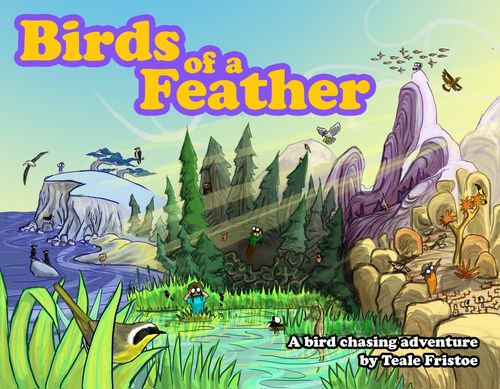
Birds of a Feather
Birds of a Feather Rulebook
Table of Contents
Table of Contents
Game Overview
You and the other players will explore different habitats to find birds. Each round, each player will play one card to determine which habitat she explores. Played cards also determine which birds are seen in the habitat. Over the course of the game, players keep track of the birds they have seen using the Birds of a Feather Score App or on score sheets.
The game ends at the end of the round when players have only one card left in hand. At that point, whoever saw the widest variety of birds over the course of the game wins!
Game Design: Teale Fristoe Graphic Design: Slim Mittens Art: Trevor Fristoe
© 2015 Nothing Sacred Games nothingsacredgames.com
Contents
- 60 Bird cards. Each habitat has:
- 1 ace
- 1 raptor
- 1 rare
- 2 of each uncommon
- 3 commons
- 1 Score Pad
Each Bird card shows a bird type symbol, the quantity of that bird in the deck, the bird's name, its points value (some birds are worth 0 points), and its habitat.
Setup
- Load the Birds of a Feather Score App on each player's phone. Scan the QR code or visit: nothingsacredgames.com/birdapp. Any player without the app needs a score sheet and pen.
- Shuffle the deck of bird cards.
- Deal each player a hand from the deck according to the table below. Place any leftover cards aside, face down.
Note: For 2 and 3 player games, deal extra dummy hands so there are 4 hands total.
| Players | Hands | Hand Size |
|---|---|---|
| 2 | 4 (2 dummy) | 15 |
| 3 | 4 (1 dummy) | 15 |
| 4 | 4 | 15 |
| 5 | 5 | 12 |
| 6 | 6 | 10 |
| 7 | 7 | 8 |
Steps of a Round
In each round, players go on trips to see birds in different habitats.
Step 1. Secretly choose cards to play. At the same time, each player secretly chooses a card from her hand, putting the card face down in front of her.
- The chosen card determines which habitat that player visits this round.
- The chosen card also helps determine which birds appear in the card's habitat.
Note: For 2 and 3 player games, each dummy hand plays a random card.
Step 2. Reveal cards. Each player reveals her chosen card. Reveal cards from dummy hands as well.
For clarity, revealed cards are represented by their Bird Type Symbol in diagrams.
Step 3. Mark seen birds. Each player marks all of the birds in her habitat on her app or score sheet. Only mark a bird the first time you see it. There is no benefit to seeing the same bird multiple times.
- Each player sees the bird on the card she played.
Example: Christie plays a Belted Kingfisher. She fills in the Belted Kingfisher spot on her score sheet.
- Each player sees the birds on other players' cards this round in the same habitat.
Example: Trevor plays a Steller's Jay and Carey plays a Mountain Chickadee in the same round. They both fill in the Steller's Jay and Mountain Chickadee spots on their score sheets.
Step 3 continued. After the first round, each player sees the birds on all players' cards from the previous round in the same habitat as the card she played this round. These cards are called lingering birds (see Step 5).
Example: In the next round, Teale plays a Mountain Quail. He fills in the Mountain Quail spot and the Steller's Jay and Mountain Chickadee spots (since the birds Trevor and Carey played in the last round are now lingering birds and can still be seen).
Note: A player does not see birds in the habitat of the lingering bird she played in the previous round (unless she played another card from the same habitat in the current round).
Example: If Trevor plays a Red-winged Blackbird this round, he doesn't see Teale's Mountain Quail this round, even though the lingering bird he played in the previous round is a mountain card. After all, he's in the wetlands now, not the mountains.
Step 4. Clear lingering birds from previous round. Except on the first round, discard all lingering birds played in the previous round.
Step 5. Save birds from this round. Move all birds players played this round (including dummy cards) into the center of the table. They are now lingering birds, and players will be able to see them in the next round.
Step 6. End game or start a new round. If players only have one card left in their hands, the game ends! Players set aside the final cards from their hands, which will not be played. It's time to determine a winner!
Otherwise, start a new round by returning to Step 1.
Determining a Winner
When the game ends, each player counts up her score:
- Each bird you saw is worth 1 point (except aces and commons, described below).
Note: Seeing the same bird more than once grants no extra points.
- Each ace seen is worth 2 points instead of 1 point.
- Commons are not worth any points, but must be seen to complete a habitat (the 'ALL' described below).
- Each habitat in which a player saw all 7 birds is worth 3 extra points (marked 'ALL' on the score sheet). A full row is worth 10 points.
Note: Each space on the score sheet has a point value shown for each point that space is worth.
Whoever has the most points saw the most beauty and wins!
Living with Score Sheets
No one likes score sheets. Here are some ideas to help make the most of score sheets in Birds of a Feather.
- Use the free Birds of a Feather Score App instead of score sheets. Scan the QR code or visit: nothingsacredgames.com/birdapp
- Laminate some of your score sheets and use erasable markers instead of writing directly on the paper.
- Reuse your score sheets with different color pens or different ways to mark them.
- If you run out of score sheets, download a free PDF so you can print out more at home. Visit: birdsofafeathergame.com
Optional Rule: Raptors
For a more cut-throat game, when a player reveals a raptor, remove all lingering birds from the raptor's habitat. No players, including the player who played the raptor card, sees any of those lingering birds this round.
- Only remove birds of the raptor card's habitat, not any others.
- Do not remove any cards played in the same round as the raptor card, or any cards played in the next round. Only remove lingering birds from the previous round.
- Players who played cards with the same habitat in the same round as the raptor see all remaining birds in that habitat, including the raptor itself.
Optional Rule: Migration
Once players are familiar with the game, you can add more strategy by having players pass cards from their starting hands. Refer to the table below to determine how many cards you should pass. After cards are dealt to each player, pass the specified number of cards to the player on your left. Add to your hand the cards passed to you by the player to your right, then play as normal.
Note: If there are dummy hands, simply skip them when passing.
| Players | 2 | 3 | 4 | 5 | 6 | 7 |
|---|---|---|---|---|---|---|
| Passed Cards | 3 | 3 | 3 | 2 | 2 | 1 |
Optional Rule: Drafting
Drafting is an alternate way to determine your starting hand. It allows experienced gamers to enjoy a much more strategic, but more complex, version of Birds of a Feather. It is not recommended for inexperienced gamers. Do not combine drafting with the migration optional rule.
Steps of Drafting
Step 1. Deal each player a pool. Each player is dealt a pool of cards. The number of cards in the pool is determined by the number of players (see below). Players can look at their own pools, but keep them hidden from their opponents.
Step 2. Draft from pool. Each player simultaneously chooses one card from her pool to keep. She adds this card to her hand. Her hand is hidden from other players, but players can look at their own hands at any time.
Step 3. Pass pool. Each player then passes the cards she did not choose to the player on her left. (Note: If you draft from more than one pool, you alternate passing directions for each pool. Start passing left, then right, then left.)
Step 4. Draft again. Return to Step 2, drafting from the pool passed to you by the player next to you. Continue until all cards from the pool have been drafted.
Step 5. Deal another pool. For most player counts, you will draft from more than one pool. Return to Step 1 and draft again until you have drafted all pools required for your player count. Don't forget to alternate passing direction.
Step 6. Play as normal. Players now play a normal game of Birds of a Feather with the hands they drafted!
The size of the pools, and the number of pools to draft, is determined by the number of players.
7 Players: Each player will draft from one pool of 8 cards.
Note: Some cards from the deck will not be used with this many players. Put these cards to the side face down after dealing pools.
6 Players: Each player will draft from two pools of 5 cards.
5 Players: Each player will draft from two pools of 6 cards.
4 Players: Each player will draft from three pools of 5 cards.
3 Players: Each player will draft from two pools of 10 cards. For the second pool, whenever a player chooses a card for her own hand, she also chooses one for a communal dummy hand. Keep the dummy hand hidden from all players. Shuffle the cards all players chose for the dummy hand together before playing as normal.
2 Players: Each player will draft from three pools of 10 cards. Each player is in charge of one of the dummy hands. Whenever a player chooses a card for her own hand, she also chooses a card for her dummy hand. Shuffle each dummy hand before playing as normal.
Birding Solo
Birding with friends is great, but birding alone can be fun too! Special thanks to Ricky Royal for the original solitaire rules.
Setup: Shuffle the deck and deal yourself a 13-card hand.
Steps of a Round
Step 1. Choose one card to play. This card determines your habitat and therefore the birds you see, as usual.
Step 2. Reveal the top three cards from the deck. You can see any of these birds that are in your habitat. (In the solitaire variant, you do not need the score app or a score sheet — just keep the cards you've seen!)
Step 3. Clear the lingering birds from the previous round, and save the birds revealed this round as lingering birds.
Step 4. Choose one card from your hand to discard, then draw the top card of the deck.
Repeat Steps 1–4 until the deck runs out of cards. That's the end of the game! Count your score as normal to see how you did!
For an even greater challenge, don't forget to use the raptor optional rule!
| Final Score | Ranking |
|---|---|
| 25 or less | Forgot binoculars. |
| 26–30 | Backyard bird watcher. |
| 31–35 | Serious birder. |
| 36–40 | Flying high! |
| 41 or more | A big year! |