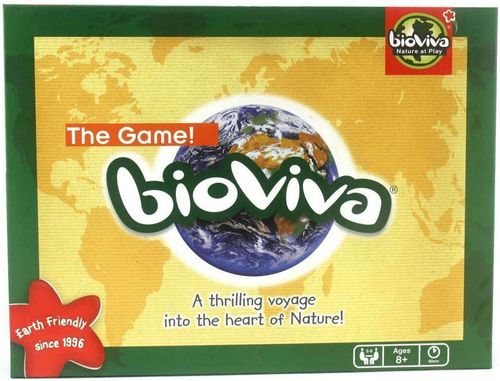
Bioviva
Bioviva Rulebook
Table of Contents
Table of Contents
Components
- 1 game board (world map)
- 224 "challenge" cards (cartes « épreuve »), with a question side (blue) and an answer side (orange)
- 32 "+" cards (cartes « + »), with a commentary side
- 12 wooden "water-drop" pawns (pions « goutte d'eau »): 6 colors, two pawns per color, each color with one correct-answer pawn (green) and one wrong-answer pawn (red)
- 1 wooden die
- 2 sticker sheets
- 72 "Viva" points
- 43 "Symbol" tiles (tuiles « Symbole »)
- 18 "A, B, C" tokens (jetons « A, B, C »), 3 per player color
- 1 cardboard magnifying glass (loupe)
- 1 rulebook
Setup
- Stick the 6 large stickers onto the faces of the wooden die.
- Stick the 12 small stickers under the 12 water-drop pawns (one green and one red per color).
- Place the board in the center of the table. Take the 32 "+" cards and place them face down (commentary side hidden) in a pile beside the board. The remaining challenge cards stay in the box.
- Each player takes 2 water-drop pawns of one color, plus the A, B, C tokens of the same color, and places them in front of them.
Object of the Game
Be the first player to collect 12 "Viva" points by winning the maximum number of challenges offered.
Starting the Game
The oldest player starts. They become the guide for this turn and roll the die. The symbol shown on the die determines the type of challenge played during this turn.
The Challenges
There are 3 types of challenge:
I - Question
- The guide draws a challenge card from the box and reads aloud the question printed on the blue side, in the box at the top. All players, including the guide, secretly choose the token (A, B or C) that matches their answer and place it face down on the table in front of them.
- Then all players reveal their token at the same time. The guide turns the card over, gives the correct answer (in the top box, orange side) and reads the commentary.
- If one or more players gave the correct answer, the guide draws a "+" card and reads the indications. The winner or winners of the challenge receive the number of "Viva" points shown.
Why is it like this? The answers to these questions are rarely well known. In Bioviva, the goal is not necessarily to prove your knowledge but rather to be surprised and discover fascinating anecdotes about our planet. And thanks to the choice of answers offered, everyone can answer on every turn!
II - Localization
- The guide draws a challenge card from the box and reads aloud the question printed on the blue side, in the middle box. Example: "Where is the highest temperature ever recorded on Earth?"
- All players, including the guide, together place their water-drop pawns on squares of the board: the correct-answer pawn (✓) and the wrong-answer pawn (✗), wherever they wish. Example: on a square of the Sahara desert. Only one token may be placed per square, and a pawn may not knock off another pawn (even if tempting!).
- Then the guide turns the challenge card over. They read the answer in the bottom box, given as the coordinates of one or more squares (in the example, square H4, which corresponds to Death Valley in California), and the commentary. The coordinates of a square are where the indicated row (a letter) meets the indicated column (a number), as in Battleship. In the example, row H, column 4.
- Finally, the guide draws a "+" card and reads the indications. The player whose correct-answer pawn is closest to the correct square receives the number of "Viva" points shown on the "+" card. If several players are tied for distance from the correct square (they are at the same distance), each of them receives the "Viva" points shown.
- If a player placed their correct-answer pawn exactly on the correct square, the "Viva" points they win are doubled.
Why is it like this? This challenge combines a dimension of speed and a dimension of bluff. It is sometimes necessary to be the fastest to place your correct-answer pawn on the square you think will win, but it can be just as effective to talk and bluff, using the wrong-answer pawn to mislead the other players…
III - Word Association
- The guide draws a challenge card from the box and secretly reads the name of the animal shown on the blue side, in the bottom box. A clarification in italics is sometimes given for the less well-known animals.
- The guide must then make the other players guess this animal using the Symbol tiles and the magnifying glass. To do so, the guide lays out in front of them the tiles they consider relevant. They may use at most 7 tiles. The players give as many answers as they wish.
- Before starting to place tiles, the guide has the right, if the animal does not inspire them, to pass once and draw a new card.
Placing the tiles:
- Place the tiles side by side, in the same horizontal row.
- If you decide to add a clarification to a tile, place another tile underneath it.
- Example: the tiles "small" + "light" + "antennae" + "leg" + "many" = Millipede!
Tiles are only the graphic representation of an idea. For example, the "leg" tile looks like a horse's leg, but it simply means "leg" in general: leg, hoof, any limb touching the ground… The same applies to all the tiles in the game.
Symbol tile meanings (as printed on the sheet):
- Yellow-background tiles show parts of animals (e.g. leather, skin, antennae, leg).
- Blue-background tiles give a context (sky, land, hot, cold, small, large…). Examples printed: land / air / water, few / many, edible, domesticated, diurnal / nocturnal, herbivore / carnivore, short / long, light / heavy, color (use it to point at any color, even on an ugly shirt of an uncle!), and a tile for "where to place" (à positionner où l'on souhaite pour désigner une couleur).
Using the magnifying glass:
-
To help the others guess the animal, the guide may use the magnifying glass in addition to the tiles. They may place the magnifying glass wherever they wish on the board (to point at a place or habitat, such as the sea for a shark or the desert for a scorpion), or anywhere in the room where the players are, to point at a texture or an object…
-
During this challenge, the guide may not mime or make any noise. They may only say "almost" to point the players toward a similar animal, or "not at all" when the players are too far from the answer. They may also say "more" when the animal's name is a compound and the first term has been found.
-
As soon as a player gives the correct answer, the challenge is over. The guide draws a "+" card and reads the indications. The winner of the challenge and the guide each receive the number of "Viva" points shown.
-
If no one has found the correct answer after 7 tiles have been placed, the challenge is considered lost and no one scores any points.
Why is it like this? This challenge has a real atmosphere, because word associations may not be obvious to every player.
In these 3 challenges, the guide takes part on the same footing as the other players. They can therefore win "Viva" points in each of the challenges.
Next Turn
Once the first challenge is over, the player to the guide's left becomes the new guide. They roll the die and a new turn of play begins.
Translator's note: the sheet reads "Une fois la première épreuve terminée" ("once the first challenge is finished"). Read in context, this describes the end of the turn: the challenge played this turn, as determined by the die, ends the turn and the next player on the left becomes guide.
End of the Game
The first player to have collected 12 "Viva" points wins the game.
Board Legend
The board's terrain colors are listed on the sheet as:
- Tundra and polar regions
- Temperate forests
- Temperate grasslands
- Taiga
- Deserts
- Scrublands and mountain meadows
- Humid tropical forests
- Wooded regions and savannas
- Sub-temperate forests and scrublands
The world map is drawn from the "Peters projection," which reproduces the true relative size of the continents. It does not show the planet according to national borders, but according to a simplified version of the large natural regions.
On this map, the Alps and the Rockies do not appear as "mountain meadow and scrubland zones"... even though there are mountains... Not always simple, science!
Note for Younger Players
The sheet has a box titled "Help for younger players" (Aide pour les plus jeunes) with these rules:
- Question: children may secretly look at another player's answer token before choosing their own.
- Localization: the 2 pawns (correct-answer and wrong-answer) of younger players are treated as 2 correct-answer pawns.
- Word Association: when children are guides, they may make animal noises or mime the animal in addition to using the tiles. They may also read the italic clarification aloud to the other players. If the animal does not inspire them, they have the right to pass twice (instead of once), and therefore draw two new cards. When children must guess, the guide must secretly show them the clarification (when one exists), covering the answer with their finger.