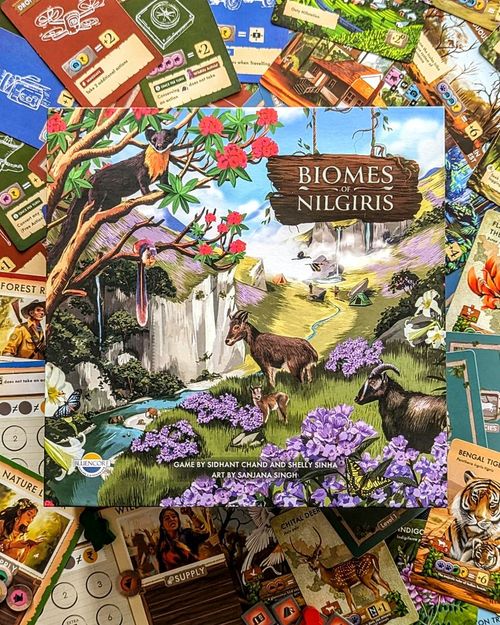
Biomes of Nilgiris
Biomes of Nilgiris Rulebook
Table of Contents
Table of Contents
Game Components
- 1 Main Board
- 4 Player Boards
- 4 Reference Cards
- 32 Biome Cards (Level 1 - 15 cards, Level 2 - 17 cards)
- 6 Starter Cards (5 Biome + 1 Field Station)
- 2 extra Field Stations
- 71 Species Cards (38 - Level 1, 33 - Level 2)
- 32 Equipment Cards (16 Character Specific, 16 Standard)
- 12 Objective Cards (A - 7 cards, B - 5 cards)
- 100 Player Tokens (Front - 25 per colour, Back - 25 per colour)
- 150 Experience Tokens (25 per type)
- 4 Character Meeples (*Available in Deluxe version)
Mini Expansion I (You Have a Mission)
- 7 Scenario Mission Cards
- 1 Reference Card
- 45 double-sided scenario tokens (15 Lantana Camera front, 15 Prosopsis front, 15 Wattle front, 45 Bloom back)
- 1 six-sided die
- 4 Tribal Meeples
- 1 Poacher Meeple
Mini Expansion II (Special Species)
- 2 Scenario Mission Cards
- 9 Documentary Cards (5 Regular and *4 Specials (Upcoming))
- *18 Advanced Species Cards (*Upcoming)
- *2 Objective Bonus Cards (*Upcoming)
* Upcoming (not available in this prototype)
Mini Expansions
Two Mini Expansions for Biomes of Nilgiris introduce additional scoring options, cards, and species for an even more challenging game!
You Have a Mission
The expansion "You Have a Mission" includes six missions inspired by real-life conservation situations: Remove invasive species, protect wildlife from poachers, learn the ways of the tribes, and more! Gain access to new actions and adapt your strategy to the goals of each scenario. Furthermore, you may even combine missions in sequence to embark on a conservation campaign.
Special Species
The expansion Special Species introduces new Species cards featuring rare animals, including reptiles, snakes, insects, butterflies, turtles, and crabs. Discovering these species rewards players with additional in-game benefits. It also contains two additional missions: The Nilgiris Documentary and the Celebrate Biodiversity missions.
Base Game Setup
Starting Map
- Place the Starter Field Station Biome card in the center of the playing area.
- Randomly place 5 Starter Biome cards next to the Field Station as shown.
Main Board
- Place the main board on the table, leaving enough space around the starting Map to place Biome cards throughout the game.
- Shuffle the Level I Biome cards and place them face down on the designated space. Set aside the Level II Biome cards.
- Shuffle the Level I Species cards and place them face down on the designated space. Then, reveal three cards in a row to the right of the stack. Set aside the Level II Species cards.
- Shuffle the type A and B Objective cards separately. Then, place 2 cards of each type face-up on the designated spaces (the order of the cards has no influence). Return the remaining Objective cards to the box.
- Set aside the Character-specific Equipment cards. Shuffle the Standard Equipment cards and place them on the designated space. Then, reveal three cards in a row to the right of the stack.
- Sort the Experience (XP) tokens by type and place them next to the board, forming a shared supply.
Player Setup
Each player chooses a player color and receives the following components in that color: 1 Player board, 1 Character meeple, and 25 Player tokens.
Then:
- Place the Player board in front of you, with the Character of your choice face-up.
- Take 1 XP token of each of the 6 types from the shared supply and place them in the Supply area of your player board.
- Place your Character meeple on the Starter Field Station Biome card.
- Place 1 Player token on the "0" space of the Ecology track on the main board.
- Place 1 Player token below the Sustainability track on the main board.
- Place the remaining Player tokens near your Player board.
- Take the 2 Equipment cards specific to your Character into your hand, and return the remaining cards to the box.
- Take 1 Reference Card.
- The first player is the player who most recently visited a national park. The first player draws 3 cards from the Level I Species deck into their hand. The player to their left draws 4 Species cards; the next player draws 5; and so on.
Game Overview
Objective
In Biomes of Nilgiris, players seek to obtain the most Ecology points (EcoP).
You gain EcoP from:
- Conserving the Nilgiri Biomes and Species.
- Achieving End-Game Objectives.
- Moving up on the Sustainability track
Rounds
The game is played over a series of rounds. In each round, each player takes a single turn, starting with the first player and proceeding clockwise. The order of play does not change throughout the game.
Turns
On your turn, you must take 3 actions. One of the actions must be a Travel action. You can only select actions you can resolve and may select the same action more than once. Resolve the actions in the order of your choice and complete one action before starting another.
There are 7 different actions to choose from:
- EXPLORE - Add Biome cards to the Map
- TRAVEL - Move on the Map, eventually revealing Biome cards
- JOURNAL - Gain XP tokens and new Species or Equipment cards
- STUDY - Make your XP tokens available to use
- EQUIP - Play Equipment cards from your hand to your playing area
- DISCOVER - Play Species cards from your hand to your playing area
- CONSERVE - Conserve Species or Biomes and gain EcoP
Midgame
Whenever a player token reaches or passes the 18 EcoP space on the Ecology track for the first time, it triggers the midgame.
Complete that round and then:
- Return to the box all the remaining Level I Species and Biome cards on the main board.
- Shuffle the Level II Biome cards and place them face down on the space designated for Biome cards.
- Then, reveal three cards in a row to its right.
Game End
Whenever a player token reaches or passes the 49 EcoP space on the Ecology track for the first time, it triggers the end of the game. Complete that round so all players take the same number of turns.
Then, players proceed to the final scoring, where they may gain additional points from Endgame Objectives and the Sustainability Bonus track.
The player with the most EcoP after the final scoring wins the game. In case of a tie, apply the tiebreakers (see Final Scoring, page 26).
Core Concepts
Objective
Ecology Points, or EcoP, is the primary measure of your success in conserving the Biomes of Nilgiris. You gain EcoP through various actions during the game, especially when resolving the Conserve action.
When you gain EcoP, advance your marker on the Ecology track on the main board as many spaces as the number of EcoP you gained.
While progressing along the Ecology track, players may gain some bonuses:
Only the first player to cross a line marked with 1st receives the indicated bonus.
Every player who crosses a line not marked with 1st receives the indicated bonus.
Resolve any bonus gained immediately after advancing your marker on the Ecology track:
Gain the XP token shown and place it in your Journal area (see Journal, page 14). You may opt to forfeit this benefit.
Take an Explore action (see Explore, page 18). This is mandatory, and the extra Explore action does not count toward the total number of actions you may take in a turn.
Place an Extra Field Station card "face-up" on the Map (see Explore, page 18, for placement rules). This is mandatory and does not count toward the total number of actions you may take in a turn.
Experience Tokens
When you resolve specific actions, you gain experience, represented by Experience (XP) tokens. There are six types of Experience, each represented by a different icon:
- BOTANY — These XP tokens are used for Conserving Biomes and Species.
- ZOOLOGY
- FIELDWORK
- COMMUNICATION
- PHOTOGRAPHY
- FUNDING — This XP token may be used to replace any other type of XP, for example, when fulfilling a cost or conserving requisite.
When you gain XP tokens indicated by a journal (icon) (rectangle shape), take the corresponding XP tokens from the shared supply and place them in the Journal area on your Player board, unless indicated otherwise.
When you gain XP tokens indicated by circular shape, take the corresponding XP tokens from the shared supply and place them directly in the Supply area on your Player board.
You can only spend XP tokens from your Supply area (you cannot spend the tokens in the Journal area). You will learn later how to move XP tokens from the Journal area to the Supply area. When spending XP tokens, return them to the shared supply.
Sustainability Track
Actions, benefits, and fulfilling the objectives printed on the main board allow you to progress on the Sustainability track.
Whenever you obtain the Sustainability icon, immediately:
- Advance your marker one space up on the Sustainability track (the first time you gain 1 Sustainability track movement, place your marker on the space "1").
- Choose 1 of the benefits indicated to the left of the space where your marker ends up.
Your marker cannot move past the "9" space on the Sustainability track. If you progress further, do not move your marker and gain only the benefit, as in step 2 above.
The benefits are the following:
- Choose one type of XP and gain 1 EcoP for every 2 XP tokens of that type in your Supply.
- Add 2 Funding XP tokens to your Supply, OR draw 3 cards (Species and/or Equipments), OR gain and resolve a Free action of your choice (it does not count towards the three actions limit).
- Add 1 Zoology XP and 1 Botany XP token to your Supply, OR add 1 Photography and 1 Communication token to your Supply, OR gain 1 EcoP.
During the final scoring, the player further up on the Sustainability track gains additional EcoP. In case of a tie, all the tied players receive the bonus. (See Final Scoring, page 26)
Actions
Explore
Expand the Map to gain access to new areas in Nilgiris.
When you take the Explore action, follow these steps in order:
- Draw the top card from the Biome deck without revealing it.
- Place the Biome card face-down on the Map adjacent to at least two existing Biome cards (each can be face-up or face-down). You may place the new Biome card in any valid position, regardless of where your Character meeple is.
- Take a Funding XP token from the shared supply and place it on the newly placed Biome card.
Travel
Move across the Biome to gather materials for fieldwork, discover species in different vegetation types, address conservation issues, and preserve the ecosystems.
When you take the Travel action, follow these steps in order:
(Note: Travel is a mandatory action)
- Move your Character meeple:
Onto an adjacent Biome card, OR from one Field Station to another Field station (at the start of the game, there is only one, but more will come into play during the game).
You may move onto a card with one or more Character meeples.
- If you move onto an unrevealed Biome card (face-down card), take the Funding XP token on the card and place it in your Supply area. Then, flip the Biome card face up.
- If you move onto a revealed Biome showing a lightning-bolt icon and an uncovered benefit, gain the benefit immediately.
Then, place one of your player tokens over the benefit icon to indicate that you revealed the Biome and the benefit is no longer available.
The lightning-bolt icon indicates an immediate gain.
Biome Cards
Each Biome card contains the following features:
A. Vegetation type
- Dry Deciduous
- Evergreen
- Moist Deciduous
- Scrub Jungle
- Shola Grasslands
B. XP tokens you gain when taking the Journal action in the Biome.
C. Information on the location or the ecological issue at stake in the Biome.
In certain Biome cards, you may also find the following:
D. The XP tokens to spend to Conserve the Biome. E. EcoP gained when Conserving the Biome. F. Sustainability track progress. G. One-time benefit for the player who reveals the Biome card.
The Field Station is a particular type of Biome card. When taking the Journal action at a Field Station, you choose which XP tokens to gain, gain from those shown on the card. The ability to move from one Field Station to another is also indicated.
Journal
Record data from the biomes, enabling you to obtain valuable insights and expertise specific to each biome!
To select this action, your Journal area must contain at least one vacant space. Resolve the Journal action by following these steps in order:
- Gain the XP token indicated on the Biome card and place it on the first topmost and leftmost space available on your Journal. This step is optional. If you decide not to take the XP token, proceed to step 4.
- If the XP token covers a space showing a Benefit, gain that benefit immediately:
- EXTRA: Take 1 Equipment or Species card from the main board into your hand.
- FREE TRAVEL: Take an extra Travel action (this action does not count as one of your three actions per turn).
- If you complete a row with three different XP tokens, immediately gain a Funding XP token and place it on your Journal, following the usual rules and gaining any additional benefits.
- Take an Equipment or Species card from the main board into your hand. You may choose any face-up card or the top card of the corresponding face-down deck.
Study
Reflect upon the experience gained and prepare to use it well.
You can only take this action if your Character meeple is at a Field Station and there is at least one XP token in your Journal area.
When you take the Study action, move all the XP tokens from the Journal area into the Supply area on your player board (you cannot move only some XP tokens from the Journal area).
Equip
You cannot fully explore the Nilgiris with bare hands! Make use of your starting equipment or the one obtained during the game.
To select this action, you must have one or more Equipment cards in your hand and be able to pay the cost of the Equipment card you choose to play. You can only play one Equipment card per Equip action. When you take the equip action, follow these steps in order:
- Play one Equipment card from your hand face up into your playing area.
- Spend the amount of XP tokens indicated on the Equipment card.
- Gain the number of EcoP indicated on the Equipment card.
The benefits shown on the card are now active. These may be:
- IMMEDIATE — Resolve the benefit immediately. Then, place one of your player markers on the Equipment card to indicate that you have already used the benefit. The equipment will remain in your playing area until the end of the game, but you cannot use it again.
- ONCE PER TURN — You may resolve the benefit at the end of this Equip action and once-per-turn after that.
- ONGOING — You may resolve them at the end of this Equip action and whenever the benefit requirement is met.
Equipment Cards
Each Equipment card contains the following features:
A. Type (Character specific or Standard) B. Acquisition cost C. EcoP gained D. Type of benefit. Benefits may be Immediate, Once-per-turn, and Ongoing. E. Benefit description
Each Character starts the game with 2 unique Equipment cards in their hand.
Discover
There is a wide variety of species in the Biomes of Nilgiris. Discover fascinating plants, birds and animals throughout your journey!
To select this action, you must have at least one Species card in your hand matching the type of vegetation of the Biome where your Character meeple is. When you take the Discover action, follow these steps in order:
- Play one Species card from your hand, matching the Biome vegetation, face up in your playing area.
- Gain the XP or EcoP indicated on the Species card.
Species Cards
Each Species card contains the following features:
A. Species name B. The vegetation type where the species may be found C. The EcoP and/or XP you gain when you Discover the species D. The Species type: Mammal, Bird, or Plant E. The endangered level: 1 - Least Concern, 2 - Vulnerable, 3 - Endangered. F. The XP cost for Conserving the Species G. The EcoP you gain for Conserving the Species
Conserve
This is the core of your hard work: Succeed in conserving Species and Biomes!
You may Conserve:
- Species you have Discovered, i.e. the Species cards in your playing area.
- Revealed Biomes that have not yet been Conserved by any player, i.e. the Biome cards that are face up and with no player marker on them.
Each Species and Biome may be conserved once.
To select this action and Conserve a Species, the Species vegetation type must match the vegetation type of the Biome where your Character meeple is. In this case, follow these steps in order:
- Spend the XP tokens indicated on the Species card.
- Gain the number of EcoP shown on the Species card.
- Species found in all vegetation types show a variable number of EcoP. N is the number of the same Species cards Conserved, including the one being Conserved with this action (see example below).
If you conserved 1 Chital Deer, you gain 1+1 = 2 EcoP
If you conserved 2 Chital Deers, you gain 2+1 = 3 EcoP
If you conserved 3 Chital Deers, you gain 2+1 = 3 EcoP
- Place a player marker of your color covering the EcoP value on the card to indicate that the Species is now Conserved.
To select this action and Conserve a Biome, follow these steps in order:
- Spend the XP tokens indicated on the Biome where your Character meeple is. (Remember: You can only spend XP tokens from your Supply area, not from your Journal area).
- Gain the number of EcoP shown on the Biome card and move up one SusP (if applicable).
- Place a player marker of your color covering the EcoP value on the card to indicate that the Biome is now Conserved.
Character Roles (Base Game)
The base game features four Characters, one of each player's color. Each Character starts the game with two unique Equipment cards and has a unique ability that you may use in your turn whenever the ability requirement is met.
Photographer
You love shooting wildlife from behind your camera lens, spending hours waiting for the right moment to get the best shot.
ONGOING Ability: When Journaling a Photography XP token, you may add it directly to your Supply.
Equipment: Headlamp & Telephoto Lens
Nature Lover
You enjoy the wilderness more than the urban jungle. Your joy lies in the discovery and tranquility.
ONCE PER TURN Ability: Equipping does not take an action.
Equipment: Backpacks & First-Aid Kit
Bird Watcher
Your eyes do not stop scanning the forest for the elusive angels of the jungle. You can spend hours standing still to see them flit around. Your favorite playlist is made of bird songs.
ONGOING Ability: When Journaling a Botany XP token, you may add it directly to your Supply.
Equipment: Spotting Scopes & Trowels
Forest Ranger
You are the official defender of the forest. You know the ground realities of protecting wildlife and preventing human-animal conflict.
ONCE PER TURN Ability: Traveling to/from a field station does not take an action.
Equipment: Rain Gear & Dart Guns
Citizen Scientist
Your passion for nature is bolstered by a scientific temper. You really enjoy participating in wildlife surveys, observing nature, and fighting passionately to protect the wilderness.
ONCE PER TURN Ability: Studying does not take an action.
Equipment: Tracking Device & Field Tent
Explorer
You go off the beaten path to unlock the secret beauty of the forest. Your best friends are guides and forest rangers.
ONGOING Ability: When Journaling a Fieldwork XP token, you may add it directly to your Supply.
Equipment: Terrain Maps & Flare Guns
Wildlife Activist
Your heart beats for the wilderness. You oppose the destruction of wildlife, motivated by ignorance or greed.
ONGOING Ability: When Journaling a Communication XP token, you may add it directly to your Supply.
Equipment: Flashlight & Sighting Compass
Animal Whisperer
You love animals, and they love you back. Everyone envies your ability to return from a jungle trek with fantastic wildlife photos.
ONGOING Ability: When Journaling a Zoology XP token, you may add it directly to your Supply.
Equipment: Scalpels & Food Scales
Final Scoring
During the final scoring, players may gain additional EcoP for fulfilling objectives and for their position on the Sustainability track.
Objective Cards
Resolve the objective cards on the main board one at a time. For each objective card, rank the players according to the conditions indicated on the card. Only the players fulfilling the conditions may gain EcoP.
Players in the first and second positions gain the corresponding EcoP, as shown on the card. No points are awarded to any other players.
If there is a tie for first place, the tied players score the first-place points, and no second-place points are awarded.
If there is a tie for second place, the tied players score the second-place points.
Note: In a 2-player game, score only the 1st position for every Objective card.
Sustainability Track
The player further up on the Sustainability track gains 5 EcoP. In case of a tie, all the tied players receive this bonus.
Winning the Game
After scoring the Objectives and the Sustainability track, the game ends, and the player with the most points wins.
If there is a tie, the tied player who discovered the most Species wins (i.e., the player with the most Species cards in their player area). If the tie persists, the tied player further ahead on the Sustainability track wins. If there is still a tie, the tied players share the victory.
Final Scoring Example
The rulebook walks through a worked three-player example, tallying: in-game EcoP; the player's SusP (position on the Sustainability track) and the End-game EcoP that highest SusP position grants; each Objective A and B card in turn (e.g. "Most All-Ecotype Species Conserved," "Most Mammals Discovered," "Most Connected Biomes Conserved," "Most Photography XP in Supply"), showing which Species or Biome cards each player qualifies with, the rank each player earns, and the EcoP awarded for 1st and 2nd place on each card. In the example, Player 1 and Player 2 both finish on 59 total EcoP, a tie broken first by Species Discovered (still tied, 5 each) and then by rank on the Sustainability track (SusP ladder), where Player 2's higher rank of 5 wins over Player 1's 4, making Player 2 the winner.
Tiebreakers
- First tiebreaker: Species Discovered.
- Second tiebreaker: Rank on the Sustainability track (SusP ladder).
Mini Expansions (Detail)
You have now gained some knowledge about the rich and unique biodiversity of the Nilgiris. It is time to take your engagement one step further, embarking on a series of missions each addressing a specific conservation challenge. Will you be able to protect the wildlife from poachers? Will you learn from the ancestral ways of the tribes? Will you manage shooting a documentary in the wild? Put yourself to these tests, and more!
You Have a Mission
This expansion includes six unique missions inspired by real-life conservation situations: Remove invasive species, protect wildlife from poachers, learn the ways of the tribes, and more! Gain access to new actions and adapt your strategy to the goals of each scenario. Furthermore, you may even combine missions in sequence to embark on a conservation campaign.
Missions are described in Scenario cards, containing all the additional information you need to play them.
In each game, you will use a Basic Scenario card, scored when the midgame is triggered, and an Advanced Scenario card, active from there on and until the end of the game.
Use the base game rules with the modifications indicated below.
Setup
- Shuffle the Basic and Advanced Scenario cards separately.
- Draw and reveal a Basic Scenario card, and take any additional setup steps detailed on the card.
- Draw an Advanced Scenario card and place it face-down beside the board.
- Return the remaining Scenario cards to the box (they will not be used in this game).
Once revealed, the Advanced Scenario card remains active until the end of the game. Players may use any additional action or mechanism introduced by the card.
Gameplay
The midgame is triggered when any player reaches or passes 18 EcoP in their turn. Complete that round and then:
- Score points as described in the Basic Scenario
- Discard the Basic Scenario card. Then, reveal the Advanced Scenario card and take any additional setup steps described.
- Return all the Level I Species and Biome cards to the box on the main board.
- Shuffle the Level II Biome cards and place them face down in the designated space on the main board.
- Shuffle the Level II Species cards and place them on the designated space on the main board. Then, reveal three cards in a row to its right.
Game End
The end of the game is triggered when any player reaches or passes the 49 EcoP space on the Ecology track in their turn, as usual. Complete that round so all players take the same number of turns.
Then, score points as described in the Advanced Scenario card.
Finally, proceed to the final scoring, where players may gain additional points from Objectives and the Sustainability Bonus track.
The player with the most EcoP wins the game. In case of a tie, apply the tiebreakers (see Final Scoring, page 26).
Conservation Mission
Raise the challenge by engaging in a Conservation Campaign consisting of multiple advanced missions!
Setup
Choose the Advanced Scenario cards you want to play, shuffle them, and place them in a face-down stack beside the board.
Gameplay
Play the game as usual, including the final scoring phase. Then, if there are still unrevealed Advanced Scenario cards, reset the game by following these steps:
- Discard the Advanced Scenario card used.
- Return the tokens in your Journal and Supply areas to the shared supply.
- Take 1 XP token of each of the 6 types from the shared supply and place them in the Supply area of your player board.
- Keep the Species and Equipment cards in your playing area and the EcoP marker in its current position.
- If your SusP score is less than 3, do not change its position. Otherwise, place it on the "3" space on the Sus track.
Continue playing until all the Advanced Scenario cards have been used. After the final scoring phase in that round, the game ends, and the winner is determined as usual.
Special Species (Not Included in the Prototype)
The expansion Special Species introduces new Species cards featuring rare animals, including reptiles, snakes, insects, butterflies, turtles, and crabs. Discovering these species rewards players with additional in-game benefits.
Setup
When preparing the Species card stacks (Setup, step 7, Page 26), sort the Special Species cards according to their level (I or II) and add them to the corresponding stacks of the Species cards from the base game.
Gameplay
Special Species cards are played using the same rules as for the base Species.
Scoring
For scoring purposes:
- When the objectives refer to groups, the Special Species cards are considered part of a new group—the Specials—in addition to the usual Mammals, Birds, and Plants groups.
- When subgroups are referred to (e.g., in the Nilgiris Global Bidiversity Mission), use the subgroup depicted in each Special Species card: Snakes, Insects, Frogs, Reptiles.
Iconography
Card Types
- Species
- Biome
- Equipment
- Objective
Vegetation Types
- Dry Deciduous
- Evergreen
- Shola Grasslands
- Moist Deciduous
- Scrub Jungle
- All Ecotypes
XP Tokens
- Zoology
- Fieldwork
- Communication
- Photography
- Botany
- Funding
Journal Icons
Icons for Fieldwork, Photography, Zoology, Botany, and Communication XP tokens mark journal spaces.
Supply Icons
Icons for Zoology, Fieldwork, Communication, Photography, Botany, and Funding XP tokens mark supply spaces.
Species Type
- Plants
- Mammals
- Birds
Endangered Level
- 3 — Endangered
- 2 — Vulnerable
- 1 — Least Concerned
Player Tokens
- Forest Ranger / Animal Whisperer
- Photographer / Citizen Scientist
- Bird Watcher / Wildlife Activist
- Nature Lover / Explorer
Poacher Cams
Four poacher-cam icons, one per player color, used by the You Have a Mission expansion.
Actions
- Explore
- Travel
- Journal
- Study
- Equip
- Discover
- Conserve
- Mission
Other Icons
- Ecological Issue (warning triangle)
- First player
- EcoP (+1)
- Draw a Card
- SusP
- Supply icon
- Immediate gain (lightning bolt)
- Free Action
- N = No. of same species conserved of All Ecotypes
Character Icons
- Animal Whisperer
- Citizen Scientist
- Nature Lover
- Bird Watcher
- Forest Ranger
- Photographer
- Explorer
- Wildlife Activist
Card Types (Mini Expansion)
- Documentary
- Special Species
Special Tokens (Mini Expansion)
- Lantana camera (Front)
- Wattle (Front)
- Prosopis (Front)
- Bloom (Back)
Special Species (Groups)
- Reptiles
- Amphibians
- Insects
- Snakes