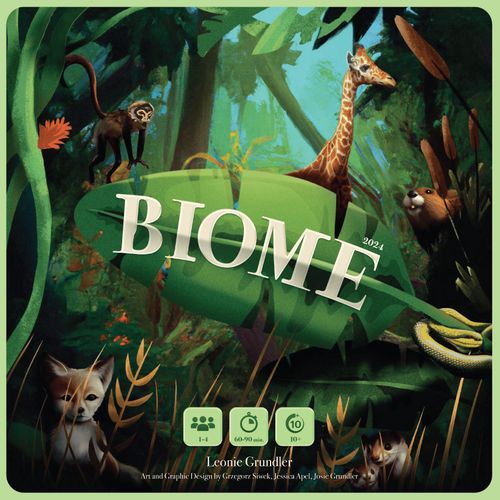
Biome
Biome Rulebook
Table of Contents
Table of Contents
- What Is a Biome?
- Components
- Game Setup
- How to Play
- "Changing Conditions" Cards
- Point Track Bonuses
- Achievements
- Game End
- Glossary
- Action Examples
- Achievement Examples
- Optional Variants
- Bountiful Biome Mini Expansion
- Natural Disasters Mini Expansion
- Biome Solo Mode Rules
- Wildlife Conservation Network & Lioness Games Partnership
- "How to Play" Quick Rules
What Is a Biome?
"A biome is an area of the planet that can be classified according to the plants and animals that live in it. Temperature, soil, and the amount of light and water help determine what life exists in a biome. A biome is different from an ecosystem. An ecosystem is the interaction of living and non-living things in an environment. A biome is a specific geographic area notable for the species living there. A biome can be made up of many ecosystems. For example, an aquatic biome can contain ecosystems such as coral reefs and kelp forests." —Nationalgeographic.org
Components
- A 1 rulebook
- B 4 player boards
- C 1 centerpiece
- D 1 standard die
- E 4 point tokens
- F 1 starting player token
- G 1 season token
- H 64 wooden player cubes
- I 1 phase token & 1 year token
- J 185 resource tokens
- K 50 wooden chicks
- L 30 wooden rabbits
- M 16 straw nests*
- N 1 metal coin
- O 3 pulp storage trays with 2 lids
- P 177 plant & animal cards
Important Clarification About "Nests": Please note that the term "Nest" used in this game refers exclusively to a gaming accessory designed to hold game components. It does not pertain to an actual nest of any living creature.
New players should start with the standard setup (pages 1–2). Advanced players may play with the optional variants (pages 9–11).
Game Setup
Step 1: Each player gets a player board — their Biome — and lays it face up in front of them.
Step 2: Place the centerpiece in the middle of the table. Place the "Standard" side face up for your first game. Take the 12 starting cards and set them aside. Combine the 177 plant and animal cards with the 10 changing conditions cards to make the main deck; shuffle the main deck and place it next to the centerpiece. Place the nests and the wooden components (resources, chicks, and rabbits) next to the centerpiece.
Step 3: Each player chooses a color and takes the corresponding 16 player cubes and point token. Each player sets their cubes on their player board and their point token on the "Start here" space of the track on the centerpiece.
Step 4: Shuffle the achievement cards and pick 3 at random. Place them face up on the designated spaces of the centerpiece and read them out loud.
Important Clarification About "Nests": Please note that the term "Nest" used in this game refers exclusively to a gaming accessory designed to hold game components. It does not pertain to an actual nest of any living creature.
Step 5: Identify the starting player. This is whoever has the most living houseplants (in their actual, real-world home!). Give this player the starting player token. The starting player will be the first to activate an action during the action phase. The starting player token is passed clockwise at the end of each season to rotate starting player privileges.
Step 6: Separate the 6 starting bird cards and have the starting player draw 1 randomly. Give them the matching starting tree card (identifiable by the number in the bottom-right corner). Moving clockwise, players continue to draw a starting bird card and receive the matching starting tree card. Once all players have 1 pair of starting cards, they should place their 2 cards orthogonally adjacent in the habitat marked on the card.
Example: You draw the Hooded Merganser and take the corresponding Tupelo Tree (see the number in the bottom-right corner of the card). Place the cards into any 2 neighboring spaces in your Marsh for free.
Note: Orthogonal means above, below, or to the side — NOT diagonally.
Step 7: Each player draws 3 cards from the main deck. Players may look at their cards immediately and hide them from other players. Each player may also place 2 legend cards next to their player board.
Step 8: Each player gets 1 of each resource (Sunlight, Fish, Leaf, Fruit, Insect, and Rodent). They can place these on the right side of their player board in the resource storage section.
Note: at the end of setup and before the game begins, all players should have their starting bird and tree cards played on their player boards, 1 of each resource, and 3 cards from the main deck in hand.
Step 9: Place the phase token on the Draw cards space of the centerpiece. Place the season token on the Fall season space and the year token on the Year 1 space of the Year track.
How to Play
Overview
Each player collects resources to play cards onto their player board (Biome). The Biome has 18 spaces made up of the Marsh, Prairie, and Jungle habitats. Action cards typically refer to specific habitats (e.g., draw X cards for each bird in your Prairie) OR to all habitats (your Biome).
Plant and animal cards are native to 1 or 2 habitats and can be played into any space in their designated habitat(s). Habitats can be identified by the shape and color of the icon in the top-left corner as well as the card's border.
- The Kapok Tree (Jungle) can only be played in the Jungle.
- The Burrowing Owl (Prairie) can only be played in the Prairie.
- The Water Lily (Marsh/Jungle) can be played in the Marsh or Jungle.
Habitats: Marsh, Prairie, Jungle, Mixed (can be played in either habitat).
There are 7 types of plant and animal cards:
- 4 animal types: Mammal, Bird, Reptile, Miscellaneous Animal
- 3 plant types: Flower, Tree, Miscellaneous Plant
Gameplay
Players start in Fall of Year 1 with the simultaneous-gameplay phases. Complete each phase simultaneously and wait for all players to finish before advancing the phase token and moving on to the next phase. After the play 1 card phase, the turn-based phases begin with the seasonal event. In the Standard game, play seasonal events in Spring and Summer only. In Fall or Winter, skip the seasonal event and move on to the action phase.
In the action phase, players take an action one at a time. When all players have completed their action, the season concludes.
Each season is one round of the game with simultaneous and turn-based phases.
Players complete each phase simultaneously:
- Reduce cards to hand limit
- Draw cards from the main deck
- Collect resources from the supply
- Play 1 card onto Player Board
Simultaneous OR Turn-based: 5. Seasonal event
One at a time: 6. Activate unused card ability
Phase Overview
① Reduce cards to hand limit: All players reduce their hand to the limit of 8 cards. For every 2 cards discarded, receive 1 resource or card. Players may freely discard 2 cards from their hand to receive 1 resource or card at any time during the game.
② Draw cards: All players may draw 2 cards from the main deck (and may exceed the hand limit by doing so).
③ Collect resources: All players may collect any 2 resources.
Don't forget! Starting Year 2, the player in last place each season gets 1 extra card OR resource during the collect resources phase. If 2 or more players are tied in last place, no one gets this bonus.
Card anatomy: Card type (e.g., Mammal), Point Value, Habitat Icon, Habitat Border, Resource Cost, Card Ability, Fun Fact.
④ Play 1 card: All players may play 1 plant or animal card into their Biome; pay the listed resource cost and advance your point token on the point track accordingly.
Note: Anytime you forgo the option to play a plant or animal card (in the play 1 card phase, from a card action, or from a bonus), you may draw 1 card instead.
Example: To play the Grizzled Tree Kangaroo into your Jungle, pay 2 leaves and 2 fruit. Return these resource tokens to the supply, place the card into any of your open Jungle spaces, and move your point token up 7 points on the point track.
Food tokens are used to play animal cards. Sunlight tokens are used to play plant cards.
⑤ Seasonal events: Each season has unique events. In the Standard setup, seasonal events are played only in Spring and Summer. Fall and Winter have seasonal events in the advanced mode as explained on page 9.
Spring
Spring's seasonal event is the nesting phase, which all players complete simultaneously.
Every bird card that is orthogonally adjacent to a nest-bearing plant card in the same habitat will make a single nest and have chicks, provided that it doesn't exceed the bird nest limit for that plant. Birds with two designated habitats can nest in a tree in either habitat (as long as it is adjacent).
Example: The Bald Eagle played in the Prairie can nest in a neighboring Marsh Tree.
Every rabbit card that is orthogonally adjacent to ANY plant card in the same habitat will make a single nest and have babies.
For every bird or rabbit that can nest, place a nest into your Biome between the animal and the plant card. All rabbits have 6 babies, so place 6 rabbit tokens in each rabbit's nest. The number of chicks per bird's nest is specified on the feather icon of each bird card.
All trees can hold up to 2 bird nests. Miscellaneous plants with 1 nest symbol can hold 1 bird nest. All plants can hold up to 4 rabbit nests.
Note: Animals can nest in different plants from one Spring to the next.
Example: Your Mallard Duck nests in the Tupelo Tree in Spring of Year 1. By Spring of Year 2, you've played a Mangrove Tree next to the Mallard Duck. The duck can make the new nest in the Tupelo Tree again OR in the Mangrove Tree, not both.
Note: You are not required to play a bird next to a tree. Trees and birds can be played independently of each other. Playing them next to each other is advantageous only because it allows the bird to make a nest.
Nesting is the only seasonal event in Spring, so after nesting, play continues to the action phase.
Note: Rabbits do not make nests like birds. Rabbits burrow underground and line the "nest" with grass and fur.
Summer
Summer begins with predation: All predators activate automatically, one at a time. The player with the fewest points activates their predators first; ties go to the player earliest in the turn order. Then the player with the second fewest points goes next, and so on.
Note: Each Summer, predators hunt and vultures scavenge. No player cube is placed on the predator cards or vulture cards when activated.
Each of the active player's predators will get to attack, as follows: First choose an opponent's nest for the predator to attack. The nest and predator must be in the same habitat type. To attempt an attack on the nest, roll a die. A successful attack is any die result higher than the number of plant cards in the target habitat.
Example: The Meerkat, which lives in the Prairie, may only attack a nest in an opponent's Prairie.
For each successful attack, return up to 2 babies from the nest to the supply and advance 2 spaces on the point track PER baby animal token removed.
Example: Your Marsh predator targets an opponent's Marsh babies. Their Marsh has 3 plants, so you must roll a 4 or higher to successfully prey on their nest.
If your predator is unable to hunt (either by lack of nest availability or unsuccessful die roll), draw 3 cards from the main deck.
The predation phase is followed by feeding and babies leaving the nest. For each baby you want to feed, pay 1 food from your personal supply back to the main supply. The type of food must match the resource cost shown on the parent animal's card. After feeding your baby animals, advance your point token on the point track 2 points per fed baby and return those babies to the supply. Only after feeding can you claim any bonuses accrued on the point track during this phase.
Note: For birds that eat 2+ food types, you may feed your chicks either of those foods.
Example: Most rabbits eat leaves. If you have 6 baby rabbits, pay 6 leaves to ensure all babies survive and earn 12 points, or choose to pay fewer leaves and lose unfed babies. For example, you might choose to save some leaves you might need for playing a card later.
The feeding phase is followed by the scavenging phase (if at least 1 of the 2 vulture cards has been played). If you have a Greater Yellow-Headed Vulture in your Jungle, you may earn 1 point and draw 1 card for each unfed baby from one other player's Jungle. Similarly, the Lesser Yellow-Headed Vulture can scavenge unfed babies in both the Marsh and Prairie habitats from one other player. After this phase, return all remaining nests and baby animals to the supply.
⑥ Action: The active player may activate one of the unused cards in their Biome. To signify that the card's action has been used, they will place one of their player cubes on the card.
Don't forget! Each action can only be used once per game! The average game is 8–10 rounds, so players typically take only 8–10 actions per game.
Continuing clockwise, each player will take their turn entering the action phase and activating a card in their Biome. Should a player be unable to OR choose not to activate any action, they may draw 1 card instead.
After all players have taken their action turn, the season ends and players move to the next season. Return the phase token to the top of the phase track and advance the season token to begin the next season. The starting player token is passed to the next player clockwise. At the end of Summer of Year 1 and Year 2, move the year token to the next space.
"Changing Conditions" Cards
Changing Conditions cards effectively expand one habitat while shrinking another. Cards will indicate which habitats they can transform and may be played anytime into any empty space in either habitat.
Example: You may place a Prairie ↔ Jungle Changing Conditions card on an empty Prairie card space to make it a Jungle space. That space is considered a Jungle habitat for all actions and Achievements. At the next opportunity to play cards, you may play a Jungle plant or animal card on your new Jungle space.
Point Track Bonuses
When your point token lands on or passes a bonus space on the point track, you immediately gain that bonus. There are 3 types of point track bonuses: get 1 sunlight, draw 1 card, or play a card from your hand for 1 less resource. Bonuses may not be activated when players loop around the track.
Note: Bonuses may be resolved in any order. If you pass a get 1 sunlight bonus and a play 1 card for -1 resource bonus, you may collect the sunlight and then benefit from the play 1 card for -1 resource bonus, or vice versa.
If giving a point or points to another player from an action you have taken moves you behind a bonus space you previously claimed, you can earn the bonus a second time when you reach it again moving forward.
Note: During your predation phase turn, if you earn the play 1 card for -1 resource bonus with points earned hunting and you have a predator card in hand, you may play and activate it immediately.
Achievements
Every game begins with 4 Achievements. The first Achievement is printed directly on the centerpiece, and the other 3 Achievements are cards drawn randomly during game setup and placed face up on the marked Achievement spaces of the centerpiece.
The first player to complete an Achievement earns the number of points on the first place space, advances their point token accordingly, and puts one of their colored cubes on the first place space of that Achievement card. The second, third, and fourth players to complete the same Achievement will place their colored cube on the second, third, and fourth space, respectively, and earn the corresponding number of points.
If multiple players complete an Achievement in the same simultaneous phase, they tie for the highest open space of that Achievement. The involved players all earn the same number of points, advance their point tokens accordingly, and place colored cubes on the same space. If a third or fourth player completes the same Achievement later, they would play their colored cube on the third or fourth space respectively (thus, a space or two will be skipped in these cases).
Example: You and an opponent both complete The Florist Achievement in the same play 1 card phase. First place is already taken (by purple), so you and your opponent share 2nd place, advance 6 points each on the point track, and place both colored cubes on the 2nd place space. A 4th player would occupy the 4th place space once achieved.
Note: If multiple players complete the same Achievement during different turns in a turn-based phase, there is no tie, since they completed it at different times. In the rare event that multiple players complete the same Achievement during the same turn in a turn-based phase, the tie is broken in turn order, beginning with the active player.
Game End
The game end is triggered in one of three ways:
- any player reaches 120 points on the point track OR
- any player fills all card spaces in their Biome OR
- players reach Summer of Year 3.
All players complete the season as normal. The player(s) with the most points on the point track at the end of that season wins the game! Leftover resources do not count for additional points. If multiple players tie for the most points, they share the victory!
Glossary
- Pay: return food/sunlight from your personal supply to the main supply
- Discard: give up cards from your hand and place in discard pile
- Give: give up resources, cards, and/or points of your own and choose another player (or share among players, if applicable) to receive them.
Action Examples
"Pay/Discard a combination of X resources and/or cards to get points." Return a mix of resources (food and/or sunlight) and/or cards to their respective supplies or discard pile in the indicated quantity, then advance the stated number of points on the point track.
"For each [card type] you have in your [indicated habitat]: get X points." For example, the Hot Lips Plant will give you 3 points per miscellaneous plant, tree, or flower in your Jungle. If your Jungle has 1 miscellaneous plant, 2 trees, and 1 flower when you take this action, get 12 points.
"For each [food type] in your supply: get 2 points (max 10 points)." For each token of the specified food type in your personal supply (up to 5 food tokens), advance 2 points on the point track (not exceeding 10 points).
"For each set of all 7 card types in your Biome: get 8 points." For example, if you activate your Texas Horned Lizard and you have at least 1 tree, flower, miscellaneous plant, bird, reptile, mammal, and miscellaneous animal in your Biome, you would earn 8 points. If you have 2 combinations in your Biome, you would earn 16 points.
"Give X food and X cards to other player(s). Then draw 2 cards and play 1 for free. Discard the non-played card(s). If you play none, draw 1 to keep." Give the indicated quantity of food from your personal supply and cards from your hand to another player or other players (you may distribute the resources/cards among multiple players as you like). Then draw 2 cards from the main deck. You may play 1 card into an available space for free (without paying a resource cost) and discard the other card. If you choose not to play either card, discard both and draw 1 new card to keep.
"Get X [resource type] and draw X cards. All other players may draw 1 card." For example, if you choose to activate the Cedar Waxwing, draw 3 cards from the main deck and get 3 fruit from the main supply. Then all other players may draw 1 card.
"Give X [food type] and X cards to other player(s). Then play a [card type] worth up to [point limit] for free." For example, to activate the Great Plains Toad, give 1 insect from your supply and 1 card from your hand to another player or other players (you may divide the resources/cards among multiple players as you like). Then play a Marsh card worth up to 3 points without having to pay the resource cost.
"Give X point(s) to another player. Then draw X cards and play 1 at a discount of -1 resource. Discard the non-played cards. (If you play none, draw 1 to keep.)" For example, to activate the Kit Fox, give 1 of your points to another player (move your point token back 1 space on the track and choose another player to move 1 point forward). Then draw 3 cards from the main deck. You may play 1 at a discount of -1 resource. If the cost is 1 resource, you may play it for free. Discard the other 2 cards. If you choose not to play any card, discard the 3 cards and draw 1 new card to keep.
"If you have at least X [card type] in your Biome, reveal X cards from the main deck. If any are a [card type], get X points and discard the cards. If none are [card type], get X [resource type] and keep the cards." For example, to activate the Red-Winged Blackbird, you must have at least 3 bird cards in any habitat(s) of your Biome. Then reveal 7 cards from the main deck. If any are a bird, move up 7 points on the point track and discard the cards. If you did not reveal any bird cards, keep all the cards and get 2 insects.
"If you have at least X [resource type] in your supply, flip a coin. If heads, get X points. If tails, draw X cards and steal a [resource type] from each player." For example, to activate the Bonobo, you must have at least 3 leaves in your personal supply. Then flip a coin. If heads, advance 8 spaces on the point track. If tails, draw 4 cards from the main deck and steal 1 leaf from the personal supply of all other players. Players may not exchange resources to prevent stealing of resources.
"Draw X cards. Pick X to keep. Discard the rest." For example, if you activate the Mountain Plover, draw 8 cards from the main deck. Pick 3 cards to add to your hand and discard the other 5.
"Draw 3 new Achievement cards. You may play 1 face up as a public Achievement. Discard the non-played cards." Draw 3 cards from the Achievement deck. You may choose 1 to become a public-facing Achievement that will be placed with the others next to the board and can be completed by all players. You may also choose not to introduce any new Achievements. Discard non-played Achievement cards.
"If you have filled up a row in your Biome, flip a coin. If heads, get X points. If tails, get X sunlight and draw X cards." To activate the Prairie Rose, you must have filled a row in your Biome with plant and animal cards. Then flip a coin. If heads, advance 7 spaces on the point track. If tails, get 2 sunlight and draw 3 cards.
Achievement Examples
The Ecologist: 5 unique species of plant cards and 5 unique species of animal cards. "Unique" pertains to species only (the name at the top of the card) and NOT the card type or habitat.
The Mammalogist: 4 mammal animal cards must have been played with at least 1 played in each habitat (Marsh, Prairie, Jungle).
The Naturalist: The entire Biome (all 18 card spaces) must be filled with plant and animal cards.
The Gardener: 1 row of the player board must be filled with diverse card types. "Diverse" pertains to the card type (flower, tree, miscellaneous plant, mammal, bird, reptile, and misc. animal).
Optional Variants
Advanced Mode
During setup, place the centerpiece with the "Advanced" side facing up. This introduces 2 new seasonal events: migration in Fall and brumation in Winter.
Gameplay is mostly the same, with players moving through the simultaneous-play phases until they reach the seasonal events phase in Fall and the collect resources and action phases in Winter. Additionally, during every season's collect resources phase, a player may not pick 2 matching resources.
Example: You may pick 1 leaf and 1 fruit, or 1 fruit and 1 sunlight, but NOT 2 sunlight or 2 leaves.
Fall
Migration (seasonal event) begins in Fall of Year 2. In turn order, players must pick 1 animal card to migrate from their Biome into their left-hand opponent's Biome. You must choose an animal that fits into an available space in their habitat.
Example: If your left-hand opponent's Prairie is full, you must choose a Marsh or Jungle animal to migrate.
Note: Within the same migration phase, any 1 animal card cannot migrate twice.
Player cubes are removed from the migrating cards and returned to the player's supply. The actions are available to be activated later by the new card owner.
The player that receives the migrating card must place it into an available space of their choice and earn half of the card's point value, rounding up. They will advance their point token on the point track accordingly. Dual-habitat animals can migrate to any available space in either of its compatible habitats.
If your left-hand opponent's habitats cannot accommodate any of your animals, you may discard 1 animal card from your Biome or simply choose not to migrate.
Winter
In Winter, resources are scarce, so in the collect resources phase, players may only pick 1 resource, not 2.
Brumation. Every Winter, all reptiles brumate and their actions may not be activated (during the action phase)!
Expert Mode
In addition to the Advanced rules, the "Exchange Anytime" ratio is increased from 2:1 to 3:1, EXCEPT for drawing cards.
Example: You have 5 sunlight in your inventory. You discard 3 sunlight to collect a fish, but discard only 2 sunlight to draw a new card.
When playing with the Natural Disasters Mini Expansion, refer to the Climate Change variant described on page 11.
Private Achievements
This variant can be played in "Standard," "Advanced," or "Expert" mode. During setup, in addition to drawing 3 random public Achievements, deal 1 to each player. These cards should stay secret until the very end of the game. Upon revealing the private Achievements, all players earn the maximum points listed for every private Achievement they completed (including others' and their own).
Bountiful Biome Mini Expansion
The Bountiful Biome cards add a unique twist to the game by enhancing the abilities of future cards. Players are encouraged to place cards strategically into their Biome to maximize the benefits from the Bountiful cards.
Mini expansions can be added in "Standard," "Advanced," or "Expert" mode, and can be combined with other mini expansions or variants.
After step 7 of setup, shuffle the Bountiful cards and deal 3 to each player. Each player may consider the 3 plant and animal cards in their hand as well as the public-facing Achievements before playing the Bountiful cards. Once during setup (before any Bountiful cards are played), players may discard up to 3 Bountiful cards and draw an equal number.
After all players have played 2 Bountiful cards face down in their Biome, players simultaneously choose where to place their third Bountiful card (face up) in the Biome of their right-hand player. Once all Bountiful cards have been placed, players take turns revealing and reading their Bountiful cards aloud before proceeding with the game!
Players may play plant and animal cards on top of their Bountiful cards and reap the Bountiful benefits if the card requirements are met. Once played, Bountiful cards remain on the player board for the entirety of the game.
If migration or a natural disaster removes a card that was played on a Bountiful card, the space becomes available and another card may be placed on the Bountiful card to claim the benefits again.
Natural Disasters Mini Expansion
During setup, players may choose to add the optional Natural Disasters Mini Expansion. Starting in Summer of Year 1 and recurring every Summer and Winter for standard mode:
- Disasters occur at the beginning of each Summer and Winter season, before any other gameplay.
- One player will flick the disaster spinner.
- Players resolve the disaster in their Biome, one at a time.
- Players do not lose points for discarding cards from their Biome.
- Save a Card: Per disaster, players may save 1 played animal or plant card that would otherwise be lost, by discarding 4 cards from their hand. They do not receive cards or resources for discarding cards in this way.
- Players draw 2 cards from the deck for each nest or card lost from their Biome due to a disaster. These cards are available for use to "Save a Card." If an animal with a nest dies in a natural disaster, the nest is removed with it.
Climate Change Variant
Advanced Mode: Use the disaster spinner at the start of every season.
Expert mode: Use the disaster spinner at the start of every season. Additionally, round up instead of down when counting results.
Overview of Disaster Spinner Fields
Tsunami Destroys half of all plant and animal cards in the Marsh, except for birds and trees, rounded down. All nests are destroyed (nests and wooden chicks/rabbits are removed from the player board). For example, if you have a bird, a tree, a reptile, and 2 mammals in your Marsh, the reptile and 2 mammals will be affected and 1 of these cards must be discarded (half of 3 cards rounded down is 1 card). You choose which to remove from your Biome. You would then draw 2 cards from the main deck from having lost 1 card to the tsunami. Prevented by: having one Mangrove Tree in your Marsh.
Drought Kills half of all animal cards in the Prairie, rounded down. Prevented by: having 2 trees in your Prairie.
Plague of Insects Destroys miscellaneous plants and flowers. Half will be devoured by the plague of insects, rounded down. Prevented by: having 2 animals that eat insects in your Prairie (see resource cost of animal card).
Hurricane Destroys half of all nests in every habitat, rounded down. Prevented by: having 3 miscellaneous plant cards in your Biome.
Tree Disease Destroys half of all trees in the Jungle, rounded down. Prevented by: having at least 3 unique species of plants in your Jungle.
Snowstorm Each player must discard half of their food and sunlight resources, rounded down. If there is only 1 player in first place, that player loses 1 additional resource. If there is only 1 player in last place, that player loses 1 less resource.
Fire All players must discard half of the cards in hand, rounded down. If there is only 1 player in first place, that player loses 1 additional card. If there is only 1 player in last place, that player loses 1 less card.
It's a Sunny Day! No disaster: Enjoy a serene season and watch your Biome flourish!
Biome Solo Mode Rules
Game Setup: Follow the regular setup in the main rulebook. The centerpiece should be flipped to the "Advanced" side. Choose whether to follow Advanced or Expert mode rules. Place 3 random Achievement cards face up on the centerpiece.
Build your Biome: Complete 3 Years of the game (12 seasons). How many points can you earn?
- 185+ Points: Did you design this game or something?
- 170–184 Points: You should be proud.
- 155–169 Points: Pawfection.
- 140–154 Points: Clap yourself on the back!
- 120–139 Points: Good effort.
- 100–119 Points: Could be better.
- <100 Points: Did you let all your chicks starve? Try again!
Alternate Game Mode: Race against the seasons! Can you reach 120 points after 10 seasons in Advanced mode (or 8 seasons in Expert mode)?
Don't forget! Exchange Anytime: Exchange 2 cards or 2 matching resources for any 1 resource or 1 card. Expert mode: When exchanging cards or resources for another resource, the exchange ratio becomes 3:1.
Gameplay
Begin in Fall and follow the phase overview as described on pages 4 and 5. For each season, first complete all "simultaneous" phases (reduce cards to hand limit, draw cards, collect resources, and play 1 card). As you complete each phase, move the phase token along the phases outlined on the centerpiece.
Seasonal Events
Fall: Migration (starts Fall of Year 2)
- You MAY discard a played animal card of your choice. If you already took that card's action, return the player cube to your supply.
- If you discard an animal card, reveal 1 card from the deck. If it is an animal that fits into an available space in one of your habitats, play the card for free into your Biome and move forward on the point track half the points the card is worth, rounded down.
Winter: Brumation. You may not activate reptiles during the action phase.
Spring: Nesting! The same rules apply as in the multiplayer game; see page 4.
Summer: Predation, Feeding, & Scavenging
- Predation Phase a. Each of your predators preys on a virtual opponent's babies. In Year 1, each roll of 3 or higher results in a successful attack, scoring 4 points. In Years 2 and 3, you must roll a 4 or higher for a success. For each unsuccessful attack in any Year, draw 3 cards. b. A virtual opponent's predators prey on your nests. In normal (Advanced) solo mode, in Summer of Year 1, nests in your Marsh are attacked. For each nest in that habitat, roll the die. If the result is greater than the number of plants in that habitat, discard 2 babies from the nest. In Year 2, your Prairie is attacked instead, in the same manner. In Year 3, your Jungle is attacked instead, in the same manner. c. In Expert solo mode, your Marsh and Prairie are attacked in Year 1, your Prairie and your Jungle in Year 2, and your Marsh and your Jungle in Year 3.
- Feeding: Follow the same rules as in the multiplayer game; see page 5.
- Scavenging: When activating vulture cards, roll the die and earn the number of points rolled.
Action Phase
Select one plant or animal card in your Biome to activate. Place one colored cube on the card to mark it as "activated."
- You may take that action only once per game!
- When actions say you may "steal resources from other players," take only 1 of each of the resources listed from the supply.
- When you "give" things to another player, resources simply go back to the supply, cards get discarded, and your point token moves back on the point track.
Once you reach the end of the action phase of Summer, move the season tracker token back up to Fall, the phase tracker token back up to "Reduce cards to hand limit," and the year token to the next year.
Continue playing through the seasons until you reach the end of year 3 when playing "Build your Biome," or after 10 (or 8) seasons if you are playing "Race against the seasons," and review your points on the point track to see if you met your goal!
Achievements (Solo Mode)
For each Achievement that you complete by the end of Winter of Year two (first 6 seasons), earn the number of points on the 1st place space. For Achievements that you complete beginning in Spring of year 2, earn the number of points on the 2nd place space. For Achievements that you complete beginning in Spring of Year 3, earn the number of points on the 3rd place space.
Natural Disasters Expansion (Solo Mode)
It is highly recommended to play the solo mode with the Natural Disasters Mini Expansion. When resolving disasters (per the instructions on page 11), round down in Advanced mode or round up in Expert mode.
"We have forgotten how to be good guests, how to walk lightly on the earth as its other creatures do." —Barbara Ward
Wildlife Conservation Network & Lioness Games Partnership
Lioness Games will donate 5% of profits from Biome sales (with a minimum donation of $10K between Jan 1, 2024 and Dec 31, 2024) to the Wildlife Conservation Network (WCN), a non-profit organization that protects endangered wildlife by supporting conservationists who ensure wildlife and people coexist and thrive. For over 20 years, WCN has helped conservationists protect endangered wildlife on every continent. WCN's unique donation model allows 100% of any donation designated for a specific species to go directly to partners in the field, with zero overhead taken out. WCN has also received 4 stars and a 100% rating from Charity Navigator, America's leading independent charity evaluator. For more information, please visit wildnet.org.
What is biodiversity? Why is it important?
Biodiversity is the variety of life on Earth. From Conservation.org: "At a time when more than 1 million species are at risk of extinction — and the links between human health and the health of the planet are clear — the stakes have never been higher, experts say." The organization also says biodiversity is key to solving climate change, sustaining agriculture, and reducing the spread of disease.
"How to Play" Quick Rules
Setup
- Each player takes a player board.
- Place the centerpiece, baby rabbits, chicks, nests, and resource tokens in the center.
- Players select a color and take 16 cubes and 1 point token. Place cubes next to your player board and the point token on the starting space of the point track.
- Randomly draw 3 Achievements and place them on the centerpiece.
- Place the main deck of plant/animal cards on the centerpiece.
- Place the phase token on the draw cards phase and the season token on the Fall space.
- Give the starting player token to the player with the most houseplants.
Starting Cards/Resources
- Each player draws 1 starting bird card at random and takes the matching starting tree card (see number in bottom-right corner of each starting card).
- Each player places both cards orthogonally adjacent in the corresponding habitat (as specified on the starting card they picked) on their player board.
- All players receive 3 cards from the main deck and 1 of each food and sunlight resource.
Earning Points
There are 6 ways to earn points:
- Playing plant and animal cards in your Biome.
- Completing Achievements.
- Maximizing the actions of your animals and plants.
- Preying on other players' babies.
- Successfully raising baby animals.
- Scavenging unfed babies.
How to Play: Collect resources to play cards onto your player board, known as your Biome, which includes the Marsh, Prairie, and Jungle habitats. Plant and animal cards belong to specific habitats.
Note: Once a card is played into your Biome, there is no way to remove it, except when migrating animal cards in the Fall or when playing with the Natural Disasters Mini Expansion.
Gameplay
- The game progresses through seasons, starting in Fall of Year 1.
- Move the phase token as you complete each phase.
Simultaneous Phases
- Phase 1 (not applicable in Fall of Year 1): Players reduce their hand to 8 cards and receive 1 resource/card per 2 discarded cards.
- Phase 2: Draw 2 cards from the main deck.
- Phase 3: Collect 1 or 2 food or sunlight resources (as indicated on the centerpiece).
- Phase 4: Spend required resources to play 1 card into your Biome and advance your token on the point track accordingly.
Point Track Bonuses
- When your point token lands on or passes a bonus space, you gain an instant bonus: draw a card, collect a sunlight, or play a card for 1 less resource.
Seasonal Events
- Spring (nesting phase): Birds and rabbits bear chicks and baby rabbits, respectively, in nests.
- Summer (predation, feeding, and scavenging phases): Predators target opponents' nests in same habitat. Feed chicks and baby rabbits to earn 2 points each. Scavengers are activated.
- Fall (migration phase): Only in Advanced or Expert mode. Players move 1 animal from their Biome to the Biome of the player on their left.
- Winter: Only in Advanced or Expert mode. Reptiles may not be activated in the action phase.
Action Phase
- Starting player takes 1 action from a card in their Biome.
- Place a player cube on the card after use.
- Each of the remaining players takes an action turn in clockwise order.
- Actions can be used only once per game.
End of Year
Pass the starting player token and reset the phase, season, and year tokens.
Achievements: To start, 4 public Achievements are available, with 1 fixed and 3 randomly drawn. As players meet an Achievement's requirements, they must claim it by placing one of their player cubes on the highest point space available and earn the corresponding number of points. If 2 or more players tie for the Achievement during the same simultaneous-play phase, they each get the full points (not divided).
Game End: The final season is triggered in one of three ways:
- A player has filled up their Biome with plant and animal cards, or
- A player has reached 120 points on the point track, or
- Players reach Summer of Year 3.
Only after players play through that season's action phase will the player(s) with the most points be announced as the winner(s).