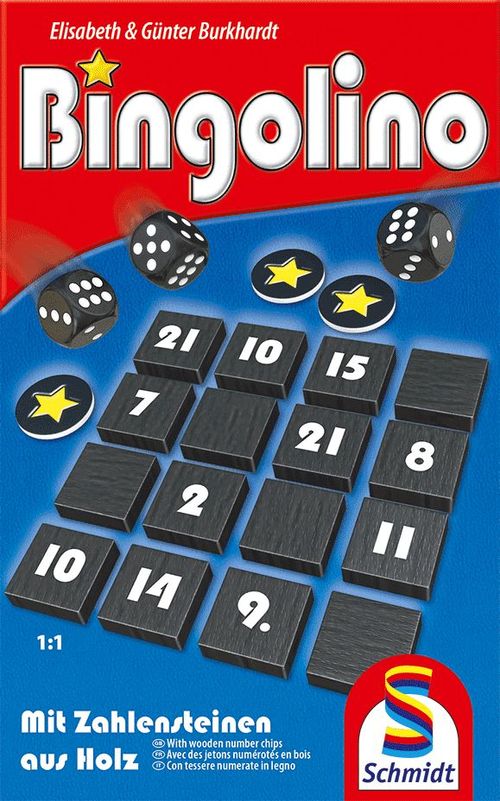
Bingolino
Bingolino Rulebook
Table of Contents
Table of Contents
Game idea
The players take turns to roll up to 5 dice. While doing this, they try to match the numbers they have displayed or use the results that other players have achieved by rolling the dice. To win, all of the numbered tiles in 4 rows, columns or diagonals must have been turned over.
Game preparation
All 66 numbered tiles are mixed face down.
Each player takes 16 numbered tiles without looking at them and places them in front of themselves face up in a grid of 4 x 4 tiles. It doesn't matter if a player has two or three of the same number. The player can freely choose the order of the 16 numbers.
The remaining numbered tiles go back into the bag without being seen. The star markers are placed where everyone can access them easily. Players take turns in a clockwise direction. The player with the darkest clothing starts the game.
Example of a display at the start of the game.
Game structure
Whoever's turn it is has to first decide how many dice (1 – 5 dice) he/she wants to roll. This makes it possible for the player to influence whether the total of the dice is high or low. After rolling, the player adds together all of the numbers rolled and says the total out loud.
The rolled total applies to all of the players!
All of the players who now have a numbered tile with the rolled total face up in front of them can now turn it over. Anyone who has several numbered tiles with the rolled total must choose one.
If the player whose turn it is does not have any matching numbered tiles or does not want to turn them over, he/she can choose to remove one of the dice to reduce the total of the dice roll. The player can now only turn over one numbered tile with the new total. The new total can only be used by the player whose turn it is at the moment (i.e. the player who rolled the dice). The total from the original, complete roll applies for all of the other players.
1st example: Edgar rolled the total '21' (6+6+5+4=21) with four dice. The number '21' appears twice in his display (marked in red). However, he can only turn over one of the two numbered tiles. The total '21' also applies to all of the other players.
Alternatively, Edgar can also remove a die to form a different total. He could thus achieve a '15' (6+5+4=15), '16' (6+6+4=16) or '17' (6+6+5=17) and turn over one numbered tile each time (marked in blue). However, in this case, the new total would only apply to Edgar. The originally rolled '21' still applies for the other players.
If the player whose turn it is still cannot turn over a numbered tile after removing a die, he/she must turn one of the numbered tiles he/she previously turned over so that it is now face up again.
This also applies only to the player whose turn it is. The other players do not have to turn over any numbered tiles if they are unable to use the rolled total.
If the rolling player does not have any face-down numbered tiles in his/her display, he/she doesn't have to do anything and it's the next player's turn.
2nd example: Edgar rolled a '17' with three dice (6+6+5=17), but he doesn't have this in his display. By removing a die, he can achieve the total '11' (6+5=11) or '12' (6+6=12). Edgar doesn't have this number in his display either. He must now turn one of the three numbered tiles he has previously turned over so that it is now face up again.
Placing the star markers
Once a player has turned over 4 numbered tiles in a horizontal row, vertical column or a diagonal, he/she calls "Bingolino!" and takes a star marker. The player then marks the completely turned-over row/column/diagonal by placing the star marker at the end of the respective row.
3rd example: Later in the game, Edgar has already been able to turn over some of the numbered tiles. During his turn, he once again rolled '21' with four dice (6+6+5+4=21). Here, too, he has multiple possibilities of turning over a numbered tile by removing a die.
He could turn over the '21' to complete a vertical column. However, he decides to remove the die with the '5' to form the total '16' (6+6+4=16). He turns over the numbered tile with the '16' and shouts "Bingolino!". This enables Edgar to take two star markers and place them in front of himself, as he was able to turn over four numbered tiles diagonally and in the column at the far right.
If, as the game progresses, one of the numbered tiles is turned back over so that it is face up again, the star marker nevertheless remains in place. However, if the numbered tile is turned over again, this does not count as another "Bingolino" and there are no additional star markers.
End of the game
The game ends when a player has been able to place 4 star markers in front of himself/herself. This player is the winner.
If several players place 4 star markers in front of themselves at the same time, these players continue playing until one player is able to place a 5th star marker. If several players manage to do this at the same time, there are several winners.