Bindle Rails Expansion #2: Louisville and Nashville
Bindle Rails Expansion #2: Louisville and Nashville Rulebook
Table of Contents
Table of Contents
Components
- 1 Scenario Map.
- 1 Turn and Stock Track.
- 1 Tech Track.
- 7 Company Cubes (colors do not matter).
- 20 Black Cubes.
- 20 White Cubes.
- 27 Event Cards.
What Makes This Game Different from the Original Bindle Rails?
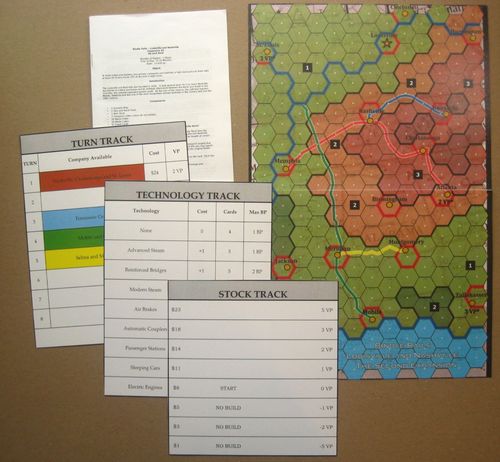
This particular expansion uses its own hex map instead of the Company Route Track from the original game. There are no Public Companies - merely your own, the Louisville and Nashville. The Private Companies you compete with are marked on the map and may be bought at certain turns.
The Technology Tree has been uprooted and replaced with a single track of research targets that determine how many cards you may play in a turn and the highest number of BPs you may spend in any one hex on the board. The tree is significantly smaller than the one in the original Bindle Rails.
You build routes across the Southeastern United States by using Build Points on the card. Each hex can require 1, 2, 3 or 4 BP.
Finally, VP are scored by connecting cities, building stations, researching technology and purchasing rivals.
Assembly
If you have purchased your copy of Bindle Rails, you should have all of the base components (minus the map). This expansion is designed to play "out of the box". Leave the mats, Manager Cards and Goal Cards in the box - you won't need them. You will need to print out the modified Turn, Stock and Technology Mats that are part of this game.
If you made your own deck, try to use cubes and markers that are roughly 1 cm in diameter or less. Regular tokens, coins and markers will work, however, the hexes on the map are relatively small. If you decide to use coins, you may need to print the map on four sheets of paper to make the hexes large enough to hold the markers.
These rules use the terms "Black Cubes" and "White Cubes". Bindle Rails came with two sets of 20 colored cubes. Simply adapt the terminology of black cubes to one set of cubes that you have and the white cubes to the other.
Initial Game Setup
- Place the expansion map on the table in front of you and place the Stock, Turn and Technology mats within easy reach as well.
- Place one Colored Cube on the "Start" position of the Stock Track. Place one Colored Cube on Turn 1 of the Turn Track. Place one final Colored Cube on the top space of the Technology Track.
- Take four of the remaining Colored Cubes and drop them from a height of at least three inches above the playing surface. These Cubes represent coal mines that you can build to receive additional VP at the end of the game.
- If any cubes roll off the board, drop them again.
- If a cube lands within one hex of a city or another cube, it must be moved at least two hexes away any cities or cubes.
- If a cube lands in terrain that costs 0 BP or 1 BP, the cube must be moved to the closest 2, 3 or 4 BP terrain.
Game Turn
The game consists of 8 Turns. Shuffle the deck and deal yourself four cards. You will play out this hand and then draw 5 Events Cards at the end of your turn. This is described below.
What's On The Event Cards
- Route Points and Structures - The gray square represents the number of Route Points you can use from this card. Some cards also have an ENGINE or BRIDGE image printed on them as well. Some routes need bridges to span waterways. Engine cards allow you to build Passenger Stations once you have acquired the right technology to do so.
- Dollar Value - The upper right square is the dollar amount you can use to move stocks up and down as well as buying rival companies.
- Events - If an event is shown, it is resolved during the Event Turn.
- Company - Abbreviation used to determine competitor stock purchases and route building.
- +/- - The plus or minus sign on the lower right corner of the Event Card is used to acquire Technology.
These cards have different values for each of the above with different strengths for building, investing or technology. How you play them will be crucial to your success.
Turn Order
- Deal Cards.
- Buy Technology, Build Routes, Buy/Sell Stocks and/or Buy Rival Companies.
- Draw Event Cards.
Hand Order
- Buy Technology.
- Build Routes.
- Build Stations.
- Buy/Sell Stocks.
- Buy Rival Companies.
You may pass any of these phases and you may play any combination of cards for any of the above events. Once you have completed or passed through each of these events, you then begin to draw Event Cards at the end of the turn.
1. Buy Technology
The Technologies in this version of Bindle Rails allow you to hold more cards in your hand, build in more difficult terrain and shield you from unfortunate events. More cards in your hand means more opportunities to build, raise cash and acquire even more technology.
To buy a Technology, place a card with a plus sign in the lower right corner to the side. You may (and usually require) multiple cards for any given technology. The number of cards you must set aside is listed on the Technology Track. Once you have paid for your technology, simply move the Colored Cube on the Technology Track down one space.
Technologies must be researched in order. They must be acquired using a number of cards with a plus (+) sign equal to the amount listed in the "Cost" column of the Technology Track.
The number of cards you draw at the beginning of a turn is determined by what technology you have researched by referring to the "Cards" column of the current row to determine how many cards you draw.
Finally, the maximum type of terrain you can build in is determined by the 'BP' column of the current row in the Technology Track. This will be explained in more detail below.
2. Build Routes
The majority of the game you will be building routes to connect to far flung cities and remote coal mines. You use cards from your hand to build your routes across different types of landscape such as plains (1 BP), marshes and hills (2 BP), mountains (3 BP) and peaks (4 BP).
The following restrictions apply:
- You must build contiguous track starting from Louisville.
- You may not build into oceans (blue hexes).
- You may not build routes if your Company Value is $5 or less on the Stock Track.
- You may not build in a hex that has more BP's than your current row on the Technology Track.
- You may not carry over BPs spent on one hex to another hex.
- If a route crosses a river (blue line between hexes), you need to use an additional card with a Bridge on it to cross the river. Place a cube spanning the river itself to mark that this bridge has been built.
- If a Bridge is removed from a route, you cannot build "further" down that route until it is replaced by another Bridge card.
If you purchase a Rival Company, their track is considered part of your network.
Example #1: You want to build to Nashville. You have not researched any technologies. You cannot build into Nashville without first researching Reinforced Bridges because Nashville is on a hills hex (2 BP).
Example #2: You want to build into hexes that are worth 2 BP and 3 BP (hills and mountains), and you have cards that are 1 BP and 4 BP. You cannot build beyond the first hex because you must use your 4 BP card first to get through the first hex.
Example #3: You have built to Nashville and recently purchased the NC&StL (red line). You want to build to Tallahassee. You have seven cards in your hand, all worth 1 BP. You can complete this line using all the cards in your hand because the NC&StL track runs to Atlanta and the remaining terrain uses 1 BP on five hexes and 2 BP on the hex immediately south of Atlanta.
Example #4: Last turn you built to St. Louis from the southeast by using a 1 BP card and a Bridge card. In the Event Round last turn you drew a 'Wash Out' event that removed your bridge. You cannot extend your line out of St. Louis without using another Bridge card to put the bridge back over the river.
3. Build Stations
Finally, if you have researched Passenger Stations, you may use a card with an Engine icon on it to place a second cube on any connected city. This cube allows you to claim double VP for this city at the end of the game. Each city on the board may only have one station. Only one station may be placed per turn.
Example #1: You have built to Nashville and Atlanta and have acquired Passenger Station technology. You have 2 cards with Engine icons in your hand. You elect to place a station in Atlanta (for 2 extra VP at the end of the game). You cannot place a station in Nashville since you can only place one station per turn. Alternatively, you could have placed the station in Nashville instead of Atlanta, however, it would be for less VP at the end of the game.
4. Buy/Sell Stocks
You always have the option to invest in your own company. You must have at least $8 of Company Value to build routes. Simply set aside a number of cards.
- You may only move a company stock up and down by the full amount of each step on the Company Stock Track.
- You may not move a company stock off the Stock Track in either direction.
- Unlike routes, money used to advance up multiple rungs of the Stock Track can be carried over to the next rung for the current turn.
Example #1: You want to increase your company value from $8 to $11 to $14. You have three cards in your hand: $5, $2, $1. You can use the $5 and $1 cards to accomplish this.
5. Purchase Rival Company
You may need to purchase a Rival Company to more quickly reach a destination. Each Rival Company has its own color marked on the Turn Track that matches its route on the Map. The Turn that a Rival Company becomes available is listed on the Turn Track as well.
You may dedicate a combination of Dollar Values on your cards and/or move down Company Stock to foot the bill for a Private Company.
- The Rival Company must connect to your existing network of track. This connection does not have to be at a city.
- Rival Companies cannot be sold once purchased.
- Rival Companies cannot be bought before they exist.
You may use your company stock to help pay for a Company. Simply add up all the Dollar Values on the Stock Track starting from the current rung of your company and moving downward to determine how much money you can transfer from your stock to pay for the Company.
When you purchase a Rival Company, place a Cube on the Turn Track next to its name. You may also place a cube on the Rival Company's route on the Map to better visualize your expanded rail network.
Example #1: It is Turn #2 and you have built to Nashville. You want to purchase the Tennessee Central (blue line). You have to wait until Turn #3 because it has not been incorporated yet.
Example #2: It is Turn #5 and you have built from Nashville to Memphis. You are able to purchase the Mobile and Ohio (green line) because your route crosses the M&O even though it does not share a common city.
Example #3: You have built to Nashville and your Company Value is $18. You have four cards left in your hand worth $3, $2, $2 and $1. You may drop your Company Value to $1 and use all but your $1 card to purchase the NC&StL.
Example #4: You have built to Nashville and are drawing Event Cards. Your Company Value is $5. You draw an 'Acquisition' card which allows you to purchase a connected Rival Company for half its regular value. You want to purchase the Tennessee Central ($12), however, half of the full price ($6) is greater than your company value of $5.
Draw Event Cards
You will now draw from the remaining cards in the deck. This is where the Events listed in the center of each card will come into play.
You must draw for 5 events or until the deck runs out of cards to draw. Upon drawing a card, instructions provide any further directions for additional draws, stock movements, etc. If you draw a card without any text for the event, it still counts for your draw total but nothing happens. The directions on the card override the regular game rules. They are permitted to do so even if they have 0 VP on the Stock Track.
When playing your Event Cards, it often helps to place them down left to right for each Event. If there are additional draws that need made, placing the cards below (almost in Solitaire style) is helpful to keep track of where you are in this part of the round.
If an event calls for a Company to receive stock adjustments (or other effect) and there are multiple companies listed on the card, each competitor on the card is adjusted.
Important! Since there are several differences between this expansion and the original Bindle Rails, the effects of some Event Cards are changed, namely:
- INEFFICIENCY: Only one 'Inefficiency' card can affect your next hand. In addition, you may always draw one card on your next turn even if this event would require more.
- BUILD!: No effect.
- MAINTENANCE: No effect.
- PROFIT: Your company always moves up at least one rung.
- LOSS: Your company ONLY moves down one rung. No other penalties apply.
- MARKET CRASH, MARKET RALLY and SELL OFF: When drawing cards for these events, only cards with Red Cubes apply to your company. Other cubes are ignored.
- ACQUISITION: You may attempt to purchase a rival company at half cost using Company Stock.
Wrapping Up The Hand
Once all the cards have been dealt, reshuffle all the Event Cards and get ready for the next round.
Scoring
Points are scored in the following manner at the end of the last turn:
- 1 VP is awarded for each Technology you research.
- 1 VP is awarded for each city you connect to that doesn't have a VP award printed on the board (except Louisville - which is worth 0 VP).
- If any cities are connected that have a VP award, add this to your score.
- If you connect your route to any Coal Mines (Colored Cubes on the Map), add 1 VP for each cube connected.
- VP are awarded (or deducted) based on the Stock Track.
If you have accumulated 20 VPs, you have won the game!
Variants
- If a Rival Company has been founded, has not been purchased and you are trying to build your own route through a hex on the board occupied by the Rival Company, you must add 1 BP to the cost of adding a route to that hex.
- If you draw a BUILD! Event Card, drop your stock down one rung.
Change History
- 4/1/09 - First Edition, Original version.
- 4/12/09 - First Edition, Update #1: Added notes for Event Cards, updated Turn Track and Company Track.
- 4/14/09 - First Edition, Update #2: Added further notes and clarifications.
- 4/16/09 - First Edition, Update #3 and #4: Rewrote rules as stand alone and removed reliance on the original Bindle Rails to play the game.
Note on the source text: the designer's PDF states the Company Value requirement as "$5 or less" in Build Routes and "at least $8 of Company Value" in Buy/Sell Stocks. Both are transcribed as printed; the PDF does not reconcile them.