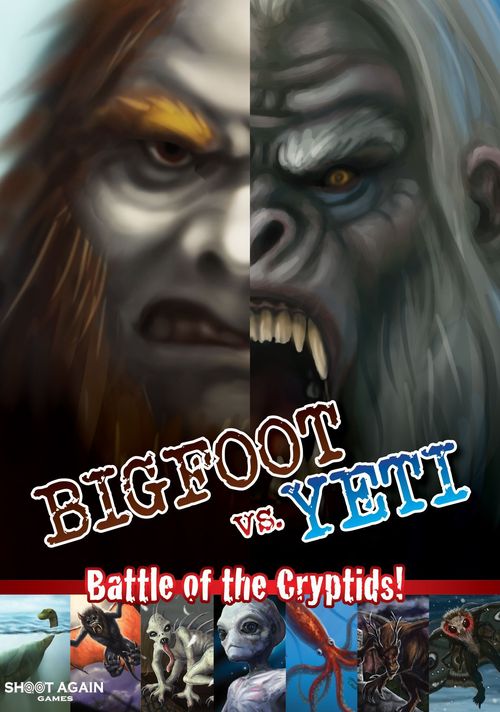
Bigfoot vs. Yeti
Bigfoot vs. Yeti Rulebook
Table of Contents
Table of Contents
What's New
A primer for players already familiar with Conspiracy! – brand new players should skip this section.
The biggest change is the Bigfoot vs. Yeti battle which is detailed on page 3. Once you have read that section, and item 3 in Scoring, you are ready to play Bigfoot vs. Yeti.
All card-set abilities in Bigfoot vs. Yeti are one-shot abilities, with one exception. That is, they take effect when the set is played and are immediately resolved. The exception is the Extraterrestrials, who are the shutout suit in the way that the Mayan Apocalypse is in Conspiracy! However, the Extraterrestrials activates with only need ten points with the player who has them going out.
What Conspiracy! called "revealing a conspiracy" and "strengthening a conspiracy" are called in Bigfoot vs. Yeti, "mounting an expedition" and "joining an expedition" respectively, but are otherwise the same.
Setup
- Randomly select a dealer.
- The dealer deals ten cards to each player.
- The dealer turns over the top card of the draw deck (hereafter referred to as the Unknown) to start a discard pile (hereafter referred to as the Tabloids).
- Play starts with the player to the left of the dealer and goes clockwise.
Player Turn Summary
Each player's turn consists of the following:
-
They must first draw a card from either the top of the Unknown or the top of the Tabloids. Should the Unknown deck have no cards left at the start of a player's turn or during a player's turn when they are required to draw from it, the round ends immediately and the normal End of Round procedure is followed.
-
Any and all of the following may be done in any order:
A) They may play one Action Card. During a player's turn, they may play one Action card and follow the directions on it. All Action cards have a lightning bolt symbol on them to help distinguish them from Expedition cards. There are two types of Action cards:
-
Proof! – These are used to help mount or join an expedition by adding additional points toward proving the existence of the appropriate creature. With one exception, Proof! cards can only be played on creatures that match their color.
Example - The Missing Pet Proof! card can only be played as part of a Sewer Alligators expedition as both are light blue. The Blurry Photo Proof! card is a wild card, and so can be played as part of any expedition or to join any existing expedition. A given expedition can have multiple Proof! cards – the expedition's unique Proof! card and one or more Blurry Photo Proof! Cards – keeping the one Action card per turn rule in mind.
-
Phenomenon - These cards represent fleeting supernatural occurrences. Once a Phenomenon card is played and its directions have been followed, it is placed on the Tabloids pile.
B) They may mount at most one expedition.
When mounting an expedition, the player must lay down at least three cards of a single expedition type. These cards can be three Expedition cards or two Expedition cards and a corresponding Proof! card. Playing a Proof!! card in this manner counts as the player's one Action card play for that turn. An expedition "type" is an expedition with all the same Expedition cards, and possibly a Proof! card.
Blurry Photos, which are wild Proof! cards, may be part of the mounted expedition as long as no more than one Action card is played in the player's turn.
-
Drawing a card must always be a player's first action and discarding a card must always be a player's last action, but any of the other actions may be done in any order.
Bigfoot vs. Yeti Battle
Bigfoot and Yeti are fighting each other to be the king of the cryptids and only one of them can be victorious. At the end of the round, the cards for whichever of these two creatures has the most points will score normally, while the cards of the other will score zero. Both Bigfoot and Yeti have their own Proof! card and two three-point solo expedition cards. The remaining six two-sided Bigfoot/Yeti cards can be part of either type of expedition depending upon their orientation. Unlike the other expeditions, once either the Bigfoot or Yeti expedition is mounted, cards of the other expedition can be played as well.
Example - The previous player mounted a Yeti expedition. The current player, on their turn, can play any Bigfoot to join that expedition. They could also play any Yeti cards they had. In this example, regardless of how many Bigfoot and/or Yeti cards the player played, it would still count as only one join of an expedition for the turn. That means they would still be free to join a second expedition or mount a new one.
The Bigfoot-only and Yeti-only expedition cards, as well as the associated Proof! cards, grant abilities. The two-sided expedition cards (the ones that can be either Bigfoot or Yeti) do not. As stated on the cards the ability allows a player to take one of the cards that can belong to either expedition from any other player and place it in front of themselves and orient it to belong to the expedition type that is stated on the card. In this way, the battle between Bigfoot and Yeti will be a dynamic one as points switch back and forth between the two creatures.
End of Round
At the end of a player's turn, after they have made the required discard, if they have no cards left in their hand they have "gone out" which ends the round. As mentioned earlier, a round may also end if a player must draw from the Unknown but there are no cards in the Unknown, or if there are no cards in the Unknown at the start of a player's turn.
After a player goes out each other player, starting with the player to the left of the player that went out, must discard one card to the Tabloids. The hand is then scored.
Scoring
By mounting expeditions, or joining them, players are accumulating points which count toward proving to the world that the creature of that expedition actually exists.
-
Once every player has made their final discard, the player who went out picks up the Tabloid pile and separates it by colors.
-
Each card in the Tabloids that is the same color as an expedition that has been played, represents a sensationalistic story like "Bigfoot Marries Local Woman!" which has appeared in the tabloid press, thereby discrediting that creature's expedition. For each card of the same color in the Tabloids, the player with the most cards of that type removes one card from the applicable expedition. Removal is done one card at a time.
Example – At the end of a hand one Loch Ness Monster expedition card and the Flipper Photo, (the Loch Ness Monster-specific Proof! card) are found in the Tabloid pile. This causes two cards to be removed, one at a time, from the Loch Ness Monster expedition with the most cards. Because the cards are removed as they are found in the Tabloids, the player with the most cards in an expedition can change resulting in different or multiple players losing cards.
If two or more players are tied for the most cards in an expedition that must remove a card due to the Tabloids, each of the tied players removes a card.
-
Determine the winner of the Bigfoot vs. Yeti battle by totaling up the points from all of the Bigfoot and all of the Yeti Expedition and Proof! cards in front of all players.
- If Bigfoot has more points in play, he has won the battle. Yeti is vanquished and all Yeti cards are discarded. Bigfoot scores normally.
- If Yeti has more points in play, he has won the battle. Bigfoot is vanquished and all Bigfoot cards are discarded. Yeti scores normally.
- If Bigfoot and Yeti have an equal number of points in play, then both types of cards are discarded and neither creature is scored (they have gone off to continue their battle elsewhere).
-
Total the points for all cards of the same expedition type among all of the players. Points are the numbers in the upper left corner of each card directly under the suit icon. All expeditions with ten or more points worth of cards showing are acknowledged as "proven" and as a result all points on those cards are doubled. It does not matter which or how many players have cards from a particular creature's expedition in front of them, all displayed cards count towards proving that creature's existence. If the total value is less than ten, the cards are counted at face value.
Continuing Play
If no player has 100 points or greater after scoring the round, the player who has the highest score becomes the dealer. In the event of a tie for highest score the first tied player to the left of the last dealer becomes the dealer.
Winning the Game
At the end of any round if any player has reached 100 or more points, the player with the largest total wins the game. In the event of a tie, play another round.
Card Breakdown
Action Cards (25)
Phenomenon (11)
- 3 - Ancient Prophecy
- 5 - Crop Circles
- 3 - Fish Falls
Proof! (14)
- 1 - Alien Autopsy Film
- 4 - Blurry Photo
- 1 - Devil Skull
- 1 - Chupacabra Body
- 1 - Claw Marks
- 1 - Flipper Photo
- 1 - Missing Pets
- 1 - Patterson Film
- 1 - Sound Recording
- 1 - Sucker Marks
- 1 - Yeti Scalp and Hand
Expedition Cards (50)
- 5 - Ahool
- 2 - Bigfoot
- 6 - Bigfoot/Yeti
- 5 - Chupacabra
- 5 - Extraterrestrials
- 5 - Giant Squid
- 5 - Jersey Devil
- 5 - Loch Ness Monster
- 5 - Mothman
- 5 - Sewer Alligators
- 2 - Yeti
Expanded Card Explanations
Ancient Prophecy - Cards that are considered part of a creature's set are both the Expedition cards and the associated Proof! card for the set. Blurry Photos are not considered part of any creature's set.
Bigfoot or Yeti (individual) - The ability to take a Bigfoot/Yeti card from in front of an opponent and flip it to your side can be used on an opponent even if the Bigfoot/Yeti card is already flipped to your side. In that case, you just take the Bigfoot/Yeti card and add it to your expedition. If no opponent has a Bigfoot or Yeti card in front of them when you play your card, you get nothing.
Bigfoot/Yeti (two-sided) - As stated previously, the Bigfoot/Yeti card has no special ability. This means that while it would be possible to join an existing Bigfoot or Yeti Expedition with one or more Bigfoot/Yeti cards, you would not activate the set's special ability.
Chupacabra - The Chupacabra special ability can only target creature abilities that are in play and therefore can not use the Bigfoot or Yeti-specific abilities unless a Bigfoot, Yeti, or either of their associated Proof!s, are in play.
Jersey Devil - In a two-player game you may return the card you looked at to your opponent's hand or you may discard it to the Tabloids.