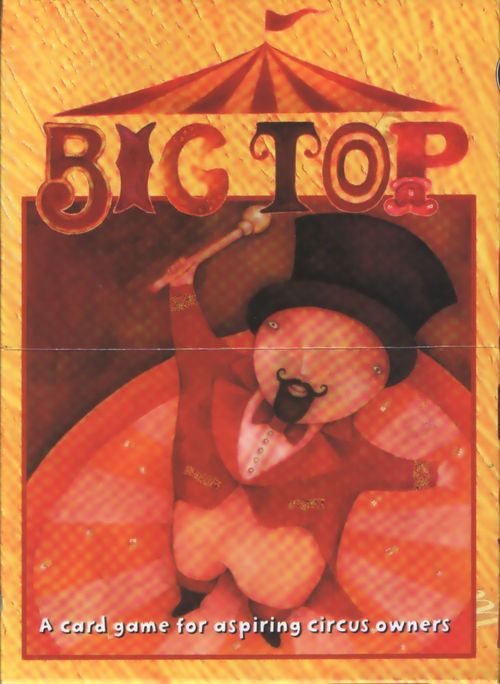
Big Top (2003)
Big Top (2003) Rulebook
Table of Contents
Table of Contents
Equipment
- 52 Circus Cards in 4 suits: Clowns, Sideshow (bearded lady), Animals (elephant), and Performers (tightrope walker)
- 24 Gate Receipt tokens (6 sets, each with the values $10, $7, $5, $3)
- 6 Scoring tokens (marked +$20)
- 6 Organizing Charts
A description of the Big Top deck
Each suit has two sets of cards numbered one through six. One set has six light numbers and other six dark numbers. Along with these twelve cards, each suit has a Poster card with a gray letter 'P'. All cards with the same background color and icon are considered part of the same suit, even though the light and dark numbers in the suit are treated differently when playing.
Goal
The object of Big Top is to be the richest and most successful circus owner. You accomplish this by playing your entire hand to make money from all your Gate Receipt tokens. You also earn extra money during card play.
Set up
Each player takes one set of Gate Receipt tokens, a Scoring token, and an Organizing Chart.
Place the Organizing Chart so that the pictures are facing you and the dollar values $0-$3 are facing the center of the table. Set your Scoring token to the side until you earn money.
Game Play Overview
The person who most recently attended a circus is first dealer. He shuffles the deck and deals all of the cards to the players. It does not matter if one player has more cards than another.
After evaluating his hand, each player places his Gate Receipt tokens face-down on the Organizing Chart, one token per picture (suit). You should invest according to your confidence that you will be able to play all of the cards of that suit. Once all players have placed all Gate Receipt tokens, the round begins.
The round starts with the player to the left of the dealer and proceeds around the table clockwise. The rules of play are described in detail in a later section, but here is an overview of what you can do on your turn:
- First decrease the value of any called cards. Then do one of the following:
- Play a called card (mandatory if possible) OR
- Play a card from your hand. You may earn money if others have called cards, OR
- Call a card OR
- Pass and do nothing if you cannot play or call a card.
Decrease Called Card Values - The first thing you do on your turn is to move all of the cards on your Organizing Chart down one space.
Play a Called Card - If you have cards on your Organizing Chart that can be played, you must select and play one of them.
Playing a Card From Your Hand - If you did not play a called card then you may play one card from your hand according to the following rules: For each suit, the first card to be played must be the Poster card. Once the Poster has been played, two piles are available, one on either side of the Poster; one for the light cards and one for the dark cards. Cards can only be played in numerical order, starting from 1 and working up to 6, in the pile of the correct shade. Light and dark cards cannot be mixed in the same pile.
Calling a Card - If you cannot play a called card, and choose not play a card from your hand, you may call a card. To call a card, simply play a card from your hand face-up in the empty "3" space of your Organizing Chart. This card cannot be a card that you can currently play. This means you may never call with a Poster card. Other restrictions on which cards you may call are discussed under the Game Play Details.
Game Play Details
This section contains details of each game round.
Decrease the value of your called cards
The first thing you do on your turn is move each of your called cards to the next lower-valued space in your Organizing Chart, if possible. Only one card may be in each space. This means that as called cards accumulate, you may not be able to move some of them.
As you play your called cards, gaps may appear in your Organizing Chart. When this happens, you may be able to move some cards and not others.
A card on the "0" position does not fall off the chart to make room for other cards; it remains on the "0" position. If you have four cards in your Organizing Chart, you cannot call another card.
Play a called card if possible
You must play a card that you previously called if it is a legal play on your turn. You cannot play a card from your hand or call if you have a playable called card on your Organizing Chart. If two or more of your called cards are playable, you may choose which one to play. This ends your turn. Do not shift the remaining cards in your Organizing Chart or earn any money!
Play a card from your hand
If you do not have a called card that you must play, you may play a card from your hand, if able. Whenever you play a card from your hand, you should immediately check all of your opponents' Organizing Charts for called cards. If any of their called cards match the suit and shade of the card you just played, you earn money for each such card. It's possible to earn money from several players with just one card. You earn money equal to the value of the space where each matching called card is. Record this money on the Scoring Track in the middle of your Organizing Chart (numbered 1 through 20). To track score, place the Scoring Token face-down on the proper number. If you earn more than $20 in a single hand, you can flip the Scoring Token over to the +$20 side and place it on the Scoring Track location corresponding to the new score minus 20. For instance, if you had 19 points, and scored 3 more points after playing a card, then you would turn your Scoring Token over so the +$20 side was showing and place it on the 2 location of the Scoring Track. You earn nothing from your own called cards!
When you play a Poster card, you earn money for all of your opponents' called cards of that suit, both light and dark shades!
Calling a Card
If you cannot play a called card, and choose not play a card from your hand, you may call a card. To call a card, simply play a card from your hand face-up in the empty "3" space of your Organizing Chart. This card cannot be a card that you can currently play. This means you may never call with a Poster card.
IMPORTANT: You cannot call a card if you already have a card of that suit on the Organizing Chart. For example, if the 2 light Animal card is already on your Organizing Chart, you cannot play the 4 dark Animal or 4 light Animal card on the chart.
You also cannot call if your Organizing Chart is full; there can be only one card per space.
Passing
You may only pass if you cannot play or call a card. You cannot pass if you have a legal play or call
End of the hand
The first player to play his last card, including all called cards, wins the hand. This ends the hand immediately.
If you win, you earn all the money from your Gate Receipt tokens ($25) and any money your have collected on your Scoring Track during this hand.
If you still have cards in-hand or called on the table when someone goes out, you do not earn the full $25 in Gate Receipt tokens; you only earn the Gate Receipt tokens for suits that you have completely played out (i.e. suits with no cards in-hand or on the Organizing Chart.) Add this amount to your money earned on your Scoring Track.
On a scrap of paper (or on the back of an old circus ticket), the scorekeeper records the total money earned (Gate Receipt tokens plus Scoring Track) for each player.
The next hand
Remove your Scoring marker from the track between rounds. You begin every hand with $0 on the track.
Deal rotates until each player has dealt once (or twice in a 3 player game.) Whoever has accumulated the most money is the most successful circus owner and wins the game!
An Example of Play
The Deal
Alf, Henry, Charles, John, and Otto sit down to enjoy an evening under the Big Top. After passing out the tokens and organizers, Alf shuffles and deals the cards. He looks at his hand:
- Clowns: Poster; Light 1
- Sideshows: Light 1, 5; Dark 2, 3
- Performers: Dark 2, 4; Light 5
- Animals: Dark 6
Investing
Alf feels really good about the Clowns because he has only two cards in that suit, and both can be played early on, so he invests $10 (places $10 on the Clown suit icon of the Organizing Chart). He is very worried about his lone Animal since it is the highest number, so he only invests $3. He decides to invest $7 on Sideshows and $5 on Performers. He is ready to go!
Round 1
Henry begins the round by playing the Sideshow Poster. Charles calls with a light 1 Performer, placing it face up in the $3 space of his Organizing Chart. Whoever holds the Performer Poster stands to make $3 if they play it before Charles's next turn! John also calls, with a dark 4 Sideshow. Next, Otto plays the dark 1 Sideshow, and marks $3 profit on his Scoring Track (he places his Scoring Token face-down on the 3 space of his Scoring Track), thanks to John's called card (the dark 4 Sideshow card). Alf plays the dark 2 Sideshow card and also profits $3 from John's called dark 4 Sideshow card.
Round 2
Henry begins the next round by playing the Animal Poster. Charles starts his turn by sliding his called card down to the $2 space. He then plays the dark 1 Animal card. Maybe Alf didn't have to worry about his dark 6 Animal card after all. Next, John slides his called card down to the $2 space and calls again, placing the dark 3 Performer in his $3 space. John either has a really tricky strategy or an awful hand. Otto plays the Performer poster, earning $5: $2 for Charles's called Performer card and $3 for John's. On his next turn, Charles will have to play his light 1 Performer, because he has to play a called card when it becomes playable. Alf plays his dark 3 Sideshow, gaining $2 more for John's called card. Like Charles, John's next play has to be with his called card that is now playable.
End of Play and Scoring
Play continues several more rounds until Otto finally plays out all of his cards. Alf did manage to play the Animal he was worried about, but the light Performers were not very popular and even though he played his entire hand, his light 5 Performer is still sitting on his Organizing Chart. So Alf earns his Gate Receipt tokens for his other three suits: $10 + $7 + $3 = $20. He also earned $13 in profits during card play. His total of $33 is recorded and the game moves on to the next deal.
Design notes
Big Top was inspired by the children's game Fan Tan. You can play Fan Tan with a Big Top deck by modifying the rules as follows:
Set-Up
Give each player 25 peanuts. Do not use the Organizing Chart or Gate Receipt tokens.
Play
Calling is not allowed. You must play if possible. If you cannot play you must put a peanut in the pot and pass.
Winning
The first player to play all his cards takes the pot and ends the hand. Play a predetermined number of rounds, for a set time limit, or until one player goes 'broke'.