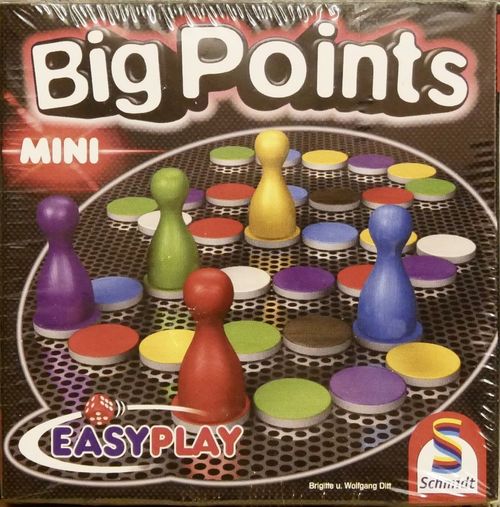
Big Points
Big Points Rulebook
Table of Contents
Table of Contents
Material
- 60 wooden counters (10 blue, 10 red, 10 yellow, 10 green and 10 purple, as well as 5 white and 5 black)
- 5 playing pieces (in the colours blue, red, yellow, green and purple)
- 1 staircase
Before starting play please punch out the parts carefully and assemble the staircase as shown in the adjacent illustration.
Setting Up the Game
Make a pile of counters next to the staircase with one each of the colours blue, red, yellow, green and purple. (Players receive a counter of the corresponding colour when the piece is moved onto the staircase.) The remaining counters (including white and black) are mixed and — starting from the steps — laid down as a pathway in any shape or form. The sequence of colours is irrelevant. The playing pieces are set up at the beginning of the pathway (illustration on right).
How to Play
A starting player is chosen, and then play continues in a clockwise direction. When it is a player's turn he chooses any playing piece and moves it to the next counter with the same colour as the figure. Pieces may only be moved forwards, not backwards.
Then he removes a counter from the path. He can choose either the first empty counter in front of or behind his piece. Occupied counters may not be collected. Players keep their counters concealed in their hand until the game is over.
Example: The player moves the blue piece to the next blue counter. Then he can either take the green counter in front of the blue piece or the black counter behind the purple piece.
- Note: If at the beginning of the game there is no empty counter behind the playing piece, the player must take the next empty counter in front of the piece. The same applies if a playing piece is moved to a counter in front of the staircase and there are no empty counters left in front of the piece. Then the player must take the last empty counter behind the piece.
- If there is no counter in the figure's colour left between the playing piece and the staircase, the piece is moved onto the staircase. It is placed on the highest empty step. The player may then take the counter of the same colour lying beside the staircase.
Black Counters
Any black counters which are won can be used later for an additional move:
- A player can use a black counter to move another playing piece after finishing his move. He may move the same figure he has just moved, or any other piece. Afterwards he takes a coloured counter as described above. Then it is the next player's turn.
- As an additional move (and only then) the player can move a piece backwards onto the next counter of the same colour.
It is not allowed to use more than one black counter during a turn. A black counter which has just been won may not be used immediately. The player has to wait until his next turn to use it.
The black counters handed in by the players are laid aside and do not re-enter the game.
End of Play and Scoring
The game ends immediately the last playing piece reaches the staircase. Now the scores are added up:
- Each counter gets the number of points written on the step where the figure of this colour is standing.
- Black counters count 0 points.
- Each white counter is worth the same number in points as the number of other different colours the player has collected.
Example: At the end of the game the staircase is as illustrated.
A player has the following counters at the end of the game: red, purple, green, black, white.
Scoring:
- 2 x red (4 points) = 8 points
- 1 x purple (2 points) = 2 points
- 1 x green (0 points) = 0 points
- 1 x black (0 points) = 0 points
- 2 x white (in addition to white, the player has a further 4 colours, i.e. 4 points) = 8 points
Total 18 points
The player with the highest total score wins. In the event of a tie there are several winners.
Repeat Rounds
The game is quickly played and so players will therefore likely want to carry on playing. One round is played for each player present, and in each game a different player starts. The points scored in each round are added up and the player with the highest total score wins. In the event of a tie there are several winners.