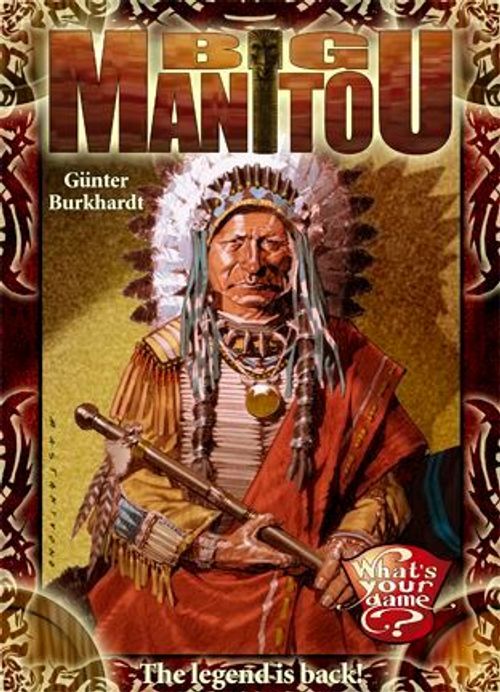
Big Manitou
Big Manitou Rulebook
Table of Contents
Table of Contents
Contents
- 5 decks consisting each of 18 cards in five different colours (every deck is distinguished by a different illustration depicted on the back of every card and representing a scene of Indian life with no effect during the game);
- 60 Booty tiles representing Buffaloes, Tipis, Horses, the Sacred Totem and Tomahawks;
- One white wooden cylinder representing the Horse;
- One brown wooden cylinder representing the Totem;
- One cloth bag;
- Game rules
Set up
Every player chooses one of the five card decks. They differ from one another for the colour and for the different illustrations representing each a scene of Indian life on their back. Every deck consists of:
- 1 Tribe Card (short description of every Hero Strenght level);
- 10 Hunter Cards (their Strenght varies from 1 to 10);
- 7 Hero Cards (2 Chieftains, 2 Squaws, 1 Rain Maker, 1 Scout and 1 Medicine Man).
If the number of players is lower than 5, the remaining decks are moved away.
All the tiles are shuffled and put into the cloth bag, from which they can be drawn during the game.
The two wooden cylinders are put aside for the moment. They will be played later during the game.
The oldest player is the dealer for the first hunt.
The Game
The game consists of several hunts, the amount of which depends on the number of players.
- With 2 or 4 players: four hunts.
- With 3 players: three hunts.
- With 5 players: five hunts.
At the beginning of every hunt the dealer draws the Booty Tiles and places them face up on the table so that they form three separate groups representing three different hunting grounds.
The amount of Booty Tiles to be placed in every hunting ground depends on the number of players, as explained in the rulebook's diagram (separate figures for 2 players, 3-4 players and 5 players).
Now every player chooses, among all their cards, the ones with which they are going to face up the first hunt. The player who is sitting on the left side of the dealer is the first player. They choose 9 cards from their own deck. The last player (the dealer) choose 7 cards and all the other players choose 8 cards.
Attention: during a 2 player-game, the first player chooses 8 cards and the other one 7.
If you want to play a quicker and less tactical game, you can just draw the cards for the hunt instead of choosing them.
The remaining cards are going to be played during the next hunt and so they are now to be placed under your own Tribe Card. During the game you will discover the best card combinations.
The Hunt
Every player shuffles the cards they have chosen, places the deck before them and draws the three top cards, which form a hand. The player on the left of the dealer starts playing. Play then passes to the next player in clockwise order.
During their turn, every player plays one face up card and places it on the nearest side (to them) of one of the three hunting grounds.
- In order to avoid any confusion, every player should place their own cards on the three hunting grounds so that it is always clear whom they belong to (see the picture).
- Now, every player draws one card from their own deck so that they always hold three cards in hand. In case the player has run out of their own deck cards, they will go on playing just with the remaining ones. The next player will do the same: they will place a new card on one of the three hunting grounds and then they will draw one card from their own deck so that they always hold three cards in hand.
- If a player placed a card on a hunting ground where he had already placed some other cards of their own, they should place it so that the other ones remain visible too.
- In case on the same hunting ground different players place their own Hero cards, a "Trial of Strenght" will be necessary (see the next paragraph).
- Every player can place a Hero card on a hunting ground where they have already placed another one of their own. In this case the two cards can be defeated with a "sacrifice" only (see the "Sacrifice" paragraph). Every player cannot place more than two Hero cards of their own on the same hunting ground!
Attention: the players can place their own Hero and Hunter cards as they wish on the different hunting grounds, since their point value never changes, even if they lie under other cards.
- When every player has played seven cards, the hunt is over. The first player will hold two cards, unplayed, in hand at the end of the round, the last player will hold no card and all the other players will hold one card. Every unplayed card has to be placed under the corresponding Tribe card, ready to be played later, during the next hunts.
Trial of Strenght
In case a player places a Hero card on a hunting ground where another player has already placed a Hero card of his own, the stronger card defeats the other one. The defeated card is turned face down.
On the left side of every Hero card are shown all the opposing cards he can defeat (arrow downwards), whereas on the right side those by which he is defeated (arrow upwards).
Example: the Medicine Man is defeated by the Chieftain and the Scout and he is able to defeat the Rain Maker and the Squaw.
On every Tribe Card there's a short description of the Trials of Strenght. On the left side of the Hero's name are listed the heroes who can defeat him and on the right side those who are defeated by him.
Attention: only one Hero card belonging to one single player can lie face up on a hunting ground and so be the winner!
- If a player place a Hero card on a hunting ground where another player has already placed an identical one, the two cards annihilate each other. Both cards are defeated and are turned face down.
- If a player places a Hero card on a hunting ground where they have already placed another one of their own, the two cards can be defeated with a "sacrifice" only.
Sacrifice
In order to attack two Heroes of the same opposing player, the player has to play a Hero card which is stronger or as strong as the top Hero card (the card that the opposing player as placed as the second one). In this case both cards, the defeated and the winning one must be turned face down.
Now, during their turn, the player can attack the remaining Hero card with a normal trial of strength (unless the opposing player decides to place another Hero card on that hunting ground again).
Example: Alex has protected his Scout by placing a Chieftain on the same hunting ground; in order to attack the Scout, Mario must sacrifice one of his Heroes (a Squaw or a Chieftain). In this way he defeats Alex's Chieftain. Now his Scout can be attacked normally.
Result of the Hunt
After all the players have played seven cards and the hunt is over, they calculate which is the most skilful Tribe.
1. Leather Thief
First, they calculate which player has scored the most strength points, during the last hunt, by playing their own Hunter cards on the three hunting grounds. They just have to add the Hunter cards value points. In the tribe of the player who has scored the most strength points prowls a leather thief. The player has to discard one of their own Tipi or Buffalo Booty-cards, as a penalty. Just in case they don't hold neither one Tipi nor one Buffalo tile, they can discard one tile of their choice. In a draw, every player discards one of their own Tipi or Buffalo Booty-cards, as a penalty. In case the player has no Booty Tile, he won't have to discard anything. So discarded Booty Tiles are moved away definitively.
Only after the first hunt, when the players have no Booty Tile yet, the Leather Thief will have to discard one of the just gained Booty Tiles, as a penalty.
2. Evaluation of the three Hunting Grounds
Now the three hunting grounds, one at a time, have to be evaluated, by starting from the one on the left, as follows:
A) The player whose Hero card is lying face up on the hunting round is the first one to take one of the Booty Tiles from that hunting ground and to place it face up before them.
B) The player with the most Hunter cards on that ground is the second one. They take two Booty Tiles instead of one. In a draw none of them takes any tile. The second player with the most Hunter cards on that ground (if there's one) takes two Booty Tiles.
C) The second player with the most Hunter cards on that ground (if there's one) takes the possible remaining Booty Tiles. In a draw none of them takes any tile.
The third player with the most Hunter cards on that ground (if there's one) takes the remaining Booty Tiles.
In case no player has placed any card on one of the hunting grounds, the corresponding Booty Tiles are definitively moved away.
A New Hunt
After dealing out the Booty Tiles, all the played cards are discarded and the second hunt can start. Every deck consists of a number of cards that is enough for two hunts. At the end of the second and fourth hunt every player will have back their own complete deck again. The players will have to play their second and fourth hunt without those cards they have already played during the first and the third one. The player on the left side of the dealer becomes the new dealer and the second hunt can start, according to the rules of the first one.
Booty Tiles
There are 5 different kind of Booty Tiles. Every time a player gains one of them, they place it face up before them.
Tipis/Buffaloes: they are necessary to win, since they grant the most victory points at the end of the game. Every couple of Tipis/Buffaloes scores 1 victory point. The number marked on these tiles shows the amount of Tipis or Buffaloes represented by them.
Example: Alex holds one 3 Tipi tile, one 1 Tipi tile, one 3 Buffaloes tile and one 2 Buffaloes tile. He scores 4 victory points. If he had held one Tipi or one Buffaloes tile more in hand, he would score 5 victory points.
Totem: the first player who takes this tile, gains the brown cylinder too. They have to place it before them and keep it as long as another player gets the same amount of Totem tiles. The latter will keep the Totem as long as another player gets the same amount of Totem tiles and so on. The player who owns the Totem will be able to place their own eighth card after that all the other players have placed their last card. You can't use the Totem special feature if you are the last player (7 cards in Hand). At the end of the game, the player with the Totem before them, gains 1 victory point.
Horse: see the Totem paragraph. After all the players have placed their cards (even after the player who has played as last because of the Totem), the player who owns the Horse white cylinder can move one of their Hunter cards from a ground to another. At the end of the game, the player with the Horse before them, gains 1 victory point.
Tomahawk: every Tomahawk tile in Hand grants 1 point more for every Hunter card held. Every Hunter card scores one point more than the number shown on that card. The Tomahawk tile doesn't apply to establish who the Leather Thief is. At the end of the game, the player with the most Tomahawk tiles gains 1 victory point.
Example: Mario is holding three Hunter cards which score 5, 3 and 7 each. He also has 2 Tomahawk tiles in hand: now his Hunters score 7, 5 and 9 each.
End of the Game
The game consists of a number of Hunts depending on the number of players. At the end of the last Hunt the player with the most points, wins the game. In a draw, the winner is the player with the most points gained with the Tipi Booty-Tiles. In a further draw, the player with the most Booty Tiles, wins the game.