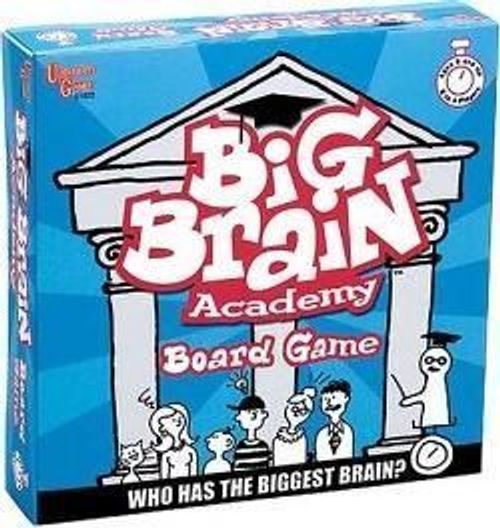
Big Brain Academy Boardgame
Big Brain Academy Boardgame Rulebook
Table of Contents
Table of Contents
Object
Be the team with the heaviest brain, according to the Brain-O-Meter Scale, after five rounds of play.
Set Up
- Spinner: Snap the spinner into place on the spinner card.
- Brain-O-Meter Scale: See diagram below for assembly.
[Assembly diagram omitted: it shows the two scale dishes being fitted onto the arms of the scale, which sits on its base.]
-
Cards: Sort the cards into five piles (Compute, Memorize, Analyze, Think and Identify). Shuffle the decks (keeping them separate) and place them face down.
NOTE: If this is not your first time playing, make sure all the marks have been erased from the cards.
-
Category Reference Guide: Separate each category's instructions by tearing along the perforated edge.
-
Red Revealer: Place the red revealer next to the card decks.
-
Puzzle Pieces: Place the puzzle pieces next to the Identify card pile.
-
Scoring Chips: Place the chips where everyone can reach them.
-
Dry Erase Pen: Place the dry erase pen next to the chips.
-
Sand Timer: Place the sand timer next to the chips.
How to Play
-
Divide into two teams.
-
The oldest player in the group goes first (Player 1 on Team 1). Player 1 spins the spinner to select the category to be played.
-
Player 1 may review the three sample cards on the Category Reference Guide to be reminded how to play the different types of cards within each category.
-
Player 1 has 30 seconds to correctly complete as many cards as possible. Another player on Team 1 may flip over cards for Player 1 to help play move faster.
-
Player 1 must pass each completed card to Team 2 so that it can check Player 1's answers. The answers can be seen using the red revealer.
NOTE: If the Memorize category is selected, a player on Team 2 draws the cards. Sound Bite cards are performed aloud and Tongue Twister cards are read aloud so that Player 1 can repeat them back. Flash Memory cards are shown to Player 1 until memorized, and then recited one at a time (i.e. memorize the top sequence of numbers and recite it and then memorize the bottom sequence of numbers and recite it).
-
Player 1 receives one chip for each card that is answered correctly. For each card answered incorrectly or passed, one chip is subtracted from the total (i.e. if Player 1 answered eight cards, with five answered correctly and three answered incorrectly, s/he earns only two chips).
See THE CHIPS section for further explanation.
-
When Player 1's turn is over, play passes to Team 2. A player on Team 2 spins to select the category and answer questions, while Team 1 checks the answers.
-
Play alternates between teams.
The Cards
Compute
- Written Math – Solve the equation.
- Coin-parison – Determine which side represents a greater amount.
- Add Agency – Select the two panels that add up to the total number of objects pictured at the top of the card.
Memorize
- Sound Bites – Listen to another player make sounds and then repeat them back.
- Flash Memory – Memorize the sequence of numbers above the red line and recite it. Then memorize the sequence of numbers below the red line and recite it. (Two per card)
- Tongue Twisters – Listen to another player read the sentence and then repeat it back correctly.
Analyze
- CubeGame – Count the number of blocks, but don't forget about the hidden ones.
- Animal Lines – Look at the numbered sequences of animals and then trace through the same patterns in the grid. The sequences may line up horizontally, vertically, backwards or diagonally, but must be in a straight line. Animals in the grid can be traced through more than once to make patterns.
- Missing Link – Connect the dots in the bottom box indicated by the red line(s) in the top box.
Think
- Get Physical – Perform the action described on the card.
- Heavyweight – Compare all of the objects tipping the scales and check the box that shows the heaviest object.
- Pathfinder – The animal at the top of the "ladder" moves down the path and must cross over to the other vertical line every time it reaches a horizontal line. Draw in a new horizontal line so that the animal on the top meets the animal on the bottom when it moves to the bottom of the card.
Identify
- Matchmaker – Find the matching pair in each grid. (Two per card)
- Word Scramble – Rearrange the letters to form words. (Two per card)
- Get in Shape – Use the puzzle pieces provided to create the shape on the card. Note: You will not need to use all seven pieces.
The Spinner
If any of the five categories (Compute, Memorize, Analyze, Think or Identify) are spun, the player must answer those types of cards.
Your Pick: If a player spins "Your Pick" s/he may choose which category to answer.
Group Pick: If Team 1 spins "Group Pick," then everyone on Team 1 can participate in answering the questions, but Team 2 gets to decide which category must be played.
Placement note: the sheet prints the following sentence in a corner away from the Group Pick text. It is placed here because it qualifies the Group Pick rule.
Since Memorize (Flash Memory, Tongue Twister, Sound Bite) and Think (Get Physical) cards cannot be done in a group, the player on Team 1 who spun the spinner should play these categories when chosen.
Teams may ONLY work together on ONE card at a time.
The Chips
One chip is awarded for every card that is answered correctly. A player should take the same color chip as the color of the category they are answering (i.e. a player who completes four Compute cards correctly should take four BLUE chips):
- Compute – Blue
- Memorize – Purple
- Analyze – Orange
- Think – Green
- Identify – Yellow
NOTE: There are three different sizes of chips, so be sure to only take the color chip that corresponds to the category that was answered.
REMEMBER: For each card that is answered incorrectly or passed, one chip is subtracted from the total number of chips awarded.
On cards that have two questions, chips are ONLY awarded if both questions are answered correctly.
- If a player answers one of the questions incorrectly, no chip is awarded.
- If a player answers both questions incorrectly, ONE chip is subtracted.
The Timer
Each player has 30 seconds to complete as many questions as possible.
The Brain-O-Meter Scale (Scoring)
Play is completed after each player has five turns. Once all players have completed their final turn, each team combines its players' chips and places them into one of the scale dishes. The team whose collective brains are the heaviest (i.e. the arrow on the face gear moves closest to the number four) wins the game.
How to Win
The team that gives the most correct answers and collects the heaviest amount of chips, according to the Brain-O-Meter Scale, is the winner.