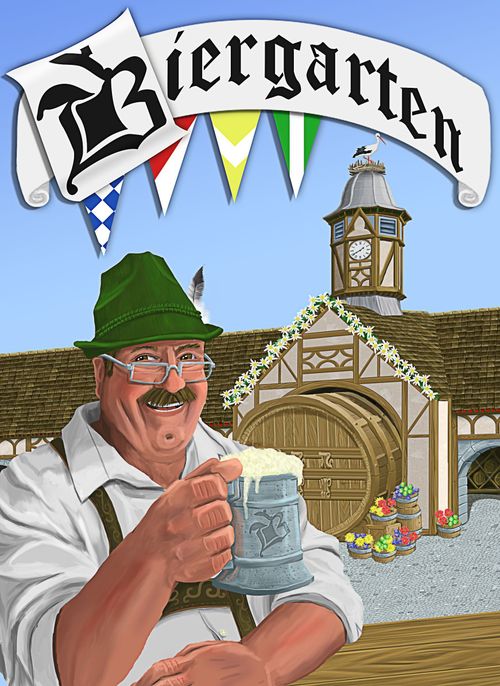
Biergarten
Biergarten Rulebook
Table of Contents
Basics
Biergarten is at it's core a tile placement game. Players are competing to sell the most bier by enticing thirsty customers to their new Biergarten. Sell more barrels by placing cards of matching colors next to each other.
All cards have shields and umbrellas to represent a cards color(s).
1 Barrel: match two cards with 1 color in common, sharing an edge that is not a wall.
2 Barrels: match two cards with 2 colors in common, sharing an edge that is not a wall.
Every card edge is either a wall or a shield of the card's color, never both.
Use the wild cards as any singular color. wild on wild is only worth 1 Barrel but counts as any color of a players choosing.
TIP: Wild matches do not have to be the same for both edges. eg: a wild card with a yellow card on one side and a red/blue on the other would be a match of yellow and red or blue.
Setup
Separate and shuffle both decks, and deal 2 common cards to every player, facedown.
Players may look at their own cards.
Turn over as many home cards as players, plus one.
Whoever visited a Biergarten last is first player.
Starting with first player, players pick a home card and place it in front of them. After all players pick, return remaining home cards to the box.
Again starting with the first player, players choose a player token and place on the Biergarten space on the "Ale" cellar board.
Turn over 3 common cards from the deck face up to form the supply, and place within easy reach of all players.
TIP: Use your hand to pick the best home tile from what's available
Turns
Moving clockwise, players will draw 1 card either from the supply or facedown from the deck. If drawing from the supply, draw a card to replace it.
Players then play 1 card adjacent to any of the cards in front of them.
Cards cannot be placed diagonally or rotated, and cards do not have to sell barrels.
Players may then either swap 2 cards from their cards in play, OR move 1 card, shifting either a vertical or horizontal row to accommodate.
A player will then count up their barrels adjust the cellar board if neccesary, and move to the next player.
If play progresses once around the table without any player drawing from the supply, players may shuffle the supply into the deck, and form a new supply on their turn.
TIP: New players may agree to move or swap more than once a turn.
Scoring
Collecting at least one match of every color (G,Y,R,B) gives that player a color bonus for 3 barrels.
Building a continuous wall, a garden with no exterior shields, earns a walled garden bonus for 6 barrels.
When one player reaches 10 or more barrels on the cellar board enter the final round.
All other players take one final turn as normal, except the player who intiated the final round, who skips their draw and play steps.
Ties go to the player last in the orginal turn order.
Count up the final barrels and declare a winner. Prost to the victor!
TIP: It's not always best to be first to ten, by careful planning a few extra barrels can be hidden in how your garden is arranged. Plan ahead and score big.
Extra
These are the rules for using the "Lager" cellar board. Recommended for a longer and more strategic game.
Setup the game as normal but flip the cellar board to the lager side.
For this game the final round starts at 15 barrels instead of 10.
Additionaly, for having at least 7 connected umbrellas of the same color. a players gets 2 bonus barrels Connections are broken by home, wild, or any card not containing at least one umbrella of the desired color.
These bonus barrels can be earned multiple times, once for each color.
FUN FACT: The ale and lager board names come from brewing. Ales traditionally are a bit easier to make and take less time. Lagers are a bit more difficult to brew and ferment longer.