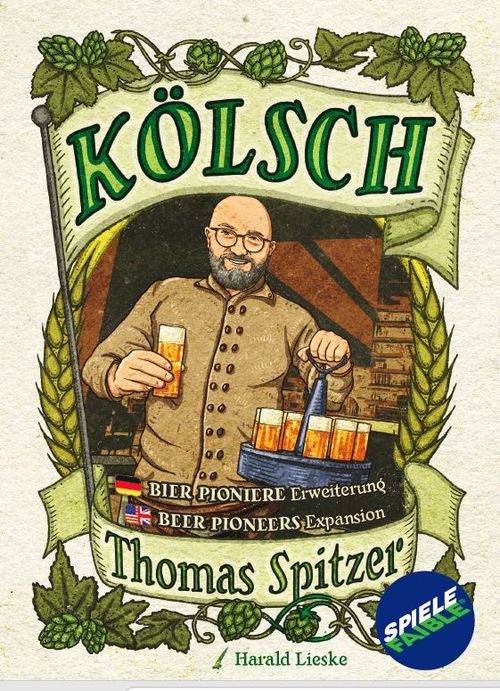
Bier Pioniere: Kölsch
Bier Pioniere: Kölsch Rulebook
Table of Contents
Table of Contents
Expansion Components
Attention: You need the base game Beer Pioneers in order to play with this expansion set.
The Kölsch expansion module can be used in combination with all modules from the Beer Boom expansion set. As with those, we recommend not using more than 2 modules at the same time.
- 1 Kölsch brewery board
- 4 Kölsch brewing dials
- 10 Kölsch beer tiles
- 1 action tile "K"
- 2 action blocker tiles for Kölsch
- 1 cover tile (for 2 players only)
- 4 Kölsch starting action cards
- 8 Kölsch order cards
- 9 new action cards
These cards can be used in combination with the base game and also all modules.
- 1 end of game tile
This can be used in combination with other modules, if appropriate.
Additional steps during setup
- Each brewmaster places 1 Kölsch board and 1 Kölsch brewing dial in front of them.
The Kölsch board represents a separate, small brewery with only one coop. This coop can be used to brew Kölsch beer only. In addition, the Kölsch board has a barrel depot for 2 barrels and 4 cellar spaces for beer tiles and/or barrels. The Kölsch brewery already comes equipped with a beer filter (see below).
- Place the action tile "K" on or next to the game board (on a free space of the game board, depending on other used modules). The action tile "K" allows the action of brewing 1 Kölsch + taking 1 barrel or moving 1 barrel.
You can perform these actions on your own Kölsch board only. (For example, you cannot take a new barrel for your regular brewery board.) No bonus action can be triggered by the action tile "K".
- The action tile "K" in a game with 2 players: Place the cover tile on one action space, regardless on which.
- Place the 2 action blocker tiles for Kölsch next to worker actions 1 and 4 on the game board, covering the respective action number.
- Take 2 random Kölsch order cards and place them face up next to the game board. Stack the remaining ones face down next to them.
- Add the 10 Kölsch beer tiles to the common supply.
- Give 1 Kölsch starting action card to each player plus 2 starting action cards from the base game. As usual, any remaining start action cards are shuffled into the action card draw pile.
- If Kölsch is the only module you are using, place the end of game marker on space "22" of the victory points track.
Changes in Gameplay
Game board – You cannot use the actions number 1 and 4 for your Kölsch board, as indicated by the Kölsch action blocker tiles. There are no restrictions for all other actions, and they may be split if applicable, for example, taking barrels or performing rotations. (Note: Per se, some actions can only be performed on the regular brewery board, since the Kölsch board, for example, does not have a progress track or slots for extensions.)
You can use the action tile "K" for your Kölsch board only.
Kölsch Board – The coop is available from the start of the game. Kölsch always needs 4 rotations to finish brewing.
Kölsch can be stored in the cellar of the regular brewery board if it wasn't brewed directly in the Kölsch brewery (e.g., through the "Malt Factory" extension or the small cellar tile). Likewise, all other types of beer can be stored in the cellar of the Kölsch brewery, as long as they weren't brewed directly on the regular brewery board (see above).
Fulfilling Kölsch orders – There are always 2 of the 8 special Kölsch order cards on display. Each of the 8 contract cards requires exactly one Kölsch with one barrel to be delivered.
When a contract is fulfilled, the card is placed at the bottom of the Kölsch order cards draw pile, and a new card is revealed immediately so that there are always 2 Kölsch orders available. If the player owns the "Truck Fleet", they may claim the bonus also when delivering Kölsch (see below).
Kölsch order cards are resolved in the same way as regular contract cards (like using the Truck action space, etc.). Some Kölsch order cards grant special rewards. If a part or parts of the reward cannot be applied (e.g., because you have used your upgrade marker already), apply the reward as far as possible. A Kölsch order may also be fulfilled using Kölsch stored in the cellar of your regular brewery. In that case, the barrel must also come from that same cellar.
Regular orders – Kölsch may be used to fulfill regular orders that require "BEER." Beer tiles may be taken from either brewery board. However, the beer and the corresponding barrel or barrels must always come from the same brewery.
Likewise, regular orders may be fulfilled using the appropriate type of beer from the cellar of the Kölsch brewery. In that case, the corresponding barrel or barrels must also come from that cellar (see above).
Specific cases
- Extensions:
- Beer filter: You may not use the 3 rotations for your Kölsch brewery. The Kölsch brewery already comes equipped with a beer filter.
- Truck fleet: You cannot place the new barrel depot on the Kölsch brewery. However, the order bonus applies to Kölsch orders as well. We assume that the truck fleet is serving both breweries.
- Malt factory: Take 1 beer tile from the common supply. This may be a Kölsch tile. You may place this Kölsch tile in the cellar of either brewery.
- Laboratory: You may use the 2 rotations for each brewing dial for Kölsch as well. We assume that the laboratory is researching for either brewery.
- Objectives:
- 3 identical beer tiles: Kölsch qualifies as 1 type, the tiles may be in both cellars.
- 4 different beer tiles: Kölsch qualifies as 1 type, the tiles may be in both cellars.
- 7 barrels: The barrels may be in both cellars.
- Beer Boom Export module:
- Deliver 2 beers of the same type and 2 barrels: The type may be Kölsch, same way as any other type. Beer and barrels may be delivered from both cellars. As usual, beer and the corresponding barrel must come from the same cellar.
- Purchase 1 beer for 3 coins: You may place the beer tile in either cellar.
- Action cards: 3 action cards from the base game require a little clarification when used with the Kölsch module. The card's function of the card is in bold print, followed by the clarification.
- a) Heinrich Beck: A regular order card with 1 type of beer only gives 1 VP additionally. His function of master brewer applies to regular orders only (purple section of action cards), not to Kölsch order cards.
Kölsch Cards Almanac
Francesco Peroni: In 1846, Francesco Peroni founded the Birra Peroni company in Vigevano. A second brewery was opened near Rome in 1864. The brewery gained nationwide recognition in the 1950s and established itself in the Italian market. In 1963, Carlo Peroni, Francesco Peroni's nephew, brewed a novel beer named Nastro Azzurro. What made this beer special was that a quarter of the grain in the original recipe was replaced with Italian maize.
Luigi Moretti: Birra Moretti was founded in 1859 by Luigi Moretti as the "Fabbrica di birra e ghiaccio" (Beer and Ice Factory). The brewery was located on what is now Via Luigi Moretti. In 1860, the first bottle of Moretti's flagship beer, Birra Moretti, hit the market. In 1996, Birra Moretti was acquired by Heineken, and the original brewery was shut down. Today, Birra Moretti is exported to over 40 countries.
Nakagawa Seibei was a Japanese brewer. After training in Germany, he became the master brewer in 1876 at Hokkaidō's first brewery, which later evolved into today's Sapporo Brewery. At the age of 18, he traveled to Europe independently. In 1872, he arrived in Berlin via Bremerhaven from England. There, he met Aoki Shūzō, who would later become Japan's foreign minister and was then a student in Berlin. Aoki provided him with financial support and advised him to train as a brewer.
William Copeland: William Copeland (born Johan Martinius Thoresen) was a Norwegian-American brewer. He founded one of Japan's first breweries, the Spring Valley Brewery in Yamate, Yokohama, in 1869. This brewery was the precursor to the Kirin Brewery Company, now one of Japan's largest domestic beer producers.
Beer Labels: Beer labels are information carriers on beer bottles, the content of which is subject to legal regulations. They are categorized into neck, body, and back labels. The Oeconomische Encyclopädie of 1858 provides the following definition: "Etiquette" refers to a small piece of paper or parchment attached to an item by merchants and traders to note its price or quality.
Beer Inspectors: In 18th-century Alsace, court-appointed beer inspectors were called "Bierkieser." Their job was to taste freshly brewed beer to ensure it met local standards, as reflected in beer purity laws. Adding any unauthorized ingredients was considered a punishable offense. In Munich, the institution of state-appointed beer inspectors existed from 1550 to 1851—spanning over 300 years.
The cooling ship (Kühlschiff) was the traditional device for wort fermentation in brewing history. It consists of a very shallow, open vessel into which the hot wort is transferred ("cast out"). The hot wort must be cooled very quickly. The longer the retention time, the better the cooling and clarifying effect—but also the higher the risk of infection by wild yeasts or bacteria. Thus, cooling ships had to be kept scrupulously clean. However, due to the high infection risk, modern industrial breweries no longer use them. Some small-scale and family breweries still operate them, such as those producing Altbier at Schumacher and Uerige breweries.
Beer tokens (Biermarken) are round or square stamped tokens made of brass, aluminum, or plastic. Until about thirty years ago, they were an essential part of nearly every tavern and brewery. Since the 19th century, they have been used as counting aids or vouchers, depending on their place of use. Despite their name, they have nothing to do with beer brand names. Today, beer tokens are rare, though they can still be found in prominent locations, such as Munich's Oktoberfest.