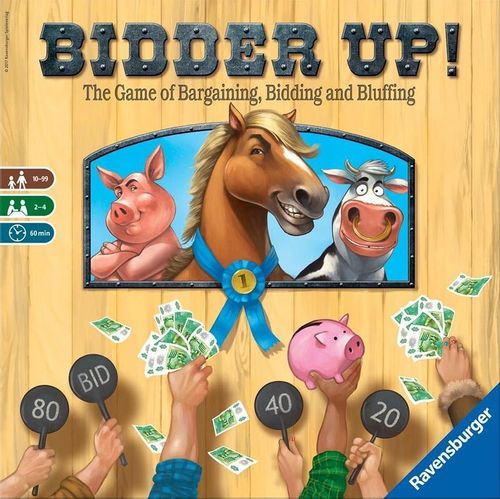
Bidder Up!
Bidder Up! Rulebook
Table of Contents
Table of Contents
Goal
The players try to complete as many, and as valuable, sets of animal types as possible. Whoever has the most points at the end wins.
The rules below describe the game for 3 to 4 players. Additional rules for 2 players are given in the Two-Player Game section.
Components
- 1 double-sided game board ("Animal Market" and "Fairground")
- 50 money notes
- 4 farmer pawns (in the player colors red, blue, yellow, and white)
- 1 cow-spot die
- 4 farm boards (in the player colors)
- 30 animals (3 of each animal type)
- 10 auction tiles
- 1 supply board
- 1 market board with 10 animal markers
- 1 auction hammer
- 1 bag with 24 raffle tickets
- 1 grand prize (the egg-laying Wool-Milk-Sow)
- 6 IOU notes (for the two-player game)
- 10 baby animals (for the Baby Animals variant)
Setup
-
First lay out the board so the matching side is visible.
- The Animal Market side shows a cow next to the start space.
- The Fairground side shows a raffle booth next to the start space.
-
In every game, 4 auction tiles determine the rules by which the animals in the pens are auctioned. Each auction tile is assigned to two pens on the board. Note: the Classic auction is already printed on the board as the default auction, so you don't need an extra auction tile for it.
Animal Market, first game: play with these 4 auctions: the Dutch auction, the Cat in the Bag auction, and the Classic auction (twice). Take the two auction tiles Dutch and Cat in the Bag. Cover the default Classic auction with them on the two wooden tiles circled in the illustration. The default auction thus applies in this game only on the two other wooden tiles. Explanations of all auctions are in the booklet from page 2 onward — it's best to read them shortly before the game starts.
Fairground, first game: play with these 4 auctions: Dutch, Secret Value, Cat in the Bag, and Classic. Take the auction tiles Dutch, Cat in the Bag, and Secret Value. Cover the three wooden tiles circled in the illustration with them. The default Classic auction thus applies in this game only on the unassigned tile. Explanations of all auctions are in the booklet from page 2 onward — it's best to read them shortly before the game starts.
Already familiar with the board game? Then assemble and place the auction tiles as you like. Always lay out at least 1 and at most 2 different Count auctions, and make sure every chosen auction suits your player count. Auction tiles are marked as either Count auctions or Value auctions. Put all unused auction tiles back in the box.
Tip: Want the most important auction rules in view during play? Lay the auction tiles face-down (back side up) — the back briefly summarizes the key info for that auction.
-
Place the supply board next to the game board so the side for 3–4 players is showing.
How to Play
Whoever sat down at the table first begins. After that, play proceeds clockwise around the table.
On your turn:
- Roll the die and move your pawn onto a space, and
- then carry out the action there.
1. Roll and Move
The player moves their pawn forward on the board the number of spaces rolled (e.g., 2 cow spots = 2 spaces). If they want, they can move more or fewer spaces than the roll shows, by paying for it. To do so they must give up money notes of their choice:
- The 1st space more or fewer per turn costs 1 note,
- the 2nd space more or fewer costs an additional 2 notes,
- the 3rd space costs an additional 3 notes, and so on.
Example: For 2 spaces more or fewer, the player would have to pay 1 + 2 = 3 notes.
The notes spent are placed face-down on the Piggy Bank space of the supply board. Stopping in place is not allowed.
On the outer loop (the outer circle), pawns always move clockwise. On the hill (the inner cross), pawns can move in any direction. They just may not move forward and then backward in the same turn. If they move from the hill back onto the outer loop, they must move clockwise there again.
Several pawns may stand on the same space.
Example: Annette rolled a 1. She could move to the goose or to the piggy bank in the middle. She may not move to the space marked in red, though, since that would mean moving counterclockwise. But Annette wants to auction off the (more valuable) cow instead. To increase her movement by 1 space, she places 1 money note on the piggy bank of the supply board. Now she may move to the cow.
2. Take the Action
Then the player carries out the action of the space their pawn landed on.
Auction Pens
Whoever moves to one of the pens auctions off animals to their fellow players: either 1 animal (small pen, A) or even 2 animals at once (double pen, B). Which auction type applies is shown on the auction tile above the pen. How the individual auctions work is explained in the booklet from page 2 onward — it's best to read them shortly before the game starts.
In general: the player whose turn it is is the current auctioneer. That means they run the auction and award the winning bidder the sale. Important: they themselves may not bid in the auction.
- There are two kinds of auctions: Value auctions and Count auctions.
- In Value auctions, the value of the bid counts (e.g., "120"). The number of notes bid doesn't matter — 0-notes are therefore only useful here for bluffing.
- In Count auctions, the number of notes bid counts (e.g., "5 notes"). Here the value of the notes bid is irrelevant — 0-notes count just as much as any other note.
Example: Annette auctions off a horse (Classic auction). Daniel wins with a bid of "120." Annette can take Daniel's money and give him the horse. Or she can use her right of first refusal — that is, she buys the horse herself and gives Daniel the money.
Winning bid awarded?
- Either: the auctioneer gives the winning bidder the animal (or animals). In exchange, they receive the winning bid from the winning bidder.
- Or: the auctioneer instead uses their right of first refusal and takes the animal (or animals) themselves. To do so, they must pay the winning bidder their bid immediately after the sale is awarded.
Won animals go onto the new owner's pasture on their farm board.
If the player now has both animals of that type together, the pair is complete and moves to the barn. (On the Fairground: if the player has all 3 animals of that type together, the set is complete and moves to the barn.)
Afterward, the pen is refilled with 1 animal (small pen) or 2 animals (double pen) from the supply stack.
Supply stack empty: if at least 1 animal can no longer be placed in the pen, it stays empty. That means players can no longer auction or win anything there. Important: when moving, the space still counts completely normally!
Special Moments During an Auction
- Nobody bids? If nobody wants to bid, the auctioneer gets the animal(s) for free.
- That's the deal! Money is never given as change. Whoever can't pay the exact amount must pay a higher price instead. This also applies to the auctioneer if they use their right of first refusal.
- Can't pay, must show. Whoever can't come up with their bid must show all of their money. The auction is then repeated. On the repeat, that player may bid at most as much as they could actually pay.
- The Golden Donkeys. If a Golden Donkey was auctioned, once the auction is settled all players receive extra money from the supply board:
- First Golden Donkey: 100
- Second Golden Donkey: 200
- Third Golden Donkey: 500
Horse-Trading Space
Here you trade animals that are standing in players' pastures (i.e., already won at auction).
First, the player who moved to the space challenges a fellow player. To do so, they name which animal is to be "horse-traded." Only animal types that both players already own on their pastures are allowed. They then make a face-down offer and place it on the table. The value of the bid counts.
Note: If you like, you may cover your bid with your hand, or, for example, deliberately fan out the face-down notes — because even though the number of notes bid is technically irrelevant, a few 0-notes can be useful here for bluffing...
Now the challenged fellow player decides:
- Either: Accept. They accept the bid, take the money into their hand. In exchange, they give the challenger the animal being traded.
- Or: Counter-offer. They place a face-down counter-offer on the table. The two bids are then swapped and secretly counted. Whoever bid more receives the opponent's animal. Important: each player keeps the money they received from the other! The player who bid higher places the animal on their pasture. If they now have the complete animal type (2 on the Animal Market, 3 on the Fairground), it moves to the barn.
Special Moments During Horse-Trading
- Tie: if both players bid the same amount, the challenger gets the animal. Both players keep the bid pile of money from their opponent.
- 2 against 1? Even on the Fairground, if one of the two players involved already owns 2 animals of that type — the horse-trade always concerns only 1 animal from each player.
Piggy Bank
Whoever lands on the Piggy Bank takes the top 5 money notes from the Piggy Bank space on the supply board. If fewer notes are there (or none at all), they receive correspondingly fewer.
How does money get into the Piggy Bank?
- Changing movement distance (see Roll and Move)
- Changing market values (Fairground only, see Market below)
- Buying raffle tickets (Fairground only, see Raffle Booth below)
Market (Fairground only)
The market board records the current value of all 10 animal types. Here, players can change the value of animals to their own advantage (or to their fellow players' disadvantage...).
Whoever moves to a market space may change the value of up to 3 different animal types. Each may be shifted 1, 2, or 3 spaces on the market board, left or right. To do so they must give up money notes of their choice:
- The 1st step for each animal type costs 1 note,
- the 2nd step for the same animal type costs an additional 2 notes, and
- the 3rd step for the same animal type costs an additional 3 notes.
More than 3 steps per animal type are not possible at once. The money notes go face-down on the Piggy Bank (supply board).
Example: Daniel moves to the market space and changes the value of 2 animal types. He raises sheep by 2 steps, paying 3 notes for it (1 note for the 1st step + 2 notes for the 2nd step). Sheep are now worth 500 points. He also lowers the value of donkeys by 1 step, paying 1 note for it. They are now only worth 350 points. In total he pays 4 notes (3 for the sheep + 1 for the donkey).
Important: once an animal type is complete and moves to the barn, its market value is locked in — it may not be changed for the rest of the game. To show this, the player flips that animal's marker on the market board from green to red.
Raffle Booth (Fairground only)
Here the player can buy raffle tickets and have a chance at instant prizes and the grand prize.
The player first decides whether they want to draw 1, 2, or 3 raffle tickets from the raffle bag. They then place the corresponding number of money notes (1, 2, or 3) face-down on the Piggy Bank of the supply board — the value of the notes given up doesn't matter. Then they draw that many tickets from the bag.
Important: no matter how many tickets the player draws this turn, they may keep only 1 of them! The chosen ticket is placed face-down in front of them. Any further tickets drawn go back into the raffle bag.
The Raffle Tickets
- Action tickets allow extra actions during the game. The player may reveal 1 of their action tickets per turn and use it in addition to their normal action (even a ticket received that same turn). When exactly they perform the ticket's action within their normal turn is up to them. Afterward the ticket is removed from the game. The individual actions are explained on the back of the booklet (see Raffle Ticket Overview below).
- Value-Gain tickets are only revealed at the end of the game. They increase the value of certain of the player's own animal types and are explained on the back of the booklet (see Raffle Ticket Overview below).
- Wool-Milk tickets (numbers 0 to 3) are only revealed at the end of the game. Players add up the numbers on their tickets: whoever has the highest total wins the Wool-Milk-Sow. In case of a tie, the player with the most Wool-Milk tickets wins. If it's still a tie, the players involved roll the die — whoever rolls higher gets the sow. If no player has a Wool-Milk ticket, the sow isn't awarded to anyone.
- The Wool-Milk-Sow is the grand prize of the Raffle Booth. Only at the end of the game is it decided who wins it. It has no value of its own. Instead, during scoring, it increases the winner's number of complete animal types by 1 (see Scoring)!
End of the Game
Animal Market: the game ends immediately after the turn in which the last animal was auctioned off (i.e., no animals remain on either the supply board or the game board).
Fairground: the game ends...
- either: immediately after the turn in which the last animal was auctioned off (the supply board and game board are empty),
- or: immediately after the turn in which a player buys the last raffle ticket (the raffle bag is empty).
Scoring
Scoring consists of the following steps. Whoever has the most points afterward wins.
Animal Market Scoring
- Calculate animal value. Add up the values of your animal types in the barn. The number on each animal tile gives the point value for that whole animal type (e.g., both cows = 800 points). Important: animal types still standing on the pasture (not yet complete) are not scored!
- Multiply. Multiply the animal value by the number of complete animal types in the barn. Someone with three complete animal types, for example, triples their points.
- Add money. Add your remaining money to your points.
Scoring example: Daniel has 2 complete animal types in his barn: Sheep worth 350, Horses worth +1,000, totaling 1,350. With 2 complete animal types, this is multiplied by 2: 1,350 x 2 = 2,700. Daniel has 350 in money. 2,700 + 350 = 3,050 points.
Fairground Scoring
- Award the Wool-Milk-Sow. Whoever has the highest raffle-ticket total wins the Wool-Milk-Sow and places it in their barn. (For ties, see Wool-Milk tickets above.)
- Calculate animal value. Add up the market value of your animal types in the barn. The marker on the market board shows the market value of the whole animal type (e.g., 3 dogs = 150 points). Important: animal types still standing on the pasture (not yet complete) are not scored! The player also adds any Value-Gain tickets (300 for a matching animal type, otherwise 100).
- Multiply. Multiply the market value by the number of complete animal types in the barn. The player holding the Wool-Milk-Sow increases their number of animal types by 1 for this step.
- Add money. Add your remaining money to your points.
Scoring example: Daniel has Wool-Milk tickets worth 1-2-2 = 5. André (2), Annette (1), and Frank (3) each have less, so Daniel wins the Wool-Milk-Sow. Daniel has 2 complete animal types in his barn, and their values have changed on the market: Sheep worth 500, Horses worth +800, totaling 1,300. With 2 animal types + 1 Wool-Milk-Sow, this is multiplied by 3: 1,300 x 3 = 3,900. Daniel has 350 in money. 3,900 + 350 = 4,250 points.
Scoring Sheet
Both sides use the same scoring sheet formula (skip any lines that don't apply to your game):
- Sum of animal values
+Value-Gain tickets+200 per baby animal in the barn (Baby Animals variant)=SubtotalxNumber of complete animal types (counting the Wool-Milk-Sow, Fairground only)=Subtotal+200 per baby animal in the petting zoo (Baby Animals variant, Fairground only)+Money−Credit taken (2-player game only)=Result
A photocopiable scoring sheet is on the back of the "Variants and Auctions" booklet.
Two-Player Game
In the two-player game, the following rules are adjusted. All other rules apply as in the game for 3 and 4 players.
Setup
Board: for the two-player game, always take the auction tiles Cat in the Bag, Number Call, and The Call, and cover the wooden tiles circled in the illustration with them. The already-printed Classic auction applies on the unassigned space.
Supply board:
- First set out the supply board with the 2-player side face up.
- Then place all 100s, all 200s, and two 500s on the corresponding spaces next to the Golden Donkey. (Fairground: place all 100, 200, and 500 notes on the corresponding spaces next to the Golden Donkey.)
- Place the 6 IOU notes on their spaces next to the Golden Donkeys.
- Take your starting money. Then shuffle the remaining money. Draw 5 notes from it and place them unseen in the box. The rest becomes a face-down stack on the Gambling space with the die.
- Raffle bag: if playing on the Fairground, draw 8 raffle tickets and put them unseen into the raffle bag. The remaining tickets go back in the box.
Play
In play, only the Piggy Bank action changes. Whoever lands on a Piggy Bank space can now choose one of three options:
- A) Raid the piggy bank: the player can draw up to 5 notes from the Piggy Bank space on the supply board.
- B) Take out a loan: the player takes either a 100, 200, or 500 note from the supply board. At the same time they take the matching IOU note. They must deduct this value (300, 600, or 1,500) from their points at the end of the game. If no matching IOU note is left on the supply board, the player can't take that loan.
- C) Gamble: the player rolls the die for money. On a...
- 1, they're unlucky: they take the top note from the Gambling stack and "gift" it, unseen, to their opponent.
- 2, they're lucky: they take the top 2 notes from the stack and keep both.
- 3, they're also lucky: they take the top 3 notes, look at them, and give 1 to their opponent. They keep the remaining two.
Tips & Tricks
- Time is money: avoid moving to empty pens. Better to pay a note (or several) to move to a better space instead. It can also be worth paying a note to reach the Piggy Bank — there the player gets up to 5 notes back.
- Horse-trade in time! Only animals in the barn score points at the end. Try to complete your animal types through horse-trading early enough in the game.
- Auction variety: the different auctions create ever-new situations and challenges. Just try them out!
- Loan shark: in the two-player game, it can pay to take out loans to win important animals for yourself — or to avoid losing them...
- Market hustle: on the Fairground, raise the value of your own animals as soon as you have two of them. With a bit of luck, you'll multiply your points. Of course, you can also lower the value of your "opponents'" animals...
- Raffle rush: once you've played the game a few times, increase the number of raffle tickets before the game starts: roll the die once and throw in that many extra tickets in addition to the base amount.
Baby Animals Variant
This variant, and the auction reference and raffle ticket reference below it, come from the companion "Varianten & Versteigerungen" (Variants & Auctions) booklet included with the game.
You can play the Baby Animals variant with either the Animal Market or the Fairground. The rules are extended as follows:
Setup
- Lay out your farm board so the side with the petting zoo is showing.
- Shuffle the 10 baby animals face-down and draw 4 of them. Place them face-up in the pen of the supply board. The remaining baby animals go back in the box.
Play
For the 4 animal types whose baby animal is laid out on the supply board, there is offspring this game.
- Animal Market: for each of these animal types there is 1 female (pink background) and 1 male (blue background). Whoever has both together first may take the matching baby animal and place it directly in the barn.
- Fairground: for each of these animal types there are 2 females (pink background) and 1 male (blue background). Whoever first owns 1 female and 1 male of the matching type may take the matching baby animal and place it on their petting zoo. As soon as the player owns all the animals of that type, the baby animal moves to the barn as well. During horse-trading, the challenger may decide which two specimens (male/female) are horse-traded against each other. Important: a player can never lose the baby animal, even if they still have to give up the adult animals through horse-trading.
Scoring
Each baby animal counts for 200 points. If it's in the barn (the animal type is complete), the points are added before the multiplication. If it's in the petting zoo (Fairground only), the points are added only after the multiplication.
The Auctions
Before the game, read only the auctions you'll actually be playing with this session. Don't forget: the general auction rules — the auctioneer doesn't bid but does hold the right of first refusal — apply to all of the auctions below.
1. Classic
(2–4 players, Value auction; pre-printed on the board)
All fellow players may shout out bids as often as they like, in any order. It's also allowed to outbid yourself. Each bid must exceed the current highest bid by at least 10. As soon as no higher bid comes, the auctioneer calls out: "Going once, going twice, going three times." Then they award the sale with the auction hammer. (In the two-player game, the other player can of course just name their highest bid directly.) In a double auction (double pen), both animals are auctioned together — "as a package," for one price — to the highest bidder.
Reminder: the auctioneer always has the right of first refusal, as usual.
Tip: want the Classic auction rules always in view? Just lay the included Classic auction tile with the info side face-up on the board.
2. Cat in the Bag
(2–4 players, Value auction)
Here the players know they're buying something, but not what...
The auctioneer reveals the 3 animals in the pen and shows them to their fellow players. They then shuffle them face-down. Their left neighbor then points to 1 of the three face-down cards. This animal is the one being auctioned. Only the auctioneer may look at it secretly. The other two are placed face-down back in the pen.
Now the auction begins. It works by the usual rules of the Classic auction. The only difference: the animal being auctioned is only revealed after the auction ends. During the auction, the auctioneer may advertise the animal however they like — they don't have to tell the truth, though...
In a double auction (double pen), 2 of the 3 animals are secretly chosen as described above and auctioned together ("as a package") to the highest bidder.
If, toward the end of the game, only 2 animals remain face-down in the pen (because the draw stack is empty), only 1 of the two is auctioned face-down. If only 1 animal remains there, it's auctioned openly, as in the Classic auction.
Reminder: the auctioneer always has the right of first refusal, as usual.
3. Dutch Auction
(3–4 players, Count auction)
In this auction, the number of money notes bid counts — their value doesn't matter. The auctioneer places the auction hammer within easy reach of everyone, in the middle of the board. They then count down slowly and evenly, starting from 10. Whoever grabs the auction hammer first wins the sale. They must pay the number of notes the auctioneer had called out at that moment. In a double auction (double pen), both animals are auctioned together — "as a package," for one price — to the highest bidder.
Reminder: the auctioneer always has the right of first refusal, as usual. If they use it, they must pay the winning bidder the number of notes bid.
4. Secret Value
(3–4 players, Value auction)
Here all fellow players simultaneously place a secret bid face-down on the table. They then all reveal their bids together. Whoever bid the highest amount wins the sale. In case of a tie, the auctioneer may choose which of these players wins.
In a double auction (double pen), the highest bid applies to the more valuable of the two animals; the second-highest bid applies to the less valuable one. (On the Fairground, the current market value is what determines this.) If the two animals are equally valuable, or several players tied for the top bid, the auctioneer chooses which player bid for which animal. The auctioneer may use their right of first refusal as they wish — for both animals, for only one of them, or for neither. They may even have the money for one of the animals paid out to them first, in order to use it to buy the other animal themselves. If they buy both animals, they must of course pay for both.
5. Secret Count
(3–4 players, Count auction)
Here all fellow players bid a secret number of money notes. They place the notes simultaneously face-down on the table, then show how many notes they bid (but not the face of the notes). Whoever bid the most notes wins the sale. In case of a tie, the auctioneer may choose which of the players involved wins.
In a double auction (double pen), the highest bid applies to the more valuable of the two animals; the second-highest bid applies to the less valuable one. (On the Fairground, the current market value determines this.) If the two animals are equally valuable, or several players tied, the auctioneer chooses which player bid for which animal. The auctioneer may use their right of first refusal as they wish, for both, one, or neither of the animals — they may even have the notes for one animal paid to them first in order to buy the other animal themselves. If they buy both, they must of course pay for both.
6. Round-the-Table
(3–4 players, Value auction)
Starting from the auctioneer's left neighbor, every player bids exactly once, in turn. Whoever bid the highest amount afterward wins the sale. In a double auction (double pen), both animals are auctioned together — "as a package," for one price — to the highest bidder.
Reminder: the auctioneer always has the right of first refusal, as usual.
7. American Count
(4 players, Count auction)
Here players raise their bids in turn. It's about the number of notes, not their value. The auctioneer's left neighbor begins. They have two options: raise, or pass.
- If they raise, they place 1 note face-down in front of them on the table.
- If they pass, they drop out of the current auction.
Then the next player clockwise takes their turn, and may likewise raise (place 1 note face-down) or pass. This continues around the table until only 1 player remains — the highest bidder. The highest bidder may then, as a final step, raise their bid once more by up to 3 notes. After that, the auctioneer decides whether to use their right of first refusal.
Explanation: in this auction, whoever placed a note last wins the sale. Anyone who passed takes back any notes they'd already bid into their hand — they can no longer rejoin the ongoing auction.
In a double auction (double pen), the sale applies to both animals together.
8. Second Hand
(4 players, Value auction)
This one gets tricky: the highest bidder wins the sale — but at the second-highest bid...
Here's how it works: all fellow players simultaneously place their bid face-down on the table. They then all reveal their bids at the same time. Whoever bid the highest amount wins the sale, at the value of the second-highest bid.
In a double auction (double pen), both animals are auctioned together, "as a package," to the highest bidder.
Example: André auctions off a cow. Annette bids the most with 120, followed by Frank, who bids 100. Annette, as the highest bidder, wins the sale — but she only has to pay 100 (the second-highest bid). Of course, André as the auctioneer can use his right of first refusal: he pays the highest bidder Annette the 100 and acquires the animal himself.
Note: if several players tied for the highest bid, the auctioneer chooses which of them wins the sale at the full price, and to whom they pay the corresponding amount (right of first refusal).
9. Number Call
(2 players, Count auction)
The other player directly names the number of notes they're willing to pay. In a double auction (double pen), both animals are auctioned together, "as a package," for one price.
Reminder: the auctioneer always has the right of first refusal, as usual. If they use it, they must pay the winning bidder the number of notes bid.
10. The Call
(2 players, Value auction)
Here the auctioneer calls out the amount they're demanding. The other player then says whether they're willing to pay it. If not, the auctioneer must use their right of first refusal and buy the animal themselves for the amount called, paying that amount to their fellow player. In a double auction (double pen), both animals are auctioned together, "as a package," for one price.
Raffle Ticket Overview
- Extra Turn: immediately after your turn, take one complete additional turn (roll, move, take the action).
- Move Market Markers: shift up to 2 green animal markers by 1 space each, left or right.
- Horse-Trade: make a horse-trade.
- Special Horse-Trade: make a horse-trade where the number of notes bid counts, not their value. Both players may cover their bid with their hand as usual.
- Value-Gain: if you have the pictured animal type complete at the end of the game, its value increases (before multiplication) by 300 points. If you don't have it complete, you may instead assign the ticket to any other complete animal type in your barn — its value increases (before multiplication) by 100.
- Wool-Milk tickets (numbers 0 to 3): whoever has the highest total at the end of the game wins the Wool-Milk-Sow.