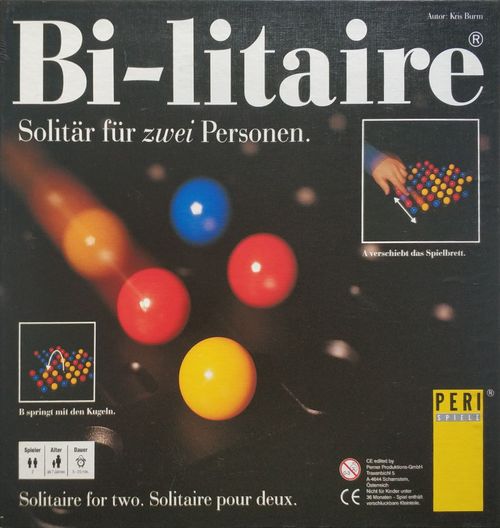
Bi-litaire
Bi-litaire Rulebook
Table of Contents
Table of Contents
Materials
- 1 board
- 12 small square sliding boards (each with 4 spaces for marbles and a recess that lets you move each small board)
- 48 marbles
- 1 rule sheet
Setup
The twelve small sliding boards are placed on the main board so that the four corners remain free (in a star shape).
The 48 marbles are placed in the hollows of the small sliding boards (4 per board). The colour of the marbles does not matter.
Decide at random who starts as the marble player.
The Marble Player
-
The marble player and the board player take turns.
-
The marble player starts. He takes a marble of his choice from the board. This is the first move. Then it is the board player's turn (see "The Board Player" below). For the following moves, the marble player must follow the rules below.
-
He always has two possibilities.
Simple jumps: if the board player does not make a move that forces the marble player to make a multiple jump, the marble player jumps over a marble to land in the empty space directly behind it.
Warning: jumping is only allowed vertically and horizontally. It is forbidden to jump diagonally, or to jump over more than one marble at a time.
The marble player may only jump with one marble at a time, which he can however choose freely.
Second possibility: the board player can force the marble player to make what is called a multiple jump (details in "The Board Player", point 4).
-
After jumping over a marble, the marble player removes it from the game.
-
The marble player tries to jump over as many marbles as possible in one turn.
-
The turn ends when the marble player can no longer jump. The number of marbles remaining on the board determines the result for the marble player.
The Board Player
-
The board player moves at least one of the small sliding boards (exception: see point 3).
-
With each move, the board player may move one, two or three small sliding boards at the same time (!), horizontally or vertically. The possibilities are:
- One small sliding board by 1, 2 or 3 spaces in one direction.
- Two small sliding boards that touch each other, by 1 or 2 spaces in one direction.
- Three small sliding boards that touch each other, by 1 space in one direction.
It is not allowed to move a small sliding board by half a space.
If you move a row of two or three small sliding boards, this can only be done lengthwise, never sideways.
-
If a small sliding board is empty (so there are no marbles on it), the board player may remove it from the game. He is not obliged to remove it. If he does, this counts as a move.
If there are two or more empty small sliding boards, the board player needs two or more moves to remove them. During this time, the marble player may try to place marbles on the empty small boards. The board player may not remove a small board that has marbles on it.
-
The board player decides which moves the marble player must make. If the board player forces his opponent to make double and triple jumps (or more), the marble player must then make these double and triple jumps (or more).
The board player must tell his opponent explicitly what he wants. If he says, for example, "triple jump", the marble player must stick to it. Even if a quadruple or quintuple jump were possible, only the first announcement counts. It is not allowed to change it.
It is possible to change direction several times within one multiple jump, for example: first jump forward, second jump to the right, third jump forward again, and so on.
If an announcement by the board player can be carried out in more than one way, the marble player may choose the variant that is most interesting for him.
The board player is not obliged to make an announcement. But if he does, the marble player must respect the number of jumps announced. If the board player does not notice that a multiple jump is possible and says nothing, the marble player can of course only make a single jump. It is not necessary to announce single jumps.
Winner
The game is played in two rounds with a change of roles. The player who, as the marble player, left the fewest marbles on the board is the winner.
Example:
- 1st round: player A is the marble player and B is the board player. The round ends with 21 marbles on the board.
- 2nd round: player B is the marble player and A is the board player. The round ends with 17 marbles on the board.
Player B is the winner.
Tips for the Board Player
Beginners will believe that the marble player has the game in hand, so to speak. A beginning board player feels that he can only very slightly influence the game. Be careful: this is a misleading impression! The board player must be very concentrated and act quickly. For this, there are three strategies:
- The board player separates the small boards that are full from the others. All marbles that sit on an isolated small board are lost to the marble player (as long as the board remains isolated).
- The board player should remove as many empty small boards from the game as possible. The fewer boards there are, the easier it is to isolate some of them, and the harder the game becomes for the marble player. Admittedly, the marble player is no fool and will try to leave a last marble on each small board (unless the board player forces him to remove it by announcing a multiple jump).
- The board player can steer the game by constantly forcing the opponent to make the multiple jumps he announces. This does nothing if, in this way, many marbles are removed from the game. In this way, the marble player can never follow his own strategy.