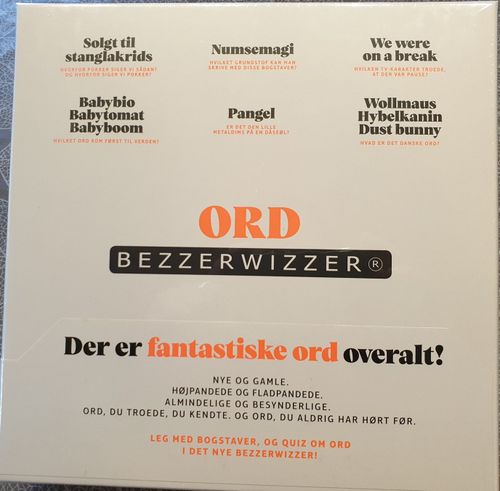
Bezzerwizzer Ord
Bezzerwizzer Ord Rulebook
Table of Contents
Table of Contents
Before Play Begins
Contents: 1 game board, 20 category tiles, 8 BEZZERWIZZER tiles, 4 ZWAP tiles, 4 playing pieces, 1 card holder, 147 question cards, 1 bag for the tiles, 1 game guide.
- The players form 2, 3 or 4 teams. A team can have one or more players.
- Choose a team colour and a matching playing piece.
- Pick two BEZZERWIZZER tiles and one ZWAP tile in your team colour.
- Put the category tiles in the bag and place the playing pieces over the starting space of the scoring track on the edge of the box.
Start Playing
The game is played in rounds. Each team draws four category tiles from the bag and places them face-up on the four squares on their side of the game board. Correct answers are awarded 1, 2, 3 or 4 points, depending on the number of dots, so think carefully about the order you place your category tiles. Each point corresponds to a space on the scoring track on the edge of the box.
Decide which team starts the first round. The first team now answers a 1-point question read out by another team. For a correct answer, the team is awarded 1 point and advances one space. If the team passes on a question or gives an incorrect answer, the playing piece stays where it is.
Once the question has been played – whether it was answered correctly or not – turn over the corresponding category tile so it's face-down: this category is now closed. Draw a new question card, and the next team to the left now takes its turn. Repeat these steps until each team has played a 1-point question.
The game then continues with each team answering their 2-point question in turn (and advancing two spaces for a correct answer). Then, each team answers the 3- and 4-point questions in the same way. A new question card is drawn for each question. This completes the first round. All the category tiles are put back in the bag, and the next round begins. The right to start the next round circulates clockwise.
Tactics
The game has two different tactical tiles that you can use to hold back your opponents or to score extra points for yourself.
BEZZERWIZZER: If you think another team won't be able to answer their question (and your team will), you can try to score points with a BEZZERWIZZER tile. Only play a BEZZERWIZZER tile when one of the other teams is taking its turn.
ZWAP: You can play a ZWAP tile during your turn to swap two category tiles on the board.
You can read more about the BEZZERWIZZER and ZWAP tiles below.
If a team plays a tactical tile, this tile remains out of play until the beginning of the next round, at which point all tactical tiles are returned to their respective teams. Teams do not have to use their tactical tiles in a given round if they don't want to.
Winning the Game
The game ends when one team reaches the last space on the playing board – which is the same as the starting space.
If some teams have been asked fewer questions than the winning team, then the question round continues until all teams have attempted the same number of questions. Teams do not have to land on the last space by exact count for the game to end.
If several teams reach the last space in the same round, these teams face each other in a playoff. All the category tiles are put back in the bag. Each team in the playoff draws a category tile from the bag and takes turns answering a question from the category they have drawn. If all the teams answer correctly, another playoff is held. This continues until only one team in the round has answered correctly.
This team is the BEZZERWIZZER winner!
BEZZERWIZZER Tile
You can play a BEZZERWIZZER tile to attempt another team's question! Be the first opponent to call out 'BEZZERWIZZER' and put a BEZZERWIZZER tile on the board, either before or after a question is read out.
The team in play (the defending team) answers the question first. The BEZZERWIZZER team gives its answer straight afterwards.
If the defending team gives the right answer, no points are awarded to the BEZZERWIZZER team. But if the defending team passes on a question or gives the wrong answer, the BEZZERWIZZER team can earn or lose points in a number of different ways:
- 3 points for a correct answer if the tile is played BEFORE the question was read out.
- 1 point for a correct answer if the tile is played AFTER the question was read out.
- 1 penalty point is given if the BEZZERWIZZER team answers incorrectly and they must move their playing piece back one space.
A team on the starting space can never move back a space.
In order to win 3 points, the opponent reading the question must play a BEZZERWIZZER tile BEFORE announcing the question.
The home stretch: If the defending team's playing piece is on a space in the home stretch (indicated by the white arrows), the BEZZERWIZZER team can choose to use its points to move that team's playing piece back one or three spaces, instead of advancing their own piece.
ZWAP Tile
You can play a ZWAP tile to swap an unwanted category tile with one belonging to another team. You can also use a ZWAP tile to make things difficult for your opponents.
A team can only use a ZWAP tile during its own turn (and before the opponent starts reading out the question).
Place a ZWAP tile on the board and swap two category tiles. You can swap another team's category tiles as well as your own. You cannot swap closed category tiles.
The guide's ZWAP diagram is captioned: Zwap between opponents, Zwap with opponents, Zwap your own categories.
If the team in play swaps a category tile – and another team has already played a BEZZERWIZZER tile on that category – the BEZZERWIZZER team can take back their BEZZERWIZZER tile. Another team can now play a BEZZERWIZZER tile on the new category tile.
Categories
The category tiles in the 17th-edition guide are listed below. Ord uses its own word- and language-related category tiles, which are not included in this guide.
- ARTS & THEATRE – Classical music, theatre and paintings
- BUSINESS – Companies, business people and products
- DESIGN – Fashion, interiors, designers and logos
- FILM – Actors, directors, film titles, roles and quotes
- FOOD & DRINK – Gastronomy, chefs, restaurants and cookbooks
- GEOGRAPHY – Countries, cities, oceans, rivers and mountains
- HISTORY – Historical figures, places and events
- HUMANS – Anatomy, physiology and medicine
- LANGUAGE – Foreign languages, grammar and sayings
- LITERATURE – Authors, book titles and literary characters
- MUSIC – Artists, albums, songs and lyrics
- NATURE – Animals, plants, geology and the environment
- POLITICS – Politicians, parties and forms of government
- SCIENCE – Physics, chemistry, astronomy and climate