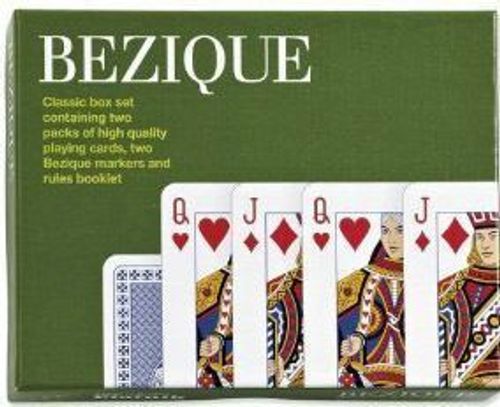
Bezique
Bezique Rulebook
Table of Contents
Table of Contents
Technical Terms Used in Bezique
Bezique (Single). The Queen of Spades and Knave of Diamonds.
Bezique (Double). Two Queens of Spades, and two Knaves of Diamonds.
Brisques. The Aces and Tens in the tricks taken.
Common Marriage. The King and Queen of the same suit, other than trumps.
Eldest Hand. The player immediately at the left of the dealer.
Fours of Aces, Kings, Queens, or Knaves.
Pack. The same as the Euchre, Piquet, or Ecarte pack, composed of thirty-two cards, all under the Seven spots being discarded.
Quint-Major. Same as Sequence.
Royal Marriage. The King and Queen of trumps.
Sequence. Ace, King, Queen, Knave, and Ten of trumps.
Stock. The number of packs of cards corresponding with the number of players, shuffled together, and ready to be dealt.
Talon. The cards remaining after the dealer has distributed eight to each player.
Rules of the Game
Bezique, as it is now played, has undergone great modifications since it has taken rank among the games in vogue. The manner of playing the game, the various modifications and counts, and the laws generally adopted, are here given.
-
Bezique is ordinarily played by two persons, with two or three packs of thirty-two cards (Euchre packs).
-
After having decided by lot, by turning two cards, which player deals, the one who deals hands the cards to be cut, and then distributes them by giving two cards, or three and two, till eight are dealt to each player, which is the number of cards almost always used in playing.
-
It is occasionally agreed to play with nine, and sometimes ten cards.
-
The number of cards having been decided and dealt to each of the players, the next card is turned up; this is the trump, which is the seventeenth if eight cards are played with, or the nineteenth if nine, or the twenty-first if it is with ten cards; that is, when two are playing.
-
After the dealer has placed the rest of the cards to his left (in this country we place the talon on the right), which forms the talon, his adversary plays first; and the one who wins the trick takes a card from the talon in order to complete his number of eight, nine, or ten cards. The one who has lost the trick then takes a card in the same manner, and the play continues till the talon is exhausted. The winner of the trick has the privilege of the lead.
-
The following is the value of the cards, in making the tricks: 1st, the Ace, which takes all other cards; 2d, the Ten; 3d, the King; 4th, the Queen; 5th, the Knave; 6th, the Nine; 7th, the Eight; 8th, the Seven.
-
Before commencing the play, it is usual to decide on the number of points which is to make the game, that is, 1,000, 1,500, 2,000, or more.
-
When the turned-up card is not a Seven, the player holding the Seven of trumps can exchange it for the turned-up card, in which case he scores ten points.
-
The value of the combinations, in counting the points, are as follows:
| Combination | Points |
|---|---|
| Each Ace or Ten taken or saved in trick | 10 |
| Each Seven of trumps, when played or turned up | 10 |
| The last trick | 10 |
| A common marriage | 20 |
| A royal marriage | 40 |
| A Bezique | 40 |
| Four Knaves | 40 |
| Four Queens | 60 |
| Four Kings | 80 |
| Four Aces | 100 |
| A sequence (quint-major) | 250 |
| A double Bezique | 500 |
(Editor's note: the OCR of the source lost the alignment of this table; the values are matched to the labels in the printed order.)
-
It is permitted to decline following suit as long as there are any cards left in the talon; but the privilege ceases when the talon is exhausted; and, moreover, the player must, if he can, win the trick.
-
In a case of a misdeal, the hand passes, or you commence anew, according as your adversary may choose.
-
The player taking the trick just previous to exhausting the talon, may then declare any combination in his hand. The winner of the trick then takes the last card in the talon, and his adversary the trump card, and afterwards no combination can be declared or counted. The declared cards on the table must be taken in the hand of each player, and the rule imperatively is: follow suit with the highest in your hand, and if you cannot follow suit, trump the trick.
-
The last trick having been made, each player counts the Aces and Tens which are in the tricks he has taken; these Aces and Tens are called brisques. For each brisque the holder scores ten points, which are added to the score made during the playing by the combinations.
-
Brisques are not counted when any one of the players makes the game by scorings made by combinations; that is to say, when neither of the players has made the number of points fixed to complete the game, then he who, with the brisques, counts most over the fixed number, wins; and, in case of a tie, the winner is the one taking the last trick.
-
After all the cards have been taken in hand, if any player revoke by not playing the highest in suit, or refuse to trump when he has not suit in hand, his adversary may claim a deduction of forty points from the score of the player so revoking, or refusing to trump.
-
There are cases where one card is made to count several times. For example: a King which has counted in a marriage can count also in the score of 80 points (four Kings); it counts also in a score of 250. It is to be understood, in the last case, that it must be a King of trumps.
-
An Ace of trumps, which has counted in a score of 100 (four Aces), can also serve to make a score of 250 (sequence). The Queen of Spades and Knave of Diamonds, after having counted for a Bezique, can serve to count in a score of 250 (sequence), and the Queen of Spades in a marriage.
[We play differently in this country. The following is the rule here: King and Queen of trumps, or any other suit once married, cannot again be married in the same hand, but may constitute one of four Kings or Queens, a sequence of trumps, or a Bezique, double or single. In other words, any card, except either of those which have been used to form Bezique, may serve to compose any other combination in which it has not previously been employed.] See note to Rule 25.
-
If, after having scored an 80 of Kings, the same combination is filled in the hand, it also counts; but neither of the first four Kings can be used to complete the combination. It is necessary (this is to be distinctly understood) that it must be a new combination.
-
The above rule holds good for Aces, Queens, and Knaves.
-
It is the practice, in order to escape errors, to place on the table, with the faces up, all cards which have been used to make the combinations after they have been declared; that is, a marriage, a 100 of Aces, an 80 of Kings, a 60 of Queens, a 40 of Knaves, a Bezique, a 250, or a 500; but the player is privileged to play these cards when he pleases.
-
The possessor of a Bezique, sequence, or any other combination of cards in hand, must take a trick before declaring the same.
-
If a player declares Bezique, and subsequently is fortunate enough to draw cards sufficient to declare double Bezique, the latter counts 500 points, in addition to the 40 points already scored for Bezique.
-
When a single Bezique is in hand, it may be declared and placed upon the table, and there remain until the double Bezique is subsequently acquired. The player must judge from the condition of his hand whether it would be better to try and achieve double Bezique, or abandon the effort for other combinations.
-
When a card is led, and other cards identical in value are played in the same round, the first card played takes precedence of all others of the same denomination, and wins the trick, unless it is trumped, or outranked by a card of superior value.
-
Only one combination may be declared at a time.
[In some coteries they play differently, and the fortunate holder of more than one combination may declare all such combinations upon taking a trick; but after Bezique has been declared, the cards composing that combination cannot be employed to form any other. It is, therefore, good policy to retain the Queen and Knave in hand, to aid in forming other arrangements of the cards, before declaring Bezique, particularly when Spades or Diamonds are trumps, for then the Queen may be serviceable in composing a royal marriage, sequence, or four Queens, while the Knave may avail in forming a sequence or four Knaves, and both may afterwards be employed to declare Bezique.] See Rule 17.
-
Whenever a player neglect to take his card from the talon, he loses the play, or, left to the choice of his adversary, he can take the next two cards.
-
The play is equally void, at the choice of the adversary, when a player plays with a card too many; he must, if the play is not declared void, play twice in succession without drawing a card from the talon.
-
A player who, having only three cards, declares four and scores, must, when the error is discovered, correct the score by not counting it, and he can be compelled to play one of the three cards, if the error is not discovered before his adversary shall have played; because this last would have been able, by reason of the error, to have thrown away a card which he supposed there was no reason to retain, since, on account of the error, he would not be able to count again by filling a combination.
Hints and Cautions to Young Players
-
It is presumed that a beginner is being instructed, and we say to him: You hold eight cards in your hand; you have led a card, and your adversary has taken it; you hold the Queen of Spades; your adversary having taken his card from the talon, you take yours; that card is the Knave of Diamonds; you have then a Bezique, but you say nothing; you wait till you take a trick, then declare it, and score 40 points; you have three Aces, and draw another from the talon; that makes a 100 of Aces, which you also declare when you take another trick, and so on, for as many combinations as you are fortunate enough to form in your hand. Whenever your adversary takes a trick, keep silent, wait patiently, for he is not allowed to score if he fails to make his declaration before you have taken the following trick.
-
It is good play to make your Aces and Tens whenever an occasion is presented for doing so, being careful, however, not to throw away the former when there is any likelihood of declaring four Aces. As the Aces and Tens count ten each in trick, the careful player, by a judicious use of small trumps and Aces of the suit led, may make an aggregate score at the end of the game of very respectable proportions. Remember, that every Ace or Ten you let your adversary take, scores twenty against you.
-
Do not fail to note, when your opponent displays a sufficient number of Bezique or sequence cards of the same denomination, to satisfy you that it will be impossible for you to form either of those combinations. This will enable you to improve your game by throwing away cards which might otherwise be retained with the false hope of making impossible combinations. For instance, we will suppose A. and B. to be playing at Bezique, with one pack of cards each; A. twice declares a common marriage in Spades, and also four Aces, two of which are trumps; it is therefore very evident that B. cannot make either a single or double Bezique, and it would be stupid in him to keep the Knave or Knaves of Diamonds in hand, unless in the anticipation of declaring four Knaves. Neither could B. hope to make up the sequence, as A. had shown both trump Aces. It would therefore be policy in B. to play out the Tens and Knaves of trump in hand, whenever opportunity offered for doing so with profit. B. would thus relieve his play, and prepare for other combinations yet in the cards.
-
Be careful not to throw away in play either Bezique or sequence cards, while there is a reasonable probability of forming either. The reward for declaring those valuable combinations, particularly double Bezique, is so far beyond that of all others in the game, that it is good play to retain in hand any card which may serve to compose either of them, as long as any chance remains of achieving either.
Bezique Without a Trump
This is played as the ordinary game, except that no card is turned to make a trump, but the trump is decided by the first marriage which is declared. For example: you or your adversary declare a marriage in Clubs, then Clubs become trumps, and so on with the other suits.
The quint-major of trumps, or the score of 250, cannot be declared until after the first marriage has been declared. The Seven of trumps in this game does not count ten points. The Beziques, four Kings, four Queens, &c., are counted the same as in Bezique when the trump is turned, and can be declared before the trump is determined. It is the same with the other cards which form combinations; their value remains the same as in the ordinary game of Bezique.
Bezique Panache
In the game so called, the four Aces, four Kings, four Queens, four Knaves, must be, in order to count, composed of Spades, Diamonds, Hearts and Clubs; thus an 80 of Kings, composed of two Kings of Spades, one of Hearts, and one of Diamonds, does not form a combination; and in like manner with Queens and Knaves. This game ought to be the object of special agreement.
With respect to the combinations of the four points, the rules are those of ordinary Bezique.
Bezique Limited to a Fixed Point
This game is played after an agreement made that the player who shall first have reached the point or number fixed for game, may stop on attaining the number of points agreed upon without playing the hand through. In this case, the player who claims to have won the game counts his points, adding to them his brisques; but if he is wrong (for example, when the game had been fixed at 1,500, and his points and his brisques only count 1,490, or less), the game is not continued, but is, on the contrary, gained by his adversary.
Three-Handed Bezique
Bezique is sometimes played three-handed and four-handed. The following is the manner of playing three-handed Bezique: The game is begun, if two packs are played with, by throwing out one card, an Eight, no matter what color. After cutting for deal, the dealer has the cards cut by the player on his left, and distributes the cards by two or by three, commencing on his right.*
As in ordinary Bezique, and according to agreement, this game is played with eight, nine or ten cards.
The first to play is the player sitting to the right of the dealer, and, in like manner, the one to the right of the winner of a trick.
All the rules which apply to two-handed Bezique, in like manner, apply to this game.
Four-Handed Bezique
This game is usually played two against two, cutting for partners, and alternating every game; the players are also permitted to choose their partners, or may, in fact, play just as chance has placed them around the table.
The cards are cut and dealt as mentioned in the three-handed game.
In making a declaration and score, the rules are the same as in the ordinary game of Bezique.
The last trick counts ten points, or more if so agreed.
The partners unite their scores and their brisques, and count them as in the ordinary game of Bezique.
The laws governing the ordinary game are equally applicable to the four-handed game.
The partners should not be placed by the side of each other, but on opposite sides of the table.
* In this country, the dealer always deals the first card to his left-hand adversary, who, being the eldest hand, commences the round when the deal is completed, and the play continues throughout to the left; just the reverse of the French practice.