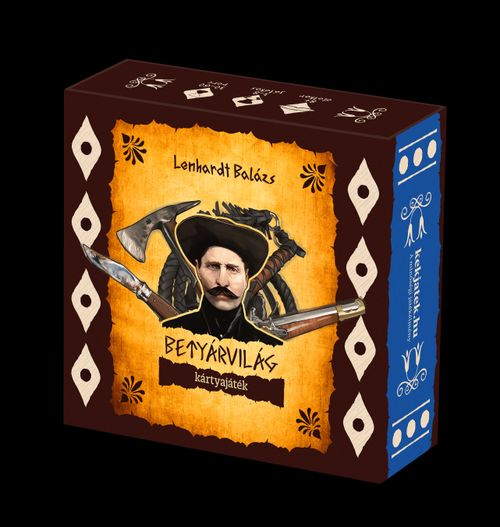
Betyárvilág
Betyárvilág Rulebook
Table of Contents
Table of Contents
Goal
Players each take on a well-known outlaw (betyár) who was a real character in nineteenth-century Hungary, and compete against one another to earn Virtus Points (VP). The goal of the game is simple: the player with the most VP at the end wins.
Deck Size
The length of the game depends on the size of the deck: the more cards in it, the longer it lasts. For the ideal playing time we recommend the following quantities, though you are of course free to decide how many cards to play with:
- 7–8 players: the full deck (120 cards)
- 6 players: 105 cards
- 5 players: 90 cards
- 4 players: 80 cards
- 3 players: 70 cards (the starting deck)
Shuffle the full deck, randomly choose this many cards, and set the rest aside.
Important: The hand limit is 10 cards. If you have more than that in your hand, at the end of your own turn you must discard down to ten.
Gameplay
Each participant chooses a character, or the players randomly assign the outlaws among themselves. Every outlaw has its own unique ability, and these are known to everyone. It is worth reading them aloud before the game begins so that everyone knows what they are.
Each player is dealt 7 cards at the start. The starting player is the one with the most misdeeds on their record. Play proceeds clockwise.
On your turn you may perform 2 actions from the following options, including the same option twice:
Drawing Cards
- For 1 action, you may draw 1 card from the draw pile.
- For 2 actions, you may take 3 cards from the draw pile.
Furthermore, if before drawing you play a Steed action card (Paripa), which grants an extra action, then for a total of 3 actions you may draw 5 cards.
The maximum number of cards you can draw in one turn is 5. Even if you could have more than three actions (for example by playing several Steeds), you still may not draw more than five cards.
Nothing prevents you from splitting your drawing into stages, for example drawing one card, then two more, if you do not want to play the first one.
Playing Cards
Some cards have a text ability and may be played for an action. Carry out their effect, then place them on the discard pile. With your two actions you may play up to two cards in one turn.
Brawling
Outlaws challenge one another to a manly brawl in order to win Virtus Points (VP). The challenging outlaws take up weapons, and the brawl is settled by the rules of rock–paper–scissors, which are detailed below. For one action you may start one brawl, so you may start up to two brawls in one turn if you have the actions. You may only challenge opponents whose character sheet is not turned face down, because that player is busy licking their wounds.
The player whose turn it is points at the opponent they wish to fight.
The challenged player may decline the duel. In that case the challenger gets 1 VP, and blindly draws one card from the other outlaw's hand. If the challenged outlaw has no weapon, they must decline the duel. If it turns out that someone cannot place a weapon (this also applies to the challenger!), they suffer a penalty of −2 VP and lose one card.
If the challenge is accepted, then before the fight the outlaws may offer each other brandy (pálinka), since whoever is a real lad stands his round.
Brandy (Pálinka)
The challenger may first offer the other outlaw one, two or three brandies, which cannot be refused. The challenged outlaw may then offer back one, two or three brandies in return. Until one of them has received three brandies, they may keep offering alternately, up until the point when they announce that they will give the other no more brandy. Then the brandies each outlaw has drunk are counted, and the effect is applied:
- 1 brandy: Secretly show the opponent which weapons you have.
- 2 brandies: You must play your weapon openly, and the opponent then places theirs.
- 3 brandies: The other outlaw has got drunk and is unfit to fight.
If both sides have drunk 2 brandies each, the brawl proceeds exactly as normal: each simultaneously reveals one weapon.
Important: If one outlaw has received 3 brandies in total, the duel ends immediately, because that outlaw is drunk and can no longer fight. In this case the winner gets 2 VP, and may also draw one more card from the drunk player, exceptionally being allowed to look at which card they take.
If the drinking is over and nobody has got drunk, or neither side has offered the other any brandy, then the real brawl begins. Both sides choose one weapon from those in their hand, and then reveal them at the same time. (An outlaw with no weapon cannot accept the challenge and must decline it at the start. In that case the challenger gets 1 VP and may draw one card from the challenged outlaw.)
Weapons work similarly to rock–paper–scissors: the hatchet (fokos) beats the knife (bicska), the knife beats the pistol (pisztoly), and the pistol beats the hatchet. The ringed whip (karikás ostor) beats everything, meaning it beats all other weapons.
The winner of the brawl gets 2 VP and may draw one card blindly from the loser, who may console themselves with 1 VP. If both used the same weapon, it is a draw and both gain 1 VP.
After the clash, the brandies and weapons that were played go to the discard pile. The loser of the duel may turn their character sheet face down, where it remains until their next turn comes around. This is not compulsory: they may remain fit to fight if they feel they were simply unlucky. But if they have no weapons left, it is strongly recommended that they turn the sheet face down. If the challenger was the loser and still has an action remaining, they may start a new brawl, even against the same opponent.
Ending the Game
The game lasts until one of the players draws the last card from the draw pile. That player finishes their turn, and then one final round begins, in which everyone gets one more turn. The discard pile is then reshuffled, except for its top five cards, so that everyone can still draw from it if they wish. When the turn comes back to the player who drew the last card, the game ends after their two actions.
Everyone reveals the treasures they have collected and adds them to the Virtus Points gained during the game. The outlaw with the most points wins! If two notorious outlaws are tied, the winner is the one who gained more points without counting treasures.
Team Play
It is also possible to play in teams when there is an even number of players. In that case the players are split into two groups, and the two bands fight against each other. The rules are exactly the same as in the base game, and outlaws have no special rights with respect to their teammates. Teammates may also challenge one another to a brawl, but at the end their points are added together, and the team with more VP wins the game.
Special Cards
Who Is the Lad in the Tavern? (Ki a legény a csárdában?)
One of the most exciting cards in the deck is a public call to every outlaw to take part in a shared brawl:
- The player who plays this card becomes the challenger. They ask every player in turn whether they will take part in the brawl. Anyone who does not commit to it may have one card drawn blindly from them by the challenger. If an outlaw has no cards in hand, they are not part of the brawl, and no card can be drawn from them.
- A player whose character sheet is face down cannot have a card drawn from them, but may choose to take part.
- If an outlaw has no weapon, or only a few, they may risk taking part, but can easily lose VP.
- The challenger first places a weapon face up (a whip may not be placed). The next participant must beat it by placing the weapon that defeats it (for example a knife over a hatchet), or place any two weapons (which may include a whip!). Those cards go to the bottom of the played cards.
- In that case the next player must place the same weapon that the previous player could not beat (so the earlier card stays on top), but they too have the option of placing any two weapons. For example, if a pistol is on top, the next player must place a knife (or any two weapons), and the pistol remains on top until someone places a suitable card on it. Whoever placed two other weapons naturally stays in the contest.
- If an outlaw cannot place any weapon at all when the turn first comes to them, they not only drop out of the brawl but also lose 2 VP.
- The outlaw whom nobody beats with their weapon (or weapons, if they placed two) wins the brawl, and receives VP equal to the number of participants, but at least 4 VP, even if only the challenger took part. Whoever placed as the second-to-last player receives 2 fewer VP, but everyone who placed at least one weapon receives 1 VP each. The outlaw who could not place any weapon at all loses 2 VP, as described above.
Steed (Paripa)
A real outlaw's life is unthinkable without a horse, so in the game too it is important what the outlaws can leap onto when they are in a hurry. A steed grants +2 actions in the turn in which it is played. This means that you can spend 3 actions in total, since playing the card itself takes one action. You may of course play several steeds in one turn, and it is not compulsory to begin with one.
Flask (Kulacs)
Outlaws were always thirsty, so most of them always had a wine flask (boroskulacs) to hand, usually covered in goatskin (csikóbőr). A flask costs one action: you lay it in front of you face up. During a brawl you may offer your opponent a drink from it; this works just like brandy, except that afterwards the card is not placed on the discard pile, but taken back into your hand. You may have at most one flask laid in front of you, since outlaw honour does not accept owning two flasks.
Important: No one may look through the discard pile, not even when someone places four cards on it as the effect of a Pipe (Pipa).
Cave (Barlang)
How long could an outlaw stay free if they did not have a secret hideout?!
The cave is where they keep their supplies, and even their stolen goods. Playing this card costs one action, and afterwards you may place, face down, at most 2 cards into it. One of them may only be a treasure, and the other must be something else, but you may not place any weapon there at all, since what sort of outlaw would not keep their weapons on them?! Things placed in the cave cannot be drawn from you, and they do not count toward your hand limit. During your own turn you may freely rearrange the items in your cave on the table, subject to the rules above, and this does not cost an extra action. Each outlaw may have only one cave placed on the table.
Priest (Plébános)
Before the priest even the most hardened villain confessed their sins, all the more so before their death. When you play a priest, you may look at all the cards held in one player's hand (you may not show these to anyone else). This costs you no action, because the card grants +1 action.
Magistrate (Szolgabíró)
The magistrate represented the law and order in the smallest settlements, and outlaws had reason to fear them. The player who plays this card may take 1 VP from the player who currently has the most VP, and place it among their own. If several players have the same, highest amount, the player may decide from whom to take it. But if the player playing the card has the most VP themselves, they cannot use the card.
Treasures (Kincsek)
Outlaws too had to make a living from something, so they robbed money, horses, cattle, food, or the occasional nobleman held for ransom. In the game these valuable spoils are called treasures; they are marked with a gold inscription, and often decide who wins the game at the end. Treasure cards cannot be played: they must be kept in hand until the end of the game, which carries the risk that they may be taken from you when you lose a brawl. Only the cave can offer protection against this, and even there you can store at most one treasure.