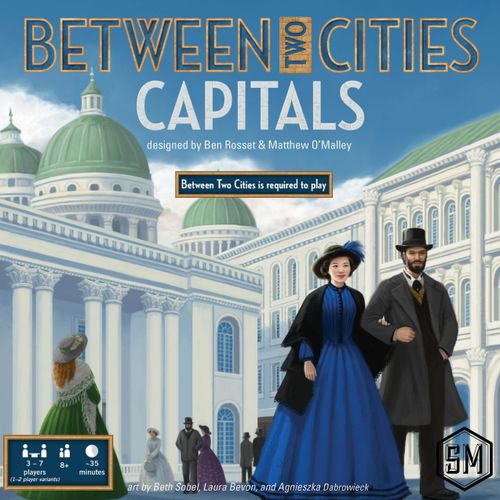
Between Two Cities: Capitals
Between Two Cities: Capitals Rulebook
Table of Contents
Table of Contents
Overview
Between Two Cities: Capitals expands the base game by adding several new challenges: landscape mats, districts and municipal buildings.
We recommend that all players learn the base game before adding this expansion.
The components of this expansion are largely modular, so you may combine them in any way you like. However, if you use the landscape mats with 5 or more players, add municipal building tiles so that everyone has enough tiles.
Components
- 7 landscape mats
- 7 district cards
- 21 municipal building tiles
- 3 district scoring tiles
- 7 pairs of city tokens (14 tokens)
- 7 player reference cards
Component key from the rulebook's illustration:
- A. Landscape mats (7 total)
- B. District cards (7 total)
- C. District scoring tiles (3 total)
- D. Municipal buildings (21 total), shuffled together with all building tiles
- E. City tokens (14 total)
- F. Player reference cards (7 total)
Setup
Setup with this expansion is the base game setup, plus the following changes:
- Shuffle all municipal building tiles together with the building tiles from the base game.
- Place 1 landscape mat for each city location (between players), so that its arrow points toward the center of the table.
- Place the 3 district scoring tiles in the center of the table.
- Place 2 random district cards above each of the 3 district scoring tiles, forming 3 pairs of district cards. Discard the remaining (seventh) district card.
- Exception: If one of the pairs is a "house-factory" pair, discard the second card of that pair and replace it with the seventh district card.
Translator's note: the source prints a "7" before "district card" in these two steps. It is read here as "the seventh (remaining) district card", which is the only card left over after three pairs of two are dealt from seven cards.
Example of setup for three districts: the illustration shows three district card pairs, each placed above its district scoring tile (9 and 3, 8 and 4, 7 and 5 points).
Dealing tiles. In the 1st and 3rd rounds, players now take 9 building tiles into hand instead of 7 as in the base game. As a result, there is one additional turn in the 1st and 3rd rounds. In the end, your city will consist of 20 built spaces instead of 16 as in the base game.
Landscape Mats
Each landscape mat depicts the natural areas within a city: a section of 5 landscape spaces that may not be built on. At the end of the game your city will form a 5x5 square, not the 4x4 square of the base game.
You may not place a tile in a way that would prevent your city from forming a 5x5 square. A landscape mat must lie entirely within the boundaries of the 5x5 city square. Remember that the landscape mat is placed with its arrow pointing toward the center of the table.
Illustration: two landscape mat placements are marked "Allowed". A third placement, where the mat extends beyond the 5x5 city square, is marked "Not allowed".
Bridges. Tiles placed next to bridges are considered adjacent for scoring and placement. For example, if a house and a factory are placed on opposite ends of a bridge, they are considered adjacent. City residents do not want to live next to factories, so such adjacency means the house scores only 1 point.
Illustration: a house placed across a bridge from a factory scores only 1 point because it counts as adjacent to the factory.
The first building tile in a city must be placed on an open landscape space on the landscape mat. Other building tiles must be placed so that they touch at least 1 previously placed tile, as in the base game.
Illustration: if the first tile is placed in a pink space, as shown, the yellow spaces mark the possible positions for the second tile.
Shop scoring. Shop scoring is unchanged from the base game. Five shops in a row score 18 points (a row of four shops scores 16 points, plus 2 points for the additional shop).
Districts
Each pair of district cards represents a district that the residents want to see in their city. Each game of Between Two Cities: Capitals has three districts.
Districts are areas of the city made up of connected tiles of these types. To score, a district does not need to contain buildings of both types. Only the largest district of each type is scored in each city.
Illustration: the city shown has an "office-shop" district of 9 tiles (green), a "factory-park" district of 3 tiles (pink) and a "house-tavern" district of 2 tiles (orange).
Scoring. District points are counted at the end of the game, after points for individual tiles have been scored. Each district scoring tile shows the number of points for that district. For each district type, the city with the largest district of that type scores the first-place points, and another city with the second-largest district scores the second-place points. The same city cannot score both first-place and second-place points for one district.
Ties for first place. If two or more cities tie for first place in a district, add the first-place and second-place points together, divide them evenly among the tied cities, and round down. For example, if three cities tie for first place, each city receives 4 points. If there is a tie for first place, no city receives second-place points.
Ties for second place. If two or more cities tie for second place in a district, the tied cities divide the second-place points evenly, rounding down. For example, if two cities tie for second place in a district that gives 5 points for second place, each city receives 2 points.
Scoring example. The illustration shows four cities and three districts.
- District 1 (9 points for first place, 3 for second): City 1 scores 9 points for first place with a district of 9 tiles. City 2 scores 3 points for second place with a district of 4 tiles.
- District 2 (8 points for first place, 4 for second): City 3 scores 8 points for first place with a district of 9 tiles. Cities 1 and 4 each score 2 points, sharing second place for districts of 3 tiles.
- District 3 (7 points for first place, 5 for second): City 4 scores 7 points for first place with a district of 5 tiles. City 1 scores 5 points for second place with a district of 2 tiles. City 4 also has a second-largest district of 4 houses at the top left, but each city scores only for its largest district.
Municipal Buildings
Municipal building tiles score points at the end of the game, like other building tiles. Each municipal building tile shows 2 types of positive tiles, which help the municipal building if they are next to it, and 1 type of negative tile, which harms it if it is next to it. These types differ for each municipal building tile.
At the end of the game, check each municipal building and score each one separately, using this algorithm:
- If it is not next to any "+" or "–" type tile, it scores 1 point.
- If it is next to only one "+" type, it scores 3 points.
- If it is next to both "+" types, it scores 6 points.
- If it is next to a "–" type, it scores only 1 point, regardless of the other tiles around it (like a house next to a factory).
For example, the residents want the Elementary School to be located near parks and houses, but not next to taverns. The illustrations show examples of scoring for the Elementary School, which scores 1 point, 3 points, 6 points and 1 point in the four examples. The tile's printed key shows the point values 1, 3 and 6, the two "+" types and the "–" type.
When scoring municipal buildings, it does not matter if the building is placed next to several tiles of one "+" type. For example, the Elementary School scores only 3 points even if it is placed next to two houses but no parks, and 6 points even if it is next to two parks and two houses.
Scoring houses. Municipal buildings are not counted as a separate building type when scoring houses.
City Tokens
Below are all the city tokens from the standard game, the special edition, and various promotional materials from conventions and regional editions. The tokens give each city a thematic identity and link it to the scoring board.
- Pyramids: Cairo, Egypt
- Colosseum: Rome, Italy
- Gateway to the West: St. Louis, Missouri, USA
- Taj Mahal: Agra, India
- Eiffel Tower: Paris, France
- St. Philip's Cathedral: Birmingham, England
- Golden Pavilion: Kyoto, Japan
- Harbor Bridge: Sydney, Australia
- Triumphal Arch: Paris, France
- Forbidden City: Beijing, China
- Sagrada Familia: Barcelona, Spain
- White House: Washington, USA
- Capitol: Washington, USA
- Brandenburg Gate: Berlin, Germany
- St. Basil's Cathedral: Moscow, Russia
- County Courthouse: Dallas, Texas, USA
- Rialto Bridge: Venice, Italy
- Tantrum House: Greer, USA
- Hotel Handelshof: Essen, Germany
- Namdaemun: Seoul, South Korea
- Temple of Heaven: Beijing, China
- Himeji Castle: Himeji, Japan
- World War Memorial: Indianapolis, USA
- Big Ben: London, England
Summary of Rules
Setup. Shuffle the municipal building tiles together with all the other tiles. Lay out the landscape mats, pointing toward the center. Add 2 district cards to each district scoring tile (a "house-factory" pair is not allowed).
Gameplay. In the 1st and 3rd rounds, take 9 tiles. The city square is 5x5, including the landscape spaces. The first tile must be placed on an open landscape space. Tiles on the two ends of a bridge are adjacent.
Shop scoring. Five shops in a row score 18 points.
Districts. Adjacent areas of tiles of one or both types form a district. Only the largest district of each type in a city scores points.
Municipal buildings. Score 1 point if the building is not adjacent to any "+" or "–" type, or if it is adjacent to a "–" type (even if there is also a "+" type). Score 3 points if it is adjacent to one "+" type. Score 6 points if it is adjacent to both "+" types.
Scoring houses. Municipal buildings are not counted as a building type when scoring houses.