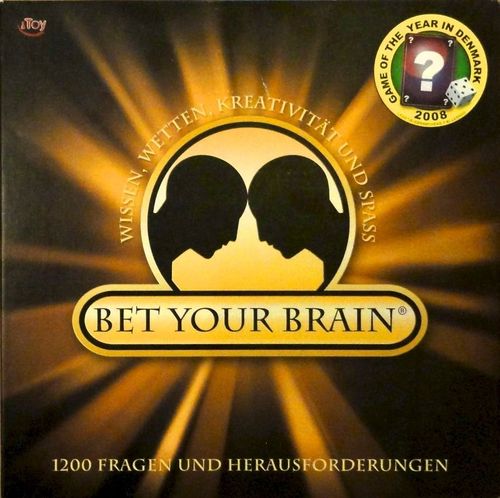
Bet Your Brain
Bet Your Brain Rulebook
Table of Contents
Table of Contents
Goal of the Game
The first player who fills their knowledge account with 23 knowledge points wins the game. Knowledge points are gained by answering questions correctly or by solving tasks, and by betting correctly on the knowledge of the players in the eight knowledge categories and task areas.
Preparation and Game Setup
- If you want to play in teams, form two, three or four teams.
- Place the game board and the hourglass on a table.
- Shuffle the question and task cards thoroughly and place them ready in the card compartments of the card insert.
- Each player receives a notepad and a pen.
- Each player chooses a colour and receives all the knowledge points and the five link stones numbered 1, 2, 3, 4 and 5 in that colour. Each player also receives one bet marker with a green tick and one bet marker with an orange cross.
- Stack the 12 credit points.
- The game board has a marked area where the knowledge points of the bank, or the points won, are placed.
- Each player places 20 knowledge points into the bank (the left half) and three knowledge points into the knowledge account (the right half) of this area. The bet markers are placed in front of each player. The five link stones are placed on the link field.
- Each player has a bet field of their colour on the game board and five link fields marked with the letters A, B, C, D and E, which are used to link answer options.
Rules of Play
1. Category Selection
The oldest player turns the arrow so that it makes at least one complete revolution, and thereby selects a category. Play proceeds clockwise. Each player comes up in turn after the other, regardless of whether the previous task was solved or the question was answered.
2. Bet
As soon as the category is known, all players place their bets. The player whose turn it is places one, two or three knowledge points on whether they can answer the question correctly. They do this by taking the number of knowledge points they want to bet from their knowledge account and placing them on their bet field.
At the same time, all other players place one, two or three knowledge points on whether the player whose turn it is can answer the question correctly or not. They do this too, by taking the corresponding number of knowledge points they want to bet from their own knowledge account and placing them on their bet fields.
Together with the knowledge points, all other players also place one of their two bet markers on the bet field. They choose the bet marker with the tick if they trust the player to know the solution, or the bet marker with the cross if they do not trust the player to know the solution. The bet marker is placed with its back side up, so that the other players cannot see what was bet on.
3. Question or Task
One of the players takes a card of the category the arrow points to and reads the corresponding question or task aloud. Care should be taken that nobody can see the back of the card, where the correct solution is shown. This is very important, because there are also tasks that must be solved together. As soon as the question or task has been read aloud, the hourglass is turned over. The question must be answered before the hourglass has run out.
The question or task is written on the front of the card and the answer on the back. If the question refers to the back of the card, only the player who has to answer the question may look at the back. Some cards also show one or more symbols on the front. A description of these symbols can be found under "List of Symbols". The symbols decide whether it is a question or task that must be solved by all players at the same time, or whether additional points can be won. For 2 questions on one card without a symbol, please choose one.
4. Settlement of the Bets
If a player wins their bet, all the knowledge points placed are returned to the knowledge account. In addition, the winnings from the bet, the same number of knowledge points as the bet, are taken from the bank and placed in the knowledge account.
If a player loses their bet, all of their placed knowledge points are handed over to their bank. If a player has lost all of their knowledge points, i.e. the knowledge account is empty, they must borrow three credit points. More about borrowing credit points can be read under "Credit Points".
5. The Next Player Is Up
6. The player who first fills their knowledge account with all 23 knowledge points wins.
The game also ends if the knowledge account of a fellow player is empty and they have already received three times three credit points. In this case the player who has the most knowledge points in their knowledge account at that moment wins the game!
We wish you lots of fun!
List of Symbols
EVERYONE AGAINST EVERYONE - The Most Correct Answers
With this symbol every player plays against every other player, i.e. all players bet that they can answer the question correctly themselves. The bet amount cannot be changed any more, but the bet marker is removed.
If the most correct answers count, the hourglass is turned over twice. As soon as the time has run out, the most correct answers are evaluated.
The answers must be noted on the notepad. To avoid that all possible answers are written down at random, the number of accepted answers is determined as follows:
When counting the answers, the number of wrong answers is subtracted from the number of correct answers - the result is the number of accepted answers. If several players have the same number of accepted answers, they all win their bet. However, you must have at least one accepted answer to win your bet.
EVERYONE AGAINST EVERYONE - The Fastest
With this symbol every player plays against every other player, i.e. all players bet that they can answer the question correctly themselves. The bet amount cannot be changed any more, but the bet marker is removed.
The player who answers the question correctly first wins their bet. The correct answer must be given before the hourglass has run out.
EVERYONE AGAINST EVERYONE - Estimation Question
With this symbol every player plays against every other player, i.e. all players bet that they can answer the question correctly themselves. The bet cannot be changed any more, but the bet marker is removed.
As soon as the time has run out, the answers are checked to see who gave the best estimate. The answer must be noted on the notepad. If the estimates of several players show the same difference, or the correct answer was noted, they all win their bet.
SPECIAL KNOWLEDGE POINT
With this symbol the player concerned has the opportunity to win an additional knowledge point from the bank (in addition to their bet) by answering the additional question correctly. Both questions must be answered before the time runs out.
The player only gets the opportunity to answer the additional question if the main question is answered correctly, or if a contest "everyone against everyone" is won.
BEFORE THE YEAR 2008
The question refers to events that took place before the year 2008.
Special Notes
Team Questions
Some questions only make sense when played in teams. These questions are marked by requiring at least two people (e.g. for drawing tasks) to complete the task.
If the game is not played in teams, these questions are skipped and a new card of the category is taken instead.
Linking Answer Options
Some question cards contain several possible answer combinations, which must be linked accordingly. These questions are answered by placing the link stones 1, 2, 3, 4 and 5 next to the link fields A, B, C, D and E on the game board, thereby linking answer combinations. An example of this is A2, B4, C1, D3 and E5.
Drawing Tasks
If a question contains a drawing task, no letters, numbers or symbols may be used.
If the player has to draw something on the basis of a specific requirement from the back of a card, they must write on a separate sheet of paper what they have drawn, to prove what was really drawn. When the player's team has finished guessing and has written next to each drawing what they think it shows, this is compared with what was written on the separate sheet of paper.
Drawing tasks are only relevant when the game is played in teams. If the game is not played in teams, the question is skipped and a new card of the relevant category is taken instead.
Empty Card Back
Some card backs contain no answer on the back. In these cases the players must decide together whether an answer is correct and can be accepted.
Credit Points
If a player has lost all the knowledge points of their knowledge account, they must take three credit points.
If a bet is won that was placed with credit points, the winnings are paid out of the bank and the credit points placed are returned. If, for example, only one credit point was placed, only this one is returned, while the others are returned once three of the player's own knowledge points are on the knowledge account.
If the bet is lost, the credit points placed are returned.
As long as there are still credit points on the knowledge account, they must be used for the bets.
A player can receive at most three times three credit points during the whole game. This can also happen three times in a row. During the game a player keeps a record on their notepad of how many credit points each player has received. If the knowledge account of a player is empty for the fourth time, the game ends. The player who has the most knowledge points on their knowledge account at that time wins the game.
Categories
The printed category key lists each category with its coloured dot:
- Sport & Anatomy - athletes, sports, sports equipment, sporting events and anatomy.
- Around the Globe - geography, biology, physics, chemistry and astronomy.
- Famous and Infamous - history, religion and classical civilisation.
- Mystery Bag - everything else, such as mathematics, writers, food, cars, toys, animals and countries.
- Film & Television - films and television, actors and actresses.
- Creativity - drawing and writing tasks.
- Music & Culture - music, musicians, instruments, books, authors and sights.
- Word Power - linguistics and the meaning of words.