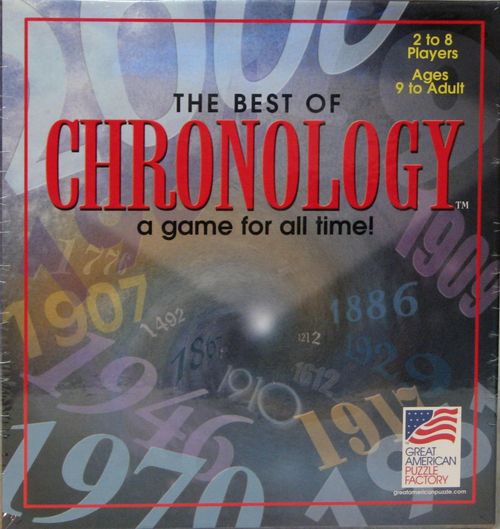
The Best of Chronology
The Best of Chronology Rulebook
Table of Contents
Table of Contents
Contents
- 548 question cards
- 8 time locks
- 1 color die
- rulebook
Setup
All players get their own time lock in three pieces, which you puzzle together and place on the table in front of you. Sort the cards into four piles by category color and shuffle each pile separately. Place the piles next to each other in the middle of the table, black-and-white side down.
The card categories and their colors are:
- Red: Inventions & Discoveries
- Yellow: History
- Pink: Art & Entertainment
- Blue: Sports
Players take turns drawing one card from a category of their choice and reading it aloud. This card is each player's starting card. Place the card below your time lock with the black-and-white side facing up.
How to Play
Choose who goes first. Play then continues to the left.
The first player rolls the die. Its color decides the category.
If the die shows white, you may choose the category. If the die shows black, the card reader chooses the category.
The card reader is always the player sitting to your right when it is your turn to answer. The card reader takes a card from the pile of the chosen category and reads it aloud without revealing the year. You must now decide whether the event on the card happened before or after the year on your own starting card. Before the year 1700, the time of the event on the card is given by decade — for example "the 1210s" — rather than an exact year, since it can be difficult to date an event to an exact year.
If you answer correctly, you get the card and place it above your time lock, to the right or left of (before or after) your starting card. Extra information about the question is printed in italics at the bottom of the card. It is read aloud voluntarily after you have answered.
You then continue rolling the die to decide the category again. The card reader takes a card from the pile of the current category and reads the card aloud without revealing the year. You now decide whether this card should be placed before, after, or between the cards already laid out (both above and below your time lock). If you answer correctly you place the card in that position above your time lock.
After every correct answer you may choose to keep playing or to secure the cards you have won and pass your turn to the next player. You must decide this before you roll the die.
If you choose to secure your cards, place them below your time lock, arranged in chronological order. Cards you have placed below your time lock can never be lost.
If you answer incorrectly you lose all the cards above your time lock (they are removed from the game). The same card reader reads the card aloud again, and the next player whose turn it is now has the chance to answer correctly and win the card for their own timeline. If that player also answers incorrectly, the card passes to the next player, and so on. The card keeps going around the table until someone answers correctly — even the player who first answered incorrectly gets another chance when it is their turn again. The player reading the card may not answer. The year may therefore never be revealed until a player succeeds in placing the card correctly.
Whoever wins the card this way places it directly on their timeline below their time lock, and the round then ends. The new card reader becomes the player to the left of the previous card reader.
If only two players or teams are playing, a missed card does not pass on. On an incorrect answer, the turn goes to the other player or team, who rolls the die, and so on.
A card you are guessing on may sometimes have the same year as a card already on your own timeline. In that case it does not matter whether the card is placed before or after that card on your timeline — both answers count as correct.
Who Wins?
The player or team that first builds a timeline of ten cards in the correct chronological order wins the game.