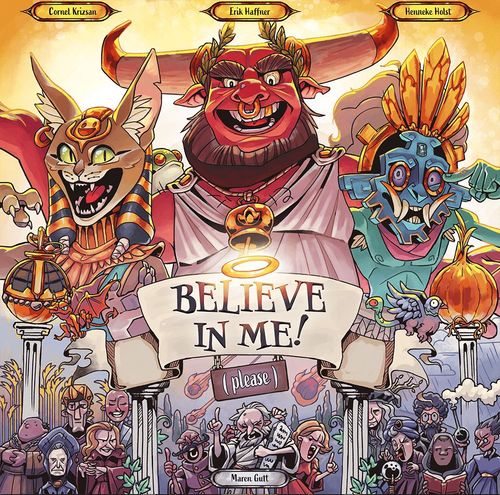
Believe in Me! (Please)
Believe in Me! (Please) Rulebook
Table of Contents
Table of Contents
Game Components
Make all this stuff subservient unto thee. And lo, the Lord created the meeple in His own image. Punching out, sorting, and lovingly caring for the game components is the highest virtue of any god.
1x Mountain of Commandments (exclusive to the "Divine Edition"). Assemble with love, using the instruction page in the box.
24 Tokens
- 4x False Prophet tokens
- 4x Nun Temples
- 16x Alignment tokens: 4x Wrathful, 4x Gentle, 4x Chaotic, 4x Unfathomable
- 25x Commandment tokens
Tokens and Dice
- 140x Believers (small meeples with great devotion)
- 1x Cube of Chaos
- 1x Start Squirrel
- 1x False Prophet figure
Game Boards
- 4x God tableaus
- 1x Main board (3 parts)
210 Cards
- 25x Commandments
- 69x Heavenly Realm cards: 14x Enlighteners, 16x Holy Host, 18x Relics, 21x Blessings
- 18x Phenomena
- 18x Monuments
- 9x Holy Hand Grenades
- 27x Trinity cards (3 stacks of 9): 9x Chaotic, 9x Gentle, 9x Wrathful
- 4x Cheat sheets
- 40x Truth cards (9 per god + 4 extra 6s)
Game Setup & Preparation
Divine Craftsmanship. The table is your temple. Smooth your robes, adjust your throne, and transform the table into your battlefield! At the beginning, all players stand as equals, but soon enough there shall be much smiting and contesting, until only one of you wears the crown.
Gods and Fellow gods. All players and fellow players shall be called gods and Fellow gods from now on. But don't get too full of yourself!
1. Prepare Game Materials
- Place the Main board within easy reach in the middle of the play area.
- Shuffle all Phenomena and place them face down (Phenomena draw pile).
- Shuffle all Heavenly Realm cards (Blessings, Enlighteners, Holy Host, Relics) into a general draw pile and place it face down (General draw pile).
- Sort the Monument cards into separate decks by Monument. Randomly take one more deck than there are gods and shuffle them into a pile.
- With 2 gods = 9 cards
- With 3 gods = 12 cards
- With 4 gods = 15 cards
- Place this pile on the Main board (Monument pile).
- Shuffle all Commandments and place this pile face down on the Main board (Commandment draw pile).
- Place the False Prophet next to it. He will enter play later.
- Set up the Mountain of Commandments and place it on a fitting space (Active Commandments). At the start of the game, there are no Commandments on it. Place the Commandment tokens stacked in front of it.
- Sort the Trinity cards by Alignment (Gentle, Wrathful, Chaotic). Shuffle each pile and place them face down separately.
- Sort the Alignment tokens (Gentle, Wrathful, Chaotic, Unfathomable) and place them next to the Trinity cards.
Main board key: 1 Phenomena draw pile; 2 Phenomena contest slot; 3 Phenomena discard pile; 4 General draw pile; 5 General discard pile; 6 Monument pile; 7 Commandment draw pile; 8 Commandment discard pile; 9 Active Commandments; 10 Mountain of Commandments; 11 False Prophet figure; 12 Trinity cards; 13 Pagan pile; 14 Alignment token.
2. Believers & Pagan Pile
- Place all Believers in the center. This is the Pagan pile.
- Place 10 Believers from the Pagan pile into your supply.
3. Each God Receives
- 1 God tableau.
- 9 personal Truth cards: 2, 2, 2, 3, 3, 4, 5, 6, 7. The cards have eye markings in the top right corner to help you distinguish them better. These cards form the personal draw pile and are placed face down on your God tableau. There should be 4 Truth cards with a value of 6 without an eye marking remaining. Set them aside; they will become relevant during the game.
- 1 unfathomable Alignment token.
- 2 random Holy Hand Grenades. Choose one and place it face down in the Holy Hand Grenade slot. Put the other one back into the box.
- 6 cards in your hand: choose 2 Truth cards from your own draw pile and 4 random Heavenly Realm cards from the general draw pile.
- 1 Cheat sheet.
God tableau key: A False Prophet token; B Twilight of the Gods/Nun Temple token; C Enlightener slot; D Holy Hand Grenade slot; E Alignment; F Head; G Torso; H Legs; I Monument slot; J Relic slot; K Phenomenon slot; L Personal draw pile; M Personal discard pile; N Cards in hand; O Believer supply; P Cheat sheet.
4. Determine the Starting God
- Each player mumbles a short prayer in an incomprehensible language.
- The one who most recently entered a holy site receives the Start Squirrel. If in doubt, settle it like civilized gods. Fireballs are not an option!
Round Overview
Sunday, Bloody Sunday... Even deities need structure. Otherwise it's just smiting, singing, and awkward small talk with squirrels. You may perform godly actions and by heavens, you'll make them look like miracles. But beware: the devil is in the details.
The god with the Start Squirrel always begins, followed by the others in clockwise order. After all gods have taken their turn as described in Phase 1: God turns, the Contest starts with Phase 2: Claiming a Phenomenon. Finally, the Start Squirrel is passed to the god on your left in Phase 3: Passing the Start Squirrel.
Goal of the Game
As soon as one god has manifested head, torso, and legs on their God tableau, the finale of the game begins (Twilight of the Gods). The completely manifested god with the most Believers wins the game.
The Divine Cycle
Phase 1: God Turns
Each god takes their turn in 3 steps.
Step 1: Resolve your God tableau. All effects currently on your God tableau or previously unlocked are activated in order:
- False Prophet (see page 11)
- Enlightener and Enlightener (see page 6)
- Alignment (see page 11)
- Monk Temple and Missionary Temple (see page 7)
- Relic and Relic (see page 6)
Step 2: Divine Actions (2 per turn). You normally have 2 Actions. (Some effects may change this.) You can choose the same Action multiple times. The following Actions are available:
- Play Heavenly Realm cards (see page 6)
- Temple Service (see page 7)
- Build Monuments (see page 9)
- Charge and optionally detonate Holy Hand Grenade (see page 9)
- Trigger a Phenomenon (see page 9)
- Banish the False Prophet (see page 11)
Step 3: Draw cards. Draw up to your current hand limit (6 cards in the beginning). The following rules ALWAYS apply:
| Card type | Draw rule |
|---|---|
| Truth cards | Maximum 2 cards. You choose them from your personal draw pile. |
| Heavenly Realm cards | Draw any number of cards from the general draw pile up to your hand limit. |
You may keep cards in your hand. You do not have to discard additional cards if you exceed your limit. It only matters when you draw cards! If a draw pile is empty, its discard pile is immediately reshuffled to form a new pile.
Phase 2: Claiming a Phenomenon
The gods compete for a revealed Phenomenon, and the winner receives rewards (see page 9). If this results in a god being fully manifested for the first time, the Twilight of the Gods begins (see page 13), and the end of the game is triggered (see page 14).
Phase 3: Passing the Start Squirrel
Pass the Start Squirrel to the fellow god on your left.
Divine Actions
Playing Heavenly Realm Cards
Order, zeal, and a touch of intimidation. Let blessings rain down, let the Holy Host crush Enlighteners into Relics, and hold an entire HEAVENLY REALM in your hand!
To play a Heavenly Realm card as an Action, place 1 card from your hand face-up in front of you. The effect of a Blessing or a Holy Host card is triggered. Afterwards they are placed on the general discard pile. Enlightener and Relic cards are placed on the dedicated slots on a God tableau.
Heavenly Realm cards consist of Blessings, Relics, Holy Hosts and Enlighteners.
- All Heavenly Realm cards are played as an Action (if possible).
- All played Heavenly Realm cards generate Truth in a Contest.
- At the end of the god turn you may draw Heavenly Realm cards up to your hand limit.
Search discard pile: Every god may only search through their own discard pile. All other discard piles are secret.
Sacrifice Costs
Sacrifice costs are paid with Believers. To do so, you must sacrifice Believers from your supply or from a location on your God tableau, hence returning them to the Pagan pile. If you cannot pay a card's Sacrifice costs, you cannot play that card. If Sacrifice costs caused by a fellow god (e.g. through Enlighteners, Blessings, the Cube of Chaos, etc.) cannot be paid, they are ignored.
The Different Types
Blessings. Heavenly help with an expiration date. And if it doesn't help, it still looks nicely. One-time effects which are placed on the general discard pile after they have been played.
- Some grant an Alignment bonus if the god playing them has the matching Alignment.
Relics. The deceased martyr from whom this relic originates gazes down from heaven. Yes, those are tears of joy! Permanent artifacts with special effects.
- Placed onto your divine hands on the God tableau (one left, one right) when you pay the Sacrifice costs.
- The right hand is initially locked until your torso is manifested.
- You may replace a Relic by paying the Sacrifice costs again. The old Relic is placed on the general discard pile.
Holy Host. Torture? We prefer to call it "assisted sensory memory recovery"! They allow you to discard Enlighteners from your God tableau.
- Can only be played as an Action if you are targeting an Enlightener.
- Counts as 3 Truth as long as your legs have not been manifested. Afterwards they count only as 1 Truth.
- You must pay the Sacrifice costs unless your Holy Host happens to match its favored Enlightener type.
Enlighteners. They ask inconvenient questions and, worse still, even know the answers. They hinder your fellow gods.
- Place them onto another god's God tableau when you have paid the Sacrifice costs.
- Their effects trigger when resolving the God tableau or at once.
- Each God tableau can hold a maximum of 2 Enlighteners at once.
- They can only be discarded from the God tableau by Holy Host cards. They are then placed on the general discard pile.
Temple Service
Those who pray don't sin. Now hiring: sacred specialists (equal opportunity employer). Monks sing, Missionaries convert, and Nuns know kung fu. With the right staff, a temple is a slick soul-catching machine. Results may be divine. Delivery included.
On your God tableau, you'll find three types of Temples where you can place Believers. All Temples are filled through Actions. You have to use Believers from your personal supply. These provide you with recurring effects when resolving your God tableau. Nun Temples can even strengthen you while claiming a Phenomenon.
Monks, Missionaries, and Nuns normally remain in their Temples until the end of the game and do not automatically return to your supply.
1. Monk Temple
Their singing is so pure, they run on bock beer.
- Place 1 Believer as an Action into a free slot of the Monk Temple, to transform them into a Monk. Monks still count as Believers.
- Each Monk illuminates 1 Believer from the Pagan pile when resolving the God tableau.
- Gentle gods may have up to 4 Monks (all others max. 3). If your Alignment changes and you are no longer gentle, move the extra Monk back to your supply.
2. Missionary Temple
They always convert in pairs: a master and his subordinate apprentice, with no prospect of employment after training.
- Place up to 2 Believers simultaneously as a single Action into a free slot of the Missionary Temple to transform them into Missionaries. Missionaries still count as Believers.
- When resolving your God tableau, your Missionaries convert 1 Believer from another god each round. Put him into your personal supply.
- Only a fully filled Missionary Temple is activated when resolving the God tableau.
3. Nun Temple
They fight for your faith, and for the sacred Veggie Wednesday.
Beware: Only available after the beginning of the Twilight of the Gods (see page 13).
- Place 1 Believer as an Action to place a Nun into a free slot of the Nun Temple, to transform them into a Nun. Nuns still count as Believers.
- In a Contest, you may sacrifice a Nun to double the lowest Truth card (only Truth cards, not Heavenly Realm cards!). Only 1 Nun can be sacrificed per Contest, even if both slots are filled.
- Only Unfathomable gods can fill both Nun slots with a single Action. If your Alignment changes and you are no longer Unfathomable, the second Nun immediately goes back to your supply.
Monks, Missionaries and Nuns are untouchable. They cannot be converted or sacrificed by fellow gods (except through card effects that state this explicitly).
Do temple believers count at game end? Yes! All Monks, Missionaries, and Nuns count as your Believers during final scoring.
Sacrificing temple believers? Yes! You can use your own Monks, Missionaries and Nuns at any time as Sacrifice costs, for example to pay for your Holy Host cards.
The Believers
Not all Believers are created equal. Sometimes they lose faith, sometimes only their lives.
Believers are depicted in three different colors within the rulebook or on the cards. The colors explain from where they are taken and where they are moved to:
| Symbol | Effect | Meaning |
|---|---|---|
| Believer (gold) | Illuminate | Moves from the Pagan pile to a god's supply. |
| Believer (red) | Sacrifice | Moves from a god's supply back to the Pagan pile. |
| Believer (green) | Convert | Moves from one god to another. |
Should the Believers in the Pagan pile ever run out, use a sufficient substitute.
Build Monuments
Build them from gold, and build them taller than the monuments of your fellow gods!
Monuments are three-part structures that immediately improve your personal draw pile and grant unique bonuses when placed on your God tableau. In the table below all possible improvements are listed.
- As an Action, draw 3 (or 4 if you are a chaotic god) Monument cards from the Monument draw pile and place one on your God tableau.
Mind the following rules:
- The first Monument is placed on the lowest Monument slot. Every new Monument card is placed one above.
- If you already have a Monument card on your God tableau, the next Monument you attach has to have the same name.
- You may start building a Monument that has the same name as a Monument a fellow god already built. Since there are only 3 Monuments of every name, no god can finish this Monument.
- You cannot replace or remove existing Monuments.
Then shuffle the remaining Monument cards back into the Monument draw pile.
Once you have a full set of 3 matching Monument cards, your Monument is complete. You gain its unique bonus.
| Monument card | Effect |
|---|---|
| First Monument card | Remove one Truth card with Truth 2. * |
| Second Monument card | Remove another Truth card with Truth 2. * |
| Third Monument card | Add one Truth card with Truth 6. ** |
* Return them from your hand, your discard pile, or your personal draw pile to the box.
** Take one of the set-aside Truth cards (without an eye marking) directly into your hand.
Holy Hand Grenade
"Count to three. Not two. And certainly not five." (Forgotten Apocrypha)
Holy Hand Grenades are a chargeable special card with an explosive one-time effect.
- At the start of the game, choose one of two Holy Hand Grenades and keep it secret. Place it face-down next to the upper right corner of your God tableau. You may look at it at any time.
- During the game, as an Action, you can place 1 Believer onto the Holy Hand Grenade slots of your God tableau, to charge it. Each time you decide whether to trigger its effect (detonate).
- When the third Believer is placed, the Holy Hand Grenade must be detonated.
- Its strength depends on the number of Believers invested. The example card Holy Hand Grenade of Evil Laughter #3 reads: with 3 Believers, destroy 2 stored Phenomena from any 2 fellow gods; with 2 Believers, destroy 2 stored Phenomena from any 1 fellow god; with 1 Believer, destroy 1 stored Phenomenon from any 1 fellow god.
- It cannot be recharged once it has detonated and stays on your God tableau.
- The Believers used remain on the God tableau even after detonation. They still count in the end scoring and CANNOT be used to pay Sacrifice costs.
Trigger a Phenomenon
You can use a Phenomenon on your God tableau as an Action by triggering its effect. Afterwards, the Phenomenon card is placed on the Phenomenon discard pile. See Phenomena (page 9).
Banish the False Prophet
You may play the False Prophet as an Action to send (banish) him to a fellow god and engrave a Commandment (see page 11). You then place the False Prophet figure on the False Prophet token of a fellow god of your choice.
Phenomena
Nobody knows why it happened. This is proof enough that I did it!
Phenomena are world events you want to claim for yourself. It's the central mechanism of the game.
- Phenomena are revealed in Phase 2 of the Divine Cycle.
- When you claim a Phenomenon, you may manifest a body part. Afterwards, you place the Phenomenon on your God tableau in a Phenomenon slot.
- You illuminate new Believers depending on your Alignment.
- They can be triggered once as an Action, then placed on the Phenomenon discard pile.
Truth Cards
Truth is what you make of it. And whoever makes the most truth is always right!
Truth cards form your personal draw pile for claiming Phenomena. At the start, your draw pile contains 9 Truth cards. All Truth cards show an eye marking in the top right corner.
- Truth cards can only be used in a Contest.
- At the end of the round, you may choose to draw up to 2 Truth cards from your personal draw pile.
- You may have more than 2 Truth cards in your hand.
- Their values range from 2 to 7.
- They may be removed or expanded through Monuments.
- As soon as the last card of your personal draw pile has been drawn, you immediately build a new face-down draw pile from your personal discard pile.
Each card generates a certain Truth value.
Claiming a Phenomenon
Truth is relative. And behold, it was good. For you. A lightning bolt strikes a tree? That was you. A comet streaks across the night sky? Obviously the physical manifestation of your divine imagination! You don't need facts, you need Truth. And preferably more of it than your competition. A well-timed "Amen!" can shake worlds, or at least show your fellow gods that your will is unwavering... and you know a bit of Hebrew.
When does this happen? After all gods have finished their turns, a new Phenomenon is revealed. For example, a tsunami, a lunar eclipse, or an unseasonably ambitious frog storm trying to organize itself into weather patterns.
How a Phenomenon Contest Works
1. Reveal the Phenomenon. The Starting god reveals the top Phenomenon card and reads it aloud.
2. Declare Truth, with cards and Amen. Only gods with a free Phenomenon slot on their God tableau may take part in the Contest.
- Starting with the Starting god, each god in turn places 1 card face down in front of themselves and says aloud, "Amen!"
- The Starting god MUST contribute a card to the Contest.
- If the Starting god is not allowed to take part, the next god must contribute a card to the Contest instead.
- If a god does not wish or is unable to contribute a (further) card to the Contest, they pass.
- Once a god has passed, they may not take part in the Contest any further.
- This continues in turn order until all but ONE god has passed. The remaining god may NOT add another card to the Contest.
3. Deploy Nun (optional). Starting with the Twilight of the Gods (see page 13): before revealing cards in a Contest, each god may sacrifice a Nun in turn order to double their lowest played Truth card.
4. Reveal & count Truth.
- All cards are revealed simultaneously.
- The Truth values of your revealed cards are added up.
- Apply modifiers:
- from Commandments, Relics, Enlighteners and Nuns. [Transcriber's note: the printed line carries no modifier value or sign; the value is not recoverable from the rulebook text and is not supplied here. Check the card's own printed effect.]
- +3 Truth bonus as long as the torso has not yet been manifested.
- Holy Host counts as 3 Truth as long as the legs have not yet been manifested.
The god with the highest Truth claims the Phenomenon!
Afterwards, all gods who have contributed at least one card to the Contest place their played cards face up on the appropriate discard piles: their own Truth cards onto their personal discard pile, and the Heavenly Realm cards onto the general discard pile in the center of the table.
In a 2-god game, both gods must contribute at least 1 card to the Contest. If only one god participates in the Contest, that god automatically wins. If no god participates or can participate in the Contest, the Phenomenon is discarded.
| Card type | Truth value |
|---|---|
| Truth card | Printed value (2 to 7 Truth) |
| Holy Host | 3 Truth (as long as Legs are not manifested). Afterwards: 1 Truth |
| Heavenly Realm card | 1 Truth |
5. Reward for the Winner
In case of a tie:
- The god with fewer Believers in their own supply and on their God tableau wins.
- Still tied? The god who contributed the last card to the Contest wins.
The victorious god:
- Illuminates Believers according to their Alignment.
- Places the Phenomenon onto a free Phenomenon slot on their God tableau.
- May manifest one body part of their Trinity (see page 11).
- With the first claimed Phenomenon, the False Prophet enters the game (see page 11).
Illumination rewards by Alignment:
| Alignment | Believers |
|---|---|
| Different from Phenomenon | 8 |
| Identical to Phenomenon | 5 |
| Unfathomable | 3 |
| Pure Unfathomable | 10 |
Example: a Gentle god claiming the Lunar Eclipse Phenomenon illuminates 5 Believers.
Phenomenon slots. A god can only place as many Phenomena as there are free slots on their God tableau. Wrathful gods can use one additional slot. AND: If all Phenomenon slots are occupied, you CANNOT participate in the Contest!
Gods with a completed Trinity, meaning 3 attached body parts, may still take part in a Contest, provided they have an empty Phenomenon slot. However, if they win the Contest, they do not receive another Trinity card. They can only illuminate Believers and place the Phenomenon on their God tableau.
The False Prophet
Thou shalt not contradict an old man with a matted beard! The False Prophet wanders from realm to realm, preaching strict Commandments that (according to him) were dictated personally by god. Unfortunately, he was entirely alone at the time, and no one can prove otherwise. He also reeked rather strongly of mysterious herbs and unknown mushrooms. But hey, if it's written on a stone tablet, it must be true......
When Does the False Prophet Appear?
- The False Prophet first appears as soon as the first Phenomenon has been claimed.
- All gods simultaneously flip their False Prophet token on their God tableau.
- Take the False Prophet figure and place it on the False Prophet token of the god who won the Contest.
Effect in the Game
From now on, the god who has the False Prophet must sacrifice 1 Believer when resolving their God tableau.
- They may use the False Prophet as an Action: name another god and send the False Prophet to them.
- The named god immediately places the False Prophet on their own False Prophet token and sacrifices 3 Believers.
- Then, the god who banished the False Prophet draws 3 cards from the Commandment pile, chooses one, reads it aloud in a thunderous voice, and "engraves" it prominently onto the Mountain of Commandments.
- Unchosen Commandments are placed on the Commandment discard pile.
If all 5 Commandments are already engraved, the False Prophet rests at the current god. As long as he rests, the False Prophet token is not resolved and he cannot be played as an Action. Only when a Commandment slot is available again, the False Prophet becomes active and is resolved at the God tableau again.
Commandments
- A maximum of 5 Commandments can be engraved.
- All gods must follow their rules and instructions.
- Once engraved, Commandments may not be replaced. (However, some effects can shatter a Commandment. It is then placed on the Commandment discard pile.)
- Commandments often target specific Attributes or Alignments.
- For better clarity, you can use the Commandment tokens. Put the corresponding Commandment token in front of you if the Commandment is targeting you.
- If the Commandment pile ever runs out, reshuffle all Commandments from the discard pile to make a new draw pile.
Commandment cards shown on the setup illustration. The Mountain of Commandments illustration on the setup page shows five engraved Commandments. Their printed text is reproduced here (the printed illustration is partly covered by the stone tokens; the text is taken from the card faces). The other Commandment cards are not printed in this rulebook.
- Covfefe (I): "Thou shalt not use the word "Covfefe", for it is an abomination to my ears." Lo, it is writ upon the stone: For all gods with Finery, Heavenly Realm cards count as 0 Truth in Contests.
- Bodily Winds (II): "Thou shalt not unleash thunderous bodily winds!" Lo, it is writ upon the stone: The Monks of all Gentle gods become inactive and illuminate no Believers.
- Food (III): "Thou shalt make no rude noises while eating." Lo, it is writ upon the stone: All gods with a completed Monument increase their hand limit by 1.
- Sneeze (IV): "Thou shalt sneeze into the crook of thine arm." Lo, it is writ upon the stone: All active Monk Temples of Unfathomable gods illuminate 1 additional Believer.
- Parents (V): "Honor thy Father and Mother as though they were thine parents." Lo, it is writ upon the stone: All gods without an Enlightener may not play Blessings.
Trinity & Alignment
Anatomy of a god. Manifestation for beginners. Body, mind, and legs. A god is nothing without their astral body. Laser eyes? Ravioli Ribs? Fish socks? You'll need all of them, because, as the saying goes, divinity is all about looks. But beware: the more complete your divine body becomes, the more transparent your intentions will be. Choose your Alignment wisely and adapt your tactics accordingly. Gentle, chaotic, wrathful, or will your ways remain unfathomable?
Manifesting Body Parts
When do you manifest body parts? Whenever you successfully claim a Phenomenon you may manifest one body part of your divine form. The body part is drawn from the Trinity pile of the corresponding Alignment of the Phenomenon. This is optional if, for example, you do not wish to change your Alignment. You still illuminate Believers and place the Phenomenon on your God tableau.
The body part ritual:
- Choose which body part you want to manifest: Head, Torso or Legs.
- Draw cards from the corresponding Trinity pile until you find the first matching body part.
- Manifest this body part face-up on the corresponding slot of your God tableau.
- Check if your Alignment needs to be changed (see page 10).
- Shuffle all non-matching cards back into the pile.
Effects when manifesting:
- You lose the bonus previously granted by that body part slot, since it is covered by the card from now on.
- You unlock a new permanent effect on the right side of your God tableau. These are marked with a lock icon.
Manifested body parts. A god can only manifest each body part once. Choose wisely!
Alignment: What Is This?
Your Alignment is Unfathomable, Gentle, Wrathful or Chaotic. It grants you different bonuses during the game and may change over the course of play (see page 11). Unfathomable is the default state at the start of the game!
How Is It Determined?
Your Alignment is determined by the majority of your manifested body parts. As soon as you receive your first Trinity card, your Alignment changes to Gentle, Wrathful or Chaotic. If you have 2 different Alignments, you return to being Unfathomable.
Example (body parts are the three Trinity slots: Head, Torso and Legs; icons as printed: flame = Wrathful, blue swirl = Chaotic, white flower = Gentle, white hook = Unfathomable):
| Body parts | Resulting Alignment |
|---|---|
| Wrathful | Wrathful |
| Wrathful + Wrathful | Wrathful |
| Wrathful + Chaotic | Unfathomable |
| Wrathful + Wrathful + Chaotic | Wrathful |
| Wrathful + Wrathful + Wrathful | Pure Wrath |
| Wrathful + Gentle + Chaotic | Pure Unfathomable |
Bonus of Body Part Slots
| Body part | Default | After manifestation |
|---|---|---|
| Head | You have a Truth 7 in your personal draw pile. | Your Truth 7 is removed from the game. Your hand limit increases to 7. |
| Torso | You automatically gain +3 Truth in Contests. | You lose your automatic +3 Truth. Your 2nd Relic hand is unlocked. |
| Legs | Holy Host cards count as 3 Truth. | Holy Host cards count as 1 Truth. Holy Host Sacrifice costs are reduced by 2 Believers. |
Alignment Effects (by Tokens)
As soon as you gain an Alignment, you receive the matching Alignment token with an effect that triggers when resolving your God tableau.
| Alignment | Effect |
|---|---|
| Wrathful | Sacrifice 1 Believer from another god. |
| Gentle | Illuminate 1 Believer. |
| Chaotic | Roll the Cube of Chaos. |
| Unfathomable | - |
If your Alignment changes, immediately exchange the Alignment token.
Pure God = 3 Identical Alignments
A god who possesses 3 body parts of the same Alignment becomes a Pure god. They flip their Alignment token and from now on gain a powerful new effect.
| Pure Alignment | New effect |
|---|---|
| Pure Wrath | After all Contest cards have been played, you force each fellow god to place 1 face-down card onto the respective discard pile. (Only if they played at least 2 cards.) |
| Pure Gentleness | You are immune to conversion (Missionaries) and the negative effects of Commandments. |
| Pure Chaos | You perform +1 Action on your turn. |
| The pure Unfathomable | When claiming a Phenomenon, illuminate a total of 10 Believers. |
Cube of Chaos
When resolving your Alignment as a chaotic god, roll the Cube of Chaos by throwing it into the Mountain of Commandments. See the table below for all possible outcomes:
| Cube face | Outcome |
|---|---|
| Blue swirl | Nothing happens. |
| Gold | Illuminate 1 Believer. |
| Green | Convert 1 Believer. |
| Red | Sacrifice 1 of your Believers. |
| Red with target | Sacrifice 1 Believer from another god. |
| Gold (two Believers) | Illuminate 2 Believers. |
The Godly Attributes
All gods are unique. And each body part possesses a specific Attribute. Commandments often target precisely these Attributes.
| Head | Torso | Legs |
|---|---|---|
| Beard | Chest hair | Toes |
| Horns | Weapon | Socks |
| Headwear | Finery | Tail |
Game End
The Twilight of the Gods
It ain't over till the fat duck quacks! Now it will be revealed whether your cult was more than just hot air. Your Nuns pray. Your Relics sparkle. Your Monument casts long, ominous shadows. The Twilight of the Gods begins...
When Does the Twilight of the Gods Begin?
As soon as a god has completed their Trinity (i.e. manifested head, torso, and legs), the final phase of the game begins.
A Momentous Occasion: The Revelation
The first god to possess all three body parts must:
- Stand up.
- Proclaim their name with all divine titles: "[Head], [Torso], [Legs]! The one true god! / The one true goddess!" ("BEHOLD! IT IS I!")
If these words are spoken with fervor and divine dignity, they may immediately illuminate 3 Believers.
Two additional things happen during the Twilight of the Gods:
1. The Nun Temple is unlocked. All players flip their Nun Temple token on the God tableau. From now on, each god may place Nuns into their Nun Temple as an Action to double Truth cards in a Contest (see page 7).
2. Final Phenomena are prepared. Draw the next 3 or 4 (depending on the amount of gods at the table). These are placed face down onto the Twilight of the Gods slots of the Main board. The remainders will be put back into the box. Once the last Phenomenon (including its Rewards and the Revelation) has been claimed, the game ends.
| Number of gods | Last Phenomena |
|---|---|
| 2-3 gods | 3 Phenomena |
| 4 gods | 4 Phenomena |
Battle Nuns in the Twilight of the Gods
In the Contest for the final Phenomena, Nuns may be used to:
- Double the lowest placed Truth card.
- Important: This only applies to actual Truth cards, not to Heavenly Realm cards.
- Each god with a Nun in their Temple may decide, in turn order and before the Revelation, whether to sacrifice her.
Unfathomable gods:
- have an additional slot in the Nun Temple and may place two Nuns with a single Action.
- If their Alignment changes, the second Nun is immediately returned to their pool of Believers.
- Only 1 Nun may be sacrificed per Contest even if both slots are filled.
Game End & Victory
Has your theological strategy borne fruit? Did you sow enough discord among your fellow gods? Surely, all those martyrs didn't die in vain! But on the divine throne, there is room for only one... Hallelujah..
The game ends immediately when the last Phenomenon in the Twilight of the Gods has been claimed.
Who wins? The god who has:
- Completely manifested their Trinity (Head, Torso, Legs) and
- has the most Believers.
Count all:
- Believers in your supply
- Believers in Temples (Monks, Missionaries, Nuns)
- Believers on Holy Hand Grenade slots
In case of a tie: both gods play Relic Rumble!
Relic Rumble. Play the rock-paper-scissors inspired mini-game as shown in the image. The winner is the one and only true god!
| Relic | Beats | Beats |
|---|---|---|
| Stone | Falafel | Feather |
| Lance | Stone | Feather |
| Feather | Falafel | Foreskin |
| Falafel | Foreskin | Lance |
| Foreskin | Stone | Lance |
Example of Play
A Typical Game Round: Phase 1, The God Turn
Hilga is facing Ralphi an. It is Hilgas god turn as she holds the Start Squirrel.
Step 1: Resolve the God tableau. First, Hilga resolves her God tableau.
- She must first sacrifice 1 of her Believers (placing it from her supply into the Pagan pile), as the False Prophet is on her God tableau.
- To make matters worse, an Enlightener is attached, and Ralphi, as the left fellow god, converts 2 of her Believers. Hilga gives him these from her own supply.
- As there is no Enlightener here, this step is skipped.
- Since she has a chaotic Alignment, she may now roll the Cube of Chaos. The result allows her to convert 1 Believer from a fellow god. One of Ralphi's Believers moves straight from his supply back to hers.
- Her Monk Temple is occupied by a Believer, so she illuminates 1 Believer from the Pagan pile.
- The Missionary Temple is also occupied, but only by 1 Believer, so she may not convert a Believer of a fellow god this round.
- Here we find the Relic "The Slingshot of Selma the Spiteful." It forces Ralphi to either discard 1 Heavenly Realm card or allow Hilga to illuminate 2 Believers. Grumbling, Ralphi discards a Blessing onto the general discard pile.
- As there is no Relic here, this step is skipped.
Step 2: Divine Actions. After resolving her God tableau, Hilga may now perform her two Actions.
- First, she wants to get rid of the pesky False Prophet and sends him to Ralphi. He must immediately sacrifice 3 Believers.
- Then she draws 3 Commandment cards from the Commandment deck. She chooses the Commandment "Beep" and engraves it onto the Mountain of Commandments. Ralphi, being a wrathful god, is affected and takes the Commandment token "II," since the Commandment is in the second position. As a reminder, he flips his Relics face down, grinding his teeth.
- As her second Action, she plays the Holy Host card "Henry the High Priest" onto the Enlightener "Wilma the Wise." She sacrifices 4 of her Believers. Unfortunately, she does not have enough in her supply, so she takes the last one from the Missionary Temple to pay the cost.
Step 3: Draw cards.
- She then draws up to her hand limit. Since she has already manifested her head, she may draw up to 7 cards. She takes 2 Truth cards (the draw limit) from her personal deck and draws 2 additional Heavenly Realm cards to refill her hand to 7 (she had 3 cards remaining).
Phase 1 Continued and Phase 2: Claiming a Phenomenon
Now it is Ralphi's turn. As Ralphi is a rather shy god and does not enjoy being in the spotlight, we respect that and skip his turn.
Phase 2: Claiming a Phenomenon. At last, Phase 2 begins: Claiming a Phenomenon, known among experts as "the Contest." Hilga reveals the (wrathful) Phenomenon "Volcanic Eruption." Not what she had hoped for, but she already has 2 body parts and could trigger the Twilight of the Gods, thus ending the game.
- As the Starting god, Hilga places one card from her hand face down in front of her and loudly declares, "AMEN!" In a two-player game, Ralphi must also contribute at least one card. Hilga is determined to claim the Phenomenon and adds another card. Ralphi still sees a chance and adds one more. Hilga continues, and after several rounds of raising, Ralphi decides he has had enough and passes. As he is the second-to-last god (not difficult with only two), Hilga may not add any further cards to the Contest.
- All cards are now revealed. Hilga has played 5 cards, and Ralphi has also contributed 5.
- Hilga's cards total 3+3+5+4+1 (two Holy Host cards counting as 3 each, one Blessing, and the 5 and 4 as Truth cards) for a total of 16 points.
- Ralphi has 3+3+5+1+1+3 (Truth cards 3, 3, and 5, two Heavenly Realm cards, and +3 because he has not yet manifested his body), also totaling 16 points.
- Hilga has fewer Believers and therefore wins the Contest.
Reward for the Winner
- Hilga rejoices and first illuminates 8 Believers, as she has so far been a chaotic goddess (head and torso manifested chaotically).
- She may now manifest another body part. It must be wrathful, as she has claimed a wrathful Phenomenon. She only needs the legs, so she draws from the wrathful Trinity stack until she finds the legs "of inane Giggling." She places them on her God tableau and checks her Alignment: since most of her body parts are still chaotic, she remains chaotic. She places the Phenomenon on an empty Phenomenon slot.
- She must now reveal herself. She stands up, spreads her arms, and proclaims: "BEHOLD! IT IS I! Clembert, the forgetful preserver of inane giggling! The one true goddess!"
- Immediately, she may illuminate 3 Believers.
- With the beginning of the Twilight of the Gods, all players flip their Nun Temple to its active side.
- The last 3 Phenomena are now prepared from the Phenomenon deck (2-3 gods; 4 for 4 gods) and placed face down on the Main board. The final 3 rounds have begun.
Phase 3: Pass the Start Squirrel. Ralphi receives the Start Squirrel and plots his revenge.
Glossary
Glossary of divine terms. If you suddenly find yourself thinking: "Wait an eon..."
- Action: With an Action you play cards, fill Temples, or build Monuments. Each god usually has 2 Actions per turn.
- Alignment (Gentle / Wrathful / Chaotic / Unfathomable): The moral stance of your god. It determines the rewards for Phenomena, enables special card effects, and affects Temple and Phenomenon slots as well as the building of Monuments. Unfathomable is the natural starting state. Pure Alignments unlock special abilities.
- Amen: A mandatory "AMEN!" must be spoken aloud when you contribute a card to the Contest. Forgetting it will earn you dirty looks.
- Believers: Your followers. They count as both victory points and resources for playing many cards. They come in different states: Believers in the Pagan pile; Believers in your supply; Believers on your God tableau.
- Claiming (Phenomenon): The Contest for a Phenomenon using face-down cards. The god with the most Truth wins the Phenomenon, illuminates Believers, and manifests one body part.
- Contest (Phenomenon): The mechanic for claiming Phenomena. All gods place cards with Truth values face-down; the highest total wins.
- Convert (Missionary): Persuading a Believer from a fellow god to join you. Triggered by Missionaries.
- Commandment: A permanent rule that applies to all gods. Introduced into the world by the False Prophet. Up to 5 may be active at once.
- Cube of Chaos: A special die rolled by chaotic gods when resolving their God tableau. Produces random effects, good or bad.
- Discard pile: A pile for all played or spent cards (e.g. Blessings, Enlighteners). There is a personal discard pile (Truth cards) and a general one (Heavenly Realm cards).
Divine Cheat Sheet
Rulebook version 1.0. The publisher's one-page cheat sheet, reproduced as printed. The credits block on the same page is not transcribed.
The Divine Cycle
Phase 1: God Turns
- Step 1: Resolve your God tableau: (1) False Prophet; (2) Enlightener and (3) Enlightener; (4) Alignment; (5) Monk Temple and (6) Missionary Temple; (7) Relic and (8) Relic.
- Step 2: Divine Actions (2 per turn).
- Step 3: Draw cards.
Phase 2: Claiming a Phenomenon
- Step 1: Reveal the Phenomenon.
- Step 2: Declare Truth. In turn, place 1 card face-down to take part in the Contest, or pass.
- Step 3: Deploy Nun (optional). Sacrifice 1 Nun to double your lowest played Truth card.
- Step 4: Reveal & count Truth. Note modifiers!
- Step 5: Reward for the winner. Illuminate Believers, place the Phenomenon on your God tableau and manifest one body part of the Phenomenon's Alignment. Change Alignment if needed.
Phase 3: Passing the Start Squirrel.
Actions
| Action | Effect |
|---|---|
| Play a Heavenly Realm card (Blessings, Enlighteners, Relics, Holy Host) | See Playing Heavenly Realm cards. |
| Temple Service | Monk, Missionary, or (later) Nun. |
| Build Monuments | Draw 3 (or 4 as a chaotic god) cards, attach one matching card. |
| Trigger a Phenomenon | If stored on your God tableau. |
| Banish the False Prophet | Send to a fellow god and engrave a Commandment. |
| Use the Holy Hand Grenade | Place Believers and optionally detonate. |
Symbols
| Symbol | Effect | Meaning |
|---|---|---|
| Believer (gold) | Illuminate | Moves from the Pagan pile to a god's supply. |
| Believer (red) | Sacrifice | Moves from a god's supply back to the Pagan pile. |
| Believer (green) | Convert | Moves from one god to another. |
Alignment
| Alignment | Effect |
|---|---|
| Wrathful | Sacrifice 1 Believer from fellow god. |
| Gentle | Illuminate 1 Believer. |
| Chaotic | Roll the Cube of Chaos. |
Card Type and Draw Rule
| Card type | Draw rule |
|---|---|
| Truth cards | Maximum 2 cards. You choose them from your personal draw pile. |
| Heavenly Realm cards | Draw any number of cards from the general draw pile up to your hand limit. |