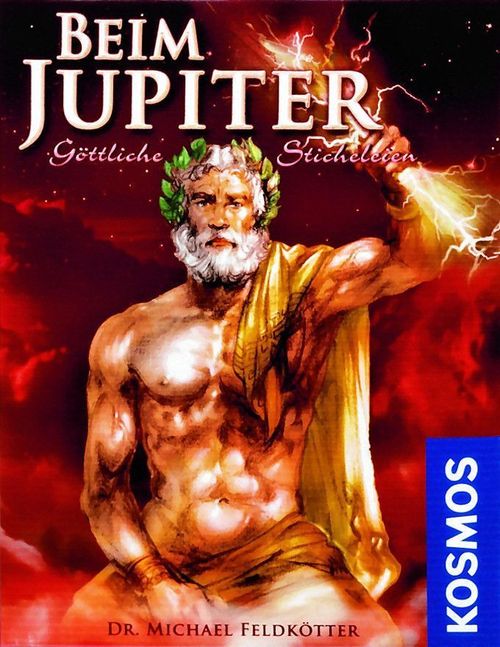
Beim Jupiter: Göttliche Sticheleien
Beim Jupiter: Göttliche Sticheleien Rulebook
Table of Contents
Table of Contents
Contents
- 87 cards
- 65 playing cards
- 60 color cards, 1-14 and a "god" card in each of 4 colors
- One "Jupiter" card
- One "Juno" card
- 3 "sacrificial lamb" cards
- 12 trick counter cards valued 1-12
- 5 marker cards (with "Jupiter" symbol), one each of 5 colors
- 5 "zero trick" cards, one each of 5 colors
- 65 playing cards
Setup
Each player takes the marker card and the "zero trick" card of one color. Depending on the number of players, some cards may be removed from the game. Unnecessary cards are returned to the box.
- 3 Players: Remove all colored cards numbered 9 to 14, along with one sacrificial lamb.
- 4 Players: Remove all colored cards numbered 12 to 14.
- 5 Players: Use all the cards.
The 12 trick counter cards are laid out on the table in consecutive order. Select a starting player.
The Game
Course of a Round
- Distribute cards
- Select a color card from the hand and lay it out face down
- Name the trump color
- Bid for the tricks
- Play the tricks
- End of the round (distribute points)
1. Distribute Cards
The dealer shuffles the cards and deals them out equally to the players. In the first round each player gets 13 cards, which are held so that other players cannot see them.
Tip: With 3 or 4 players one card is left over in each round. It should be set aside unseen for the current round. At the start of the next round it should be shuffled together with the other cards.
2. Choose a Card from the Hand and Lay It Out Face Down
Each player chooses one of the color cards from his hand and lays it face down for the time being in front of him. The chosen card serves in the first place for determination of the trump color; in the second place, it tells how many victory points it is worth if it is won at the end of the round.
Important: Only color cards with point values may be chosen, not sacrificial lamb cards, "god" cards, Jupiter or Juno. In later rounds it can sometimes happen that a player has only such unsuitable cards in his hand. In such a case the cards are shuffled and dealt again.
3. Deciding the Trump Color
As soon as all players have chosen a color card, the cards are turned over. Now the trump color for the round is determined. If more cards of one color are exposed than of any other single color, that color is the trump for the upcoming round. If there is a tie between two or more colors among the face-up cards, the sum of the points on these cards is compared. The color with the highest total is the trump color for the upcoming round. If there is still a tie between the two colors, the color with the highest single card is the trump color.
If there is still a tie, the round is played with no trump.
In summary:
- Trump color: greatest count of face-up cards
- if tied: greater point total of the cards
- if still tied: greatest single point value
- if still tied: no trump color
Example: Two cards each of blue (trident) and red (wheel) are turned up, one of yellow (bow). The choice of trump color is between blue and red. The sum of the two colors' cards is identical (12 each). Therefore, red is trump, since the "red 11" is the highest single card among the colors in contention.
In the first round of play the trump is chosen only by the initial face-up cards. In succeeding rounds the trump is chosen not only from the cards newly turned up, but also from those already turned up in previous rounds but not yet won (see also 6. "End of the round").
4. Bid for Tricks
Place color cards beside the trick counter cards.
Starting with the player to the left of the dealer (the start player), each player in turn now assigns his face-up color card to one of the trick-counter cards, placing his card beside it. All these cards should be placed on the same side of the column of trick counter cards. In the first round all numbers from 1 to 12 are available, since 12 tricks are played. By this placement the player declares how many tricks he intends to win in this round.
Play marker cards: A player can also play a marker card at the same time on his color card. If he so wishes, he places the marker card together with his color card (placed on top of it in such a way that the number on the color card is visible) next to a trick counter card. With this he locks his color card against intervention by other players. If a player locks his color card, he is sure of at least this card if he fulfills his trick bid. (Even so, he may still win some more valuable card.) However, he may be at a disadvantage if he does not fulfill his bid (see 6., "End of the round"). If a player does not want to lock his color card, he places his marker card in front of him. The implication of the scoring method is that unlocked "bids" are not binding; still, it is wise to estimate accurately in order to increase the chances of taking victory points.
This marker card after its assignment must lie either on top of the player's color card or in front of the player.
"Zero trick" card: Each player has besides his marker card a "zero trick" card. Each player can use this card once in the game to declare that he wants to take no tricks in the upcoming round. He places his color card in front of him rather than beside a trick counter card, covering it with the "zero trick" card. The player can win only this color card in the round and no other. If the player takes no tricks, he takes the color card as his victory-point award. If he does not fulfill his bid, because he has taken one or more tricks, the color card is removed from the game. In either case, this used "zero trick" card is removed from the game at the end of the round.
5. Play Tricks
The start player begins the trick by playing any card he chooses from his hand face up. This color is "led". All other players in clockwise order must play exactly one card. The following rules of play apply:
- First of all, each player is required to play the color led if possible.
- If a player cannot play the color led, he may either play a trump or discard any other card from his hand.
- If a trump card is led, each player must play a trump if possible; otherwise, any card.
When each player has played one card, the player with the highest card of the color led takes the trick, unless it contains a trump. (Colors which are neither trump nor the suit led cannot win the trick!). If a trump was played to the trick, the player with the highest trump wins the trick. The players lay the tricks they win before them in such a way that all players can tell how many each one has won. At the end of the round the count of the tricks won is of the first significance; the contents of the tricks are only meaningful if there is a tie for the trick count. The player who wins a trick leads to the next, which continues as above.
Exceptional Cards
-
Jupiter and Juno: These cards are the highest trumps in the game. They have no color in themselves, i.e., they are independent of the actual trump color. If a trump is led, one must, if necessary, play a Jupiter or Juno card (either because the player has no other trump card or does not want to play another one). If the Jupiter or Juno card is led, trumps are considered led, and all players must play a trump (if possible). If both cards are played to the same trick, the one played first wins the trick. If there is no trump color, Jupiter and Juno are the only trumps, and the lead of one calls for the play of the other.
-
"God" cards: "God" cards can be the lowest or highest of their color at the discretion of the player. When one is played, the player must choose at that time whether it is to be the lowest or the highest card of its color, i.e., 0 or 15, and must announce this clearly.
-
Sacrificial lambs: These cards are the lowest in value and can never win a trick. They are even lower than a "god" card played as a 0. These cards can be played at any time, even if the player can follow suit. If one is led to a trick, the next player may play any card. The color of this card is considered the color led and must be followed.
6. End of the Round: Distribute Points
A round ends as soon as all cards in the hands have been played. Each player now counts the tricks he has won, announces the total, and looks at the corresponding trick counter card. If there is at least one color card there, the player can take one of these cards as a victory-point card. This works as follows:
-
First, all players who used their marker cards and did not make their bids must remove the marker card from the locked card and place it beside the trick count card whose number matches the number of tricks they actually took (on the side of the column opposite the color cards).
-
If only one player has made a particular number of tricks, regardless of whether he bid that number, he may take the highest color card lying there and place it before him as a victory point. If there is no color card there, he gets no points in this round.
-
If two or more players have taken the same number of tricks, the order of selection of the color cards lying there is as follows:
a. A player who has locked his color card and made his bid gets first choice (of the color cards at that trick counter card). He may take his locked color card or any other color card which is not locked. When he takes a color card, he immediately removes his marker card (i.e., if a player does not take his own locked card because he has taken a more valuable one, his card is no longer locked against the other players). If two or more players have made their bids and also locked their cards, the point values in the tricks are counted. (Cards with no numerals count 0). The player with more points then has first choice if it concerns unlocked cards.)
b. Second choice goes to the player who has not locked his card and still has his marker card in front of him. He may take the highest of the remaining color cards (at that trick counter card). As in a) above, players who have equal rights decide the rank order based on the point values of the cards taken.
c. Third choice goes to a player who locked his color card but took a number of tricks different from his bid, whose marker card lies beside a trick counter card. He may now take the highest remaining color card (at that trick counter card, if any are left). Ties are decided by points taken as in a).
Essentially this is true: If there are not enough color cards next to a trick counter card, players who are permitted to choose from them (after they are all taken) get nothing.
-
If a player takes no tricks, he takes no color card, unless he has played the "zero trick" card in this round. In that case he takes the color card he covered with the "zero trick" card.
Example: At the start of the round the Yellow player played the "blue 6" (trident) (next to the "IV" card) and locked it. The Red player played the "green 5" (fruit) (also next to the "IV" card) and locked it. The Green player played the "red 8" (wheel) (next to the "I" card) and locked it; the "green 4" (fruit) came from the Blue player (next to the "II" card), not locked. The "yellow 1" and "yellow 9" remain from the previous round. Yellow and Red each took four tricks and thus fulfilled their bids. Green wanted to take one trick but took two, so he now lays his marker card on the left next to the II trick counter card. Blue took two tricks (fulfilling his unlocked "bid" and assuring himself a victory point card).
At the trick counter card "II" the allocation of points runs as follows: Since there are no locked cards, Blue has precedence over Green, because while Blue's bid is not binding (since his card was not locked), Green failed to fulfill his (locked) bid. Blue takes the "green 4", leaving the "yellow 1" for Green.
At the trick counter card "IV" Yellow and Red both have a claim on their locked cards. The most valuable card, however, is the "yellow 9". Therefore, both players now count the points in their captured tricks. Yellow has 47 points, Red only 38. Therefore Yellow has first choice, and he takes the "yellow 9" and removes his marker card. Then Red takes the now unlocked "blue 6". The "green 5" and the "red 8" remain for the next round.
All players now take back any remaining marker cards and lay their color cards won as victory points exposed so that all players can count their points and see which cards are out of the game.
Further Rounds
After the allocation of victory points the highest trick counter card is removed from the game, since there is one trick fewer in each successive round.
Color cards which are not won remain beside the trick counter cards. They can be won as victory points in later rounds and are also included in the determination of trumps.
The starting player of the last round deals for the next. He shuffles the remaining cards (for the 3- and 4-player game he includes the extra card left over in the previous round) and deals out an equal number of cards to each player in turn. In the second round each player gets 12 cards, in the third 11, and so on.
Then each player chooses a card from his hand to determine the trump and to serve as a victory point card. To choose the trump color, the total point count of all cards of each color is counted; above all, the cards left over from the previous round must be taken into consideration along with the ones newly played. After the determination of trumps the game proceeds as already described. First the tricks are bid for, then played.
End of the Game
The game ends after 8 rounds, i.e., at the end of the round in which the trick counter card "V" is the highest one used. Each player now counts the victory points he has won. The player with the most points wins the game.