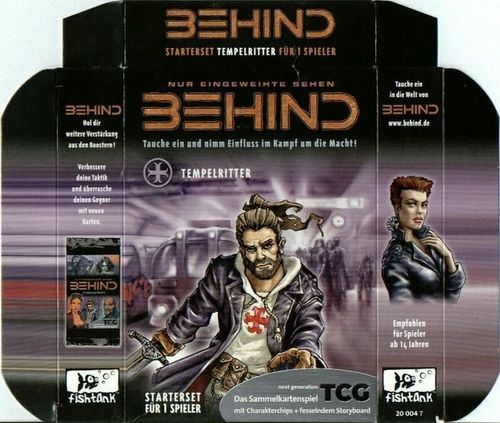
Behind (2003)
Behind (2003) Rulebook
Table of Contents
Table of Contents
- Contents
- Rule of Precedence
- Rule of Ownership
- The Cards
- First Steps
- The Beginning
- The Course of the Game
- Special Card Effect (Spezieller Karteneffekt)
- Ability Check (Fähigkeitsprobe)
- Discarding a Card (Karte abwerfen)
- The End
- Abilities (Fähigkeiten)
- Befehl (Command) -- Fähigkeit X+
- Bündnis (Alliance)
- Glaube (Faith)
- Hellsicht (Clairvoyance) -- Fähigkeit X+
- Körperlos (Incorporeal)
- Mut (Courage)
- Regeneration -- Fähigkeit X+
- Schrecken (Terror) -- Fähigkeit X+
- Unterstützung (Support) -- Fähigkeit X+
- Wandler (Shapeshifter) -- Fähigkeit X+
- Wirbel (Whirl) -- Fähigkeit X+
- Destroyed Cards (Zerstörte Karten)
- Own Decks (Eigene Decks)
- Terrain and Climbing (Gelände & Klettern)
- Large Battles (Große Schlachten)
- Transformations (Verwandlungen)
- Flying (Fliegen)
- Weapons (Waffen)
- Handing Over and Picking Up Items (Gegenstände übergeben und aufheben)
- Hand Cards, Supply and Discard Pile (Handkarten, Nachschub und Rückzug)
- Viewing Angle (Sichtwinkel)
- Tournament Games (Turnierspiele)
- Timing
- Scenarios (Szenarien)
- Glossary (Die Begriffe)
- More Questions?
Contents
For your first game each player should choose one of the pre-constructed decks. Each of the five societies naturally follows a different strategy. Later you can assemble your own deck. For that purpose there are, besides the starter sets of the societies, so-called boosters, small additional packs with new cards.
The five societies are: Sisterhood (Schwesternbund), Vampires, Werewolves, Heirs of the Templars (Tempelritter) and Ghosts.
The starter set for 2 players contains, besides a deck of the Sisterhood and a deck of the Vampires, tableaus with character chips, terrain chips and detailed instructions. A starter set for 1 player contains a further deck of one of the societies of the Werewolves, Templars or Ghosts, further tableaus with character and terrain chips, and likewise detailed instructions.
Boosters are additional packs of eleven cards each. Many of the cards are not contained in the starter sets but can only be found in booster packs.
Rule of Precedence
Should a card in play contradict or change the rules explained here, the text of the card takes precedence over these rules.
Rule of Ownership
During the course of the game it is possible for cards to change owner: at the end of a game they are returned to their rightful owner.
The Cards
There are two different kinds of cards in BEHIND: character cards and action cards.
Character cards each represent a character from the world of BEHIND. All values important for the game are noted on them. The character card shows: affiliation, title, Strength, Dexterity (Geschick), Resistance (Widerstand), character points, abilities, and edition / card number / rarity.
Action cards give you the action possibilities you need for your characters during the game. Important: every card can be used in three different ways: to determine the fate number, in the form of the effect described on it, or to move your own characters. The action card shows: fate number (top left), title, affiliation, movement range (Bewegungsweite, bar on the left edge), movement number (Bewegungszahl, bottom left), effect, quote, edition / card number / rarity, and action category. Card type markers: D = Permanent (Dauerhaft), L = Legendary (Legendär), E = Unique (Einzigartig).
First Steps
First the basic rules of BEHIND are explained using an example game for two players. Should you encounter unknown terms in the following rules, look them up in the back part of the rules booklet (from page 46).
Begin the game by each of you laying out the character cards of your deck face up in front of you on the table, shuffling your action cards and placing them in front of you as a draw pile (Nachschub).
In our first game we play the scenario "Unser Revier!" ("Our Turf!", see also page 40) and therefore place six small obstacles with some distance between them in the middle of the table. These can be the terrain tiles or, for example, a glass or a small box.
Both of you now turn up the top card of your supply (Nachschub) and look at the number in the upper left corner (fate number). The player with the higher number is the starting player and begins the game. If tied, simply turn up another card. You then place the turned-up cards next to your supply, because this is where your discard pile (Rückzug) forms.
The starting player now places the character chips of the characters lying in front of him face up between the obstacles. His opponent may likewise place the chips of his characters face up at a table edge of his choice. Make sure the two groups are about 20 to 25 centimetres apart (minimum distance three card lengths). Each player then draws five hand cards from his supply, which he should keep secret from his opponent.
Each player's character cards have a sum of character points of 30 in this example.
Before you start, of course you want to know how you can win. The goal of this scenario is to eliminate all enemy characters. That means you must try to injure the characters of your opponent. Other scenarios have other goals and therefore require other strategies.
The starting player now begins the game. Suppose he wants to move one of his character chips toward the enemy character chips. For this he chooses one of the action cards in his hand and looks at the movement bar on the left edge of the card. Depending on how far the bar is coloured, he may now move one of his character chips that distance (movement range, Zugweite).
If the number in the lower left corner of the card (movement number) shows a "2" or "3", he may even perform the movement two or three times. He may also divide the movement among as many of his character chips as the movement number indicates.
After that the first action is over and the card is placed on the discard pile (Rückzug).
Since each player may perform three actions per turn, the starting player can now play two further cards as movement and then discard them. After the three actions the player draws cards from his supply until he again has five in hand. That means the starting player now draws three cards.
Now the other player is on turn. He too now moves his character chips for the first time and uses all three actions to get closer to the opponent. Keep moving your own character chips until one of them touches an enemy character chip.
Did it work? Then we come to your first melee combat.
The player whose turn it is now uses one of his three actions for a melee attack. As said, the precondition is that one of his character chips touches an enemy chip. Of the two touching characters, look at the top number of the three attributes on the left side of their character cards. This value shows how strong the character is (Strength).
The player on turn now plays an action card of his choice from hand and adds its fate number (top left) to the Strength of his character. Then he also turns over the top card of the supply (draw pile) and adds its fate number as well (Strength + fate number of a hand card + fate number of the top card of the supply). This sum is his melee value.
His opponent then does the same. He adds to the Strength of his attacked character the fate number of a hand card of his choice and of the top card of his supply and thereby also determines his melee value.
The player with the higher value wins the melee. He checks whether the difference between the two values is exactly as high as or higher than the Resistance (lowest number of the three attributes) of the loser. If so, the defeated opponent is injured. That means his character card is turned sideways.
If a character is injured twice, his character card is turned again so that it is upside down. A third injury eliminates the character: then both the character chip and the character card are removed from the game. In our example (scenario "Unser Revier!") the player who first eliminates every enemy character wins.
Example: Christian plays a group of Vampires, Barbara part of the Sisterhood. Ludwig von Auenstedt (Strength 4, Resistance 3) meets Sahra Jeanette (Strength 1, Resistance 2) during the game, and Christian uses one action in his turn to attack the sister in melee with Ludwig. To the Strength of 4 he plays a hand card with a fate number of 6 and turns up the top card of the supply. This shows a fate number of 3, so that Christian's character has a total melee value of 13. That is quite good. Barbara plays to Sahra Jeanette's Strength of 1 a hand card with a fate number of 5 and turns up the top card of her supply. The fate number also shows a 5, so that Barbara achieves a melee value of 11 for her character and has thus lost the melee. Since the difference between the two values is 2 (13-11=2) and this value is as high as Sahra Jeanette's Resistance, she is injured and her character card is therefore turned by 90º.
Of course you have considerably more possibilities to use your actions in the game. If you want to know how to use abilities such as "Regeneration", "Schrecken" (Terror) or "Befehl" (Command), shoot at your enemies or use the text of the cards, simply read on.
The Beginning
BEHIND is a game for two or more persons. Each player decides on one of the five societies: Ghosts, Vampires, Werewolves, Sisterhood or Heirs of the Templars. In your first game it is advisable to take a pre-constructed deck; later you can assemble your own decks (see "Own Decks", p. 33).
It is also possible for two or more players to play the same society. Since the characters are unique cards (see "Special Card Effect" from p. 23), a character can only be played by one player. In this case you would have to hold an influence duel (Einflussduell). For simplicity, in your first game you should choose different societies.
Each player lays out all characters of the deck face up in front of him on the table. On each character card lying out you place the matching character chip of the character. Remaining character chips are set aside. They are no longer needed in the first game.
Then each player shuffles his remaining cards, lets an opponent cut, and places the cards within reach in front of him as his own draw pile, the so-called supply (Nachschub).
Then you jointly choose a scenario from the back part of these rules (see "Scenarios" from p. 39). If you cannot agree, each of you turns up the top card of his supply and you compare the fate numbers in the upper left corner. In case of a tie you draw a further card and compare the fate numbers again. The whole procedure is called an influence duel (Einflussduell). The higher value in the duel wins, and the victorious player may in this case choose the scenario. All cards turned up in this way are then placed on the discard pile, the so-called retreat (Rückzug).
Lay out a few obstacles in the middle of the table as described in the scenario and place the character chips of your participating characters according to the setup described in the scenario (see also "Terrain" p. 34). Memorise your scenario goal well, because only so can you win!
Each player then draws five cards from his supply; they form his so-called hand. An influence duel, as described above, decides who begins the game. The winner of the duel is the starting player and is on turn; the other players follow clockwise until the end of the game.
Advice (Marius "Eisenhand"): In your first game take the scenario "Unser Revier!" on page 40. It is best suited for getting started. Once you have placed terrain and character chips and drawn your first five hand cards, each of you should think about your tactics. Ask yourself helpful questions such as "Which society am I playing against?", "What are the strengths of this society?" and "How can I exploit its weaknesses to reach the game goal?". Only the incompetent leader has no plan of his own.
The Course of the Game
The starting player begins the game with his turn and is the acting player (agierender Spieler). The turns of his opponents follow clockwise. Should a player play a card that affects the game for one round, this means it applies until the end of the turn of the player who plays before him, i.e. until shortly before his next turn.
The turn of the acting player consists of the following phases:
- I. Organisation phase (checks for some cards)
- II. Action phase (perform actions)
- III. Supply phase (draw cards)
I. Organisation Phase
Some permanent cards played in earlier turns do not necessarily stay in play but require an influence check (Einflussprobe).
For this the acting player, who currently influences and thus controls the card, turns up the top card of his supply and compares its fate number with the influence value (Einflusswert) of the influenced card. If the value of the turned-up fate number reaches or exceeds the influence value of the card, the check is successful and the card stays in play.
If the fate number is lower than the influence value of the card in play, the check failed and the card is placed on the discard pile (Rückzug). In both cases the turned-up card of the supply is likewise placed on the discard pile after the influence check.
This procedure is repeated for each card that requires an influence check. The acting player determines the order.
Advice: In the first turn of your game you do not yet have any permanent cards lying out. You can therefore simply skip the organisation phase. Now, however, you must pay attention, because the most important phase begins...
II. Action Phase
Now the player whose turn it is may perform three actions. In later, larger games the number of actions per turn can also change (see "Große Schlachten" / Large Battles, p. 34).
An action is first announced by the player naming the acting character. For many actions the playing of an action card is then necessary.
Important: each action card in hand contains several possibilities. A card can be used either for movement of one's own characters or for determining the melee, shooting or dodge value in an attack. In addition the effect of a card can also be used individually according to the card text.
Movement
Moving one's own characters is only possible in one's own turn and costs one action.
Each card shows a movement number in the lower left corner and a movement range on the left edge. If a player wants to play an action card as movement, the movement number in the lower left corner determines how many characters influenced by him he may move.
The movement range on the left edge shows the distance and applies in a straight line through the terrain, but not over obstacles, only around them. The distance is measured from the centre of a character chip.
The values need not be used completely, i.e. one may also move fewer characters or less far than the movement range would allow. In addition, with a higher movement number, for example 3, it is also possible to move not three different characters but two or three times the same character in one overall movement.
In order to attack an enemy character in melee, the character chip of the attacker must be in direct contact with the character chip of the opponent (see "Melee Combat" p. 19). If a character chip would overlap another, the one just moved is placed so that the two chips touch. As with obstacles, moving over a character chip is also not possible.
If a character is in contact with another character, that is, his character chip touches at least one enemy character chip, and wants to break away from it, then after playing the movement card he must first succeed at an ability check (Fähigkeitsprobe, see "Fähigkeitsprobe" p. 26). The level of the check equals the Dexterity (Geschick) value of the enemy character. With several enemies, this equals the highest Dexterity value. Each additional enemy beyond the first who is in combat with the character raises the check by +1.
If the check succeeds, the character may move according to the usual rules. If the check fails, the action was unsuccessful and the movement card is discarded without effect; the action is used up without further consequences.
Advice: I know that to someone not yet initiated this all sounds very confusing. But I suggest that you first use both actions in your round to move one or more of your characters toward the opponent.
Melee Combat (Nahkampf)
As an action a character can also attack an enemy character in his turn. The precondition is that both character chips touch in the terrain (see "Movement" p. 18).
For this the attacker plays an action card from hand and adds to the fate number at the top left of the hand card the current Strength value of the attacking character from the character card. Then he also adds the fate number of the top card of the supply. This is his melee value (NW, Nahkampfwert).
Both cards are then thrown onto the discard pile without further effect. The hand card may be played, the card of the supply must be played. Then the defending player proceeds likewise and thereby determines his melee value.
To determine whether and how severely the inferior character is injured, one compares the Resistance value of this character with the difference, i.e. the difference of the two melee values. If this difference reaches or exceeds the Resistance value, the inferior character suffers a single injury. The character is injured twice if the difference is at least twice as high as the Resistance value. With a difference at least three times as high he receives three injuries, etc. The effects of injuries are described under "Injuries" (p. 22). A tie of the two melee values has no further effect on the game.
A player may also attack an opponent with several characters at the same time. For this he adds the Strength values of his assisting characters to the Strength value of his attacking character and the values of the two played cards. This is however only possible if the assisting character chips also touch the opponent and are not themselves bound by other opponents – they may therefore not touch any further enemy character chips. Such assistance is also only possible in the attack and not in the defence. If the character fighting alone fends off the melee, his player may choose an enemy character participating in the fight who receives the damage. With several injuries the damage may also be divided among several enemy characters.
How a character can break away from a fight is described above under "Movement" (p. 18).
Advice: Should two enemy character chips touch, simply try step by step your first exchange of blows as described and look up the effects in the section on injuries. Just try, it will work out!
Ranged Combat (Fernkampf)
Through certain items, magic and special abilities, ranged attacks are also possible.
If a character has a ranged-combat possibility, he can attack an enemy character visible to him by a ranged attack. The range of the attack equals twice the total movement of the card that enables the ranged attack for him.
The line of sight between shooter and target must not be obstructed by other characters or obstacles. A conceptual line between the centres of the two character chips must therefore be drawable without interruption. In addition, the character chip of the shooter must not touch an enemy character chip. The target may however be in melee combat.
If a character wants to attack an enemy by a ranged attack, he adds the current Dexterity (Geschick) value of his character card, the fate number of the equipment or magic card that enables the ranged attack for him, and the fate number of the top card of the supply. This sum is his shooting value (SW, Schusswert). The card of the supply must be turned up and is then thrown onto the discard pile without further effect.
Then the defending player may play a hand card and must turn up the top card of his supply. The fate value of these two cards is added to the Dexterity value of the defending character; both cards are then discarded. This sum is the dodge value (AW, Ausweichwert).
If the dodge value of the target reaches or exceeds the shooting value of the shooter, the shot has no further effect. If the shooting value of the shooter is higher than the dodge value of the target, the difference of the two values is, as in melee, compared with the Resistance value of the target and the target is possibly injured (see "Injuries" below).
Injuries (Verletzungen)
A healthy character fights with his full Strength and Dexterity value.
If a healthy character is injured once, he counts as "lightly injured" and the player turns the corresponding character card by 90º sideways as a sign of his injury. This means the character must from now on use a Strength value and Dexterity value lower by 1 (minimum of 0).
If a character was injured twice, his character card is turned a further 90º, thus 180º in total, upside down. His Strength and Dexterity values are now lowered by a total of 2 (minimum of 0).
If a character was injured more than twice, he counts as eliminated. His chip and his card are removed from the game. All items played on him are placed on the discard pile.
Through some card effects it is possible to heal a character. Each healing improves the health of an injured character by one injury. A lightly injured character thus becomes healthy; a severely injured one is only lightly injured. Neither a healthy nor an eliminated character can be healed.
Special Card Effect (Spezieller Karteneffekt)
Every action card can be used as described in its card text and costs the player one action. The effect takes place as explained on the card.
First the acting player names the card effect and the one of his characters who wants to perform the action. Then the effect takes place in the game as described. Should a card effect require a target, for example in the form of a particular character or place, that is not present in the current game, the card also cannot be played according to its card text. There is still the possibility of making an effect check (Effektprobe). How that works is described from page 26.
When playing an action card according to its card effect, the designations of certain card types are often important.
Every "Ort" (Place) is permanent, that is, it stays in play after being played successfully and has a permanent effect. A player who plays a place lays it face up next to his character cards in front of him on the table. Some places carry the addition "Geheim" (Secret).
Every "Gegenstand" (Item) is likewise permanent but must be assigned to a character. After playing an item the player places it visibly under a character card. If the character is eliminated and removed from the game, every item assigned to him is placed on the discard pile (see "Injuries" p. 22). Every "Waffe" (Weapon) also counts as an item. Each character can carry any number of items and weapons, but may use the effect of only one weapon per combat.
All permanent cards are influenced by the player who played them.
A "Ereignis" (Event) affects the game once and is then placed on the discard pile.
Other cards are assigned to the categories "Magie" ("Zauber" (Spell), "Wunder" (Miracle), "Macht der Erde" (Power of the Earth), "Kraft der Toten" (Power of the Dead), "Blutmacht" (Blood Power)), "Person" and "Moment" (see "Moments" p. 25).
For cards bearing the note "Zusatz" (Addition), the text of the card takes effect automatically when its fate number is used. It does not matter whether the card was played from hand or turned up from the supply for a check. If, for example, a card with a fate number of 5 reads "Zusatz: Kampfwert+2" and the card is used as an attack or defence card, the final combat value of the card is 7 (see "Melee Combat", p. 19).
If a card is "Einzigartig" (Unique), it may be in play only once. If a unique card is already in play and an opponent wants to play a card with the same name, the two affected players hold an influence duel. Both turn up the top card of their supply and compare the fate numbers in the upper left corner. In case of a tie a further card is drawn and the fate numbers are compared again. The higher value in the duel wins and the victorious player may keep his unique card in play. The loser of the duel must place his copy of the unique card on the discard pile. All cards turned up in the influence duel are then also placed on the discard pile and the action is over.
A "legendary" card is likewise unique and can therefore be in play only once. If an attempt is made to play a second copy of the card, the competing players likewise hold an influence duel as described above. A legendary card may moreover be present only once in a deck (see "Own Decks" p. 33).
Neither unique nor legendary cards can be played two or more times by the same player.
Attention! Every character is also legendary. Should two or more players want to play with one and the same character, they must likewise hold an influence duel before the start of the game. The winner of the duel may use the character in the game; the loser must remove the character card from the game. It is therefore important to choose one's characters with care.
Advice: At the beginning not every card effect will seem useful to you, but the combination of several card effects marks the good tactician. And the better you become, the faster you will make a name for yourself in the world of BEHIND.
Moments (Momente)
Of action cards bearing the note "Moment", the special card effect can be used not only in one's own turn but also in the turn of an opponent. For every Moment played in this way, however, you may perform one action fewer in your next following turn. So remember exactly the number of Moment cards you played in opponents' turns. Naturally a player cannot play more Moments in the opponents' turns than he would have actions in his own next turn. By playing a Moment during an opponent's turn, an enemy action may even be interrupted (see "Timing" p. 38).
Advice: In your first game, therefore, only two Moment cards per round are possible in an opponent's turn.
Ability Check (Fähigkeitsprobe)
The use of some abilities and the playing of some action cards (effects) require an ability check or effect check with X+.
This means that the acting player, as with an influence check, turns up the top card of his supply and compares the fate number with the value X of the ability check. The check succeeds and has the stated effect if the turned-up fate number is at least as high as the stated number of the check. If the turned-up number was smaller, however, the action has passed without success. In both cases the turned-up card is discarded.
Example: A werewolf with the ability "Regeneration 4+" tries to heal himself by spending an action. For this the player turns up the top card of his supply. The fate number shows a 6, so the ability check succeeded and the werewolf was able to heal himself. The card goes to the discard pile. Had the card shown a fate number of only 3 or less, the action would not have been successful.
For some checks no particular value is given; instead the player may choose a number himself. The choice of the number must however be made before turning up the card of the supply.
Discarding a Card (Karte abwerfen)
By spending an action a player may in his turn also discard a single hand card to the discard pile without further effects. In this way he can rid himself of currently useless cards and draw more cards from the supply again in the supply phase (p. 27).
III. Supply Phase (Nachschubphase)
As the last phase, at the end of every turn all players draw cards from their supply until they have five hand cards. So even at the end of an opponent's turn a player refills his hand cards to his full hand size. Once the supply is used up, the discard pile (Rückzug) is shuffled immediately and placed as the new supply.
During a turn it is quite possible through card effects for a player to hold more than five cards in hand. In addition the number of hand cards in later games can vary from the usual five (see "Große Schlachten" p. 34).
The End
If a player reaches his scenario goal, the game ends immediately and he has won. Some scenarios also end after a certain number of rounds. The winner is then determined as described in the scenario.
Advice: You now know the most important rules. The following special rules bring further finesse into the game and give you more possibilities to shape the game to your taste.
Abilities (Fähigkeiten)
In BEHIND many of the characters have special abilities that make them stronger and give them advantages in the game. The following section shows the most important abilities in an overview. Where "Fähigkeit X+" is noted, an ability check of X or more is necessary for the successful use of the ability (see "Fähigkeitsprobe" p. 26).
Befehl (Command) -- Fähigkeit X+
By spending an action and succeeding at the ability check, a single enemy character can be moved by the total movement of the card that was turned up from the supply for the check. Both character chips, that of the victim and that of the commander, must however not touch any enemy character chip before the movement. As with a ranged attack, the commanding character must be able to see his victim. The movement must not lead the victim out of the playing area but may change its viewing angle. A command cannot be applied to one's own characters.
Above all Vampires and some Ghosts have, through their strong will, the possibility of influencing other beings.
Bündnis (Alliance)
If a character with the ability "Bündnis" assists another in combat (see "Melee Combat" p. 19), not only the Strength but also the value of the ability of the assisting character is added to the melee value of the one assisted. In a game with three or more players the respective player decides whether his character wants to assist an ally and use the ability "Bündnis". Not only warriors of the Sisterhood but also some Werewolves and Templars master this ability.
Glaube (Faith)
If a character who has the ability "Glaube" fights alone against several opponents, he may add his Faith value to his Strength for each additional opponent after the first. This is possible in attack as well as in defence. A character with the ability "Glaube +2" may therefore add +4 to his Strength when fighting three opponents. This applies, however, only to each unbound opponent who does not himself touch any further enemy character chip.
Especially Templars and some warriors of the Sisterhood can use their strong faith in the form of this ability.
Hellsicht (Clairvoyance) -- Fähigkeit X+
By spending an action and succeeding at the ability check, the acting player may look at the four top cards of his supply. Afterwards he may place the cards back on top of or beneath his supply in any order. It is also possible to place some on top and others beneath his supply. The character chip of the clairvoyant character must not touch any enemy character chip during the action. If fewer than four cards remain in the supply, the player may also look at correspondingly fewer cards.
The seeresses of the Sisterhood and some Ghosts like to resort to Hellsicht.
Körperlos (Incorporeal)
If a character has this ability, he may move through every character chip and every obstacle. His movement must not end in the obstacle or character chip itself. (If you play by tournament rules (p. 38), a movement that would end in a character chip or obstacle is not allowed. That is, the movement does not take place and the action is forfeited without replacement.) The line of sight of an incorporeal character is, however, obstructed by obstacles and characters like that of other characters. Otherwise too the usual rules apply to incorporeal characters. Above all Ghosts are incorporeal.
Mut (Courage)
If an opponent wants to use the ability "Schrecken" against a courageous character, the frightener receives a penalty equal to the Courage value on his ability check. In each of the societies there are courageous characters. For only those who are courageous can become a legend.
Regeneration -- Fähigkeit X+
If an injured character with this ability succeeds at the ability check by spending an action, he may heal one injury (see "Injuries" p. 22). With this ability one can only heal oneself, not others. Vampires and Werewolves often have bodies that can heal themselves through Regeneration.
Schrecken (Terror) -- Fähigkeit X+
A character with the ability "Schrecken" can frighten a single enemy character by spending an action and succeeding at the ability check. The consequence is that the enemy character cannot act in his next turn. He may however defend himself normally and may therefore also use the ability "Glaube" in doing so. Both character chips, that of the victim and that of the frightener, must not touch any enemy character chip. As with a ranged attack, the frightening character must be able to see his victim. One can break away from a frightened character without a check (see "Movement" p. 18). With several characters his Dexterity value is therefore not relevant when breaking away and does not make the check harder by +1.
Especially Ghosts, but also Werewolves and Vampires, can use their appearance to frighten.
Unterstützung (Support) -- Fähigkeit X+
If a character with the ability "Unterstützung" equips himself with an item and the subsequent ability check succeeds, equipping cost no action. The player therefore still has a further action free. The ability can however only be used if the character equips himself and not others. Thanks to their financial means, above all Templars, Sisters and Vampires can fall back on the possibility of Unterstützung.
Wandler (Shapeshifter) -- Fähigkeit X+
A character with this ability transforms, by spending an action and succeeding at the ability check, into an animal form, half human, half beast. For the duration of the transformation the character can still carry items but no longer use them. In return, for this duration his Strength rises by +3 and his Resistance by +1. To see how long the transformation lasts, the player must pass a further ability check in each organisation phase of his following turns or the character transforms back. A voluntary transformation back at the beginning of one of his own following turns is possible and requires no check.
Naturally above all Werewolves master the ability of a Wandler. But some Vampires too know this art.
Wirbel (Whirl) -- Fähigkeit X+
A character with the ability "Wirbel" has two ways of using it. Either, by spending an action and succeeding at the ability check, he places an item of his choice within range of the total movement of the card that was turned up from the supply for the check on the discard pile. Or, with the same expenditure, he places a place (Ort) of his choice on the discard pile. Discarding a place is independent of range but is made harder for him by -2 ("Fähigkeitsprobe"). The character chip of the whirling character must not touch any enemy character chip during the action.
The use of Wirbel is typical of the wrath of many Ghosts. Only few Werewolves also master this ability.
Destroyed Cards (Zerstörte Karten)
Sometimes cards count as destroyed. This means they are not only placed on the discard pile but removed from the game entirely.
Own Decks (Eigene Decks)
Since you have already played some scenarios, you surely want to build your own decks now. An own deck gives you even more opportunity to play to your taste and to refine your own strategy.
You must observe the following rules:
A deck must consist of at least 40 action cards; there is no maximum limit. Character cards do not count towards the number of cards in the deck.
Every character must belong to the same society and may be represented only once. Every legendary action card may be in the deck only once. Every other action card may be represented up to three times. All action cards must likewise belong to the society and bear the corresponding affiliation symbol of the society. In addition, cards without a symbol can be used by every society and taken into the deck.
As you can see on the character cards, each character costs a different number of character points (CP). The more powerful a character is, the more CP he costs. So that every player influences equally strong characters at the beginning of a scenario, it is best to agree before a game with how many character points you want to compete against each other.
In the first game 20 to 30 CP are recommended. Then you choose your characters, whose sum must not exceed the agreed value.
Terrain and Climbing (Gelände & Klettern)
Obstacles serve as cover from enemy ranged attacks and attacks through special abilities. Use them to reach your scenario goal, for it is not always advisable just to storm wildly at the enemy.
Every character can climb obstacles if the obstacle in question is flat and his character chip has room on it. At the start of his movement the character chip must stand at the lower part of the obstacle and the total movement of the movement card must be sufficient to overcome the height of the obstacle. Melee combats between characters at different height levels are not possible.
If a character chip lies on a higher level but at the edge of the height difference, there is line of sight. Shooting at the character and the use of abilities such as Schrecken or Befehl are therefore possible.
In the first games you can improvise the obstacles with boxes and other small objects. Later, for more realism, you should build small trees, houses and hedges. Tips can be found on the homepage www.behind.de.
Large Battles (Große Schlachten)
Of course you do not always want to play only small scenarios but also large battles. Nothing changes in the composition of your characters and decks. Only the number of your hand cards, to which you draw at the end of each turn, and the number of your actions change. Look at the following table.
| CP | Hand cards | Actions / Moments | Deck card count (minimum) |
|---|---|---|---|
| up to 30 | 5 | 3 | 40 |
| from 31 | 6 | 4 | 50 |
| from 61 | 7 | 5 | 60 |
In this way you can play not only more actions in your own turn but also more "Moments" (see "Moments" p. 25) in the turn of your opponents. In larger battles the minimum number of cards in your deck also changes, as the table shows.
You should also try a game with three or more players. It is fun to form coalitions with allies in the course of the game -- but it can also happen that a supposed friend betrays you.
Transformations (Verwandlungen)
Transformations of a character through card effects or abilities, such as transformation into mist, a bat, a wolf or the mixed form of human and beast (see also "Abilities/Wandler" p. 31), are only allowed from the character's original human form. A transformation from, for example, the form of a wolf directly into mist is therefore not possible.
Transformed characters can normally carry items but cannot use them in their transformed form.
Flying (Fliegen)
Some card effects allow a character to move by flying. This has the advantage that in his movement he may fly over other characters and obstacles, that is, he can move across them. Landing on another character chip is not possible. A flying character can land on an obstacle only if the obstacle is flat and his character chip has room on it completely. In addition, the line of sight of a flyer is not obstructed by obstacles or other characters. Otherwise the usual rules apply to flying characters.
Weapons (Waffen)
A character may carry any number of items in the game, but may use only one weapon per combat. In addition, a character whose chip touches an enemy character chip is not allowed to perform a ranged attack.
Handing Over and Picking Up Items (Gegenstände übergeben und aufheben)
By spending an action a character can hand an item he carries and influences over to another character. For this the two character chips must touch, neither may be in a fight, and the item must also be carriable by the new bearer (the card text informs about this). If one of the two characters is the victim of the ability Schrecken, a handover is not possible.
In some scenarios you must pick up an item from the ground with a character. For this you simply move the character chip onto the item, end your movement on it and announce the picking up of the item to your fellow players. The item is now in the possession of your character without a further action.
Hand Cards, Supply and Discard Pile (Handkarten, Nachschub und Rückzug)
A player may not look at the hand cards and the supply of an opponent without further card effects. One's own supply is also excluded from this. A discard pile (Rückzug), whether the opponent's or one's own, may however be looked at at any time. The order of the cards must not be changed in doing so.
Viewing Angle (Sichtwinkel)
If you look closely at a character chip, you will notice a marking of usually 90º at its edge. This shows the viewing angle of the character. Every character can use abilities that need a line of sight to their target, such as magic, Schrecken, Befehl, but also ranged attacks, only on opponents who are within his viewing angle.
In addition, movement is only possible in the direction of the viewing angle. After a movement a character chip may be turned as desired.
Each character may, once in his own turn, at any time and without spending an action, be turned as desired, even if he does not otherwise move during the turn.
If a character touches an enemy character chip in the 90º angle opposite the viewing angle, he receives a bonus of +1 to his melee value in a melee combat against this opponent (bonus area for melee combat).
Tournament Games (Turnierspiele)
Since tournaments allow the meeting of experienced players, some rules are stricter for them. For example, at tournaments measuring distances before a movement or a ranged attack is not allowed. The action is thus announced with the performing character and possible target and then carried out without checking distances. If no target is in range, missed shots are therefore also possible.
The course of a tournament and further tournament rules can be found at www.behind.de.
Timing
Especially at tournaments the exact sequence of an action is important. If a character wants to act, the acting player first announces the action, shows the action card possibly needed, and names the acting character. Then he carries out the effects of the actions. If he is interrupted in this by an enemy Moment, he must pause in his action and give precedence to the Moment.
If several players, the acting player himself included, want to play a Moment at the same time, the Moment with the higher fate number takes effect before a Moment with a lower fate number. If the fate numbers are equally high, the acting player may decide on the order of these Moments.
Scenarios (Szenarien)
The following section contains various scenarios that you can play. If a scenario requires a distance of one or more card lengths, simply take the back of an action card and measure the complete length of a card with it.
After some scenarios experienced you can also give your imagination free rein and design the meeting of societies through your own settings and backgrounds.
"Unser Revier!" ("Our Turf!")
Number of players: 2
Situation: For some time you have been trying to expand your turf, but again and again the presence and influence of another society can be felt. In the evening it comes to a decisive battle as you meet in a remote part of the city.
Terrain: Place six small obstacles in the middle of the table. Determine by an influence duel (p. 24) who begins with this, and then alternate. The winner of the influence duel then also begins with the setup of his characters.
Setup: The first player places his character chips between the obstacles in the middle of the table. A chip may be at most one card length from another chip. Then the opponent places his character chips at a table edge of his choice. Each of his chips may likewise be at most one card length from one of his own chips. In addition every chip must be at least three card lengths from an enemy character chip. The player in the middle of the table begins the game.
Goal: The player who first eliminates all enemy characters has been able to expand his turf and thereby wins the game.
(Illustration of the starting setup: character cards of each player with a sum of character points of 30; terrain chips; minimum distance three card lengths.)
"Das Juwel von Athen" ("The Jewel of Athens")
Number of players: 3
Situation: The societies have long been hunting the legendary Jewel of Athens. The legend says that in the Middle Ages the gemstone was decisive in fighting the plague. Now, so the rumours say, the jewel has surfaced again.
Terrain: Place eight obstacles in the middle of the table. Determine by an influence duel who begins with this, and then alternate. The winner of the influence duel then also begins with the setup of his characters. The runner-up of the duel follows.
Setup: The first player places his character chips between the obstacles in the middle of the table. A chip may be at most one card length from another chip and must be at least four card lengths from the table edges. Then the next player places his character chips at a table edge of his choice. Each of his chips may likewise be at most one card length from one of his own chips. In addition every chip must be at least three card lengths from an enemy character chip. The third player begins at the table edge opposite the second player. The conditions for the distances between own and enemy chips apply to him likewise. The player in the middle of the table begins the game; the other players follow clockwise.
Goal: The player in the middle of the table tries to move the Jewel of Athens with one of his characters over a table edge. If he succeeds, he has won the game. The other players are not allied but each tries on his own to eliminate the bearer of the jewel. If a character succeeds in this task in melee combat, he automatically carries the jewel and in turn tries to move the gemstone over a table edge to win the game. If the bearer is eliminated by a ranged attack or in another way, his character chip is turned over at the place where it last lay. This marks the place where the jewel now lies. If a character ends his movement touching the jewel, he is in possession of the gemstone without a further action. Also observe the rule "Handing Over Items" on p. 36.
Special rules: At the beginning of the game the player in the middle of the table names one of his characters to his fellow players. This character possesses the Jewel of Athens at the start of the game. It is best to mark him with an unused chip. Every character who is in possession of the jewel in the course of the game may, by spending an action, heal himself or a character whose chip touches his own without a check (see "Injuries" p. 22). The jewel cannot be discarded or destroyed by Wirbel or other effects.
(Illustration of the starting setup: pages 44-45.)
Glossary (Die Begriffe)
Some important terms are explained here in alphabetical order. You need not memorise every term; simply look up here when needed. (Page references are to the German rulebook.)
- Ausweichwert (AW), Dodge value (p. 22): The value determined when a character is under fire.
- Beeinflusste Karte, Influenced card (p. 16): The player who influences a card controls it, that is, only he can use it in the game.
- Bewegungsweite (BW), Movement range (p. 18): The bar on the left edge of an action card. Likewise used above all in ranged combat and when moving a character.
- Bewegungszahl (BZ), Movement number (p. 18): The lower left value of an action card. Used above all in ranged combat and when moving a character.
- Charakter, Character (p. 6): A figure from the world of BEHIND, represented in the game by a character card and a character chip. Each player usually leads several characters in the game and acts through the actions of the characters.
- Charakterchip, Character chip (p. 14): Represents a character in the terrain.
- Charakterkarte, Character card (p. 6): Shows the character values and abilities of a character.
- Charakterpunkte (CP), Character points (p. 6): Show the power of a character.
- Charakterwerte, Character values (p. 6): The three values Strength (S, Stärke), Dexterity (G, Geschick) and Resistance (W, Widerstand).
- Deck (pp. 4, 33): All action cards of a player.
- Dauerhaft, Permanent (pp. 16, 23): Permanent action cards stay in play and can continue to affect the game. Characters, places, persons and items are permanent.
More Questions?
For praise, criticism, suggestions and questions, visit the official BEHIND site at www.behind.de. There you will learn, besides further scenarios, special rules and tournament dates, more about the backgrounds of the societies and their persons. Via the website you also have the possibility of contacting the developers of the game directly. We would also be pleased if you made your own ideas known to other players at www.behind.de.