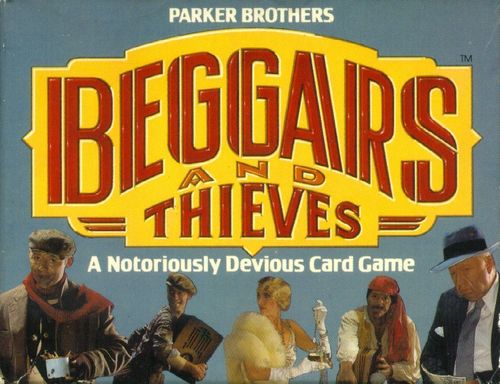
Beggars and Thieves
Beggars and Thieves Rulebook
Table of Contents
Table of Contents
Equipment
2 decks of 42 cards: each contains a complete playing deck consisting of a black Thief suit with 14 cards, and green, blue, and red Beggar suits with 8 cards each; plus 4 score cards.
The Cards
- There are two identical decks of cards. Only one deck at a time is used in game play. Unwrap one deck, spread out the cards and look them over. You'll have:
- Thief cards: These are the 14 cards with color photos and a black tile background. They're numbered 1 through 14. Thief cards are trump and are more powerful than the Beggar cards.
- Beggar cards: These are the 24 cards with black and white photos and a blue, green, or red tile background. Each of the three colored suits is numbered 1 through 8.
- Scoring cards: These 4 cards each contain the basic scoring for the 3-, 4-, and 5-player games. They are not used in game play and should be removed from the deck before play begins. Keep them as a reference for the scoring procedure.
- You'll note that Thief cards numbered 5 through 14 and Beggar cards numbered 5 through 8 have a second number on them, to the right of the playing value of the card. This is the point value of the card. At the end of each hand, players total the point values of the cards they won; this total is used to determine their score for that hand. Cards numbered 1 through 4 have no point value.
Playing Value / Point Value: each card's playing value is the number in the upper corner, and its point value is the second number to the right of it (cards 5 through 14 of the Thief suit and 5 through 8 of the Beggar suits only).
- Now look at the six of Thieves. You'll see the word PARTNER below the playing and point values. This "partner card" has special meaning in the 4- and 5-player games only.
General Playing Rules
These general playing rules apply to all versions of Beggars and Thieves and are not repeated.
If you are unfamiliar with some of the words used in these rules (such as trump, trick, blind, Leaster), refer to the Glossary at the end for definitions.
-
To determine the first dealer, each player draws a card from the deck. The player with the highest numbered card wins the deal.
-
The player to the left of the dealer plays any card, face up. Play continues clockwise until each player has played a card. The player who put down the most powerful card wins the trick and takes and keeps all the cards played. The player who takes a trick leads the first card of the next trick. A player can win a trick only with the highest Thief (trump) card played or, if no Thief card is played, with the highest card of the suit led. (Editor's note: in the scan, the words "A player can" in this sentence are struck through by a printed line; they are kept here as printed.)
-
Players must follow suit if possible. If a player does not have a card of the suit led, he or she may either play a Thief (trump) card or play a card of another suit.
-
Continue until all the cards have been played.
BEGGARS AND THIEVES
The unknown element makes Beggars and Thieves a question of trust and judgment for everyone. If you take the blind, you'll have a partner to help you win points—only no one, including you, will know for sure who your partner is. Or, with a Leaster you'll all play on your own. Either way, it pays to be sneaky.
The object of Beggars and Thieves is to be the first player to reach a score of 20.
For Four Players
Rules are the same as the five-player game below except each player receives nine cards and there are two cards in the blind.
For Five Players
Set Up
-
Remove the number one card of the blue Beggar suit and put it aside. This card will not be used in this game.
-
The dealer shuffles the remaining cards and deals seven cards, face down, to each player and deals two cards, face down, into the blind.
The Blind
The blind is an extra hand, or kitty, dealt face down to the table.
-
The player to the left of the dealer decides if he or she has a strong enough hand to pick up the blind (see Playing Hints). If not, the next player to the left has a chance to take the blind. This continues until a player has picked up the blind or all players have passed. (If no one wants the blind, a Leaster is played. See rules under Leaster.)
-
The player who picks up the blind and the player who holds the six of Thieves are partners and, together, want to take as many points as possible.
The other players join together for that hand to try and stop the partners from taking more than 60 points.
-
The player who picks up the blind now has nine cards. He or she must lay down or "bury" two of the cards. The player keeps these cards, face down, in front of him or her. Any points buried will be included in his or her point total at the end of the hand.
-
A player may not bury a Thief card as long as a Beggar card remains in his or her hand. If a player has to bury a Thief card, he or she must tell the other players that a Thief card is being buried, although the number and point value of the Thief cards buried need not be announced.
The Partner Card
The six of Thieves is the partner card and provides the unknown element of risk in this game.
The identity of the partner is not announced. The other players, including the player who picked up the blind, do not know for sure who the partner is until the partner card is played.
A certain amount of "table talk" is allowed. You can try to convince other players that you're on their side (but you can't give them any specific information, like what cards you're holding or what card you're going to play), and they can do the same. In the end, though, you must all decide for yourselves whom you can trust—who is on your side and who is against you.
Whoever holds the partner card is automatically the partner of the player who picks up the blind, unless:
-
The player who picks up the blind feels he or she has a strong enough hand to play alone. Then he or she announces that no partner is necessary for that hand.
-
The player who picks up the blind has the six of Thieves and decides to play alone. No announcement of this should be made.
-
The player who picks up the blind has the six of Thieves and does not want to play alone. In this case he or she asks for the player holding the next highest Thief card above the six (that he or she does not have) to be the partner.
Example: The player who picked up the blind holds the six and seven of Thieves and does not want to play alone. He or she asks for the player holding the eight of Thieves to be the partner.
Leaster
A Leaster is played when no one picks up the blind. Unlike the regular game, the object here is to take the least number of points. The blind is set aside, face down. The winner of this hand is the player who (1) takes the fewest points and (2) wins at least one trick. There are no partners in this hand.
Scoring
-
The player who picked up the blind and his or her partner (if there is one) count up the number of points each took during that hand and add them together.
-
Their opponents count up the number of points each took during that hand and add them together.
-
The side taking the most points wins that hand. Each winning player receives a score as follows:
| Points | Score |
|---|---|
| 61-90 | 2 |
| 91-119 | 4 |
| 120 | 6 |
Example 1: If the player who picked up the blind and his or her partner win the hand with 93 points, they each receive a score of 4.
Example 2: If the opponents win the hand with 74 points, each receives a score of 2.
Example 3: If there is a tie (60 points each), the opponents win the hand and each scores 2.
-
The winner of a Leaster receives a score of 3.
-
If the player who picked up the blind plays alone and wins, he or she gets a bonus score of 2. If he or she loses, each opponent receives a bonus score of 2.
Example: If the player who picked up the blind plays alone and wins the hand with 112 points, he or she receives a score of 4 plus a bonus of 2 for a total score of 6. If the opponents win the hand with 112 points, each receives a score of 4 plus a bonus of 2 for a total score of 6.
Winning
The first player to reach a score of 20 wins the game. If two or more players reach a score over 20, the highest total wins. If a tie occurs, everyone plays another hand.
Cutthroat, For Three Players
If you dare to take the blind in Cutthroat it's 2 against you, to see which side has the stronger cards. Or, if no one takes the blind, you'll play a Leaster with each of you playing on your own.
The object of Cutthroat is to be the first player to reach a score of 20.
Set Up
-
Remove the 1 and 2 of the blue and green Beggar suits and the 1 of the red Beggar suit and put them aside. These cards will not be used in this game.
-
The dealer shuffles the remaining cards and deals ten cards, face down, to each player and three cards, face down, into the blind.
-
Remember, the Partner card has no special meaning in Cutthroat.
The Blind
The blind is an extra hand, or kitty, dealt face down to the table.
-
The player to the left of the dealer decides if he or she has a strong enough hand to pick up the blind (see Playing Hints). If not, the next player to the left has a chance to take the blind. This continues until a player has picked up the blind or all players have passed. (If no one wants the blind, a Leaster is played. See rules below.)
-
When one player picks up the blind, the other two players join together for that hand to try and stop him or her from taking more than 60 points.
-
The player who picks up the blind now has 13 cards. He or she must lay down or "bury" three of the cards. The player keeps these cards, face down, in front of him or her. Any points buried will be included in his or her point total at the end of the round.
-
A player may not bury a Thief card as long as a Beggar card remains in his or her hand. If a player has to bury a Thief card, he or she must tell the other players that a Thief card is being buried, although the number and point value of the Thief cards buried need not be announced.
Leaster
A Leaster is played when no one picks up the blind. Unlike the regular game, the object here is to take the least number of points. The blind is set aside, face down. The winner of this hand is the player who (1) takes the fewest points and (2) wins at least one trick.
Scoring
-
The player who picked up the blind counts up the total number of points he or she took during that hand.
-
The two opponents count up the number of points each took during that hand and add them together.
-
The side taking the most points wins that hand. Each winning player receives a score as follows:
| Points | Score |
|---|---|
| 61-90 | 2 |
| 91-119 | 4 |
| 120 | 6 |
Example 1: If the player who picked up the blind wins the hand with 93 points he or she receives a score of 4.
Example 2: If the opponents win the hand with 74 points, each receives a score of 2.
Example 3: If there is a tie (60 points each), the opponents win the hand and each scores 2.
- The winner of a Leaster receives a score of 3.
Winning
The first player to reach a score of 20 wins the game. If two players reach a score over 20, the higher total wins. If a tie occurs, everyone plays another hand.
Snear, For Two Players
To win Snear you want to take as many points as you can. You'll need just the right combination of skill and a little bit of luck to convince your opponent that you have the winning cards.
The object of Snear is to be the first player to reach 500 points.
Set Up
-
Remove the 1 and 2 of each Beggar suit and put them aside. These cards will not be used in this game.
-
The dealer shuffles the remaining cards and deals one card, face down, to the opponent and then one to himself or herself, continuing until both players have a row of six cards face down in front of them.
-
The dealer then deals out twelve cards (six to each player), face up, on top of the cards that are face down.
-
The remaining cards are dealt out face down, so that both players have four cards in their hand.
Play
-
The opponent plays the first card either from the cards he or she is holding or from the six cards face up in front of him or her. The dealer then plays a card in the same manner.
-
If a face up card is played, the card under it must be turned up after that trick is completed.
Winning
Point values are totaled after each hand. The first player to score 500 points is the winner. If both players reach a score over 500 points, the higher total wins. If a tie occurs, play another hand.
Playing Hints
For All Games
Try to keep track of what cards, especially trump, have been played.
The Blind (3-, 4-, and 5-player games only)
If you have a fairly strong hand to begin with (one with 3-4 high Thief cards and 1-2 high Beggar cards), taking the blind can increase your chances of winning that hand. The blind can be helpful in several ways:
- You have a chance of picking up additional Thief cards in the blind.
- You can bury high-point-value Beggar cards.
The Partner Card (4- and 5-player games only)
If you're holding the partner card and you have a strong hand, you may want to play that card as soon as possible to let the player who took the blind know you are the partner. Then the two of you can try for a 120-point sweep.
Glossary
Trump: a card or suit that outranks other cards or suits. In the Beggars and Thieves card games Thieves are the trump suit and outrank the three Beggar suits. Any Thief card outranks any Beggar card.
Example: The one of Thieves is more powerful than any Beggar card.
Hand: that part of the game when all the cards that were dealt out are played. For instance, all the cards are dealt out and play begins. When no one has any cards left the hand is over. It will usually take several hands to complete one game.
Trick: all the cards played in a single round, that is, the cards that are showing on the table after each player has played a card.
Winning a trick: To win a trick you must have played the most powerful card showing—either the highest trump (Thief) card played, or if no trump were played, the highest card of the suit led.
Example 1: The red 4 of Beggars was led. Also played were the red 8 of Beggars, the 2 of Thieves, and the 4 of Thieves. The 4 of Thieves wins this trick. (Highest trump card played)
Example 2: The blue 5 of Beggars was led. Also played were the blue 7 of Beggars and the red 8 of Beggars. The blue 7 of Beggars wins this trick. (Highest card of suit led)
Blind (in 3-, 4-, and 5-player games only): a kitty; a number of cards dealt, face down, to the table. Each player in turn has a chance to pick up the blind, either until someone takes it or until all players have passed.
Leaster (in 3-, 4-, and 5-player games only): the game played when no one picks up the blind. The object in this game is to take the least number of points, while winning at least one trick.