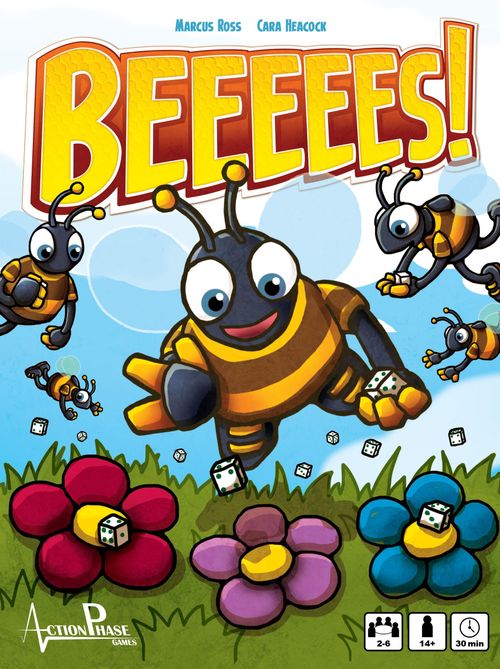
BEEEEES!
BEEEEES! Rulebook
Table of Contents
Table of Contents
Objective
BEEEEES! is a real-time, dice-rolling game where your goal is to roll your dice faster than your opponents so that you can claim Flower tiles by matching your Bee dice to the values printed on them. If you place the most dice on a Flower, you get to add it to your Hive, as a Honeycomb. The more Honeycombs of the same color you can arrange next to each other, the more points you will score at the end of the game.
Components
- 25 Bee dice (5 sets of 5 dice, in 5 different colors)
- 80 double-sided Flower / Honeycomb tiles (5 sets of 16 tiles, labeled A-E)
- 30 Helper Bee tokens
- 5 Beeline Race cards
- Illustrated rules
Setup
- Give each player a set of five Bee dice and one Beeline Race card in their player color.
- Create a supply of Helper Bee tokens, by adding six Helper Bees per player to a pile in the middle of the table.
- Divide the Flower tiles into stacks, based on the letters printed on each tile. There should be sixteen tiles in each stack.
- For each stack, place all the tiles Flower side up and shuffle. Give one stack to each player.
- Return any unused components to the box.
Gameplay
To start the game, all players hold their five Bee dice in one hand and their stack of sixteen Flower tiles in the other, with the Flower side facing the palm of their hand.
On the count of three, all players simultaneously place their stacks on the table (Flower side up), keeping them within reach of the players on their immediate left and right.
Then all players begin rolling their dice as fast as they can, trying to match their rolls to the numbers printed on the Flower tiles in their reach.
Rolling Dice
There are no turns. Gameplay is simultaneous and continuous.
All players roll and reroll their dice as fast as they can.
Players must always roll their dice by shaking them between both hands cupped around the dice as though they were shaking bees in a beehive (even if only rolling one die). Your hands are your beehive!
Players can reroll their dice as often as they like, but they CANNOT save any dice between rolls. All dice not matched to a Flower MUST be rerolled every time.
Whenever a player's dice are returned (for any reason), they must be rerolled before their face value can be used again.
Matching Dice
After rolling, if one or more of a player's dice match an empty die spot on a Flower within their reach, then that player may claim that spot by placing their die on top of it. Each spot can only be claimed by one die, and dice cannot be removed from a Flower until all three dice spots have been matched. (See: Regular Flowers under All About Your Flower Tiles below.)
Players can ONLY match their dice to the topmost Flower of the three stacks closest within their reach: their own stack, and the stacks of the players on their immediate left and right. Any other stacks of Flowers in the game are out of reach and unavailable to that player.
When a stack is depleted of tiles, it does NOT extend a player's reach. Players within reach of the depleted stack now have one fewer stack to choose from.
Claiming Flowers
When a Flower is completed, all dice are returned to their owners, and the player with the most dice on that Flower claims it to build into their Hive before taking any other actions.
Please Note: The player who placed the last die on a Flower is responsible for returning their opponents' dice back to them.
Helper Bees: If a second player had one matched die on the completed Flower, that player claims a Helper Bee for their contribution.
Buzzkills: If three players each had one die on the completed Flower, then it is declared a "BUZZKILL" and removed from the game. No Helper Bee tokens (or points of any kind) are claimed.
Building Hives
When a player claims a Flower tile, they flip it to its Honeycomb side and then build it into their Hive.
The first two Honeycombs built in a Hive must be placed next to each other. Then, additional Honeycombs must be placed so they share at least two edges with existing tiles in the Hive.
Please Note: Your Hive should be built out in the area immediately in front of you on the table.
All About Your Bee Dice
Bee dice have five numbered faces (1-5) and one face depicting a bee. Depending on the type of die, the bee depicted will either be a smiling Worker Bee or a stinging Killer Bee.
Worker Bees
Each player has two Worker Bee dice. Worker Bees are wild and can be used as any number.
Worker Bees can be used to match a single die or as part of grouped dice on a Regular Flower, or to match any number on a Beeline Race card.
Killer Bees
Each player has three Killer Bee dice. Killer Bees can be used to steal Flowers.
If a player rolls two or more Killer Bees in a single roll, they can call out "KILLER BEES!" to steal one Regular Flower (not Wildflower) currently on top of any stack within reach and add it to their Hive. (See: Building Hives under Gameplay above.)
The Killer Bee dice used should be placed next to the stack that the Flower was stolen from, as a reminder of what just happened. If any dice were on that Flower, the player who stole the Flower should return them to the proper player.
No Helper Bee tokens are claimed for dice removed from a Flower stolen by Killer Bees.
All About Your Flower Tiles
There are two types of Flower tiles in the game: Regular Flowers (blue carnations, purple violets, red roses, white lilies, and yellow daisies) and Wildflowers. Regular Flowers show three dice on one side. Wildflowers have no dice printed on them and can only be claimed by winning a Beeline Race. (See: Beeline Races under Wildflowers below.)
Regular Flowers
Regular Flowers all have three die spots, numbered 1-5, which appear either as a solitary die (single, white die with colored pips), or as grouped dice (multiple, colored dice with white pips).
Solitary die indicate that you can place one of your dice as soon as it matches the number of the depicted die.
Grouped dice cannot be placed one at a time like solitary dice can be. They must be placed all at once from a single roll.
There are three possible die spot combinations on Regular Flowers:
- Three solitary die spots, where each spot can be claimed one at a time.
- One solitary die spot and two grouped dice spots, where the solitary die spot can be claimed by itself but the two grouped dice must be claimed from a single roll.
- Three grouped dice spots, where all three spots must be claimed from a single roll.
Remember: As soon as each die spot on a Flower is covered by a matching die, it is considered to be complete. Whoever has the most dice on that Flower, claims the tile and adds it to their Hive.
Wildflowers
Wildflowers score more points at the end of the game because they count as every color of Honeycomb. They cannot be claimed in the same way as Regular Flowers. They can only be claimed by winning a Beeline Race.
Please Note: Each Wildflower is treated as a separate race. If more than one Wildflower is within your reach, you must choose which race to enter.
Beeline Races
When a player reveals a Wildflower on top of their stack, that player calls out "BEELINE!" to announce the start of a new Beeline Race. Any player within reach who has all five of their dice may enter the race by placing their Beeline Race card next to the stack with the Wildflower on it.
Please Note: If you have fewer than five dice available to you (because they are currently matched on top of a Regular Flower), you must wait until all your dice are returned to you before you may enter a Beeline Race. You may NOT take them back before their Flower is completed.
Players competing in a Beeline Race roll their dice as normal. After each roll, they can place any number of their matched dice in sequence on their Beeline Race card (1-2-3-4-5). Players must place their dice in order, they cannot skip ahead in sequence.
Worker Bees can be used as any number, but Killer Bees have no effect.
The first player to have all five of their dice in sequence on their Beeline Race card ends the race and claims the Wildflower tile to immediately build it into their Hive. (See: Building Hives under Gameplay above.)
Please Note: You can abandon a Beeline Race at any time, but you must reroll all five of your dice before you can use their values again.
End of Game
The game ends immediately when the supply of Helper Bees is depleted or when three Flower stacks in a row are empty. Grab pen and paper, and appoint a scorekeeper to calculate each player's total score.
Scoring
Each edge in a player's Hive that is shared between Honeycombs of the same color scores 1 point. Wildflowers count as every color, and therefore score 1 point for every edge they share with another tile.
Each pair of Helper Bee tokens scores 1 point, rounded down. In addition, the player(s) with the most Helper Bees is declared "The Bee's Knees" and awarded 3 additional points.
The player with the most points wins the game.
Tie Breakers
In case of a tie, the player with the FEWEST Honeycomb tiles in their Hive wins the game. If still tied, the player who claimed the most Helper Bee tokens wins. If there is STILL a tie, the victory is shared.
Example of Scoring
Connee has 6 points for red, 3 points for yellow, 5 points for blue, 7 points for purple, and 1 point for white. She does not earn any points for having only one Helper Bee token.
Connee's final score is 22.
Overview
Setup: Players take their dice in one hand and Flowers in the other.
Playing the Game: To begin, all players place their stack of Flowers in front of themselves, then begin rolling their dice as fast as they wish. Players try to match their dice rolls to the numbers on the Flowers in their reach.
Scoring: When all of a Flower's numbers are covered, the player with the most dice on that Flower takes the tile and adds it to their Hive. If a second player had a die there, that player gains a Helper Bee.
End of Game: The game is over when three stacks of Flowers in a row are depleted, then players add up points for their Hive.
Special Rules:
- Wildflowers create their own Beeline Races.
- Dice have a special face that will help you during the game. Worker Bees are wild, and Killer Bees can steal Flowers if you roll two of them at the same time.
Common Formations & Point Values
Remember, each matched edge is 1 point for Regular tiles. The rulebook's quick-reference chart shows example Hive formations and the points they score: a single, isolated tile scores 0; two tiles sharing one edge score 1; three tiles in a row score 2; three tiles in a triangle score 3; four tiles in a diamond score 4; five tiles in a flower cluster score 5; six tiles in a larger cluster score 6; and seven tiles forming a complete flower shape score 7.